
Chakras are a concept from Indian tantra and yoga traditions: in Sanskrit, the word cakra means “wheel” or “circle”2, and refers to meditation focal points in the body, imagined as formations of energy similar to disks or flowers3. The best-known system today is the seven-chakra system, running from the base of the spine to the crown of the head. Each chakra has its own colour, and in the crystal community, certain stones are associated with each one.
Historically, the picture is different: in the West, chakras were only assigned rainbow colours in the 20th century, and lists of stones are a modern custom of the crystal community. In ancient texts, chakras do have colours, but there is no rainbow in them.
What are chakras?
In tantra traditions, chakras are places on which to focus attention during meditation: they are visualized as colourful formations of light in the shape of a lotus flower or spinning wheel3. In Monier-Williams’ Sanskrit dictionary, one of the meanings of cakra is “a circle in the body for mystical purposes,” listing six such centres from Mūlādhāra to Ājñā2. The Latvian dictionary Tēzaurs.lv explains the mythological meaning of chakra as one of several hypothetical energy-transmission centres in the human body, from which, according to Tibetan and Indian beliefs, all physical energy flows1. The same entry also gives another meaning: an ancient Indian throwing weapon, a metal ring 12 to 15 cm in diameter with a sharp outer edge1.
Composer and writer Kurt Leland, who has studied the history of Western chakra systems, writes that ancient texts did not describe chakras as something to be regulated. They were to be pierced, dissolved and overcome through demanding meditation and ritual practice, which led in seven stages to liberation from the cycle of rebirth4. The modern Western idea of chakras with colours, properties, and stones is much more recent.
Where does the 7-chakra system come from?
The number of chakras varies in different traditions. Leland, studying Indian sources, found systems with only four chakras and others with forty-nine4. Sanskrit scholar Christopher Wallis (Hareesh) writes that each branch of tantra developed its own chakra system: texts teach systems with five, six, seven, nine, ten, twelve, twenty-one, and more chakras3.
The seven-chakra system that is popular today comes not from an ancient scripture but from the 16th-century treatise Ṣaṭ-cakra-nirūpaṇa, “Description of the Six Centres”3. It is part of the sixth chapter of the Bengali tantra practitioner Pūrnānanda’s work Śrī-tattva-cintāmaṇi, written in the year 1499 of the Shaka era, that is, in 15775. The text describes six chakras, and Woodroffe notes that the seventh centre at the crown of the head, Sahasrāra, is not even called a chakra5.
This text was published in English in 1919 in London by Sir John Woodroffe, a judge of the Calcutta High Court, under the pseudonym Arthur Avalon5,6. He wrote his works in close collaboration with Atal Behari Ghose, a Bengali follower of Shaktism6. The book was titled The Serpent Power and contains a translation with commentary5. Leland calls it the first scholarly edition in English to describe one version of the chakra system4. The basis of seven chakras appeared in Western esotericism as early as the 1880s with Helena Blavatsky and the Theosophists4, and in 1927 Charles Leadbeater’s book The Chakras was published4. Leland traces this entire development in his book Rainbow Body: A History of the Western Chakra System from Blavatsky to Brennan (Ibis, 2016)4.
What are the names of each chakra and what do they mean?
Chakras are usually named after their location or symbol, but the Sanskrit names have their own meanings. The transliteration follows Tēzaurs1; the explanations and the number of petals follow Woodroffe’s translation5:
- Root chakra, Mūlādhāra: from the words mūla “root” and ādhāra “support”; the lotus has 4 petals.
- Sacral chakra, Svadhisthāna: the lotus has 6 petals.
- Solar plexus chakra, Manipūra: the text explains that the centre is “brilliant as a jewel” (maṇi); the lotus has 10 petals.
- Heart chakra, Ānahata: the lotus has 12 petals.
- Throat chakra, Viśuddha: the lotus has 16 petals.
- Third eye chakra, Ājñā: the name means “command”; the lotus has 2 petals.
- Crown chakra, Sahasrāra: the name literally means “thousand-petaled lotus.”
Woodroffe emphasised that in the text, the centres are located in the spine at the level of the corresponding body part, for example, Ānahata is “the spinal centre in the region of the heart”5. In the stone table, too, the locations are given only according to tradition.
What are the chakra colours and why do they form a rainbow?
In the modern system, the colours follow the order of the spectrum: the root chakra is red, the sacral orange, the solar plexus yellow, the heart green, the throat blue, the third eye indigo, and the crown violet. Leland writes that in the West, assigning each chakra a single colour in spectrum order began in the 1930s, in some systems with seven colours including indigo, in others with six colours and white4. From the 1920s to the 1950s, the Western chakra system gradually adopted rainbow colours, and among the main contributors Leland mentions colour healing practitioner Ivah Bergh Whitten in the US, her student Roland Hunt, and British practitioner S. G. J. Ouseley4.
The rainbow colours and the now-familiar list of chakra properties were first combined in a single text in 1977. Ken Dychtwald brought them together in his book Bodymind, published in June 1977, and in an article in Yoga Journal in July and August of the same year4. That is why Leland writes that the “ancient” Western chakra system is barely forty years old4.
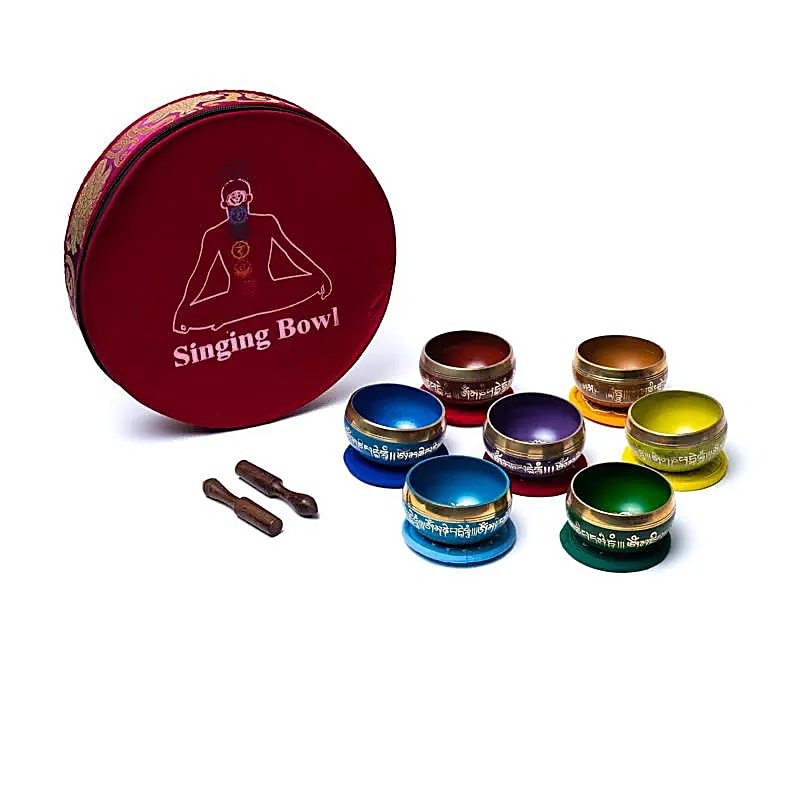
Did you know? In the summary table of Woodroffe’s book, the colours are completely different. The element Earth of the root chakra is yellow, the Water of the sacral chakra is white, the Fire of the solar plexus is red, the Air of the heart chakra is “smoky,” and the Ether of the throat chakra is white5. The heart lotus in the text is “red as the bandhuka flower,” while the four petals of the root chakra are dark red5. In our chakra singing bowl sets, by contrast, the colours follow the modern system, from red for the root chakra to violet for the crown chakra8.
Which stones are associated with each chakra?
Associating stones with chakras is a modern practice of the crystal community, not an ancient tradition. Leland mentions gemstones and minerals among the correspondences added to chakras by Western esotericism and alternative practices, alongside metals, zodiac signs, musical notes, and tarot cards4. Wallis emphasises that the crystals and essential oils associated with each chakra in books and on websites have no basis in the original Sanskrit sources3. There is no single list of crystals, and recommendations differ among various guides7.
The table lists stones from our stone encyclopedia, so that they match the stone pages and products. Several stones in the encyclopedia are associated with two or even three chakras.
| Chakra | In Sanskrit | Location by tradition | Colour in the modern system | Stones |
|---|---|---|---|---|
| Root | Mūlādhāra | base of the spine | red | black tourmaline, hematite, red jasper |
| Sacral | Svadhisthāna | lower abdomen below the navel | orange | carnelian, orange calcite, moonstone |
| Solar plexus | Manipūra | navel area | yellow | citrine, pyrite, tiger’s eye |
| Heart | Ānahata | centre of the chest at heart level | green | rose quartz, green aventurine, emerald |
| Throat | Viśuddha | throat area | blue | aquamarine, amazonite, sodalite |
| Third eye | Ājñā | between the eyebrows | indigo | lapis lazuli, labradorite, fluorite |
| Crown | Sahasrāra | top of the head | violet | amethyst, clear quartz, selenite |
Often, a stone is chosen by colour: green aventurine and emerald are associated with the heart chakra in the encyclopedia, whose symbolic colour is green. However, colour is not the only rule. Rose quartz is pink but is associated with the heart chakra, while colourless clear quartz and white selenite are listed for the crown chakra. Tiger’s eye is associated with as many as three chakras: root, sacral, and solar plexus, while moonstone is linked to the sacral, third eye, and crown chakras.
How are chakra stones used in the crystal community?
Crystal enthusiasts use chakra stones as a system of colours and symbols. Our encyclopedia and articles describe some common customs:
- arrange seven stones in a row from red to violet, for example, placing peach aventurine between the red and yellow stones;
- hold a stone in your hands or place it nearby during meditation, as is done with amethyst;
- choose a stone by chakra, zodiac sign, or simply by preference, as described in the article Crystals by Zodiac Sign.
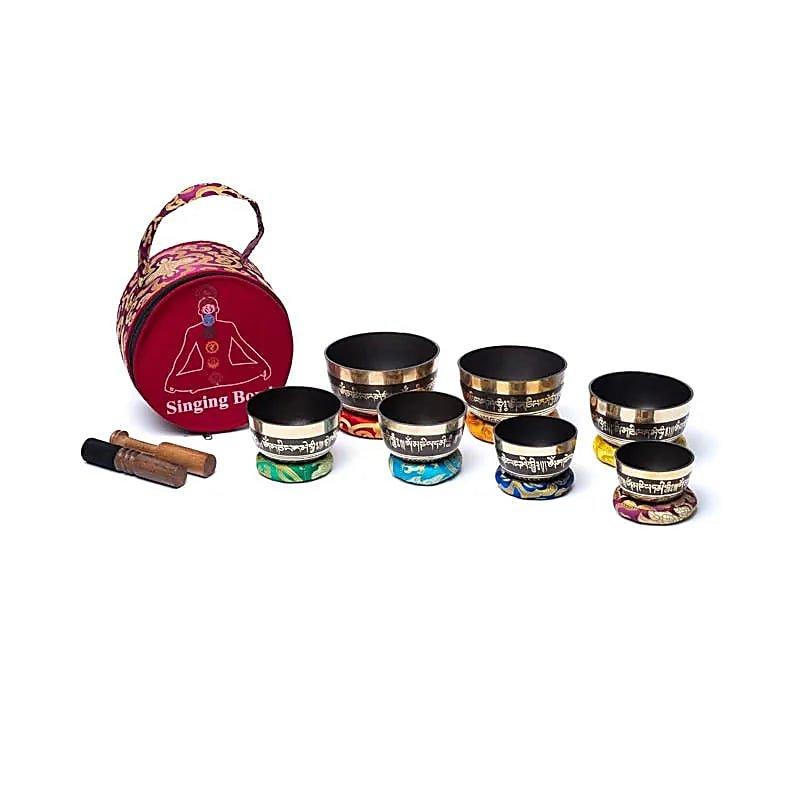
Our range of crystal sets includes a set of seven figures about 2 cm each, with a stone for each chakra: red jasper, peach aventurine, golden quartz, green aventurine, lapis lazuli, amethyst and clear quartz. The figures are the five Platonic solids, a star tetrahedron (Merkaba) and a sphere. Chakra colours are also used in sound instruments: in chakra singing bowl sets, the bowls are arranged by colour from the root chakra to the crown chakra. For more about bowls, read the article Singing Bowls.
There is no scientific evidence that crystals affect chakras: carefully conducted clinical studies do not support such theories7. Chakra stones are a symbol and a custom, not a medical remedy.
It is useful to know how to care for stones. Selenite has a hardness of only 2, and its surface can become matte or start to dissolve in water, while amethyst and rose quartz can fade in prolonged sunlight9. The full table is on the encyclopedia’s care page, and community cleansing methods are described in the article How to Cleanse Crystals. If you want to arrange stones in a geometric pattern, see the steps for a crystal grid.
Frequently Asked Questions
How many chakras does a person have?
The number differs between traditions: different tantra texts describe systems with five, six, seven, nine, twelve, and more chakras. The best-known today is the seven-chakra system, which comes from the 1577 text “Description of the Six Centres” and its English translation in the 1919 book “The Serpent Power.”
What is the order of chakra colours?
From bottom to top: root chakra red, sacral orange, solar plexus yellow, heart green, throat blue, third eye indigo, and crown violet. This rainbow sequence is a 20th-century Western addition.
What are the Sanskrit names for the chakras?
Mūlādhāra (root), Svadhisthāna (sacral), Manipūra (solar plexus), Ānahata (heart), Viśuddha (throat), Ājñā (third eye), and Sahasrāra (crown).
Which stones correspond to the heart chakra?
In our encyclopedia, the heart chakra is associated with rose quartz, green aventurine, emerald, as well as malachite, aquamarine, and amazonite. The heart chakra’s colour in the modern system is green.
Are chakra colours ancient?
No. In ancient Indian texts, chakras do have colours, but these do not form a rainbow. Spectrum colours began to be assigned to chakras in the West in the 1930s, and together with the modern list of properties they were first published in 1977.
Can chakra stones be washed in water?
It depends on the mineral, not the chakra. Quartz can be rinsed, but selenite should not be placed in water, as its surface can become matte or start to dissolve. Before cleaning, check the encyclopedia’s care table.
Sources (9)
- ↩ Tēzaurs.lv, entry “čakra” (LU MII, autumn version 2026): tezaurs.lv/čakra
- ↩ M. Monier-Williams, A Sanskrit-English Dictionary (1899), entry “cakra”, University of Cologne digital version: sanskrit-lexicon.uni-koeln.de
- ↩ C. Wallis (Hareesh), “The Real Story on the Chakras”, 2016: hareesh.org
- ↩ K. Leland, “The Rainbow Body: How the Western Chakra System Came to Be”, Quest 105.2, Spring 2017, pp. 25-29 (from the book Rainbow Body, Ibis, 2016): theosophical.org
- ↩ A. Avalon (J. Woodroffe), The Serpent Power, Dover, 1974 (1st edition Luzac & Co., London, 1919): archive.org
- ↩ K. Karttunen, Persons of Indian Studies (Who Was Who in Indology), entry “Woodroffe, John (Arthur Avalon)”: whowaswho-indology.info
- ↩ D. J. Ladouceur, “Crystal healing”, EBSCO Research Starters, 2024: ebsco.com
- ↩ frequencies.lv, Chakra singing bowl set with bag (product description): frequencies.lv
- ↩ FREQUENCIES stone encyclopedia, care table: frequencies.lv/enciklopedija/kopsana/