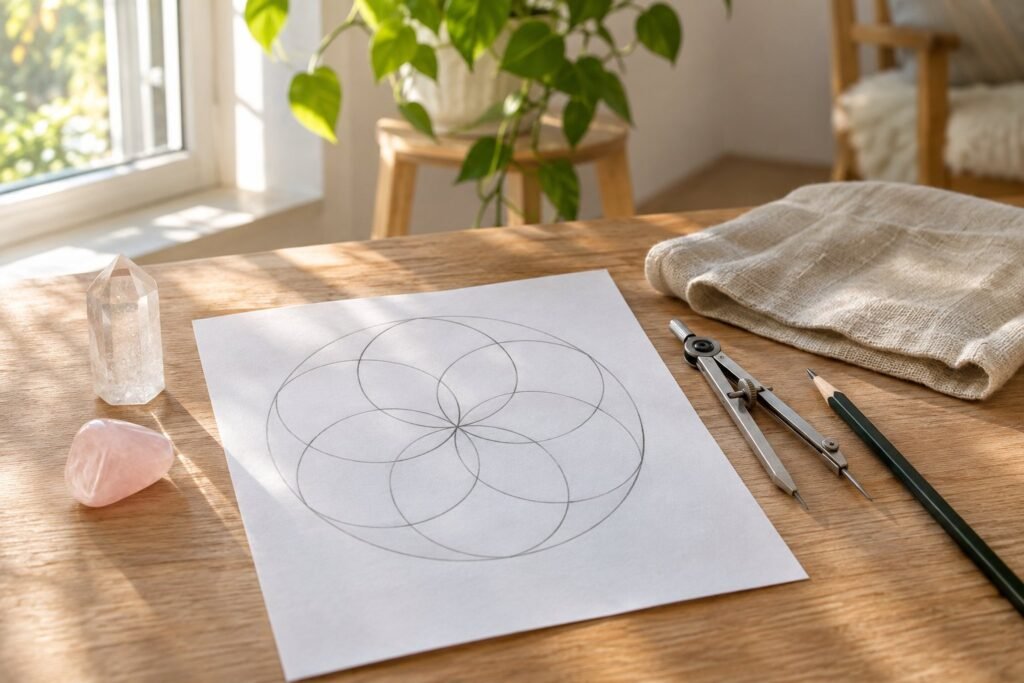
The Flower of Life is a geometric ornament made up of 19 equally sized circles that overlap one another and form six-petalled flowers. New Age literature calls it the pattern of creation. A similar network of circles can already be seen on the threshold slab of an Assyrian palace from the 7th century BCE, but the name Flower of Life only arose at the end of the 20th century.
The geometry of the ornament can be checked with a pair of compasses, and its history with museum collections. Some popular stories about the ancient Egyptians have no evidence behind them.
What is the Flower of Life in geometry?
The mathematical encyclopaedia MathWorld describes the Flower of Life as a fragment of 19 circles from a triangular lattice in which the circles overlap1. All the circles have the same radius, equal to the distance between the centres of adjacent circles. Each circle therefore passes through the centres of its neighbouring circles, and the figure has sixfold rotational symmetry: rotated by 60 degrees, it looks exactly the same1.
The region shared by two such circles is a lens-shaped figure called a vesica piscis, Latin for “fish bladder”4. These lenses make up the petals of the flower. MathWorld notes that this figure was already known in ancient Babylonian mathematics as the “bull’s eye”4.
The network of circles can be continued without end. Six circles can be drawn around one circle, then 12 around those, then 18, so the number of circles grows as follows: 1, 7, 19, 37 and so on. In the Flower of Life the network is stopped at 19 circles, and Drunvalo Melchizedek describes it as enclosed in two concentric circles12.
How do you draw the Flower of Life with compasses?
You will need a pair of compasses, a sharp pencil and paper. Do not change the opening of the compasses until the last step, because the whole figure depends on it. Call the radius of the circle r.
- Draw a circle in the middle of the paper. Choose a radius no larger than one sixth of the width of the paper, because the finished flower with its outer circle will be six radii wide.
- Put the point of the compasses at any spot on the line of the circle and draw a second circle. It will pass through the centre of the first circle.
- The two circles intersect at two points. Put the point at one of them, draw the next circle, and continue along the line of the first circle until there are six circles around the centre. This is the Seed of Life: seven circles with six petals in the middle2.
- On the outside, neighbouring circles intersect at six more points. Draw six new circles, each centred on one of these points.
- New intersection points have now appeared on the straight lines that run from the centre through the centres of the first six circles. Draw six more circles, each centred on one of these intersection points. There are now 19 circles in all.
- Finally, put the point in the centre and open the compasses to the farthest point of the outer circles, that is, to 3r. This circle touches the six outermost circles and closes the flower. Many people also draw a second, slightly larger circle.
If a circle does not meet the intersection points, the most likely cause is that the opening of the compasses has shifted.
What are the Seed of Life, the Tree of Life and Metatron’s Cube?
Books on sacred geometry derive several more figures from the Flower of Life. Their names are new as well: MathWorld explains the names Seed of Life, Fruit of Life and Metatron’s Cube by the terminology of Melchizedek’s 1999 book1,3.
| Figure | What it is geometrically | Origin |
|---|---|---|
| Seed of Life | 7 equal circles: one in the centre and six around it, each passing through the centre of the central circle | The seven-circle pattern appears in a mosaic of the 1st century BCE in Herod’s palace at Herodium; the name is modern2,18 |
| Flower of Life | 19 circles on a triangular lattice with sixfold symmetry, often enclosed in two concentric circles | A similar network of circles exists in Assyria, 7th century BCE; the name dates from the end of the 20th century1,6 |
| Fruit of Life | 13 circles from an extended network: the central circle and, around it, two rings of circles in hexagon form | Melchizedek’s terminology1,3 |
| Metatron’s Cube | The 13 centres of the Fruit of Life, each connected to every other, giving 78 line segments in all | Melchizedek’s terminology3 |
| Tree of Life | A Kabbalistic diagram in which 10 sefirot are arranged in the shape of a tree | Jewish mystical tradition; such diagrams have been in use for about 700 years16 |
In Metatron’s Cube, by picking out particular line segments, one can see flat projections of the cube, octahedron and tetrahedron. It is often said that it contains all five Platonic solids, but MathWorld writes that this depends on the segments and projections chosen and does not follow from the definition of the figure itself3.
The Tree of Life is a Kabbalistic diagram with ten sefirot, which Jewish mysticism understands as divine emanations16. Penn State University Press, which published the book on these diagrams by Professor J. H. Chajes of the University of Haifa, writes that they have been at the centre of Jewish mystical practice for seven hundred years16. In his book Melchizedek claims that the Tree of Life was not created by the Kabbalah and that the Egyptians carved it on the columns of Karnak and Luxor about 5,000 years ago12. This claim is unproven, and at the relevant point Melchizedek cites no verifiable source.
Are the Platonic solids also found in crystals?
The Platonic solids are five regular polyhedra: the tetrahedron, cube, octahedron, dodecahedron and icosahedron. In the dialogue “Timaeus” Plato linked four of them with the elements: fire with the tetrahedron, air with the octahedron, water with the icosahedron and earth with the cube. He assigned the dodecahedron to the universe as a whole, because of all of them it comes closest to a sphere13.
Minerals grow according to their atomic structure, not according to symbols, yet the shapes of some crystals come close to the Platonic solids. Pyrite usually forms cubes, pyritohedra and octahedra, or combinations of them14. Fluorite crystallises in cubes and octahedra and has perfect cleavage along the planes of the octahedron faces15.
Smoothly polished Platonic solids, on the other hand, are the work of human hands. For example, our shop’s sacred geometry figure set contains five Platonic solids, a star tetrahedron and a sphere, made from seven stones including amethyst and rock crystal, and the set currently (20 November 2026) costs €36.00.
Where does the Flower of Life ornament appear in history?
The Louvre holds a threshold slab more than two metres high from Ashurbanipal’s palace in Nineveh5,6. The archaeology website of the French Ministry of Culture dates it to the reign of Ashurbanipal, 669-626 BCE, and describes its decoration as a carpet pattern6. In the museum’s photograph the central part of the slab is covered by a network of six-petalled flowers made of equal circles, framed by ornamental borders5.
In his book “A New Kind of Science”, Stephen Wolfram mentions an even earlier example: a Phoenician ivory carving made around 900 BCE, now in the British Museum19. The seven-circle pattern, now called the Seed of Life, can be seen in a floor mosaic of the 1st century BCE from the bathhouse of Herod’s palace at Herodium in the Judean desert2. The mosaic can be viewed at the Israel Museum in Jerusalem18.
Some of Leonardo da Vinci’s notes are kept in the Biblioteca Ambrosiana in Milan, in the so-called Codex Atlanticus. On folio 307 verso, several flowers made of circles are drawn inside a large circle. The library dates this folio to around 1517 and describes it as the conclusion of a geometric game (ludo geometrico): an openwork pattern of stars and roses7. Leonardo studied such patterns in connection with lunes, figures bounded by arcs of circles7,19. MathWorld mentions a related circle construction on folio 309 verso of the codex1. The name Flower of Life did not exist in Leonardo’s time.
Is the Flower of Life at Abydos thousands of years old?
The frequently cited “oldest” Flower of Life is in the Osireion, a structure originally built underground behind the temple of Pharaoh Seti I at Abydos in Egypt8,9,11. Seti I reigned from 1290 to 1279 BCE8. The archaeology website The Past describes the building as Seti’s cenotaph in the form of Osiris, that is, a symbolic tomb9, but the Rosicrucian Egyptian Museum writes that the date and meaning of its construction are still being studied8.
At the centre of the Osireion is a hall with massive granite pillars9. David Furlong, who organises tours to Egypt, writes that the Flower of Life drawings are painted fairly precisely in red ochre, mainly on two pillars, and that at least thirteen can be seen10. There are Greek letters between the circles10,11. Malcolm Stewart, a lecturer on sacred geometry, writes that the letters seem to have been written by the same hand that drew the circles. He therefore concludes that the drawings were made much later than the building, roughly from the time of Alexander the Great in the 4th century BCE to around 400 CE, and does not rule out a somewhat earlier date11. Furlong even allows the 5th or 6th century CE, because the drawings are at the top of the pillars, which could be conveniently reached only when the building was partly filled with sand, and next to them is the Christogram ICXC10.
Popular texts claim that the Abydos drawings are about 6,000 years old. Stewart writes that there is no evidence for this11. Furlong and Stewart are not Egyptologists, so this is their observation, not an archaeological dating. Nevertheless, the Greek letters suggest that the drawings most likely date from after the time of Alexander the Great, not from the reign of Seti I.
Did you know? In his book Melchizedek says that he learned of the Abydos Flower of Life from a photograph taken by Katherine Raphael. In his own photograph, another Flower of Life can be seen next to it on the same stone12.
Where does the name Flower of Life come from?
MathWorld writes that the name “Flower of Life” is modern1. It is usually linked with Drunvalo Melchizedek, who led the Flower of Life Workshop from 1985 to 1994. The first volume of the edited transcript of the workshop was published in 1999 by Light Technology Publishing under the title “The Ancient Secret of the Flower of Life”12.
In the book Melchizedek claims that everything that has been created is contained in this drawing. He adds that he cannot prove every aspect of creation in the drawing, but promises to show enough evidence12. His stories about the Egyptian origin of the Tree of Life are likewise unproven. These claims can be regarded as part of a modern spiritual tradition, but not as history. To read about the torus, another popular figure of sacred geometry, and its mathematics, see the article Torus: Symbol of Sacred Geometry.
What does the Flower of Life symbolise today?
In the New Age community the Flower of Life is regarded as a symbol of the pattern of creation12, and in the crystal community many people use it as the base for a crystal grid. Usually one stone, such as a rock crystal point, is placed in the centre, and others, such as amethyst or rose quartz, at the intersections of the circles. This is a community practice and a personal choice, not a scientifically proven effect. The Flower of Life is also in the FREQUENCIES logo.

Hexagons can also be seen in nature, but for physical, not symbolic, reasons. Snowflakes have sixfold symmetry because the water molecules in the lattice of an ice crystal are arranged in hexagons17; you can read more about this in the article Snowflakes and Ice Crystals.
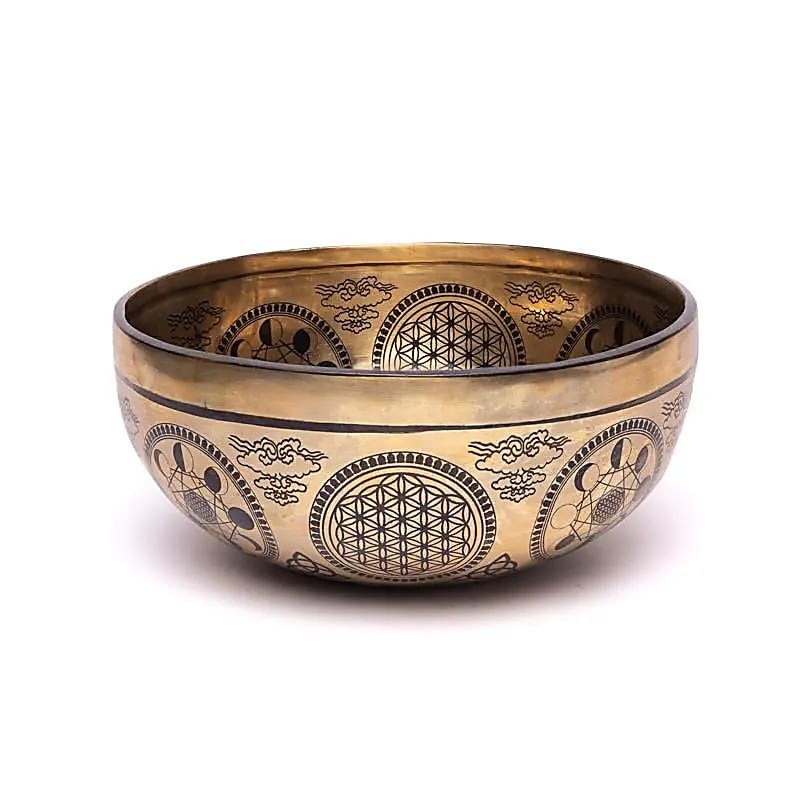
In our shop the Flower of Life decorates sound instruments. Currently (20 November 2026), the Flower of Life singing bowl with a hand-engraved ornament costs €149.31, the laser-engraved singing bowls with the Flower of Life, the Tree of Life or Metatron’s Cube cost €226.70, and the Flower of Life mirror gong, 60 to 80 cm in diameter, costs from €294.30 to €631.30. The bowl with hand engraving is in the Flower of Life section, and the gongs are in the Mirror Gongs section. To find out how to choose and play a bowl, read the article Singing Bowls, and for mirror gongs the article Types of Gongs.
Frequently asked questions
What does the Flower of Life mean?
Geometrically, it is an ornament of 19 equally sized circles with sixfold symmetry. In the New Age community it is regarded as a symbol of the pattern of creation. This is a spiritual tradition, not a proven fact.
How many circles are in the Flower of Life?
The Flower of Life has 19 circles, which are often enclosed in two concentric circles. The Seed of Life has 7 circles and the Fruit of Life has 13.
How old is the Flower of Life?
A similar network of circles can be seen on an Assyrian threshold slab from the time of Ashurbanipal (669-626 BCE), and Stephen Wolfram mentions an even earlier Phoenician ivory carving from around 900 BCE. The age of the drawings in the Osireion at Abydos has not been established, but the Greek letters between the circles suggest that they most likely date from after the time of Alexander the Great. The name Flower of Life arose at the end of the 20th century.
How do you draw the Flower of Life?
Keeping the opening of the compasses unchanged, draw a circle, then six circles with their centres on its line, then six circles at the outer intersection points and another six at the new intersection points. There are 19 circles in all, and they are closed by a circle whose radius is three times larger.
What is the difference between the Flower of Life and the Tree of Life?
The Flower of Life is a network of equal circles, while the Tree of Life is a Kabbalistic diagram with ten sefirot, which has been used in Jewish mysticism for about 700 years. New Age literature links the two, but the claim of an Egyptian origin for the Tree of Life is unproven.
Sources (19)
- ↩ Wolfram MathWorld, Flower of Life: mathworld.wolfram.com
- ↩ Wolfram MathWorld, Seed of Life: mathworld.wolfram.com
- ↩ Wolfram MathWorld, Metatron’s Cube: mathworld.wolfram.com
- ↩ Wolfram MathWorld, Vesica Piscis: mathworld.wolfram.com
- ↩ Musée du Louvre, threshold slab AO 19915 from Nineveh: collections.louvre.fr
- ↩ French Ministry of Culture, Khorsabad: Threshold found in Nineveh, rug decoration: archeologie.culture.gouv.fr
- ↩ Veneranda Biblioteca Ambrosiana, Codex Atlanticus, f. 307 verso (Google Arts & Culture): artsandculture.google.com
- ↩ Rosicrucian Egyptian Museum, New Kingdom Monuments: Abydos, the Temple of Seti: egyptianmuseum.org
- ↩ The Past (Current Publishing), The Osirion at Abydos: a cenotaph for Sety I: the-past.com
- ↩ David Furlong, The Osirion and the Flower of Life: davidfurlong.co.uk
- ↩ Malcolm Stewart, The ‘Flower of Life’ and the Osirion: Facts are more interesting than Fantasy (2008): davidfurlong.co.uk
- ↩ Drunvalo Melchizedek, The Ancient Secret of the Flower of Life, Volume 1, Light Technology Publishing, 1999 (publication data): barnesandnoble.com
- ↩ Stanford Encyclopedia of Philosophy, Plato’s Timaeus: plato.stanford.edu
- ↩ Handbook of Mineralogy, Pyrite: handbookofmineralogy.org
- ↩ Handbook of Mineralogy, Fluorite: handbookofmineralogy.org
- ↩ J. H. Chajes, The Kabbalistic Tree, Penn State University Press, 2022: psupress.org
- ↩ Kenneth Libbrecht, SnowCrystals.com, Snowflake Science: snowcrystals.com
- ↩ The Israel Museum, Jerusalem, Mosaic floor from a bathhouse in Herod’s palace (Google Arts & Culture): artsandculture.google.com
- ↩ Stephen Wolfram, A New Kind of Science (2002), note Ornamental art: wolframscience.com