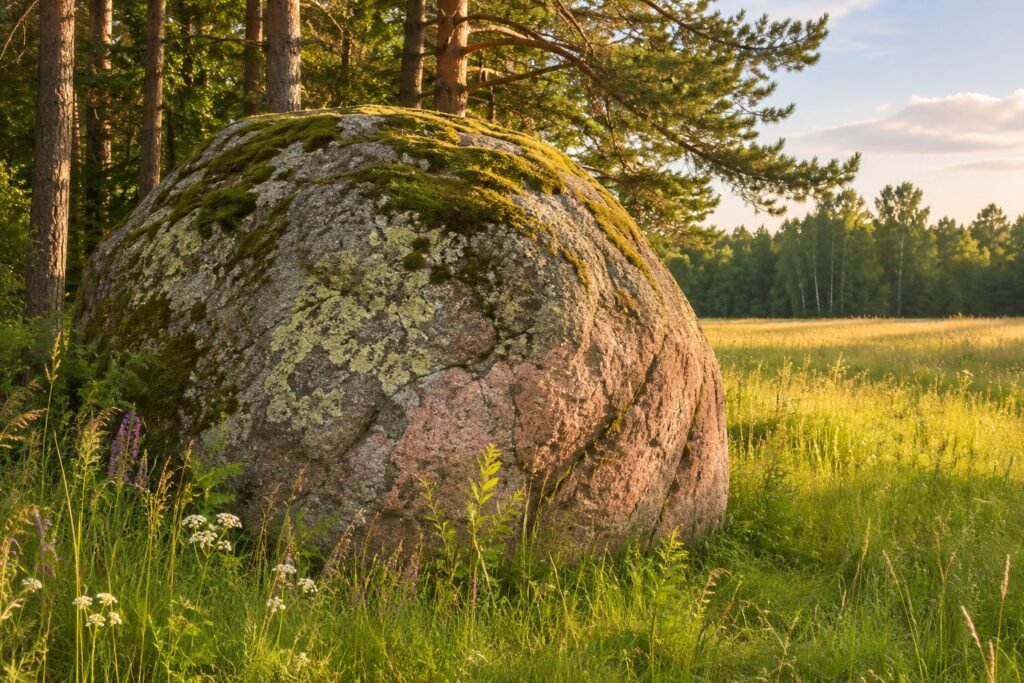
Latvia’s largest giant boulder, the Great Stone of Nīcgale, has an above-ground volume of 170 cubic metres, but how far it extends underground is not known [1, 2]. In the legend this stone was carried by the devil, who wanted to dam a river but ran out of time because the cockerels crowed [3]. More than 360 giant boulders are known in Latvia, and many of them have tales and legends woven around them [1, 5].
What Is a Giant Boulder and How Many Are There in Latvia
Field boulders, or glacial erratics, are rock fragments that a glacier has broken off, carried along and rounded, more than 10 cm across, and giant boulders are the largest of them [1]. Under Cabinet of Ministers Regulation No. 461, a giant boulder is a field boulder with an above-ground volume of 10 cubic metres or more, and both the stone itself and a 10-metre-wide strip around it are protected [4]. Only the visible part counts towards the status [5].
The number of known giant boulders keeps growing: thanks to observant people, new ones are found from time to time [1, 5]. In May 2026 a stone on the bank of the River Malta near Ornicāni in Rēzekne Municipality was granted giant boulder status. It is more than 10 metres long and 5 metres wide, and its above-ground volume is about 15 to 18 cubic metres, but most of it lies underground [5]. Smaller stones can be valuable too: municipalities include many field boulders larger than 5 cubic metres in their lists of natural monuments of local importance [1].
You can estimate the volume with a tape measure. The advice sheet of the Nature Rarities Repository (Dabas retumu krātuve) and the Latvian Fund for Nature recommends measuring the length, the width and the height above ground. If the stone looks like a loaf of bread, divide the product of these figures by 2, and for a pyramid-shaped stone divide it by 3 [1]. For example, a loaf-shaped stone 4 m long, 3 m wide and 2 m high has a volume of about 12 cubic metres, so it already counts as a giant boulder.
Where Latvia’s Huge Stones Come From
During the last ice age, about 20 to 22 thousand years ago, Latvia was entirely covered by the Scandinavian ice sheet, and the ice moved forward by several hundred metres a year [6]. The glacier broke off rock fragments and carried them along [1]. The University of Latvia geologist Ģirts Stinkulis points out that the glacier brought many of Latvia’s stones from Scandinavia, some from the bed of the Baltic Sea and a large share from the territory of Estonia [2]. When the glaciers retreated 12 to 14 thousand years ago, the stones stayed where the ice had left them [1, 5].
The glacier also shaped the stones. Dainis Ozols’s book “Minerals and Rocks of Latvia” says that a stone carried by a glacier loses its sharpest projections and gains one or two opposite faces that have been ground flat. Such a stone is often compared to a flat iron, and its flat, smoothed surfaces are called facets. Stones of softer rock keep striations that run parallel to the long axis of the stone [7].
Did you know? Every spring “new” stones appear in the fields. Stinkulis explains this by frost: stone conducts cold better than porous soil and freezes sooner, so a small hollow forms beneath it. Water that collects there turns to ice, expands and pushes the stone upwards. The more often the temperature swings around zero, the faster the stones reach the surface. The exact rate is not known, but an article on LSM, the Latvian public broadcaster’s news site, estimates that stones may rise by about 5 cm a year [2].
What Giant Boulders Are Made Of
Ozols writes that most of Latvia’s field boulders are gneisses and granite gneisses, while granites are among the most common, especially rapakivi granites with large, round feldspar crystals [7]. Where these rocks came from and how to tell them apart is explained in the article Types of Rocks. In 2008 researchers from the Latvian Petroglyph Centre described the Kapsēde giant boulder as an orange-brown granosyenite. It contains orthoclase, more than 10% quartz, biotite and hornblende, with darker, reddish-brown orthoclase crystals scattered through the groundmass [8].
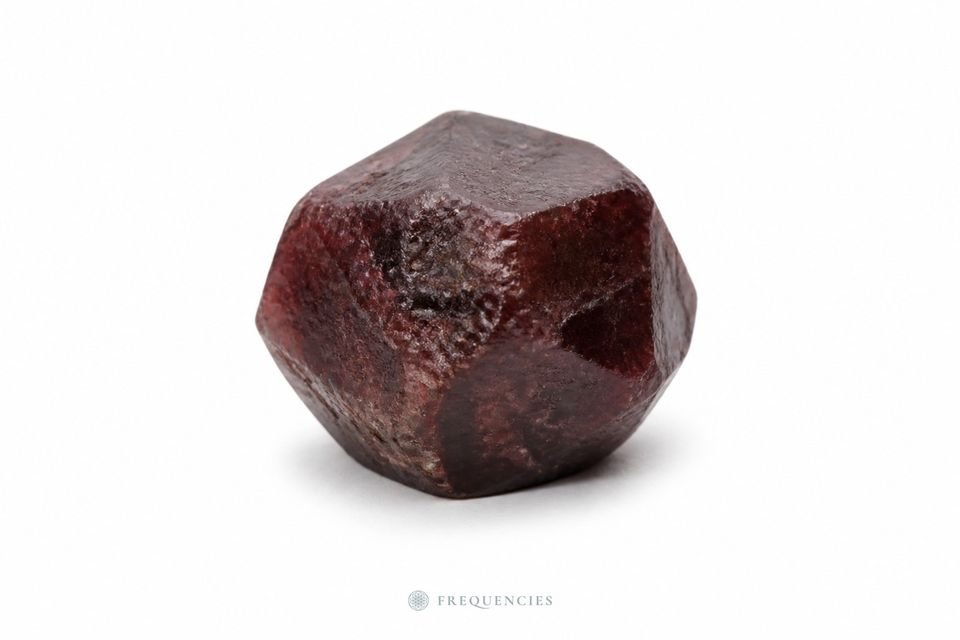
Crystal lovers will know these minerals too. The main minerals in granites and gneisses are quartz and feldspars [7]. You may know the green variety of the potassium feldspar microcline as amazonite; moonstone is orthoclase with thin layers of albite, while labradorite belongs to the plagioclase feldspars [9]. Ozols adds that red-violet crystals of almandine, a member of the garnet group, can often be seen in Latvia’s field boulders [7].
Ozols advises against picking garnet grains out of the rock, because a specimen with the mineral still in its rock is far more valuable [7]. This applies doubly to a giant boulder, because it is protected by law and splitting or damaging it is prohibited [1, 10]. You can look at feldspar varieties and garnets and hold them in your hand as polished stones, for example in the garnet category.
Devil’s Stones: Why the Devil Carries Stones in Legends
Before scientists had explained the work of the glacier, legends explained where the stones came from: devils were said to have carried the stones about at night and scattered them across the fields [1]. The researchers Jānis Cepītis and Lilija Jakubenoka write that in legends about particular stones in the landscape the main character is the devil. Thanks to the publications of the archaeologist Juris Urtāns, the Latvian legend motif best known internationally is that of the devil who carries stones and leaves marks on them [11].
In legends about stones from three different regions of Latvia, the devil’s work is cut short by a cockerel. In the Nīcgale legend the devil, whom God had driven out of his river, was carrying a large stone to dam the river. The devil had not yet got halfway when the cockerels crowed. In his anger he hurled the stone high into the air, and it drove deep into the ground [3]. The devil was carrying the great stone of Kapsēde to Liepāja to smash St Anne’s Church, but he was disturbed by a cockerel’s morning song [12]. The devil wanted to throw the Devil’s Stone at Sērpils, not far from Staburags, into the Daugava so that the raftsmen would drown. When a cockerel began to crow, the devil dropped the stone and kicked it; a footprint was left in the stone, and a little spring appeared beneath it [13].
Stories about stones vary. On an expedition of the Archives of Latvian Folklore to Ilūkste, it was recorded of a large stone in Nīcgale forest that it had fallen from the sky and that in the days of the manor lords feasts were held there: the stone was said to be so big that a table and benches could be set on it [14]. Several legends are also known about the Kapsēde giant boulder [8].
Pērkons and the Devil: Split Stones
The second large group of legends tells of the battle between Pērkons, the thunder god, and the devil. Cepītis and Jakubenoka point out that Pērkons is the sky deity most often linked with stones in the legends and that he is the enemy of the beings of the earth and the underworld. In the legends Pērkons chases the devil, and wherever the fleeing devil steps on a stone, a footprint stone appears; where Pērkons strikes, a hollow is left in the stone, and he tends to split the devil’s stones. In one legend Pērkons split the Žākļi stone in Vireši Parish because people worshipped earth deities on it [11].
The Kapsēde giant boulder has both a legend and a researchers’ description. The legend tells that the devil had stolen the stone from the castle of Pērkons, but Pērkons caught up with the thief and split the stone in two with lightning. The researchers describe a stone split in two, with a network of cracks and an unevenly weathered surface, and in the early 20th century part of the stone was used to make crushed stone. In 2008 the stone consisted of three parts: a main part of about 40 cubic metres and two broken-off pieces of 14 and 3 cubic metres. The main part is 5.8 m long and 4.3 m high [8].
Cepītis and Jakubenoka add that even a stone called the Stone of Pērkons cannot be regarded as a sacred site dedicated to Pērkons, because in the legends Pērkons appears at stones mainly in battles [11]. How the symbol of Pērkons was worn in jewellery is explained in the article Amulets and Talismans.
Footprint Stones, Trough Stones and Cup-Marked Stones
Depending on their shape, stones with hollows are called trough stones, bowl stones, cup stones, plate stones, footprint stones and cup-marked stones, and there are also boundary stones, cross stones and memorial stones [1]. Footprint stones are among the most common: they have one or more hollows that resemble the print of a human or animal foot. Some of these hollows were cut in the 18th and 19th centuries in attempts to split the stone, but in time their origin was forgotten and the stones found their way into legends [1].
A good example is the Anģīši Devil’s Stone. In 1931 Emma Vībere, a pupil at Mazsalaca Gymnasium, wrote down a story that a devil had lived in Anģīša Bog and, running across the stone, had left seven footprints in it, like a cow’s hoofprints [15]. According to the Latvian Fund for Nature, these hollows were made in the 19th century in an attempt to split the boulder [1].
The Meļķītāri Trough Stone near Mulda Bog is the largest trough stone in Latvia: a 25-cubic-metre stone with a deep, trough-shaped hollow on top. The hollow is most likely natural. At the foot of the stone archaeologists found charcoal and potsherds, which fits the local stories that Midsummer (Jāņi) was celebrated, children were christened and offerings were brought at the stone. The 18-cubic-metre Abava Devil’s Stone bears no marks cut by human hand, but Iron Age jewellery has been found around it [1].
Cup-marked stones are considered the oldest cult stones in Northern Europe. The 2017 advice sheet of the Nature Rarities Repository and the Latvian Fund for Nature mentions 56 cup-marked stones known in Latvia, most of them discovered in the previous ten years. The round cups on their surface were made in the Early Bronze Age, but why they were made is not known. The Ustinova cup-marked stone has 126 cups, 2 to 4 cm deep, and researchers learned of it in 2014 from a local historian [1]. Not every unusual stone is an ancient sacred site: in 2022 archaeologists investigated the cylindrical hollow stone at Jēči in Naukšēni, and Urtāns writes that the investigation gave no proof of its sacred significance, although he does not rule it out either [16].
How to Protect a Giant Boulder
Giant boulders do not grow or multiply: there are exactly as many as the glacier brought [1]. Within the territory of a natural monument it is forbidden to damage or destroy the monument or to diminish its aesthetic, ecological and cultural-historical value, and on a geological natural monument it is forbidden to write, draw or engrave, or to move the monument [10]. The Latvian Fund for Nature explains that a giant boulder must not be split or buried either, and that new carvings, altering existing carvings and removing mosses and lichens are not allowed [1].
Carvings last a long time. In 2008 the inscription “Weltkrieg 1914 + 1916” left by German soldiers, with the battalion and company designations, could still be seen on the Kapsēde giant boulder, together with small scratchings from recent times [8]. Mosses and lichens have a value of their own: at least 55 species of lichen and 20 species of moss grow on field boulders, adapted to life on the dry stone surface that heats up quickly in the sun, and they may include rare protected species [1].
If you find an impressive stone, look at it from the ground, do not pull off the moss and do not dig around it, because an ancient cultural layer may have survived next to cult stones [1]. Measure the stone with a tape measure and report your find on the nature data portal dabasdati.lv or to the enthusiasts of the Nature Rarities Repository [1]. Perhaps it will be your report that adds to the list of known giant boulders.
Frequently Asked Questions
What is a giant boulder?
A giant boulder is a field boulder with an above-ground volume of 10 cubic metres or more. In Latvia all giant boulders are protected natural monuments, together with a 10-metre-wide strip around them.
What is the largest stone in Latvia?
The largest known giant boulder is the Great Stone of Nīcgale. It is 3.5 m high, its length and width exceed 10 m, and its above-ground volume is 170 cubic metres.
How many giant boulders are there in Latvia?
More than 360 giant boulders are known in Latvia, and new ones are found from time to time. In May 2026 a stone on the bank of the River Malta in Rēzekne Municipality was granted this status.
Why are some stones called devil’s stones?
In legends, big stones are often carried by the devil: he wants to dam a river or destroy a church, but a cockerel’s crowing makes him drop the stone. In the legends, hollows that look like footprints are left by the fleeing devil, while other hollows are made by a strike of the thunder god Pērkons.
Can a giant boulder be moved or split?
No. A giant boulder must not be moved, split, buried or damaged, and you must not write, draw or engrave on it. Removing mosses and lichens is not allowed either.
What is a footprint stone?
A footprint stone is a stone with one or more hollows that resemble a human or animal foot. Some of the hollows were cut in the 18th and 19th centuries in attempts to split the stone, and later legends explained them.
Sources
- Nature Rarities Repository (Dabas retumu krātuve) and Latvian Fund for Nature, advice sheet “How and Why to Protect Stone Heaps and Field Boulders” (project “Landscapes Speak”, 2017; text by A. Opmanis, B. Strazdiņa, L. Brizga-Kalniņa): ldf.lv/wp-content/uploads/2024/12/Ka-un-kapec-saudzet-akmenu-kaudze…
- LSM.lv, 10.05.2021, “Why New Boulders Appear in Fields Every Spring” (Ģ. Stinkulis, Associate Professor at the University of Latvia, programme “Vides fakti”): www.lsm.lv/raksts/dzive–stils/vide-un-dzivnieki/kapec-pavasari-tir…
- Archives of Latvian Folklore, folklore collection of Janīna Vilmane (LFK 2143), legend “How the Great Stone of Nīcgale Came to Be”, told by Lūcija Velika, garamantas.lv: garamantas.lv/lv/file/1937284/2143-Janina-Vilmane-01-0086
- Cabinet of Ministers Regulation No. 461 (14.07.2022) “Regulations on Protected Geological and Geomorphological Natural Monuments”, point 1, row 1 (in force): likumi.lv/ta/id/334009
- LSM.lv, 29.05.2026, M. Puzāka, “Unusually large stone in Rēzekne Municipality gains giant boulder status” (S. Putna, senior expert at the Nature Conservation Agency): www.lsm.lv/raksts/dzive-stils/vide-un-dzivnieki/29.05.2026-neparast…
- LSM.lv, 25.07.2026, K. Lamsters (Department of Geology, University of Latvia), “Latvia’s relief: a huge Ice Age archive. What are University of Latvia scientists studying in it?”: www.lsm.lv/raksts/dzive-stils/vide-un-dzivnieki/25.07.2026-latvijas…
- D. Ozols, “Minerals and Rocks of Latvia”, Latvian Petroglyph Centre, 2008 (on the Nature Conservation Agency website): rocks of field boulders, glacially shaped stones, feldspars, garnets: www.daba.gov.lv/lv/media/1745/download
- Latvian Petroglyph Centre, “Report on the Liepāja District Stone Research Project”, 2008, No. 10 “Kapsēde Giant Boulder” (senvietas.lv): www.senvietas.lv/wp-content/uploads/2020/02/87.KapsedesDizakmensLPC…
- FREQUENCIES Stone Encyclopedia: amazonite (microcline), moonstone (orthoclase with albite layers), labradorite (plagioclase); data from GIA, Mindat, geology.com: frequencies.lv/enciklopedija/menessakmens/
- Cabinet of Ministers Regulation No. 264 (16.03.2010) “General Protection and Use Regulations for Specially Protected Nature Territories”, points 38.1, 40.1 and 42.1 (in force): likumi.lv/ta/id/207283
- J. Cepītis, L. Jakubenoka, “The connection of mythological stones to deities of the earth and lower world, and their place in the sacred landscape”, Culture Crossroads, Vol. 5, 2011, pp. 34-55: www.culturecrossroads.lv/index.php/cc/article/view/215
- Archives of Latvian Folklore, folklore collection of Mirdza Birzniece (LFK 2140, 425): the great stone of Kapsēde and St Anne’s Church in Liepāja, garamantas.lv: garamantas.lv/lv/file/1969163/2140-Mirdza-Birzniece-02-0086
- Archives of Latvian Folklore, collection of the Madona District Research Museum: “The Devil’s Stone at Sērpils”, recorded by J. Krūmiņš in 1948, garamantas.lv: garamantas.lv/lv/file/1009796/1838-Madonas-muzejs-08-0203
- Archives of Latvian Folklore, 1st research expedition to Ilūkste (LFK 1800, 699): a large stone in Nīcgale forest, garamantas.lv: garamantas.lv/lv/file/820733/1800-ekspedicija-Ilukste-01-0059
- Archives of Latvian Folklore, Mazsalaca Gymnasium collection (LFK 1182, 6): the Anģīši Devil’s Stone, written down by E. Vībere on 02.09.1931, garamantas.lv: garamantas.lv/lv/file/847969/1182-Mazsalacas-gimnazija-01-0004
- J. Urtāns, “The Naukšēni Jēči stone: new data on cylindrical hollow stones”, journal “Krustpunkti: kultūras un mākslas pētījumi” (Crossroads: Culture and Art Studies), 2024, No. 2: culturecrossroads.lv/index.php/kkmp/article/view/383