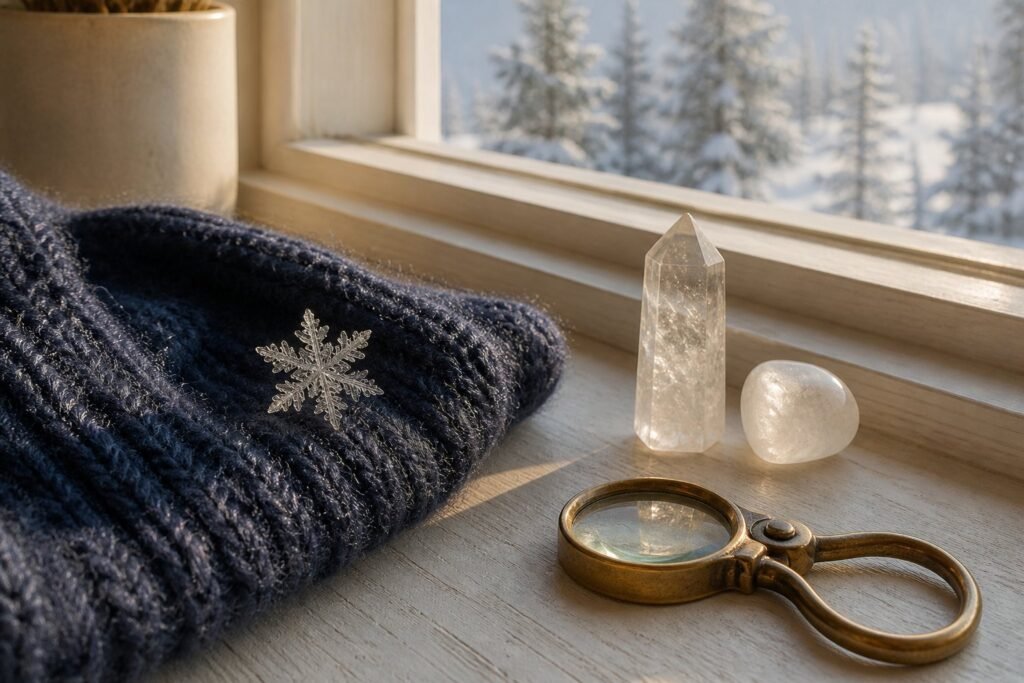
While crossing Charles Bridge in Prague, the German scientist Johannes Kepler noticed snowflakes on his coat and began to wonder why they have exactly six arms [1]. In 1611 he published a short treatise on the question, but scientists found the answer only three centuries later [2]. The word “crystal” itself, meanwhile, originally meant ice in Ancient Greek.
Why Snowflakes Are Hexagonal
Ice is a mineral, in other words a recognised mineral species with the formula H2O and a hexagonal, or six-sided, crystal system [3]. In a snow crystal the water molecules line up in a precise hexagonal lattice, and this structure gives rise to the six-fold symmetry that we can see with the naked eye [4]. A brand-new snow crystal looks like a tiny hexagonal prism with two basal faces and six side faces [4].
The words “snow crystal” and “snowflake” are not quite synonyms. A snow crystal is a single ice crystal, while a snowflake can be almost anything that falls from winter clouds: often hundreds or even thousands of crystals collide in the air and stick together in fluffy clumps [4]. The largest snow crystal ever photographed measured 10 mm from the tip of one arm to the other, while the smallest can be no thicker than a human hair [5]. All six arms of a crystal grow alike because in the cloud they go through the same changes in temperature and humidity at the same time [4][6].
The perfectly symmetrical stars seen in photographs are, however, the exception in nature. Kenneth Libbrecht, professor of physics at the California Institute of Technology (Caltech), who studies how ice crystals grow from water vapour [7], writes that symmetrical snow crystals are rare and that irregular crystals are the most common [8]. One rule is strict, though: there are no eight-armed snowflakes in nature [9].
Kepler’s New Year’s Gift and Snowflakes Before Him
Kepler’s treatise, written in Latin, “Strena seu de nive sexangula” (“A New Year’s Gift, or On the Six-Cornered Snowflake”), is 24 pages long, and Kepler gave it to his friend and patron Wacker von Wackenfels [1]. He was looking for a gift that would be next to nothing, and he put a pun in the title: in Latin “nix” means snow, while in colloquial German “nix” (nichts) means “nothing” [1]. In the treatise Kepler also explored how spheres can be packed most densely in space and wondered whether the hexagon might be the most efficient shape, but in the end he admitted that the science of his day could not yet give an answer [1][2]. That became possible only once scientists had learned enough about atoms, molecules and how they are arranged in solids [2].
Did you know? In China the six arms of snowflakes were noticed long before Kepler. In 135 BC a Chinese scholar wrote that the flowers of plants and trees usually have five points, but snow flowers always have six [2]. In Europe the six-fold symmetry of snowflakes was correctly described by the English astronomer Thomas Harriot in 1591, 20 years before Kepler’s treatise [2].
How a Snow Crystal Forms in a Cloud
A snowflake starts to form in a cloud when a supercooled water droplet freezes onto a tiny particle of dust or pollen [6]. The crystal then grows from water vapour that turns straight into ice without passing through the liquid stage [4][6]. Snow crystals should not be confused with frozen raindrops, which are a different form of precipitation [4].
The shape of a crystal depends mainly on temperature and, to a lesser extent, on humidity [6][10]. At around minus 2 °C thin plates grow, at around minus 5 to 6 °C slender needles and columns, and at around minus 15 °C large, thin plates again [6][10]. The more humid the air and the faster the growth, the more branched the forms [10]. Why a crystal grows as a plate at one temperature but as a column at another is still not fully understood [10].
This pattern was discovered by the Japanese physicist Ukichiro Nakaya. In 1935 a special low-temperature laboratory was built at Hokkaido University in Japan, and in March 1936 Nakaya and his colleagues grew the first artificial snow crystal in a glass apparatus [11]. Before that he had tried threads of silk, cotton and fine wire, and even spider’s web, but only frost-like clusters of tiny crystals formed on them [2]. Success came with a rabbit hair from an assistant’s fur coat: the natural oils in the hair held back the formation of frost, and individual crystals grew on it that looked almost exactly like those grown in clouds [2][11]. The diagram that shows crystal shapes at different temperatures and humidities is also known as the Nakaya diagram [10][11]. The saying “Snowflakes are letters sent from heaven” is Nakaya’s own [11].
Wilson Bentley and the Question of Whether Two Snowflakes Can Be Identical
The first photograph of a single snow crystal was taken on 15 January 1885 by Wilson Bentley, a 19-year-old farmer from Jericho, Vermont [2][12]. He built an ingenious device himself to attach a camera to a microscope, and over 46 years he captured more than 5,000 snow crystals on glass photographic plates [2][12]. His book “Snow Crystals”, with more than 2,000 photographs, came out in November 1931, and on 23 December that same year Bentley died at the family farmhouse in Jericho, where he had lived all his life [2][12].
In all his work Bentley never found two identical crystals [12]. In 1925 he wrote: “Every crystal was a masterpiece of design and no one design was ever repeated. When a snowflake melted, that design was forever lost.” [12]
Modern science agrees with him, with one caveat. NOAA explains that each snowflake takes a slightly different path from the cloud to the ground and meets slightly different conditions on the way, so you will not find two completely identical flakes [6][13]. Libbrecht has grown “identical twins” in the laboratory: two crystals that grew under identically changing conditions took on almost the same shape, but even they are not exactly alike [14].
Why Snow Is White When Ice Is Transparent
A single ice crystal is as clear as glass. A snowdrift looks white because light is reflected from the surfaces of countless crystals and only a small part of it is absorbed [15]. In the same way, heaps of salt, sugar or crushed glass look white, even though each grain is colourless and transparent [15].
You will find a similar example in the world of crystals. Milky quartz and rock crystal are varieties of the same mineral, quartz, but the white, cloudy look of milky quartz comes from microscopic fluid inclusions that were trapped in the crystal while it was growing [16][17].
Pliny the Elder: Rock Crystal as a Kind of Ice
In Book 37 of his “Natural History”, the Roman naturalist Pliny the Elder wrote that crystal is found only where the winter snow freezes hardest, and that it got its Greek name because it is a kind of ice [18]. He added that rainwater and pure snow are needed for crystal to form, which is why it cannot bear heat and only cold drinks are poured into vessels made of it [18].
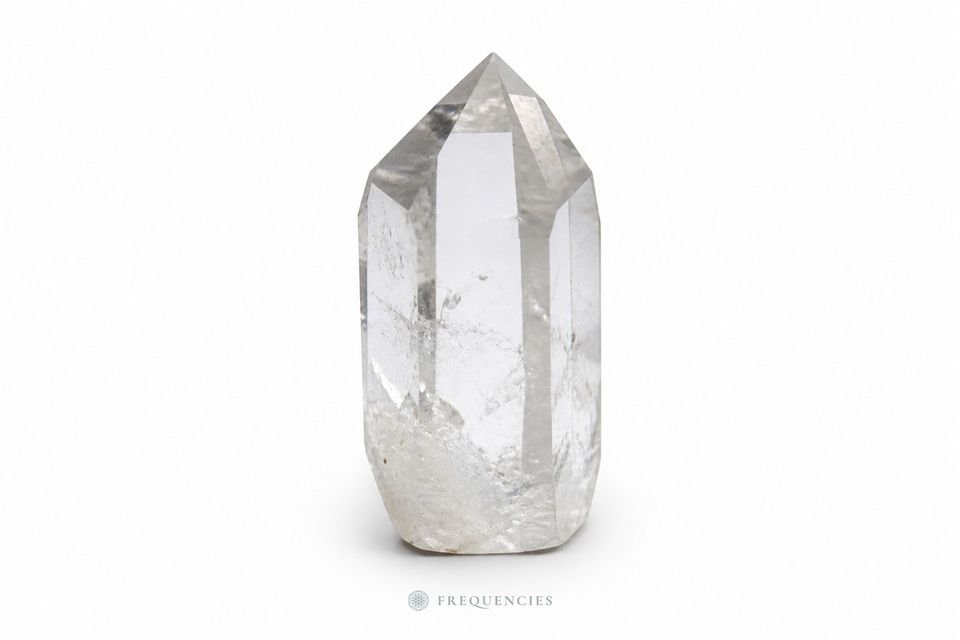
The Ancient Greek word κρύσταλλος (krystallos) comes from κρύος, meaning frost or cold [18]. In Homer’s “Iliad” and “Odyssey” the word means ice, but in later texts, such as the work of Strabo, it also means rock crystal [19].
Pliny was a keen observer. He noticed that crystal is six-sided with pyramid-shaped tips, and wrote that no art can imitate the brilliance of its faces [18]. Today we know that rock crystal is a transparent variety of quartz with a hardness of 7 on the Mohs scale, and quartz crystals really do grow as hexagonal prisms with a pointed tip [17][20]. Ice and quartz look alike, but chemically they are completely different: ice is H2O, while quartz is silicon dioxide, SiO2 [3][17]. Rock crystal can also be told apart from glass by its coolness: quartz stays cool in the hand for longer, while glass warms up faster [20].
Wintry Stones: Rock Crystal, Milky Quartz, Selenite and Snowflake Obsidian
If you would like to bring a winter mood into your home with stones, rock crystal is the most natural choice. It is durable, scratches ordinary glass and can be rinsed briefly in water [20]. Do not put a clear rock crystal sphere on a sunny windowsill, as it can focus the sun’s rays like a lens and set nearby objects alight [20]. In our shop’s rock crystal category there are polished stones, spheres and chips: a 4 cm sphere, for example, currently costs €18.50, and a bag of chips from €3.50. You can compare the shapes crystals are cut into in the article Crystal Shapes.
With its whiteness, milky quartz is reminiscent of snow, and it is just as hard as rock crystal, with a hardness of 7 [20]. In the milky quartz category you will find polished stones, chips and a polished milky quartz heart (about 4 cm, currently €11.11).
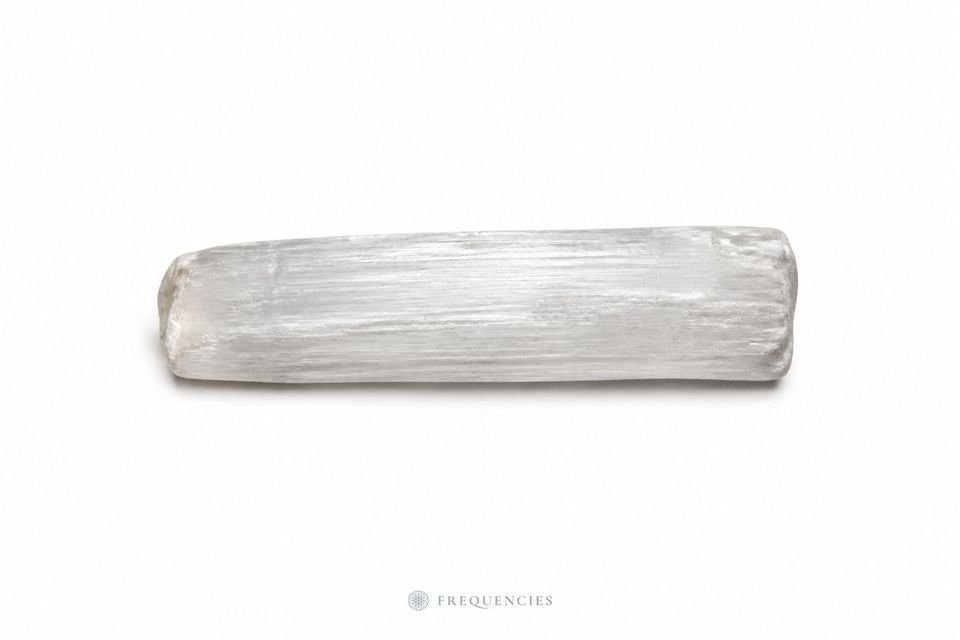
Selenite is gypsum, and in the trade the name is often used for fibrous satin spar [20]. It is soft, with a hardness of only 2, and can be scratched with a fingernail [20]. Gypsum slowly dissolves in water, at about 2 g/l, so keep selenite dry and clean it only with a dry cloth [20]. White selenite glows softly in candlelight, and selenite candle holders suit winter evenings well, such as the round Snowball selenite candle holder (about 10 × 10 cm, currently €24). If you like the light of selenite, read our article on the selenite lamp as well.
Snowflake obsidian is volcanic glass with white patterns. Being a glass, obsidian is chemically unstable, and over time radiating clusters of white or grey cristobalite crystals begin to form in places within it, which look like snowflakes in a polished stone [21]. With a hardness of 5 to 5.5, obsidian is better suited to pendants and decorative objects than to rings [20]. You can read more about this volcanic glass on the encyclopedia page on obsidian, and care tips for all stones are summarised in the care table.
A Family Experiment: Catch a Snowflake and Cut Out a Proper Paper Snowflake
If you want to look at snow crystals for yourself, Libbrecht suggests getting a small magnifying glass of about 5x, a piece of dark fabric or dark card, and waiting for a cold day [22]. Catch the flakes while they are still falling, because those lying on the ground have usually already broken up, and on mild days there may be no interesting crystals at all [22]. Depending on how cold it is, plates, needles, columns or branched crystals may land on the dark background [6][10]. As a first challenge Libbrecht suggests finding a capped column, a rarer form that René Descartes first described as a type of snow crystal in 1637 [2][22].
Then you can pick up the scissors. For a paper snowflake to look like a real one, it must have six arms, not eight: fold the sheet in half, then in half again, then fold the remaining part into three equal parts and cut off the excess [9]. For a more natural look, Libbrecht suggests cutting side branches that leave the main arms at an angle of 60 degrees [9].
Paper Snowflakes: A Step-by-Step Template
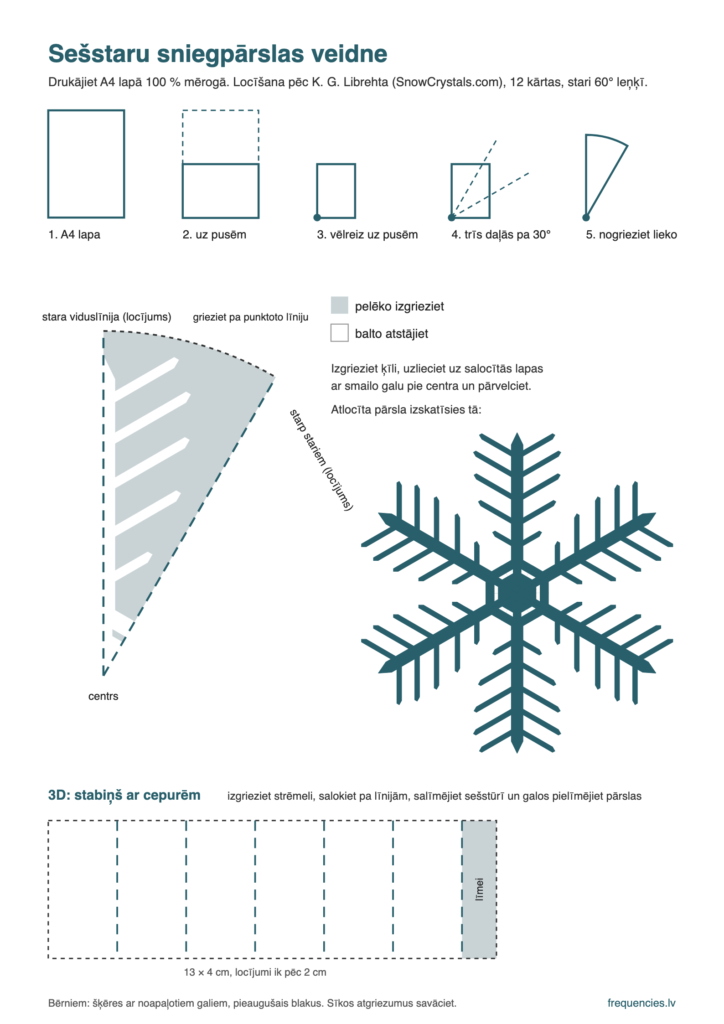
To make the flake look like a real snow crystal, Libbrecht suggests cutting, in addition to the side branches, two concentric hexagons in the centre and a rib along the middle of each arm [9]. All these elements are cut in one go, because in the folded sheet every cut is repeated 12 times.
- Take a thin A4 sheet and fold it in half, then in half again [9]. The corner where the two folds meet will be the centre of the flake.
- Fold this right angle into three equal parts of 30 degrees each: fold one edge inwards so that the folded part takes up a third of the angle, then fold the remaining part over it [9].
- Cut off the excess paper so that a narrow wedge is left, with its pointed end at the centre of the flake [9]. The wedge now has 12 layers.
- Draw the pattern in pencil. Along one edge of the wedge, leave a narrow strip of paper: this will be the centre line of the arm. From the strip, draw side branches slanting towards the wide end of the wedge at an angle of 60 degrees to the strip, but do not take them as far as the other edge, or they will join up with the branches of the neighbouring arm.
- Near the pointed end, leave the paper uncut across the full width of the wedge: this will become the central hexagon. In this part, mark a slit 1 to 2 mm wide that starts at the other edge, runs at right angles to it and ends a few millimetres before the centre line of the arm. When the flake is unfolded, this slit will become a hexagon within a hexagon.
- Cut away the paper between the branches and cut out the slit, then carefully unfold the flake and leave it overnight under a heavy book so that it flattens out.
To make the flake resemble a particular type of crystal, choose one: for a plate, cut a hexagon with small notches along its edges, and for a star of the kind that grows at around minus 15 °C [4], leave long arms with side branches. Twelve-armed snowflakes also occur in nature: when two small six-armed crystals collide in the air, they can stick together and carry on growing together [23]. You can make such a flake by gluing two identical paper flakes one on top of the other so that all 12 arms are evenly spaced.
3D Paper Snowflakes: A Capped Column and a Crossed Flake
Real snow crystals are three-dimensional too. Star-shaped plates are thin and flat, but other crystals are not: simple hexagonal prisms can be long, slender columns, thin plates or anything in between [4]. Libbrecht compares his favourite type of crystal, the capped column, to two wheels on an axle or an empty cotton reel. A crystal like this forms when it passes through different temperatures as it grows [23].
You can glue together a model like this. From thicker paper, cut a strip 4 cm wide and 13 cm long, fold it every 2 cm and leave the last centimetre for the glue. Glue the strip into a hexagonal tube. Cut out two identical six-armed flakes that keep a solid hexagon at least 4 cm across in the centre, and glue one to each end of the tube. Libbrecht also describes columns with several caps, in which there are further plates between the two outer ones [23]: for a model like this, glue together two shorter tubes and glue a third flake in between them.
A simpler decoration is a crossed flake. Cut two identical flakes from thicker paper. In one flake, cut a narrow slit from the tip of an arm to the centre, and in the other, the same slit from the tip of the opposite arm to the centre. Then slide the flakes into each other. This is a decorative shape rather than a model of any particular crystal, but it is easy to hang on a thread.
Safety when cutting with children. Give younger children children’s scissors with rounded tips and stay close by. The folded sheet has 12 layers, so cutting takes some strength: choose thin paper, and leave thicker paper and small cuts to an adult. Only adults should use a craft knife, and only on a cutting mat. Afterwards, gather up the small offcuts, because for children under three, swallowing foreign objects and choking are among the biggest injury risks [24]. For the same reason, keep small polished stones and chips in winter decorations out of reach of little ones: crystals are not toys.
Frequently Asked Questions
Why do snowflakes have six arms?
Ice is a mineral with a hexagonal crystal lattice: water molecules arrange themselves in hexagons, and this gives the snow crystal its six-armed symmetry. All six arms grow alike because in the cloud they go through the same changes in temperature and humidity at the same time.
Can two snowflakes be identical?
In nature each snowflake falls along a different path and grows in slightly different conditions, so you will not find two completely identical flakes. The physicist Kenneth Libbrecht has grown almost identical twin crystals in the laboratory, but even they are not exactly alike.
Is ice a mineral?
Yes. Ice is a naturally occurring crystalline substance with the formula H2O and a hexagonal crystal system, and in mineralogy it is a recognised mineral species.
Why is snow white?
Ice is transparent, but in a snowdrift light is reflected from the surfaces of countless crystals and only a small part of it is absorbed. In the same way, heaps of salt or sugar look white, even though each grain is colourless.
How do you cut a snowflake from paper?
Fold the sheet in half, then in half again, then fold the remaining part into three equal parts and cut off the excess. This gives you a six-armed flake, as in nature, because there are no eight-armed snowflakes.
How big are snowflakes?
The smallest snow crystals, known as diamond dust, can be no thicker than a human hair. The largest snow crystal ever photographed measured 10 mm from the tip of one arm to the other.
How do you make a 3D paper snowflake?
Glue a strip of paper into a hexagonal tube and glue a six-armed flake to each end. This gives you a model of a capped column. This type of snow crystal also occurs in nature and looks like two wheels on an axle. A simpler option is to slide two identical flakes into each other along slits.
Can a snowflake have 12 arms?
Yes. If two small six-armed crystals collide in the air, they can stick together and carry on growing as a twelve-armed flake. There are no eight-armed snowflakes in nature.
Sources
- J. Howarth. Johannes Kepler on Snowflakes or what to give someone who has everything, St Edmund Hall, University of Oxford
- K. G. Libbrecht. Snowflake History, SnowCrystals.com
- Ice Mineral Data, Webmineral.com
- K. G. Libbrecht. A Snowflake Primer, SnowCrystals.com
- K. G. Libbrecht. Fun Facts About Snowflakes, SnowCrystals.com
- How do snowflakes form? Get the science behind snow, NOAA (US National Oceanic and Atmospheric Administration), 2016, updated 2022
- Kenneth G. Libbrecht, Professor of Physics, Caltech (California Institute of Technology)
- K. G. Libbrecht. Snowflake Myths and Nonsense, SnowCrystals.com
- K. G. Libbrecht. Proper Paper Snowflakes, SnowCrystals.com
- K. G. Libbrecht. The Snow Crystal Morphology Diagram, SnowCrystals.com
- A. A. Gunawan. Low temperature science: the past, present, and future, Hokkaido University, 2021
- Wilson Bentley biography, Jericho Historical Society, Vermont
- How Do Snowflakes Form?, NOAA NESDIS
- K. G. Libbrecht. Identical-Twin Snowflakes, SnowCrystals.com
- K. G. Libbrecht. Why is snow white?, SnowCrystals.com
- Milky Quartz, Amethyst Galleries Mineral Gallery
- Quartz, Minerals.net
- Pliny the Elder. Natural History, Book 37, Chapter 9 (English translation by J. Bostock and H. T. Riley), Perseus Digital Library, Tufts University
- H. G. Liddell, R. Scott. A Greek-English Lexicon: κρύσταλλος, Perseus Digital Library, Tufts University
- FREQUENCIES stone encyclopedia: rock crystal, milky quartz, selenite, obsidian (hardness, care, how to recognise)
- H. M. King. Obsidian, Geology.com
- K. G. Libbrecht. Snow and Ice Activities, SnowCrystals.com
- K. G. Libbrecht. A Guide to Snowflakes, SnowCrystals.com
- Bērnu klīniskā universitātes slimnīca (Children’s Clinical University Hospital). Bērnu “traumu topa” augšgalā: svešķermeņu norīšana un aizrīšanās [At the top of the children’s injury chart: swallowing foreign objects and choking], press release on LV portāls, 10.06.2022