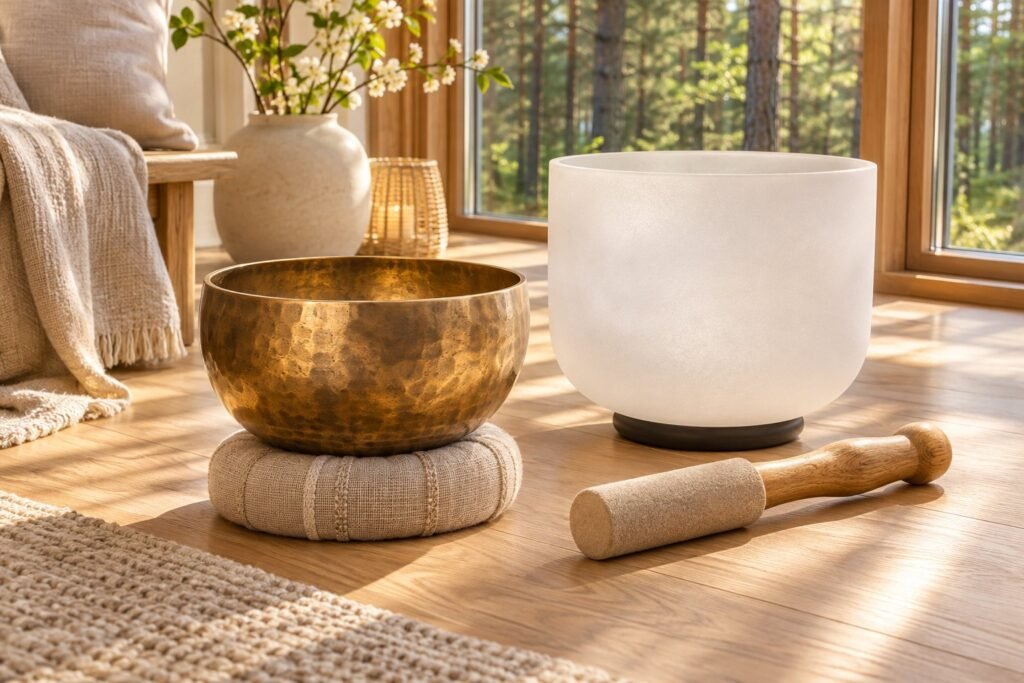
A singing bowl works on the same principle as a wine glass whose rim you run a wet finger around. So write researchers from the University of Liège and the Massachusetts Institute of Technology, who studied Tibetan bowls in the laboratory [1]. The physics of bowls explains practical things too: why the mallet should be moved slowly and evenly, why a wider bowl sounds lower, and why a crystal bowl sounds different from a metal one.
How a Singing Bowl Makes Its Sound
A bowl can be made to sound in two ways: by striking it with a mallet or by rubbing its rim. When a suede-covered mallet is run along the rim, it alternately sticks and slips. While it sticks, the mallet drags the rim along with it, and when it slips, the rim springs back to its starting position, just like the rim of a wine glass under a finger [1]. Rubbing mainly excites the bowl’s fundamental tone with its overtones. In this mode of vibration, the rim has four points that hardly move and four that move the most [1]. Striking, by contrast, excites several modes of vibration of different pitches at once, so a struck bowl sounds richer, while a rubbed bowl sounds steadily for as long as the mallet keeps moving.
A handmade bowl is not perfectly symmetrical, so its fundamental tone splits into two tones close together that differ by a few hertz. Both sound at once, and the ear hears them as a wave-like pulsing [1].
Did you know? If you pour water into the bowl, its tone drops, and if you play harder, wave patterns appear on the surface of the water. In a bowl excited even more strongly, the waves break, tiny droplets splash up from the surface, and the researchers observed that they can bounce and skate across the trembling water [1]. The Chinese bowl with handles, which is played by rubbing the handles with wet palms, works in a similar way [1].
Metal Singing Bowls: Bronze and the Story of Seven Metals
Metal singing bowls are usually made of bronze, that is, an alloy of copper and tin. The physicist Denis Terwagne of the University of Liège and the MIT mathematician John W. M. Bush write that the bowls are handmade and their exact composition is not known, but besides copper and tin the bronze may also contain zinc, iron, silver, gold and nickel [1]. A story often heard is that genuine bowls are made of an alloy of seven metals. We found no independent measurements to confirm this.
Concrete figures come from materials scientists at the Silesian University of Technology, who examined a bowl about 13 cm across bought in Patan, Nepal. X-ray fluorescence analysis showed that by mass it contained 75.8% copper and 23.2% tin, while zinc, antimony, silver, lead, iron and nickel together made up only about one per cent [2]. The structure of the metal showed that the bowl had been cooled rapidly after hot working [2].
Most of our metal bowls are handmade in Nepal. We have not had the alloy composition given on the product pages tested in a laboratory. Each bowl sounds slightly different, and the product pages do not state the note. Individual metal bowls currently cost from €70.30 (Cho-Pa, 14 cm) to €540 (Cho-Pa, 38 cm). You will find all of them in the section Metal Singing Bowls. Many of them come without a mallet, which you can add separately.
Did you know? The history of singing bowls is surprisingly hard to document. The music historian Ted Gioia writes that while working on his book he searched various primary sources in vain for more detailed information about them. Even the amateur researcher Frank Perry, who had examined more than 4,500 bowls and divided them into 45 types, knew little about where the tradition came from [3].
Crystal Singing Bowls: Quartz Glass
According to manufacturers’ descriptions, crystal bowls are made from high-purity crushed quartz, which is melted and shaped into a bowl in a centrifugal mould. In a 2023 conference paper, the New York University sound artist Anastasia Clarke quotes manufacturers who give quartz purities of 99.992% and 99.8% [4]. If molten quartz is cooled fast enough, no crystals form and the result is transparent amorphous silicon dioxide [5]. In chemical composition the bowl is the same as rock crystal, but in structure it is glass, like natural Libyan desert glass or volcanic obsidian. Read more about this in the article on crystal glasses and rhinestones.
Clarke writes that a properly played crystal bowl produces a stable, clear tone that is closer to a sine wave than the sound of bronze bowls, as it contains fewer overtones [4]. Many manufacturers’ bowls are rough and matt on the outside, while the inside is as smooth as glass. The rough surface creates friction, and at the start of playing the tone comes with a faint hiss, which fades as the bowl settles into an even sound [4].
Quartz glass is fragile. Clarke describes how within four months she accidentally damaged her first two bowls: in an experiment she dropped small “hematite” magnets, coins and other metal objects into them, and hairline cracks appeared in the bowls [4]. “Hematite” magnets like these are usually made of an artificial material, as natural hematite is only weakly magnetic. Do not drop anything into a crystal bowl. Our crystal bowls currently cost from €235 (25 cm hand bowl with handle) to €265.60 (30 cm orange bowl in D), while a set of seven bowls costs €1,756.20. They are all in the section Crystal Singing Bowls, and the 30 cm bowls come with a mallet and a rubber ring to stand the bowl on.
Metal or Crystal: How to Choose
| Feature | Metal bowl | Crystal bowl |
|---|---|---|
| Material | bronze: copper and tin with small amounts of other metals | quartz glass from high-purity crushed quartz |
| Sound | many overtones, a pulsating sound | clear, stable tone with fewer overtones |
| Tuning | not stated on our product pages; each bowl sounds different | 432 Hz and the note are stated for our bowls |
| Weight in our shop | from 0.6 to 5.6 kg | 30 cm Lotus bowl about 4.4 kg |
| Durability | should be protected from drops and scratches | fragile, can crack even from a small metal object |
| Mallet | suede or felt; the bowl can also be struck | the mallet supplied or a rubber one, never wooden |
| Current price in our shop | from €70.30 | from €235 |
A metal bowl is the choice for anyone who likes a rich, changing sound with many overtones. Small and medium metal bowls are also much lighter than a 30 cm crystal bowl. A crystal bowl suits you if you want a clear, sustained tone with a known tuning or plan to play several bowls together. Bear in mind that a 30 cm crystal bowl is heavy and needs a padded bag.
Before you order, bear the delivery time in mind. All our singing bowls and their accessories are currently in the supplier’s warehouse: on the product page you will see the note “Available at supplier’s warehouse”, and delivery in the Baltic States takes about 15 working days [6]. Items in our own warehouse, such as stone bracelets, are usually delivered in the Baltic States within 1 to 3 working days [6]. If you need a bowl as a gift for a particular date, order it in good time.
Size, Wall Thickness and Tone
The fundamental tone of a bowl is determined by its dimensions and material. Terwagne and Bush show that the tone gets higher if the wall of the bowl is thicker, and lower if the bowl is wider: the fundamental tone in hertz is roughly proportional to the wall thickness divided by the square of the radius [1]. For the four old bowls they measured, 12 to 18 cm in diameter, the fundamental tones ranged from 187 to 428 Hz [1]. A 12.3 cm bowl studied by researchers at Rollins College had a fundamental tone of 621 Hz [7], so the tone cannot be predicted precisely from the diameter alone.
In practice, this means that of two bowls with similar wall thickness, the wider one will sound lower. The diameters of our individual metal bowls range from 14 to 38 cm, so most of them are wider than the ones measured in the studies.
What Does 432 Hz Mean on a Crystal Bowl
Musical instruments are tuned to a reference note. The international standard ISO 16:1975 specifies that the A above middle C (A4) is 440 Hz [8]. If an instrument is specified as 432 Hz, it is tuned so that A is 432 Hz, that is, 8 Hz lower. The difference is about a third of a semitone.
The 432 Hz label refers to the tuning, not to the quality of the bowl, and the bowl itself sounds a particular note, for example D. This is important if you want to play the bowl together with other instruments: if they are tuned to 440 Hz, they will sound out of tune with the bowl. Our 30 cm orange Lotus bowl is listed as a D, while for the 30 cm bowl with bag and the 25 cm hand bowl you can choose the note on the product page [9].
How to Play a Singing Bowl: Striking and Rubbing
Place the bowl on a cushion or a rubber ring, or hold a small bowl on the flat of your hand without wrapping your fingers round its sides. The walls and rim of the bowl vibrate [1], and every touch dampens the sound. Strike the outer rim of the bowl briefly and lightly with a soft mallet and let the sound ring out. For a crystal bowl, use a rubber mallet and, as indicated on the product page, do not play it too loudly [9].
To make the bowl sing, first strike it gently, then press the mallet against the outer rim and move it in a circle with steady pressure and slow, even speed. The volume depends on how firmly the mallet is pressed and how quickly it is moved [7]. If the mallet starts to chatter, it is most likely briefly losing contact with the vibrating rim. Researchers at Rollins College write that chatter often occurs when the mallet is moved faster or pressed more lightly [7], so slow down and press more evenly.
The material of the mallet changes the sound. In the descriptions of our accessories, suede mallets are meant for metal bowls, while felt mallets give a softer sound with fewer overtones and are recommended for large bowls; the larger the mallet head, the larger the area in contact with the bowl [9]. For a crystal bowl, use the mallet supplied or a rubber one, as the product page warns against wooden mallets. It also advises keeping crystal bowls at least 30 cm apart and not putting your head inside a bowl [9]. You will find all the accessories in the section Sound Instrument Accessories.
How to Care for and Store a Singing Bowl
After playing, wipe a metal bowl with a soft, dry cloth, especially if you have touched it with your fingers. If you played with water in it, pour the water out and wipe the bowl dry. Do not use shop-bought metal polishes: conservators at the US National Park Service warn that many contain ammonia or harsh abrasives that can damage the surface irreversibly [10]. They also point out that patina is a thin, fairly stable layer of corrosion and that polishing can remove decorative coatings or gilding as well [10]. Be especially gentle with coloured and two-tone bowls, such as a black bowl with a gold-coloured inside.
Store and carry a crystal bowl in a padded bag, stand it on a rubber ring when playing, and never put one bowl inside another. Wipe it with a soft cloth, dry or slightly damp. Keep both metal and crystal bowls somewhere dry from where they cannot fall. You will find all bowls and sets in the category Singing Bowls.
Frequently Asked Questions
How do you play a singing bowl?
Place the bowl on a cushion or on your palm, tap the rim lightly, and then run the mallet round the outer rim with steady pressure at a slow speed.
What is the difference between metal and crystal singing bowls?
Metal bowls are made of bronze, and their sound has many overtones. Crystal bowls are made of quartz glass and have a clear, stable tone and a stated tuning, but they are fragile and, in the larger sizes, heavier.
What are Tibetan singing bowls made of?
Usually bronze, that is, an alloy of copper and tin. A Nepalese bowl analysed in the laboratory contained 75.8% copper and 23.2% tin by mass, with all other metals together making up about one per cent. We found no independent measurements to confirm the story of seven metals.
What does 432 Hz mean?
It is the tuning: the instrument is tuned so that A is 432 Hz, not 440 Hz as laid down in the ISO 16 standard. This is important if you play the bowl together with other instruments.
Why does the mallet chatter against the bowl?
Most likely, the mallet is briefly losing contact with the vibrating rim. This happens if it is moved too quickly or pressed too lightly. Slow down and press more evenly.
How long does it take to deliver a singing bowl?
Our singing bowls and their accessories are currently in the supplier’s warehouse, and delivery in the Baltic States takes about 15 working days. The exact delivery time is given on each product page.
Sources
- D. Terwagne, J. W. M. Bush, “Tibetan singing bowls”, Nonlinearity 24 (2011) R51-R66, freely available version arXiv:1106.6348: arxiv.org/abs/1106.6348
- M. Jabłońska et al., “Thermal and structural analysis of high-tin bronze of chemical composition corresponding to the composition of the singing bowl”, Journal of Thermal Analysis and Calorimetry 137 (2019) 735-741, Table 1: doi.org/10.1007/s10973-019-08015-z
- T. Gioia, “My Afternoons with the Singing Bowl Lady”, The Honest Broker, 17.12.2022: www.honest-broker.com
- A. Clarke, “Shard-Speakers: An Inquiry into the History, Sonic Properties, and Musical Possibilities of Quartz Crystal Singing Bowls”, NIME 2023: nime.org/proceedings/2023/nime2023_63.pdf
- Elkem, “Fused silica”: www.elkem.com/products/others/fused-silica/
- frequencies.lv, “Delivery and Returns”, point 3 “Delivery times”, and product pages (availability as of 08.11.2026): frequencies.lv/piegade-un-atgriesana/
- S. R. Collin, C. L. Keefer, T. R. Moore, “The Etiology of Chatter in the Himalayan Singing Bowl”, Proceedings of the Third Vienna Talk on Music Acoustics, 2015: viennatalk2015.mdw.ac.at
- ISO 16:1975 “Acoustics. Standard tuning frequency (Standard musical pitch)”, catalogue entry, Austrian Standards: www.austrian-standards.at
- frequencies.lv product pages: crystal singing bowl 432 Hz with bag (30 cm), crystal bowl Lotus D 432 Hz (30 cm), mallets and felt mallets for singing bowls: frequencies.lv
- US National Park Service, Conserve O Gram 10/2 “Caring For Silver And Copper Alloy Objects”, 1999: www.nps.gov