
In Latvian field boulders, such as the gneiss on the rocky Vidzeme coast, red-violet almandine crystals can often be seen [24]. Almandine is just one of the minerals of the garnet group. The same group also includes orange spessartine, emerald-green uvarovite and melanite, the black variety of andradite, but the colours of the different species overlap, so the species cannot be determined by colour alone.
What is a garnet group mineral
Garnet is not the name of a single mineral. In the nomenclature approved by the International Mineralogical Association (IMA) in 2013, the broadest grouping is called the garnet supergroup: it includes all minerals with the garnet crystal structure, whatever their chemical composition, and at the time of the report it contained 32 approved species [1]. The garnet group itself consists of silicates with the general formula X3Y2(SiO4)3. X can be magnesium, calcium, divalent iron, manganese and other elements, while Y can be aluminium, trivalent iron, chromium, vanadium and others [1, 2]. In 2013, the group contained 14 species, but GIA names six main ones: almandine, pyrope, spessartine, grossular, andradite and uvarovite [1, 3, 4].
If a crossword clue asks for a garnet group mineral, any of these six names will fit, and the number of letters decides which one: the shortest is pyrope with six letters, the longest is spessartine with eleven.
Gemmologists sometimes divide the six species into two groups: pyralspites (pyrope, almandine, spessartine) and ugrandites (uvarovite, grossular, andradite) [22]. The IMA 2013 nomenclature does not recommend this traditional division [1]. To learn about the origin of the word garnet itself, see the article Origin of Stone Names.
Did you know? The IMA report appendix contains a list of 715 names given to garnets since ancient times: they are synonyms, variety names, and obsolete and discredited names [1]. One of the garnet group species, majorite, was first described in a meteorite found in Western Australia [1].
Six Garnets in One Table
| Species | Formula | Common colours | Density, g/cm³ | Where it forms |
|---|---|---|---|---|
| Almandine | Fe3Al2(SiO4)3 | dark red, brownish red, red-violet | 4.32 | metamorphic rocks, pegmatites, granites |
| Pyrope | Mg3Al2(SiO4)3 | blood red, purple-red, orange-red | 3.58 | ultrabasic igneous rocks |
| Spessartine | Mn3Al2(SiO4)3 | orange, reddish orange, red-brown | 4.12 to 4.32 | granites, pegmatites, metamorphic rocks |
| Grossular | Ca3Al2(SiO4)3 | colourless, yellow, orange, brown, green | 3.59 | metamorphic rocks |
| Andradite | Ca3Fe2(SiO4)3 | yellow, green, brown, black | 3.8 to 3.9 | contact-metamorphosed limestone |
| Uvarovite | Ca3Cr2(SiO4)3 | green | 3.77 to 3.81 | chromite deposits |
The table data are from Mindat and Britannica [7, 8, 9, 10, 11, 12, 15, 17, 18, 19, 20]. All six crystallise in the cubic system, and well-formed crystals are usually rhombic dodecahedra or trapezohedra (icositetrahedra) [7, 24]. In the book “Minerals and Rocks of Latvia”, Dainis Ozols writes that garnets can be recognised almost unmistakably by their crystal shape, but are told apart from one another by colour and by the rocks in which they occur [24]. GIA gives a hardness of 6.5 to 7.5 on the Mohs scale for gem garnets [3]. How the metamorphic rocks in which most garnets form [25] come about is explained in a separate article.
Almandine and Pyrope: Red Garnets
GIA describes red garnet as one of the most common gemstones, found in metamorphic rocks on every continent [4]. According to Britannica, almandine is the most widespread garnet, and it usually forms a mixture with pyrope and spessartine [15]. Geologists use almandine to assess the degree of metamorphism of a rock [15]. Dark red almandine, cut as a cabochon, is called carbuncle, and its base is sometimes hollowed out to make the stone appear lighter. If almandine contains rutile needles, a four-rayed star can be seen in the cabochon [15]. The name comes from the ancient city of Alabanda in what is now Turkey: the Alabandic carbuncles described by Pliny the Elder were cut and polished there [1, 7].
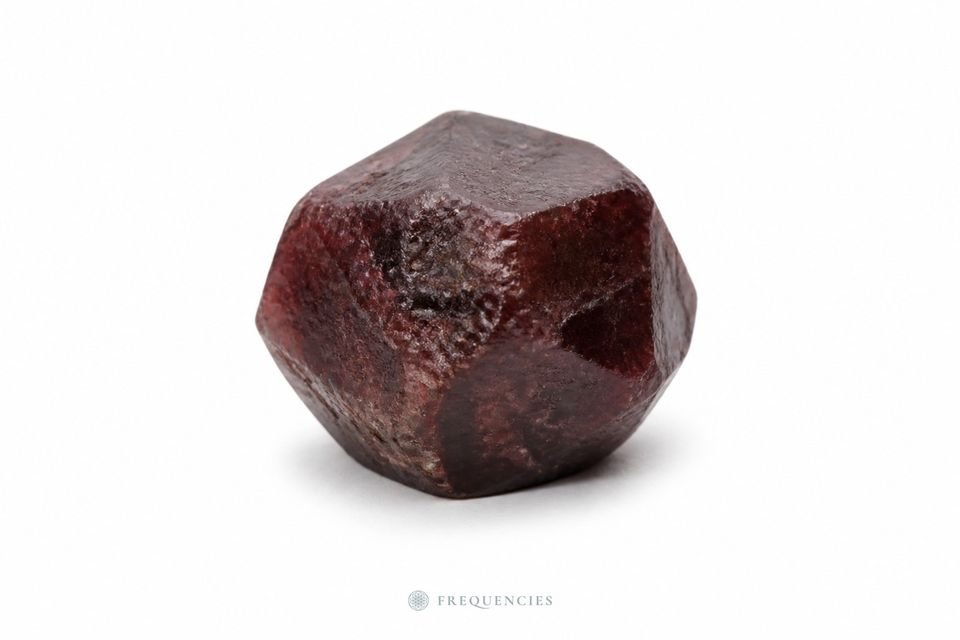
Almandine is common in Latvian field boulders, and on the beaches of Vidzeme and Kurzeme the waves heap up red-violet almandine sand [24]. Do not pick garnet grains out of the rock: Ozols points out that a specimen in which the garnet is still in its rock is much more valuable [24].
Pyrope is a magnesium aluminium garnet, and its name comes from the Greek word pyropos, meaning “fire-like” [1]. It forms mainly in ultrabasic igneous rocks [8], and Ozols notes that Siberian diamond deposits were discovered by following pyrope grains in river and stream sands [24]. Tiny pyrope grains have also been found in Latvian sands [24]. Pure pyrope is colourless, but such specimens are rare in nature [8]. The purple-red intermediate form between pyrope and almandine is called rhodolite [5].
The polished garnets in our shop come from India, and the small stones are dark red to reddish brown. Whether they contain more almandine or pyrope cannot be determined without a laboratory, but a magnet can give a clue. Garnet can be rinsed briefly in water, and you will find other care tips in the care table [25]. The history of Bohemian pyrope and the symbolism of garnet are described on the garnet page in the encyclopedia.
Spessartine: The Orange Manganese Garnet
Spessartine is a manganese aluminium garnet. When nearly pure it is pale orange-yellow, but the more almandine it contains, the more orange or dark red it becomes [17]. It is found in granites, pegmatite veins and metamorphic rocks [17]. GIA adds that eye-visible inclusions are common in the orange garnets, spessartine and hessonite [5]. In 1797, Martin Klaproth called the mineral from the Spessart mountains in Bavaria “garnet-like manganese ore”, and it was given the name spessartine in 1832 [9].
Grossular and Andradite: Calcium Garnets from Colourless to Black
GIA writes that grossular probably has the widest range of colours of all garnet species: from colourless through yellow and orange-red to bright green [5]. The name comes from the Latin name of the gooseberry, as the first specimens were gooseberry-coloured [10]. The orange to red-brown variety is called hessonite, or cinnamon stone, and Britannica notes that it shows swirls inside that distinguish it from spessartine [18, 5]. Massive greenish grossular, which only superficially resembles jade, is sometimes sold as South African or Transvaal jade to increase its price [18]. What the name jade covers is explained on the encyclopedia’s nephrite page.
The green grossular called tsavorite was first found by the Scottish-born Kenyan gemmologist Campbell Bridges in north-eastern Tanzania, and the name, after Kenya’s Tsavo East National Park, was proposed by Henry Platt, president of Tiffany & Co. [14].
Andradite is a calcium and iron garnet. It is named after the Brazilian mineralogist José Bonifácio de Andrada e Silva, who described one of its varieties in 1800 [1, 11]. Britannica stresses that its dispersion, the splitting of light into colours, is even greater than that of diamond [19]. Green andradite is called demantoid, from the old German word Demant, meaning “diamond”, and it was first described from samples near Nizhny Tagil in the Urals [13]. GIA mentions that horsetail inclusions in demantoid are among the rare internal features that increase the stone’s value [3]. Yellow andradite, because it resembles topaz, is called topazolite, while the black, titanium-bearing variety is called melanite [19].
Both calcium garnets are usually found together in contact-metamorphosed limestone [19], and Ozols calls them typical skarn minerals, which hardly occur in Latvia [24]. GIA explains that tsavorite is green grossular, while demantoid is green andradite. Andradite is softer, but it has a higher refractive index and dispersion [6].
Uvarovite: The Green Chromium Garnet
Uvarovite is a calcium chromium garnet, and its colour is green [12]. Britannica calls it the rarest of all garnets: the crystals are usually too small to cut; otherwise its colour would let it compete with emerald [20]. GIA notes that it is sometimes set in jewellery as clusters of crystals [4]. Uvarovite occurs in chromite deposits, for example in the northern Urals, California, Canada, Finland and Polish Silesia [20], but in Latvia it turns up only rarely, as single grains in sand [24].
The mineral is named after the Russian statesman Count Sergey Uvarov, who was president of the St Petersburg Academy of Sciences from 1818 to 1855 [12]. Mindat warns that many so-called uvarovites are actually chromium-bearing grossular or pyrope, or green andradite [12].
How Garnets Are Told Apart: Colour Is Not Enough
GIA gemmologists acknowledge that assigning each new garnet to one of the six main species is a hard task, as many garnets are chemical mixtures of two or more species [3, 4]. In the laboratory, the refractive index, density and chemical composition are measured [22].
At home, a magnet can give one clue. Gemmologists use strong rare-earth magnets to test how strongly a stone is attracted, and in the GIA journal Gems & Gemology, Donald Hoover summarised the magnetic susceptibility of the pure species [22]. Pure pyrope and pure grossular are not attracted to a magnet, almandine and spessartine are the most magnetic, andradite reacts slightly less, and uvarovite’s reaction is weaker still [22]. Therefore, if a red garnet reacts noticeably to a neodymium magnet, it most likely contains a lot of almandine or spessartine. This test does not damage the stone, but the species can only be reliably determined in a laboratory. Do not scratch polished garnets, as hardness testing leaves marks on the stone.
Garnet and Ruby: Red Stones with a Shared Ancient Name
In antiquity, red garnets were often called carbuncles, although the word was used for almost any red stone [23]. Mindat notes that around 325 to 300 BCE Theophrastus may have referred to garnet by a word that apparently was also used for red spinel and pinkish-red sapphire [2]. Even today, deep red pyrope is sometimes given the name ruby with a place name attached, such as Cape ruby from South Africa [16].
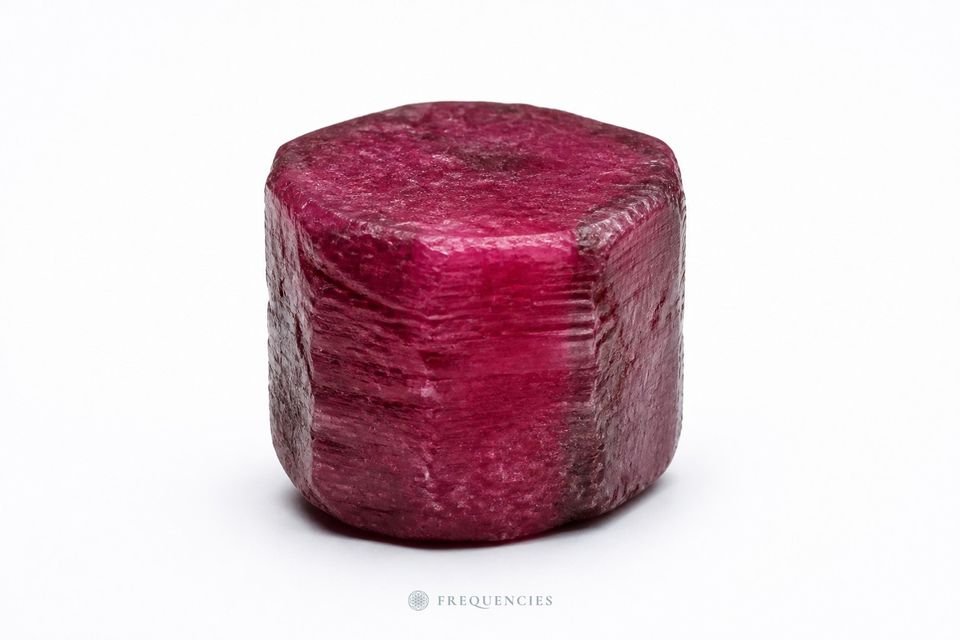
Ruby is a variety of corundum and is harder than garnet: ruby has a Mohs hardness of 9, while garnet is 6.5 to 7.5 [25]. Practical ways to tell them apart are summarised in the FAQ on the garnet page. If you would like to compare the two red stones side by side, the ruby category in our shop includes ruby in fuchsite from India, in which ruby grains are embedded in green fuchsite mica, and raw ruby from Africa.
Frequently Asked Questions
What is a garnet group mineral?
It is any of the silicates in the garnet group with the same crystal lattice but different chemical composition. The best known are almandine, pyrope, spessartine, grossular, andradite and uvarovite, and in the IMA 2013 nomenclature the group contained 14 species.
How many types of garnet are there?
In 2013, the IMA recognised 32 species in the garnet supergroup, 14 of them in the garnet group itself. In the gem trade, GIA considers five species important, while the sixth, uvarovite, usually has crystals too small to cut. Garnets also have many variety names, such as rhodolite, hessonite, tsavorite and demantoid.
Which garnet is green?
Grossular can be green (its green variety is called tsavorite), as can andradite (its green variety is demantoid) and uvarovite, which is always green.
Is garnet magnetic?
It depends on the composition. Pure pyrope and grossular are not attracted to a magnet, but almandine and spessartine react to a strong neodymium magnet. Many garnets are mixtures of species, so the reaction varies from stone to stone.
Which garnet is the rarest?
Britannica calls uvarovite the rarest garnet; its crystals are usually too small to cut. In the gem market, GIA names the green garnets demantoid and tsavorite as rare.
What is rhodolite?
Rhodolite is a purple-red garnet, a mixture of pyrope and almandine. GIA notes that red garnets, including rhodolite, usually have no eye-visible inclusions.
Sources
- E. S. Grew, A. J. Locock, S. J. Mills et al., “Nomenclature of the garnet supergroup”, IMA report, American Mineralogist 98, 2013, pp. 785-811 (University of Alberta copy): www.eas.ualberta.ca/eml/files/Garnet_nomenclature_2013_format…
- Mindat.org, “Garnet Group”: www.mindat.org/min-10272.html
- GIA Gem Encyclopedia, “Garnet”: www.gia.edu/garnet
- GIA, “Garnet Description”: www.gia.edu/garnet-description
- GIA, “Garnet Quality Factors”: www.gia.edu/garnet-quality-factor
- GIA, “Garnet Buyer’s Guide”: www.gia.edu/garnet/buyers-guide
- Mindat.org, “Almandine”: www.mindat.org/min-452.html
- Mindat.org, “Pyrope”: www.mindat.org/min-3321.html
- Mindat.org, “Spessartine”: www.mindat.org/min-3725.html
- Mindat.org, “Grossular”: www.mindat.org/min-1755.html
- Mindat.org, “Andradite”: www.mindat.org/min-223.html
- Mindat.org, “Uvarovite”: www.mindat.org/min-4125.html
- Mindat.org, “Demantoid”: www.mindat.org/min-1258.html
- Mindat.org, “Tsavorite”: www.mindat.org/min-7836.html
- Encyclopaedia Britannica, “Almandine”: www.britannica.com/science/almandine
- Encyclopaedia Britannica, “Pyrope”: www.britannica.com/science/pyrope
- Encyclopaedia Britannica, “Spessartine”: www.britannica.com/science/spessartine
- Encyclopaedia Britannica, “Grossular”: www.britannica.com/science/grossular
- Encyclopaedia Britannica, “Andradite”: www.britannica.com/science/andradite
- Encyclopaedia Britannica, “Uvarovite”: www.britannica.com/science/uvarovite
- Encyclopaedia Britannica, “Garnet”: www.britannica.com/science/garnet
- D. B. Hoover, “Determining Garnet Composition from Magnetic Susceptibility and Other Properties”, Gems & Gemology 47(4), 2011, pp. 272-285 (GIA): www.gia.edu/dam/migrated-assets/gems-and-gemology/pdf/WN11.pdf
- GIA, “Garnet History and Lore”: www.gia.edu/garnet-history-lore
- D. Ozols, “Minerals and Rocks of Latvia”, Latvian Petroglyph Centre, 2008 (on the Nature Conservation Agency website): www.daba.gov.lv/lv/media/1745/download
- FREQUENCIES Stone Encyclopedia: garnet and ruby (hardness, care): frequencies.lv/enciklopedija/granats/