
One and the same mineral, amethyst, can come to you as a raw point, a smooth pocket stone or a cluster of dozens of crystals. The shape decides much more than the look: where the stone will stand, how to clean it and whether it can be left on a sunny windowsill. Once you know how each shape is made, choosing a stone for yourself or as a gift is much easier.
Tumbled Stones: Four Weeks in a Rotating Barrel
Tumbled stones are not polished one at a time. Rough pieces go into a rubber barrel together with abrasive grit and water, the barrel turns, and the stones are ground smooth by the grains that work their way between them. The classic method has four stages of about seven days each: coarse silicon carbide grit, medium grit, fine grit and finally polishing with aluminium oxide. After each stage the stones and the barrel are washed thoroughly, so that coarser grains do not spoil the shine. In vibratory tumblers the whole process takes one to two weeks.
Stones of similar hardness are tumbled together, because softer stones wear away before the harder ones have had time to round off. Tumbled rock crystal, amethyst or tiger’s eye, with a hardness of 7 on the Mohs scale, stands up well to being carried in a pocket or pouch, while softer stones scratch more quickly. Tumbled stones are a good choice for a first stone, a gift pouch and a collection you want to hold in your hand. If you choose a flat tumbled labradorite, look at it straight from above: in the best specimens the flash of colour shows from this angle, because they are cut parallel to the reflecting layers. The selection, from aquamarine to green aventurine, is in the Tumbled Stones section.
Raw Stones: A Shape Grown by Nature
A raw stone keeps everything that tumbling wipes away: natural faces, striations and colour zones. The flat faces are no accident: they reflect the orderly arrangement of atoms inside the mineral, which is why each mineral has its own characteristic shape. Quartz grows as six-sided prisms with horizontal striations, tourmaline forms long columns with deep lengthwise striations and a rounded triangular cross-section, and pyrite forms cubes that look as if they had been sawn in a workshop. Near Navajún in Spain, almost perfect natural cubes like these are found in large numbers.
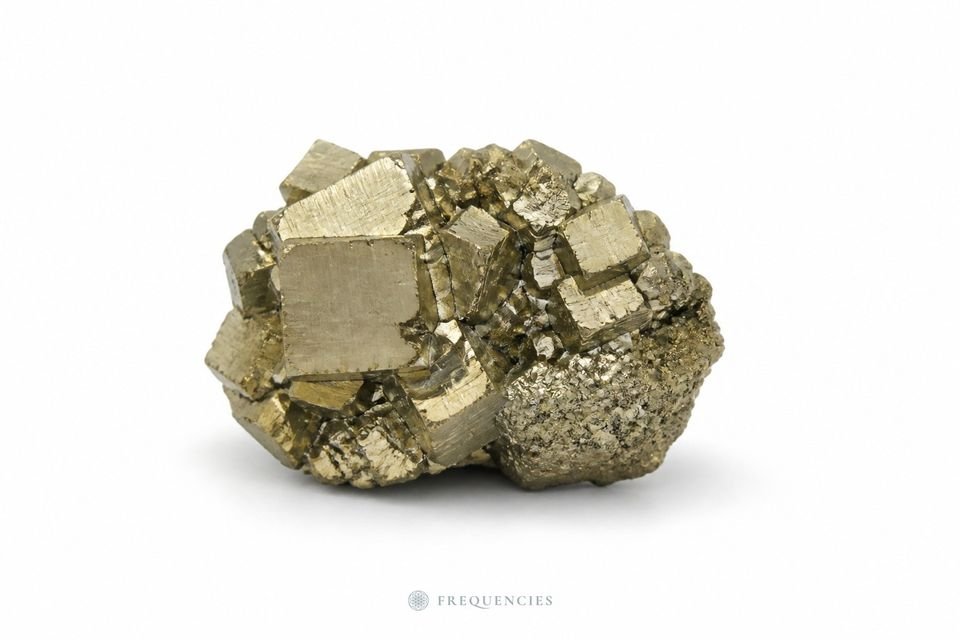
Raw amethyst often shows angular zones of darker and lighter colour, which is one of the signs of a natural crystal. Fluorite cleaves in four directions, so broken pieces tend to form octahedra. Raw stones suit a shelf, a collection and anyone who wants to see a mineral as it grew. Bear in mind that edges can be sharp and points fragile. Keep pyrite dry, because in damp conditions it oxidises and loses its shine, and do not breathe in dust from raw malachite. You will find amethyst points, rainbow fluorite and pyrite in the Raw Stones section.
Points and Wands: Natural or Polished Tips
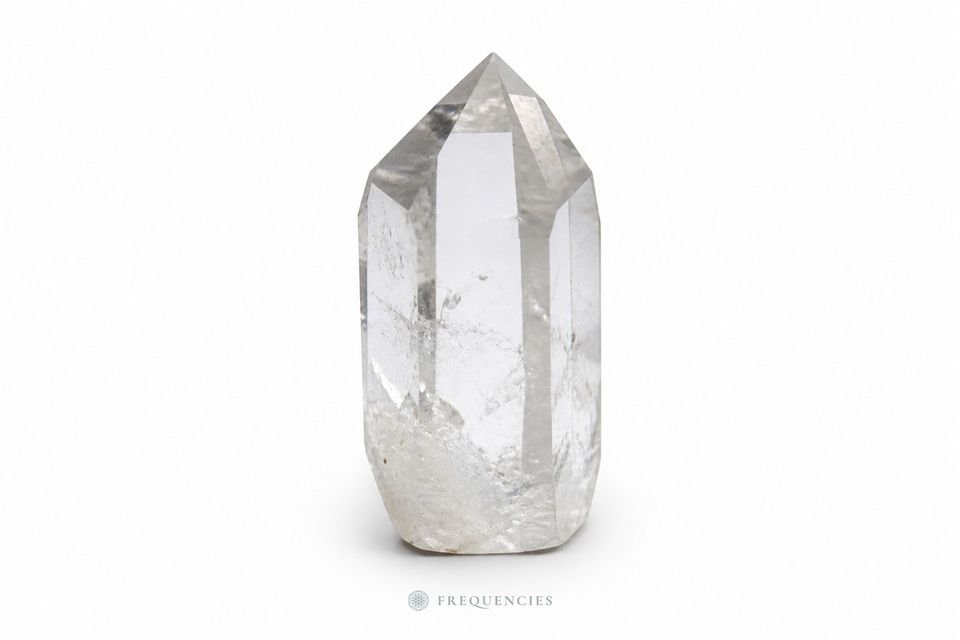
A natural quartz point is a single crystal that has grown upwards from a base. The faces of its tip are often of unequal size, you can feel horizontal ridges along its sides with your finger, and the surface tends to be slightly matt rather than mirror-smooth. If the crystal was not attached to a base at one end, it can form a point at both ends. Our double-terminated amethyst crystals from Brazil are like this.
A polished point is cut from a larger piece: the six side faces are ground, the tip is made symmetrical and the base is cut flat so that the point stands on its own. In the trade such points are also called generators. They look geometrically clean, whereas in a natural point you can trace how the crystal grew, and in Lemurian quartz the ridges you can feel are the main identifying feature. Both kinds suit a desk or a shelf; just protect the tip from falls.
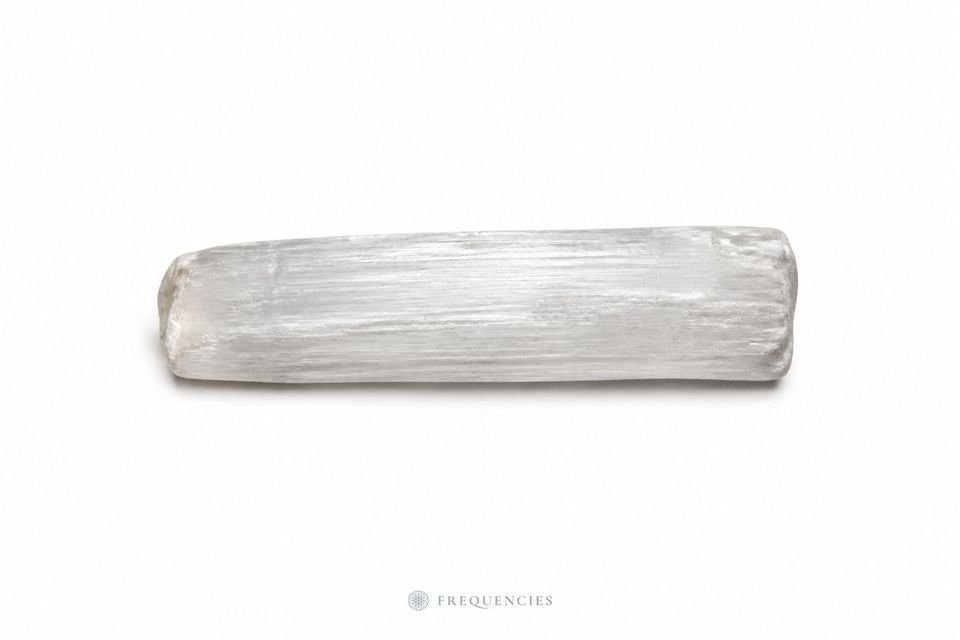
Alongside the points, the shop also has selenite wands from Morocco. These are usually made of satin spar, a fibrous gypsum with a silky lustre and a hardness of 2, so keep the wands dry and clean them only with a dry cloth. Natural and polished points, as well as wands, are gathered in the Points and Wands section.
Clusters and Geodes: Crystals That Grew in a Cavity
A cluster (druse) is a rock surface covered with many small crystals. A geode is a rounded rock with a hollow inside whose walls are lined with crystals. Many geodes started out as gas bubbles in lava: the lava solidified, the cavity remained, and later water seeping through the rock deposited silica in it. The crystals grow from the walls inwards, so their tips point towards the centre of the cavity.
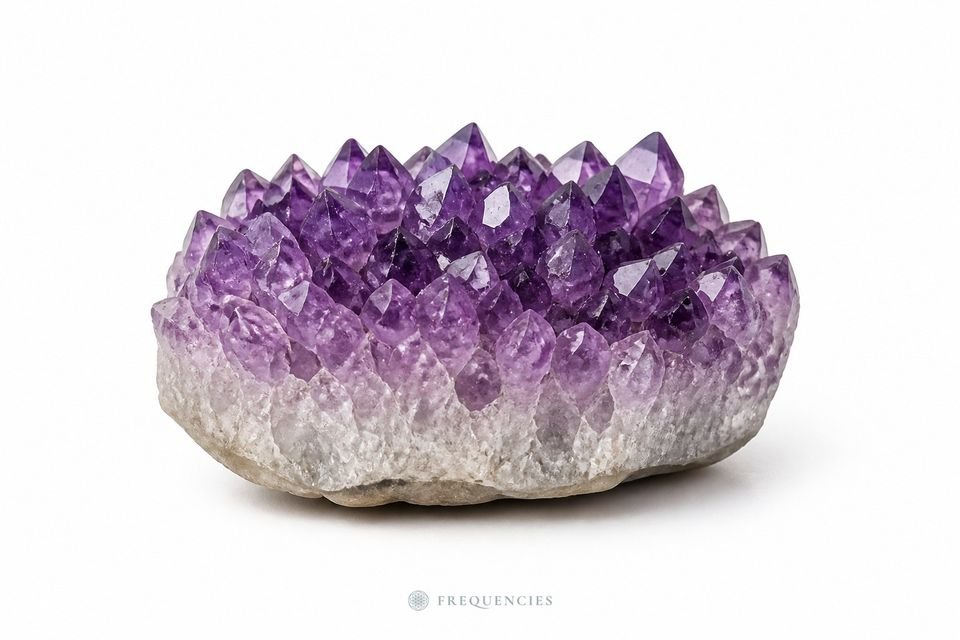
The most famous amethyst geodes come from the state of Rio Grande do Sul in southern Brazil and from neighbouring Uruguay. They occur in basalt lava flows that erupted about 134 million years ago, when the supercontinent Gondwana broke apart. In northern Uruguay amethyst has been mined for more than 150 years, and the largest geodes are more than five metres tall. In 2024, after studying more than 30 mines in northern Uruguay, geologists from the University of Göttingen concluded that the amethyst crystals there grew in a surprisingly cool environment, at 15 to 60 °C, from a solution similar to groundwater.
The amethyst clusters in our shop come from Brazil, and those with a flat base stand steadily on a shelf or in a hallway. Dust clusters with a soft brush. Keep amethyst out of direct sunlight, as its violet colour can fade, while the orange colour of mandarin quartz is often a thin coating of iron oxides, so clean it only dry. You can see the specimens with their sizes and weights in the Clusters and Geodes section.
Spheres: A Lot of Work and One Safety Rule
A sphere takes a lot of material and work. The stone is first sawn into a cube, or close to one, the corners are cut off, and it is then ground in a machine in which rotating concave grinding cups turn the stone and shape it into a ball with ever finer abrasives. Even from a perfect cube, only π/6, or about 52%, of the volume is left in the sphere; the rest turns to dust. In return, a sphere shows the inner pattern of the stone from every side, and on a stand it looks like a design object. Our rock crystal and selenite spheres come with a stand.
Safety note. A clear rock crystal sphere acts as a lens in sunlight. The rays converge just behind the surface of the sphere, exactly where a curtain, paper or a wooden windowsill may be. In January 2024 firefighters in Essex, England, were called to a bathroom fire: a decorative glass ball was being used as a doorstop, and the sunlight it focused set a pile of towels alight. The fire service’s advice: do not keep mirrors or glass and crystal objects in direct sunlight on windowsills and dressing tables, especially in winter, when the sun is low.
Rose quartz spheres can turn paler in prolonged sunlight, and a selenite sphere is gypsum, which dissolves in water, so clean it only dry. Spheres of rock crystal, lapis lazuli, black tourmaline, rose quartz and selenite are in the Spheres section.
Did you know? The Smithsonian Institution’s National Museum of Natural History in Washington holds a rock crystal ball that the museum calls the largest flawless quartz sphere in the world. It is 32.7 cm in diameter, weighs 48.5 kg and was ground in Shanghai in 1923 and 1924 from quartz that was possibly mined in Burma, now Myanmar.
Hearts and Pyramids: Shapes with an Ancient History
These shapes are cut from a larger stone and polished, so the material can be chosen for its colour and pattern. The heart is a symbol of love and a favourite gift: a flat heart sits comfortably in the palm, while a standing selenite heart suits a shelf. In a phantom amethyst heart you can make out the outlines of earlier crystal faces. As the Gemological Institute of America (GIA) explains, a phantom forms when an earlier face is covered by a thin layer of another mineral and the quartz then carries on growing. You will find hearts for gifts in the Heart Shapes section.
The stepped shungite pyramid is made in the Saqqara style, which resembles the pyramid of the pharaoh Djoser, the oldest Egyptian pyramid still standing, with six steps and a height of about 60 metres. Shungite can leave dark marks, so keep it away from light-coloured fabrics. The Mexican obsidian pyramid is made of volcanic glass with a hardness of 5 to 5.5, so protect it from knocks. Both, as well as the selenite pyramid, are in the Pyramids section.
Obelisks: From Egypt to Your Shelf
Like the pyramid, the obelisk comes from Egypt. Ancient obelisks were cut from a single block of stone, usually red granite from the quarries at Aswan, and the word itself means “spit” in Greek. The Unfinished Obelisk still lies at Aswan: completed, it would have been about 42 metres tall and weighed about 1,200 tonnes, but work stopped when cracks appeared in the stone.
Britannica describes an obelisk as a tall, tapering monolithic pillar. In ancient Egypt obelisks were set up in pairs at temple entrances. Hieroglyphs were carved on the four sides, usually religious dedications to the sun god and inscriptions in honour of rulers, and the pyramid-shaped tip (pyramidion) was often covered with an alloy of gold and silver called electrum. The oldest surviving obelisk dates from the reign of the pharaoh Senusret I (Sesostris I), which lasted from 1918 to 1875 BC. It still stands at Heliopolis, now a suburb of Cairo, where the temple of the sun god Ra once stood. The base of Queen Hatshepsut’s 30-metre obelisk at Karnak records that quarrying it took seven months.
In the time of the Roman emperors many obelisks were taken to Italy, and at least a dozen to Rome itself. The largest surviving ancient obelisk now stands in the Piazza San Giovanni in Laterano: it is 32 metres tall, weighs about 230 tonnes and was originally erected at Karnak by Thutmose III. In the 19th century Egyptian obelisks also reached Paris, London and New York. One of the obelisks of the Luxor Temple was taken from Egypt in 1831 and now stands in the Place de la Concorde in Paris. The two so-called Cleopatra’s Needles have no historical connection with Queen Cleopatra: they were erected at Heliopolis by Thutmose III, and today one stands on the Thames Embankment in London and the other in Central Park in New York. One of the best-known modern obelisks is the 169-metre Washington Monument, completed in 1884.
The obelisks in our shop are 7 to 15 cm tall and suit a bookshelf or a desk, and you can see them all in the Obelisks section. At present they come in selenite, amazonite, tiger’s eye, sunstone, pyrite and rock crystal. Turn a tiger’s eye obelisk in the light: the golden band moves, and it is strongest in a stone cut parallel to the fibres. Protect the point, as it is the first part to suffer if the obelisk falls.
Octahedra: A Shape Fluorite Makes by Itself
An octahedron is a polyhedron with eight faces. The faces of a regular octahedron are eight identical equilateral triangles. It has six vertices and 12 edges and is one of the five Platonic solids. You can picture it as two identical square-based pyramids joined base to base.
In the mineral world the octahedron is a characteristic form of fluorite. In nature fluorite grows both as cubes and as octahedra, and the octahedral shape is also hidden in its cleavage. Fluorite is the only common mineral with perfect cleavage in four directions, and these planes are parallel to the faces of an octahedron. Mindat writes that fluorite cleaves perfectly and easily along these planes. That is why broken pieces are often octahedral, and sometimes an almost perfect octahedron can be cleaved from a crystal. Exceptionally clear pieces of fluorite are also used for microscope, telescope and camera lenses.
Fluorite has a hardness of 4 on the Mohs scale, so a steel knife will scratch it. The same cleavage that produces octahedra makes the stone sensitive to knocks, and on larger crystals the edges are often chipped along exactly these planes. Keep fluorite in a separate pouch. The care table in our encyclopedia also recommends protecting it from water and direct sunlight. Other minerals form octahedra in nature too, for example pyrite, whose crystals can be cubes, octahedra or pyritohedra. If you would like an octahedron as a geometric shape, the shop also has a set of stones with all five Platonic solids, including the octahedron. You will find fluorite in the Fluorite section.
Chips: The Smallest Pieces for Bowls and Arrangements
Chips are small raw or tumbled pieces, in our shop from 0.1 to 2.5 cm. They are poured into glass jars and small bowls, used as a base for other stones and in craft projects. In the shop, the pink opal chips come in a small glass bottle. Hard chips, such as rock crystal and rose quartz, can be rinsed in a fine sieve and left to dry completely, but orange calcite chips should be cleaned only with a dry brush. Keep chips and small tumbled stones out of reach of children under 3, as they can be swallowed. Choose by colour in the Chips section.
Soft Stones and Care by Shape
On the Mohs scale a harder mineral scratches a softer one, and a fingernail has a hardness of about 2 to 2.5. Selenite (gypsum, hardness 2) can be scratched even with a fingernail. It slowly dissolves in water, at about 2 g per litre, and can turn matt after washing, so clean it only with a dry cloth. Calcite (hardness 3) is sensitive to acids and has perfect cleavage in three directions, so its corners chip easily if it is dropped. Malachite (3.5 to 4) is a copper carbonate, sensitive to acids and heat, and it should not be soaked in water either. Selenite comes in almost every shape in the shop, from wands and spheres to hearts and pyramids, but its care stays the same. Keep soft stones in a separate pouch, because quartz-group stones with a hardness of 7 will scratch them.
| Shape | Best for | Care |
|---|---|---|
| Tumbled stones | pocket, gift pouch, first stone | hard ones may be rinsed briefly |
| Raw stones | shelf, collection | soft brush; keep pyrite dry |
| Points and wands | desk, shelf | protect the tip; clean selenite dry |
| Clusters and geodes | shelf, hallway | dust with a brush; keep amethyst in the shade |
| Spheres | on a stand, on a shelf or desk | keep clear ones out of direct sunlight |
| Hearts | gift, palm of the hand | soft, dry cloth |
| Pyramids and obelisks | desk, bookshelf | protect the tip and corners |
| Chips | bowls, arrangements | rinse hard ones in a sieve, clean soft ones dry |
The care rules for each stone are summarised in the encyclopedia’s care table. For orders from €30, delivery to parcel lockers in the Baltic States is free.
Frequently Asked Questions
How is a tumbled crystal different from a raw one?
A tumbled stone is rounded for several weeks in a rotating barrel with abrasive grit, so it is smooth and stands up well to being carried in a pocket. A raw stone keeps its natural faces and striations, but its edges can be sharp and its points fragile.
Can a rock crystal sphere be kept on a sunny windowsill?
Better not. A clear sphere gathers the sun’s rays like a lens, and they converge just behind its surface. A nearby curtain, paper or wooden windowsill can catch fire, especially in winter, when the sun is low.
How can you tell a natural crystal point from a polished one?
On a natural point the faces of the tip are often of different sizes, you can feel horizontal ridges on the sides, and the surface tends to be slightly matt. On a polished point the faces are symmetrical and mirror-smooth, and the base is usually cut straight.
What is the difference between a cluster and a geode?
A cluster is a rock surface covered with many small crystals. A geode is a rounded rock with a hollow lined with crystals inside. The most famous are the amethyst geodes from Brazil and Uruguay.
What is an octahedron?
An octahedron is a polyhedron with eight faces. In the mineral world it is typical of fluorite, which cleaves in four directions parallel to the faces of an octahedron, so broken pieces are often octahedral.
Which crystals should not be washed with water?
Do not soak selenite, calcite, malachite, pyrite, fluorite, angelite or lapis lazuli in water. Clean them with a dry cloth or a soft brush; you will find the full list in the encyclopedia’s care table.
Which crystal shape makes the best gift?
For someone whose taste you are still getting to know, the safest choice is a tumbled stone or a heart, as they are durable and pleasant to hold. A collector is more likely to appreciate a raw crystal, a point or a cluster that shows how the mineral grew.
Sources
- FREQUENCIES stone encyclopedia (FREQUENCIES stone encyclopedia: labradorite, pyrite, fluorite, amethyst, Lemurian quartz, mandarin quartz, rock crystal, rose quartz, tiger’s eye, shungite, obsidian, selenite, calcite, malachite, angelite, lapis lazuli)
- rocktumbler.com/tips/rock-tumbler-instructions/
- rocktumbler.com/tips/how-long-does-rock-tumbling-take/
- www2.tulane.edu/~sanelson/eens211/introsymmetry.htm
- minerals.net/mineral/quartz.aspx
- minerals.net/mineral/tourmaline.aspx
- minerals.net/mineral/pyrite.aspx
- shop.australian.museum/products/pink-amethyst-generator-2
- geology.com/articles/geodes/
- uni-goettingen.de/en/3240.html
- eurekalert.org/news-releases/1060037
- hplapidary.com/blogs/lapidary-blog/how-to-make-a-stone-sphere-a-step-by…
- patents.google.com/patent/US20030194951A1/en
- edmundoptics.com/knowledge-center/application-notes/optics/understanding-…
- gia.edu/gems-gemology/fall-2016-gemnews-large-aqueous-primary-fl…
- science.smith.edu/geosciences/petrology/petrography/quartz/quartz.html
- essex-fire.gov.uk/incidents/sunlight-reflecting-crystal-ball-causes-fire-2…
- siarchives.si.edu/collections/siris_sic_6900
- penn.museum/blog/sphere-and-now
- penntoday.upenn.edu/news/back-story-penn-museums-crystal-ball
- gia.edu/articles/winter-2020-gemnews-phantom-quartz-imitation
- thedailystar.net/backpage/news/egypt-reopens-its-oldest-pyramid-after-14-…
- smithsonianmag.com/smart-news/egypts-oldest-pyramid-reopens-public-after-14…
- worldhistory.org/Egyptian_Obelisk/
- britannica.com/technology/obelisk
- egymonuments.gov.eg/en/monuments/the-unfinished-obelisk/
- geology.com/minerals/mohs-hardness-scale.shtml
- geology.com/minerals/calcite.shtml
- frequencies.lv/products/ametista-kristali-ar-divam-smailem-4-6-cm/
- frequencies.lv/products/ametista-druza-ar-plakanu-pamatni-7×7-cm-353g/
- frequencies.lv/products/kalnu-kristala-sfera-4-cm/
- frequencies.lv/products/selenita-sfera-8-cm-600g/
- frequencies.lv/products/sungita-piramida-5×5-cm/
- frequencies.lv/products/obsidiana-piramida-4×4-cm/
- frequencies.lv/products/selenita-stieni-8-10cm-3/
- frequencies.lv/products/smalkas-kalnu-kristala-skembas-01-03-cm-550g/
- frequencies.lv/products/oranza-kalcita-skembas-05-15-cm/
- frequencies.lv/products/fantoma-ametista-sirds-formas-pulets-akmens-30-…
- geology.com/minerals/fluorite.shtml
- minerals.net/mineral/fluorite.aspx
- mindat.org/min-1576.html
- mathworld.wolfram.com/RegularOctahedron.html
- frequencies.lv/products/cakru-kristalu-komplekts-7-sakralas-geometrija…