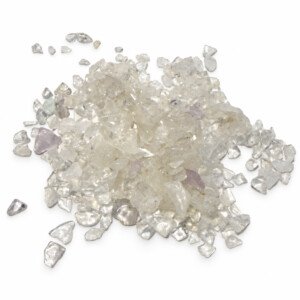
Clear Quartz
Quartz variety

Clear Quartz

Clear quartz is a stone traditionally associated with clarity, amplification and order.

Hardness 7 May be rinsed in water Sunlight is not harmful Fire
In brief

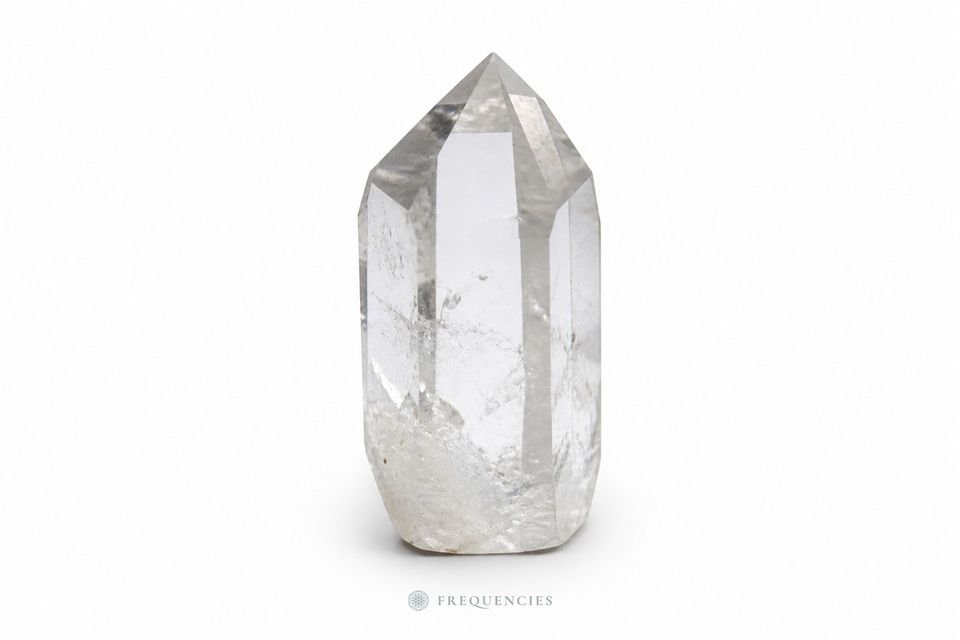
Clear Quartz is colourless, transparent quartz (SiO2) with a hardness of 7 on the Mohs scale, which is why it is suitable for jewellery. In English it is called both clear quartz and rock crystal. It is found in Brazil, Madagascar and Switzerland. In the crystal community, it is seen as a symbol of clarity and a universal stone that can be placed together with other crystals.

Clear Quartz in our shop

Exhibit label

Name
Clear Quartz · Clear Quartz / Rock Crystal
Type
Mineral
Mineral group
Quartz group (SiO2)
Hardness
7 on the Mohs scale
Colour
Clear to slightly milky
Main locality
Brazil
Localities
Brazil, Madagascar, Switzerland, USA
Planet
Sun (tradition)

Mohs hardness scale

7out of 10

A hard stone: it scratches glass and is durable in everyday wear. Even so, protect it from knocks.

Care

Water

May be rinsed in water

A brief rinse in lukewarm water, then wipe dry.

Sun

Sunlight is not harmful

May be kept in a bright place.

Storage

Durable in everyday wear

Avoid: prolonged heat, harsh cleaning agents, strong knocks.

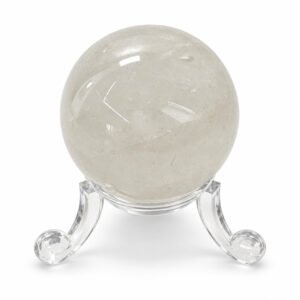
Note. Clear quartz spheres and other transparent round crystals can gather the sun's rays like a lens and set nearby objects alight, so do not place them on a sunny windowsill or near curtains.

In the crystal community, the following are used for cleansing: a brief rinse under running water, the presence of selenite, sound vibrations, moonlight.

From geology to your shelf

  • How it forms. Clear quartz is the colourless, transparent variety of quartz (silicon dioxide). Most quartz crystallises from magma, but well-formed crystals usually grow from hot hydrothermal solutions in veins and cavities, where they line the walls like a druse. Large crystals also form in pegmatites.
  • History. The ancient Greeks called it krystallos, a word associated with ice. Pliny the Elder believed that rock crystal was ice frozen for ever. Luxury vessels were carved from rock crystal, for example the Fatimid ewer made around the year 1000, which is kept in the Louvre.
  • How to recognise a genuine stone.
    • Round air bubbles and a completely uniform interior point to glass; in natural quartz, inclusions are irregular.
    • Hardness 7: quartz scratches ordinary glass, whereas glass does not scratch quartz.
    • Quartz stays cool in the hand for longer, whereas glass warms up faster.
  • Treatment and imitations. The most common imitations are glass and a material pressed from quartz powder and resin. Laboratory-grown quartz cannot be told apart by home tests, and "aura" quartz is natural quartz coated with a thin layer of vaporised metal.
  • How to choose. Look for clarity, a bright vitreous lustre and undamaged points. Inclusions point to a natural origin, whereas a completely flawless and very cheap piece may be glass.
  • Traditional meaning

    This is crystal tradition and symbolism, not a scientific or medical claim. The chakras, signs and elements match our product pages.

    Chakras

    Crown Chakra

    Clear quartz is traditionally associated with Crown Chakra energy and order.

    Zodiac signs

    ♌︎Leo♑︎Capricorn

    In traditional crystal astrology, clear quartz is often associated with people who value order and inner balance.

    Element

    Fire

    The Fire element is traditionally said to give this stone order and a balanced character.

  • Main symbolism: clarity and amplification
  • Traditionally associated with clarity, amplification and mindful inner work
  • Traditionally associated with order and inner peace
  • In the crystal community, clear quartz is traditionally regarded as a universal stone that can be placed together with other crystals. Many people put it on a desk, in a meditation space or at the centre of a crystal grid, and also use it for charging other stones.
  • The traditional meaning of crystals has not been medically proven and does not replace the advice of a professional.

    Stories and legends

    The ancient Greeks and Romans regarded rock crystal as eternal ice.

    The ancient Greek word "krystallos" meant both ice and rock crystal, and the word "crystal" comes from it. The Roman naturalist Pliny the Elder believed that rock crystal was ice frozen for all time, because it was found near Alpine glaciers. Only later was it established that it is the mineral quartz.

    The world's largest flawless quartz sphere is kept at the Smithsonian Institution.

    The sphere weighs about 48.5 kg and has a diameter of roughly 33 cm. It was polished in China in 1923 to 1924 from quartz that was most likely mined in Burma. The sphere can be seen in the gems and minerals hall of the Smithsonian National Museum of Natural History in Washington.

    The famous crystal skulls turned out to be much younger than claimed.

    The crystal skulls of the British Museum and the Smithsonian Institution were long passed off as Aztec artefacts. A 2008 study under the electron microscope revealed traces of rotary tools of a kind not used in the Americas before the arrival of Europeans. The British Museum skull was most likely made in the 19th century, and the Smithsonian specimen later still, in the 20th century.

    A quartz crystal is found in almost every quartz watch.

    In 1880 the brothers Jacques and Pierre Curie discovered that compressed quartz generates an electric charge; this phenomenon is called the piezoelectric effect. The first quartz clock was made in 1927 at Bell Laboratories in the USA. In modern watches a tiny quartz crystal oscillates 32,768 times a second, and time is measured by these oscillations.
    Interesting facts

    • The ancient Greeks used the word "krystallos" for both ice and clear quartz; Pliny the Elder believed that rock crystal was ice frozen so hard that it no longer melts.
    • The word "crystal" also comes from this Greek word.
    • Quartz crystals oscillate at a very precise frequency, which is why quartz resonators are used in watches and electronics.

    How to use it

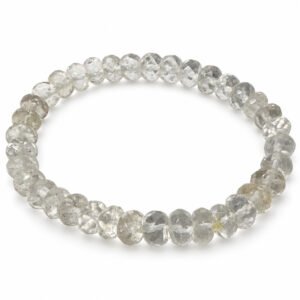
    • Wear it every day as jewellery traditionally associated with clarity and amplification

    Pairs well with

    Frequently asked questions

    Is clear quartz quartz?

    Yes, clear quartz is colourless, transparent quartz with the chemical composition SiO2. It is known by both names, clear quartz and rock crystal, and both refer to one and the same stone. Its hardness is 7 on the Mohs scale, so it is suitable for jewellery.

    What does clear quartz symbolise?

    In the crystal community, clear quartz is regarded as a symbol of clarity and a universal stone that can be placed together with other crystals. Traditionally it corresponds to the Crown Chakra, the Fire element, and the signs of Leo and Capricorn.

    How can real clear quartz be recognised?

    Quartz scratches ordinary glass, whereas glass does not scratch quartz. In natural quartz, inclusions are irregular, whereas round air bubbles and a completely uniform interior point to glass. Quartz stays cool in the hand for longer. A piece that is too flawless and very cheap may be glass.

    Can clear quartz be washed in water?

    Yes, clear quartz can be washed in warm soapy water and rinsed under running water. Avoid steam cleaners and sudden temperature changes: for example, do not rinse a cold stone in hot water.

    May clear quartz be kept in the sun?

    Yes, clear quartz does not usually change colour in the sun. Take care only with spheres and other round shapes: they act like a magnifying glass, gather the sun's rays at a single point and can set nearby objects alight, so do not place them on a sunny windowsill or near curtains.

    Why is clear quartz called a crystal?

    The word "crystal" comes from the Greek krystallos, which was used for both ice and clear quartz. The Roman naturalist Pliny the Elder believed that rock crystal was ice frozen for ever, because it was found near Alpine glaciers.

    Where is clear quartz mined?

    Clear quartz is mined in many places around the world, chiefly in Brazil and Madagascar, as well as in Switzerland and the USA. Well-formed crystals usually grow from hot hydrothermal solutions in fissures and cavities, where they form druses.

    Clear Quartz in our shop: more

    Sources. Mineralogical data: GIA Gem Encyclopedia, Mindat, Encyclopaedia Britannica (frequencies.lv crystal database v2).
    Further information: en.wikipedia.org, geology.com, minerals.net, rockhounding.org.
    Shopping Basket
    Scroll to Top