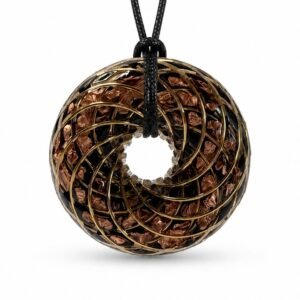
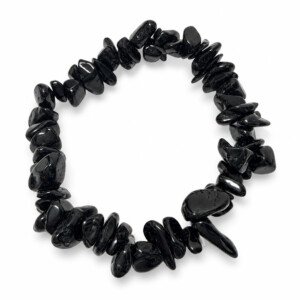
Black Tourmaline

Black Tourmaline

Black tourmaline is a stone traditionally associated with strong grounding, protection and a sense of security.

Hardness 7-7.5 May be rinsed in water Sunlight is not harmful Earth
In brief

Black tourmaline, or schorl, is an iron-bearing borosilicate of the tourmaline group and the most common tourmaline species: it probably makes up 95% or more of all tourmaline found in nature. It has a hardness of 7 to 7.5 on the Mohs scale. In the crystal community, black tourmaline is regarded as a symbol of grounding, protection and a sense of security.

Black Tourmaline in our shop

Exhibit label

Name
Black Tourmaline · Black Tourmaline / Schorl
Type
Mineral
Mineral group
Schorl, tourmaline group (borosilicate), NaFe3Al6(Si6O18)(BO3)3(OH)3(OH)
Hardness
7-7.5 on the Mohs scale
Colour
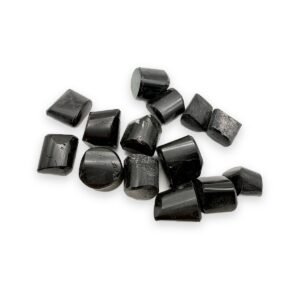
Matt black to deep black with a striated structure
Main locality
Brazil
Localities
Brazil, Pakistan, Africa, Afghanistan
Planet
Saturn (tradition)

Mohs hardness scale

7-7.5out of 10

A hard stone: it scratches glass and is durable in everyday wear. Even so, protect it from knocks.

Care

Water

May be rinsed in water

A brief rinse in lukewarm water, then wipe dry.

Sun

Sunlight is not harmful

May be kept in a bright place.

Storage

Durable in everyday wear

Avoid: prolonged heat, harsh cleaning agents, strong knocks.

Note. Black tourmaline is brittle, so protect it from knocks. It is better not to keep it in water for long.

In the crystal community, the following are used for cleansing: sage or palo santo smoke, the presence of selenite, sound vibrations, moonlight.

From geology to your shelf

  • How it forms. Black tourmaline, or schorl, is a sodium-iron tourmaline, and it makes up 95% or more of all the tourmaline found in nature. It usually forms in granite and granite pegmatites, but large, well-formed crystals grow in fissures and cavities during hydrothermal activity.
  • Where the colour comes from. The black colour is determined by the high iron content in the composition of the mineral itself, not by impurities. The same iron gives schorl a high magnetic susceptibility.
  • History. The name "schorl" (German Schörl) comes from the village of Schorla in Saxony (now Zschorlau), and it was in use before 1400. Dutch traders brought tourmaline from Ceylon and called it the "Ceylon magnet", because heated tourmaline attracts and repels ash.
  • How to recognise a genuine stone.
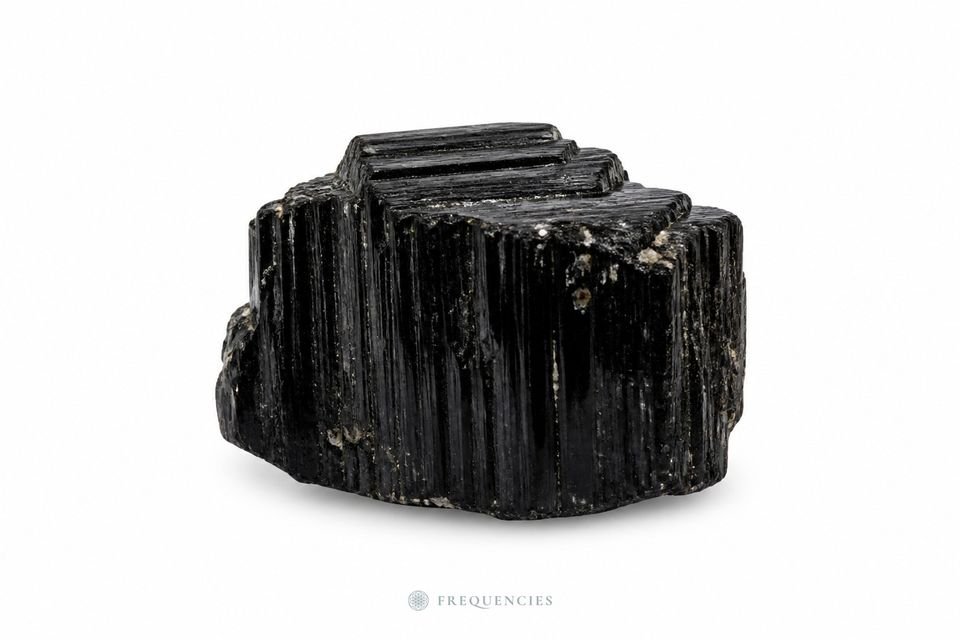
    • Long prismatic crystals with lengthwise striations and a triangular, rounded cross-section; other common minerals do not have a triangular prism.
    • Hardness 7 to 7.5, no pronounced cleavage, white streak.
    • Because of its high iron content, a strong neodymium magnet can attract it weakly.
  • How to choose. Look for whole, shiny crystals with clear striations and undamaged terminations. Because tourmaline is brittle, check that there are no cracks or cross fractures.
  • Traditional meaning

    This is crystal tradition and symbolism, not a scientific or medical claim. The chakras, signs and elements match our product pages.

    Chakras

    Root Chakra

    Black tourmaline is traditionally associated with the root chakra and a sense of security.

    Zodiac signs

    ♑︎Capricorn♏︎Scorpio♎︎Libra

    In traditional crystal astrology, black tourmaline is often associated with people who value a sense of security and inner balance.

    Element

    Earth

    The Earth element is traditionally said to give this stone a symbolism of security and a balanced character.

  • Main symbolism: strong grounding and protection
  • Traditionally associated with strong grounding, protection and more conscious inner work
  • Traditionally associated with a sense of security and inner peace
  • In the crystal community, black tourmaline is traditionally associated with stability and safety, which is why many people place it by the front door of the home or in the corners of a room. It is also used at the start of meditation as a symbol of rootedness.
  • The traditional meaning of crystals has not been medically proven and does not replace the advice of a professional.

    Stories and legends

    The name "schorl" for black tourmaline comes from a village in Saxony.

    The name "schorl" was in use before 1400, when the present-day village of Zschorlau in Saxony was called Schorla, and black tourmaline was also found in the nearby tin mines. The first description was given in 1562 by the German pastor Johannes Mathesius. The word "tourmaline", in turn, comes from the Sinhalese language of Sri Lanka.

    Tourmaline was called the "Ceylon magnet".

    The Dutch East India Company brought tourmalines from Ceylon to Europe in large quantities. It was noticed that warmed tourmaline attracts and then repels hot ash, so it was nicknamed the "Ceylon magnet". This property is called pyroelectricity: when the temperature changes, an electric charge arises at the ends of the crystal.

    Schorl is the commonest tourmaline on Earth.

    Black tourmaline, or schorl, probably makes up 95% or more of all the tourmaline found in nature. Its crystals are long, with a triangular cross-section and pronounced lengthwise grooves. The coloured tourmalines known as gemstones are much rarer.
    Interesting facts

    • Schorl, or black tourmaline, is the commonest variety of tourmaline.
    • The name "schorl" was in use before 1400; it is linked to a village in Saxony that was then called Schorla (now Zschorlau) and near which a great deal of black tourmaline was found in tin mines.
    • Tourmaline is pyroelectric and piezoelectric: when it is heated or compressed, an electric charge arises on its surface; in black tourmaline this property is weaker than in the coloured kinds.

    How to use it

    • Wear it every day as a piece of jewellery traditionally associated with strong grounding and protection

    Pairs well with

    Frequently asked questions

    What is schorl?

    Schorl is black, iron-bearing tourmaline and the commonest species in the tourmaline group: it probably makes up 95% or more of all the tourmaline found in nature. The name comes from the Saxon village of Schorla, today's Zschorlau.

    What does black tourmaline symbolise?

    In the crystal community, black tourmaline is associated with grounding, stability and a sense of safety, which is why many people place it by the front door of the home or in the corners of a room. Traditionally it corresponds to the root chakra, the element of earth and the signs of Capricorn, Scorpio and Libra.

    How can you recognise black tourmaline?

    Black tourmaline has long crystals with a triangular, rounded cross-section and pronounced lengthwise grooves. It is hard and opaque, with a vitreous lustre and a white streak. Other common black minerals do not have such a triangular prism.

    Is black tourmaline magnetic?

    Slightly. Because of its high iron content, a strong neodymium magnet can attract black tourmaline weakly. Tourmaline is also pyroelectric: when heated it acquires an electric charge, and Dutch traders once called it the Ceylon magnet because it attracted ash.

    Can black tourmaline be washed in water?

    Yes, GIA recommends cleaning tourmaline in warm soapy water, but avoiding ultrasonic and steam cleaners and sudden temperature changes. For untreated crystals, a brief rinse and immediate drying are enough.

    Does black tourmaline fade in the sun?

    No, GIA notes that tourmaline is generally stable in light. Avoid only strong heat and sudden temperature changes, which can cause cracks.

    Is black tourmaline suitable for jewellery?

    Yes. With a hardness of 7 to 7.5 on the Mohs scale it is hard enough for pendants and bracelets, but it is brittle, and untreated crystals can break. Before buying, check that the stone has no cracks or cross fractures.

    Where is black tourmaline mined?

    Black tourmaline is mined in many countries, including Brazil, Pakistan, Afghanistan and several African countries. It forms in granite and granite pegmatites, but large crystals grow in fissures and cavities during hydrothermal activity.

    Black Tourmaline in our shop: more

    Read more

    Black Tourmaline: Properties, Meaning, and How to Use It in Daily Life

    Sources. Mineralogical data: GIA Gem Encyclopedia, Mindat, Encyclopaedia Britannica (frequencies.lv crystal database v2).
    Further information: en.wikipedia.org, en.wikipedia.org, geology.com, gia.edu.
    Shopping Basket
    Scroll to Top