
The number on a tuning fork shows how many times per second its prongs vibrate. 128 Hz is C, and doctors use a fork of this kind to test vibration sense; 432 Hz is A in a tuning 8 Hz lower than the standard 440 Hz, while 528 Hz comes from the “solfeggio” series of the second half of the 20th century, whose claims about effects are unproven.
What is a tuning fork and how does it sound?
The Latvian dictionary Tēzaurs describes a tuning fork as an instrument made of two metal rods joined at one end, whose free ends produce a sound of constant pitch when they vibrate1. In our shop it is also called a sound fork (skaņu dakša in Latvian).
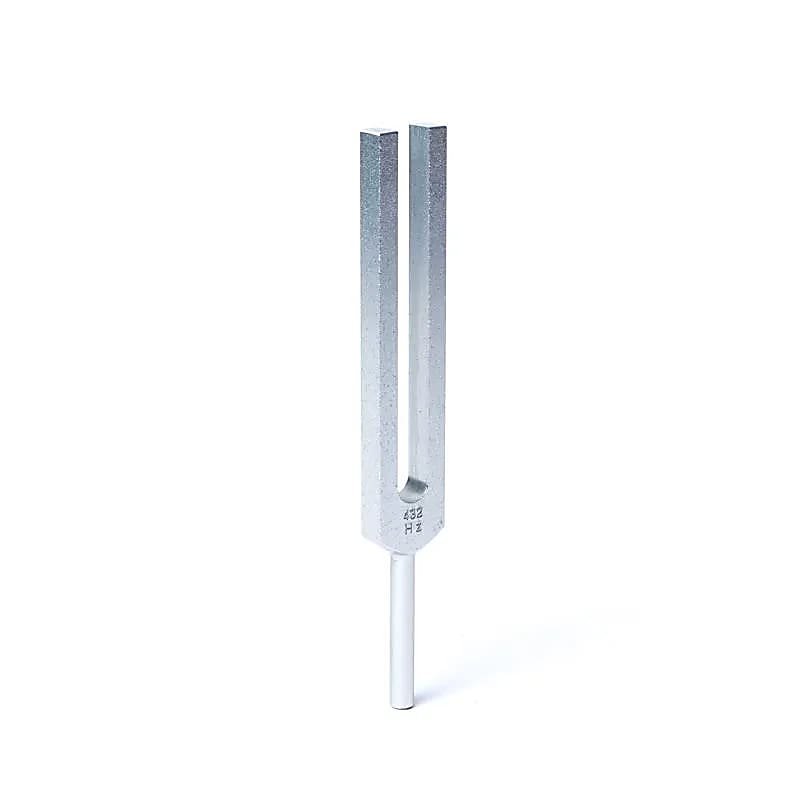
The tuning fork was invented in 1711 by John Shore, principal trumpeter at the English royal court, for whom George Frideric Handel wrote many trumpet parts2,3. When Shore split his lip during a performance, he took up the lute and tuned it with his fork. The acoustician Daniel A. Russell recounts Shore’s joke: he had no pitch-pipe with him, but he did have a “pitch-fork”2.
When a tuning fork is struck, both prongs vibrate at the same frequency but in opposite directions4. One hertz (Hz) is one vibration per second5, so the prongs of a 432 Hz tuning fork make 432 vibrations per second. If the material and the cross-section of the prongs are the same, the frequency is inversely proportional to the square of the prong length2: prongs twice as long sound two octaves lower.
A tuning fork struck lightly gives an almost pure tone. Russell measured a 432 Hz fork: after a light strike the spectrum showed only one narrow peak at 432 Hz, but after a harder strike the so-called “clang” tone also appeared, at 2605 Hz, a little more than six times higher2. This overtone dies away quickly, leaving a pure sine wave4.
Did you know? At the 1876 Philadelphia Centennial Exhibition, Rudolph Koenig showed a tonometer with 692 tuning forks from 16 to 4096 Hz, which matched the range of a piano. It is now kept at the Smithsonian National Museum of American History2. If you have a quartz clock or watch, it most likely contains an even smaller tuning fork: a tiny quartz resonator in the shape of a tuning fork vibrates at 32,768 Hz and serves as the time reference6. Why this particular number, and how quartz converts vibrations into an electrical signal, is explained in the article about crystals in technology.
Why do doctors use 128 Hz tuning forks?
The number 128 comes from a tuning in which C is 256 Hz. In 1713, Joseph Sauveur proposed a pitch standard now known as the “philosophical” or “scientific” tuning: C is 256 Hz, so every C has a whole-number frequency7. The frequency doubles with each octave, giving the series 128, 256, 512, 1024. In this series 128 Hz is the C of the small octave (C3). In standard tuning that C is 130.81 Hz, so a 128 Hz tuning fork sounds slightly lower than the C on a piano.
Manufacturers of medical tuning forks still use this series. The catalogue of the German manufacturer Riester includes tuning forks C 128, C 256, C 512 and so on up to 4096 Hz, and alongside them A 440 as well8. A study published in the Journal of Clinical Neuromuscular Disease in 2014 states that the 128 Hz tuning fork is the tool most often used in clinics to test vibration sense9.
In the Diabetes Canada guidance, the doctor strikes a 128 Hz tuning fork and places it on the bony prominence on top of the big toe while the patient’s eyes are closed, then asks whether the patient feels the vibration and when it stops. The guidance stresses that the test can rule out neuropathy but does not show how great the risk is that it will develop in the future10. This is a doctor’s examination, not a home method. In hearing tests, including the Rinne and Weber tests, 256 and 512 Hz tuning forks are often used2.
Why do orchestras tune to 440 Hz?
Before there was a standard, A sounded different in every place. In 1834, the silk manufacturer Johann Scheibler made a tonometer of 56 tuning forks covering the octave from 220 to 440 Hz in steps of 4 Hz2. He also established that the average A of Viennese concert pianos was 440 Hz, and in the same year German scientists endorsed this pitch3.
In 1859, Paris set A at 435 Hz, known as the diapason normal, and in 1885 the Vienna Congress endorsed it as a common European tuning11,7. The present 440 Hz tuning was adopted at the 1939 London conference11. The international standard ISO 16:1975 states that A is 440 Hz and that instruments used for tuning must reproduce it to within 0.5 Hz12.
Where does 432 Hz come from?
432 Hz is an A that is 8 Hz lower than the standard. The difference is about 32 cents, or a third of a semitone. What this means if you play together with other instruments is explained in the article about singing bowls.
Ellen Lockhart, a music historian at the University of Toronto, writes in a 2025 article on tuning in Italy that 432 Hz as the “Pythagorean diapason” was first proposed by Charles Meerens, because all the frequencies of the keyboard could then be expressed as whole numbers7. In Pythagorean tuning, A lies a major sixth above C (ratio 27/16), and from Sauveur’s C of 256 Hz this gives 256 × 27/16 = 432 Hz. In modern equal temperament, A above a C of 256 Hz would be 430.54 Hz (our calculation), so the “scientific” C of 256 Hz and an A of 432 Hz coincide only in Pythagorean tuning.
In 1871 Giuseppe Verdi supported the French 435 Hz, but later he slightly preferred 432 Hz, since it was said to be even more comfortable for singers7. He was concerned that too high a pitch strained singers’ voices. In 1881, at the Italian Musicians’ Congress in Milan, Verdi’s librettist Arrigo Boito spoke in favour of 432 Hz on Verdi’s behalf, and after this congress 432 Hz became Italy’s recommended A. In 1884 the Italian Ministry of War decreed an A of 432 Hz for all orchestras and military bands. Italy did not manage to introduce it nationwide, because the 1885 Vienna Congress voted for 435 Hz7.
Today 432 Hz is actively promoted by the Schiller Institute: in the late 1980s it began to advertise the “Verdi tuning” and managed to get a bill tabled in the Italian parliament to make this tuning compulsory for orchestras7. 432 Hz is now often called “Verdi’s A”, but Lockhart stresses that Verdi spoke of pitch as a matter of standardisation, not of the body or of nature7. There is no convincing evidence that 432 Hz is more natural or better for the body. The introduction to a 2019 pilot study by Diletta Calamassi, a researcher at the University of Florence, states that there are no scientific studies confirming this hypothesis. In that study 33 volunteers listened to the same music tuned to 440 Hz and to 432 Hz. After the 432 Hz version the average heart rate was about 5 beats per minute lower, but the authors recommend repeating the experiment with more participants and in randomised studies13. In another small study, 28 kickboxers achieved better test results after warming up with music tuned to 440 Hz than with 432 Hz or with no music14. There are few studies, they are small, they measure different indicators, and their results differ.
Our crystal singing bowls are tuned to 432 Hz and can be found in the section Crystal Singing Bowls. Currently (20 November 2026), individual bowls cost from €160.00 to €265.6015.
What is 528 Hz and the “solfeggio” frequencies?
The name “solfeggio” refers to medieval solmization. Guido of Arezzo, who lived from about 995 until some time after 1033, took the syllables ut, re, mi, fa, sol and la from a hymn to John the Baptist: they are the opening syllables of its six lines16. The syllables denoted notes in relation to one another, and the fact-checking site Science Feedback points out that it is impossible to know exactly what frequencies were sung several centuries ago17.
The modern “solfeggio” frequencies are much more recent. According to Science Feedback, in the 1970s the herbalist Joseph Puleo derived them from a pattern in the verse numbers of the Book of Numbers in the Bible17. They were spread more widely by the book “Healing Codes for the Biological Apocalypse”, published in 1999 by Leonard Horowitz and Puleo18. The series includes, for example, 396, 417, 528 and 741 Hz, and 528 Hz is linked with the syllable mi19.
The frequency 528 Hz is credited with “transformation and miracles”, including the repair of DNA. Craig Good, an author at Skeptoid, writes that there is no evidence that any musical tones could “repair” DNA19. In the PubMed medical research database, a search for “528 Hz AND DNA” on 20 November 2026 finds only two articles unrelated to this topic20.
Musically, 528 Hz is not a standard note. In standard tuning it is about 16 cents higher than the C of the second octave (C5, 523.25 Hz), and in 432 Hz tuning it lies between C and C sharp (our calculation). A 528 Hz tuning fork therefore fits neither 440 Hz nor 432 Hz tuning.
What does each number mean and what is proven?
| Frequency | What it is | Origin | What is proven |
|---|---|---|---|
| 128 Hz | the C of the small octave (C3) in the series where C is 256 Hz | Sauveur’s “scientific” tuning, 1713 | the tuning fork most often used in clinics to test vibration sense |
| 256 and 512 Hz | the C of the first and second octave (C4 and C5) in the same series | same series | often used in hearing tests |
| 440 Hz | the A of the first octave (A4), international standard | 1939 London conference, ISO 16:1975 | agreement on tuning |
| 432 Hz | A about 32 cents lower | Meerens’ “Pythagorean diapason”, Italian decree 1884, Schiller Institute | few studies, they are small, results differ |
| 528 Hz | not a standard note | Puleo in the 1970s, book in 1999 | DNA repair not proven |
| 32,768 Hz | quartz tuning fork in a clock or watch | electronics | stable time reference |
How do you use a tuning fork at home?
Hold the tuning fork by the stem and strike it with a soft rubber mallet or against your knee. Do not strike it against a table or with a metal object: this excites unwanted vibration modes and can leave a notch in the prong, which changes the frequency. The purest tone comes from striking the prong about a quarter of its length from the end2.
Rotate the sounding tuning fork about its long axis, about a hand’s width from your ear, and in one full turn you will hear four loud and four quiet spots2. Our product page recommends using the tuning fork at a sensible volume and not holding it right against the ear15. If the stem of a sounding tuning fork is pressed against a table, the sound becomes much louder and a tone exactly one octave higher appears, although the prongs themselves do not vibrate at the octave2. For a 432 Hz tuning fork this tone is 864 Hz.
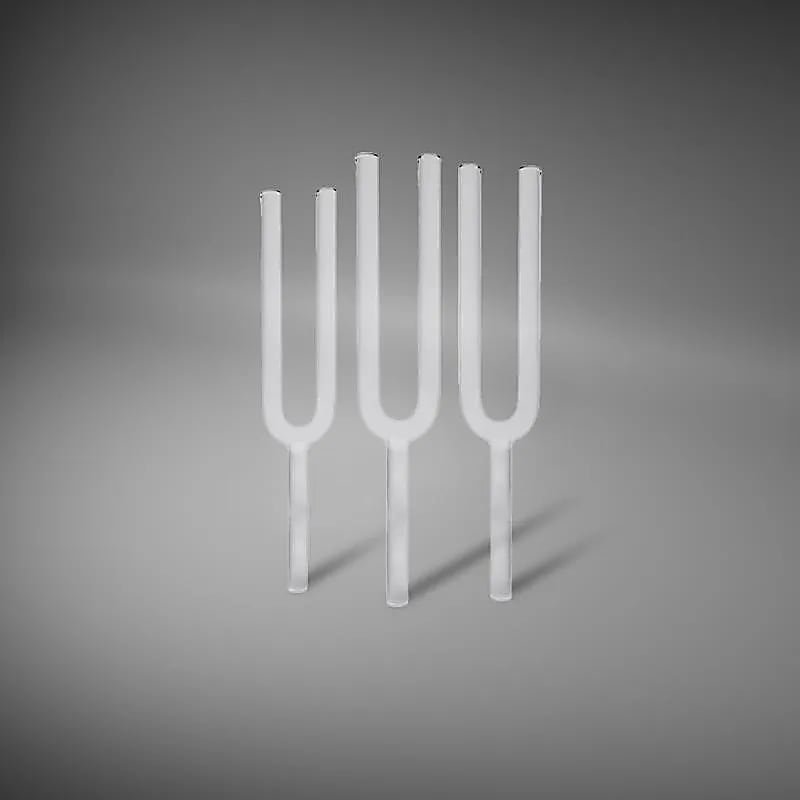
Our Tuning Fork 432 Hz is made of aluminium alloy, is 18 cm long, weighs about 85 g and currently (20 November 2026) costs €26.80. The set of seven quartz tuning forks with mallets and an aluminium case is listed on the product page with a length of 35 to 41 cm and a weight of 5.36 kg, and costs €1,171.3015. Quartz is the same mineral that makes up rock crystal, but the product page does not state whether the forks are made of natural crystal or of fused quartz, like the crystal bowls. Both products are held in the supplier’s warehouse, so delivery takes about 15 working days, and delivery to parcel lockers in the Baltic states is free from €30. You will find all the forks in the section Sound Forks, and other instruments in the section Sound Instruments.
In the crystal community, tuning forks are also used to cleanse stones with sound. This method needs neither water nor sunlight, so it is chosen, for example, for selenite, which dissolves slowly in water, or amethyst, whose violet colour can fade in prolonged sunlight. Other methods used in the community are described in the article How to Cleanse Crystals.
Frequently asked questions
What does 432 Hz mean on a tuning fork?
The tuning fork sounds the note A in a tuning where A is 432 Hz, that is, about a third of a semitone lower than the standard 440 Hz. There is no convincing evidence that this tuning acts on the body.
Why do doctors use a 128 Hz tuning fork?
It is used to test vibration sense, for example by placing the struck tuning fork against the big toe. In hearing tests, 256 and 512 Hz tuning forks are used more often.
Does 528 Hz repair DNA?
No, this is not proven. 528 Hz is part of the “solfeggio” series devised in the 1970s, and there is no evidence that musical tones can repair DNA.
Who invented the tuning fork?
The tuning fork was invented in 1711 by John Shore, a trumpeter at the English royal court.
Why is the standard 440 Hz and not 432 Hz?
440 Hz was agreed at the 1939 London conference and is set by the standard ISO 16:1975. 432 Hz was supported in Italy at the end of the 19th century, but in 1885 Europe chose 435 Hz.
How do you strike a tuning fork correctly?
Hold the tuning fork by the stem and strike it with a soft rubber mallet or against your knee. Do not strike it against a table, because a notch may form in the prong and change the frequency.
Sources (20)
- ↩ Tēzaurs.lv, entry “kamertonis”: tezaurs.lv/kamertonis
- ↩ D. A. Russell, “The Tuning Fork: An Amazing Acoustics Apparatus”, Acoustics Today 16(2), 2020: acousticstoday.org
- ↩ Whipple Museum of the History of Science, University of Cambridge, “Historical Notes: a Brief Chronicle of the Tuning Fork”: www.whipplemuseum.cam.ac.uk
- ↩ HyperPhysics, Georgia State University, “Tuning Fork”: hyperphysics.gsu.edu
- ↩ M. A. Lombardi (NIST), “Fundamentals of Time and Frequency”, The Mechatronics Handbook, Chapter 17: tf.nist.gov
- ↩ US patent US6959472B2, quartz tuning fork resonator at 32,768 kHz: patents.google.com
- ↩ E. Lockhart, “Tuning Sounds in Italy, 1750-1885”, Nineteenth-Century Music Review 22(3), 2025, doi:10.1017/S1479409824000375: doi.org/10.1017/S1479409824000375
- ↩ Riester, medical tuning fork catalogue “Tuning forks”: riester.de
- ↩ S. Lai et al., “Diagnostic Accuracy of Qualitative vs. Quantitative Tuning Forks: Outcome Measure for Neuropathy”, Journal of Clinical Neuromuscular Disease 15(3), 2014: pmc.ncbi.nlm.nih.gov
- ↩ Diabetes Canada, “Rapid Screening for Diabetic Neuropathy Using the 128 Hz Vibration Tuning Fork”: www.diabetes.ca
- ↩ Handbook for Acoustic Ecology, Simon Fraser University, entry “Concert Pitch”: www.sfu.ca
- ↩ ISO 16:1975 “Acoustics. Standard tuning frequency (Standard musical pitch)”, catalogue description Austrian Standards: www.austrian-standards.at
- ↩ D. Calamassi, G. P. Pomponi, “Music Tuned to 440 Hz Versus 432 Hz and the Health Effects: A Double-blind Cross-over Pilot Study”, Explore 15(4), 2019: doi.org/10.1016/j.explore.2019.04.001
- ↩ N. Jebabli et al., “Effects of 440-Hz vs. 432-Hz preferred music frequencies, during warm-up …”, PeerJ 13, 2025: pmc.ncbi.nlm.nih.gov
- ↩ frequencies.lv product pages: Tuning Fork 432 Hz, Crystal Quartz Tuning Fork Set for 7 Chakras, crystal singing bowls 432 Hz (data 20 November 2026): frequencies.lv
- ↩ Encyclopedia.com, “Guido d’Arezzo”: www.encyclopedia.com
- ↩ Science Feedback, “No evidence to support claim that Solfeggio frequencies remove toxins from the body”, 30.09.2022: science.feedback.org
- ↩ Google Books, bibliographic entry: L. G. Horowitz, J. Puleo, “Healing Codes for the Biological Apocalypse”, Tetrahedron Publishing, 1999, ISBN 0923550011: books.google.com
- ↩ C. Good, “Solfeggio Frequencies”, Skeptoid, episode 474, 07.07.2015: skeptoid.com/episodes/474
- ↩ PubMed (US National Library of Medicine), search “528 Hz AND DNA”, 20 November 2026: pubmed.ncbi.nlm.nih.gov