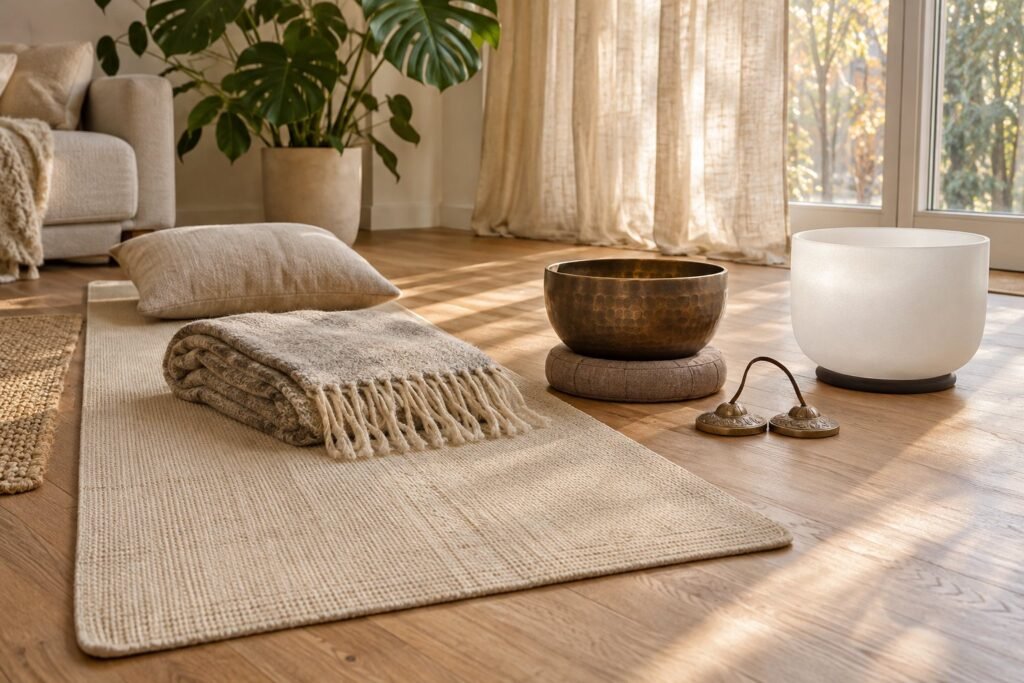
A sound bath at home is a listening practice: you lie in a quiet, dimly lit room while someone slowly plays a singing bowl, tingshas, a gong or another instrument, letting each sound ring out fully. To hold one, all you need is one instrument, a place to lie on the floor and 15 to 20 minutes. The most important things are a moderate volume and pauses between the sounds.
A sound bath is not a medical procedure, and everything you need can be prepared in a single evening.
What is a sound bath and where does the name come from?
The Latvian name (skaņas pelde) is a translation of the English expression “sound bath”, and our shop’s product descriptions also use the Latvian term “skaņu vanna”. Dictionary.com defines a sound bath as prolonged listening to the sounds of singing bowls, bells, chimes and similar instruments, used in meditation, and dates the first recorded uses of this meaning to between 2005 and 20101. The instruments themselves are much older than the name. For example, the British Library’s Endangered Archives Programme has digitised a pair of tingshas from the late 19th century, kept in a household in the Spiti Valley in the Himalayas11. The history and physics of singing bowls are described in the article Singing Bowls: Metal or Crystal.
How a sound bath unfolds can be seen clearly in a 2017 study of singing bowl sound meditation carried out by researchers at the University of California, San Diego. The participants lay on yoga mats, some with a pillow and blanket, with their heads towards the instruments, which stood on the floor. Tibetan and crystal singing bowls, gongs, tingshas, bells and a didgeridoo were played, and the session lasted about 60 minutes2.
Did you know? At one of the study sites, participants listened to the sounds of about 80 Tibetan bowls, 6 crystal bowls and 6 gongs, and the bowls sounded for about 95 % of the time2. At home, one bowl is enough.
What do studies say about the effects of a sound bath?
There are few studies, and they are small. Moreover, they mainly examine singing bowls rather than sound baths in general. In a 2020 systematic review, researchers at the University of Adelaide found only four peer-reviewed studies of singing bowls, and the design used in two of them provided a low level of evidence. Because there are few studies and a risk of methodological errors, the authors write that singing bowl methods cannot currently be recommended, and they call for future research with stricter methods3.
The California study mentioned above involved 62 people, and the authors themselves write that its greatest weakness is that it was a non-randomised observational study without a control group2. A 2025 review of Tibetan singing bowls for adults included 14 studies with 12 to 81 participants each, and five of them had no control group. The authors write that the small number of participants limits the conclusions and that the studies were too varied for a meta-analysis, and they call for carefully designed controlled studies in future4. Neither review claims that there is no effect: both conclude that the existing studies are not enough for reliable conclusions. It is therefore more accurate to regard a sound bath as a listening practice rather than a health method.
How do you prepare the room, the lighting and a place to lie down?
Choose a room where nobody will disturb you for 20 to 30 minutes, and put your phone on silent. Soft surfaces absorb some of the sound: Sarah Wakefield, an audiologist at Nova Southeastern University in the US, explains in Yoga Journal that people and soft surfaces absorb sound, so there is less echo in the room9. A room with a carpet, curtains and blankets will have less echo than an empty room with a hard floor.
Keep the light dim: draw the curtains and switch on a single lamp with a warm light, such as a selenite lamp. For advice on choosing its size and position, read the article Selenite Lamp.
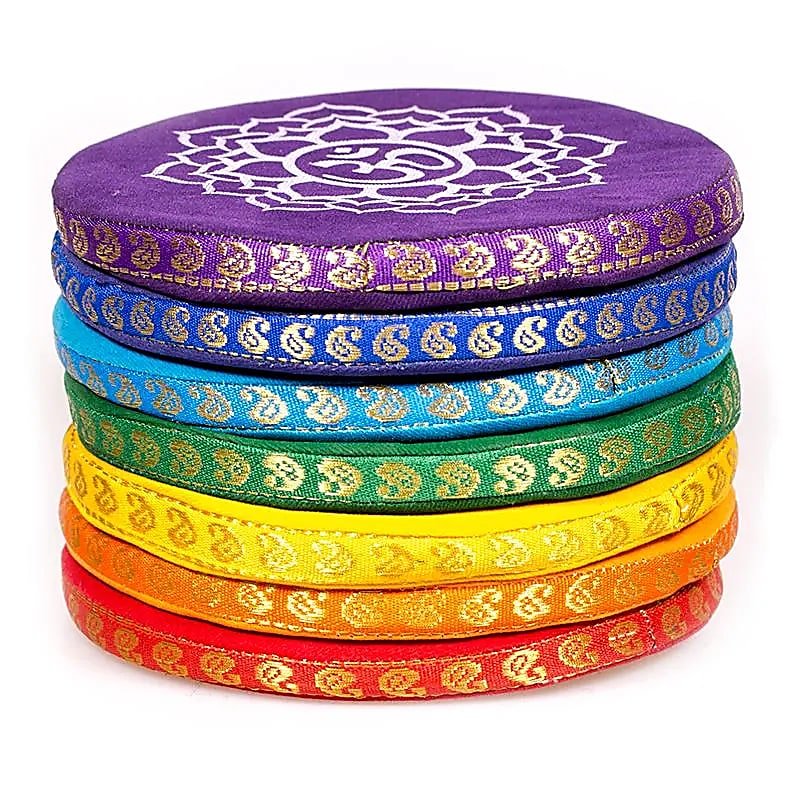
For lying on, a yoga mat, a pillow under your head and a blanket are suitable, because you may feel cold when you lie still. Put the instruments on the floor or on a low table, but not right next to your head, because the sound is louder closer to the source9. Put the bowl on a cushion or a rubber ring so that it stands steady. Our 30 cm crystal bowl set includes such a ring12. In the crystal community sound is also used to “cleanse” crystals; you can read about this custom in the article How to Cleanse Crystals.
Which instruments are useful for a sound bath at home?
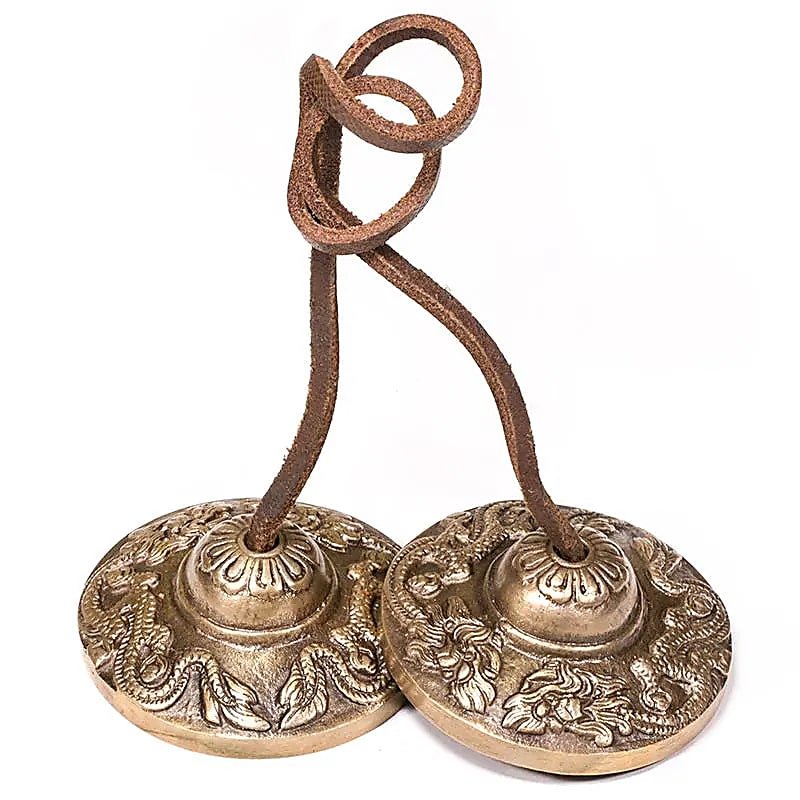
To start, one instrument with a long decay and one with a short, clear sound for the beginning and end are enough, for example a singing bowl and tingshas. Tingshas are two small cymbals joined by a leather strap11.
According to its description, our Lotus crystal bowl is made from quartz powder heated to more than 1700 degrees13. It is therefore not carved from a piece of rock crystal: in structure it is quartz glass. To find out how it sounds compared with a metal bowl, read the article Singing Bowls. The bowl is heavy and fragile: our 30 cm Lotus bowl weighs about 4.4 kg13. According to its description, the transparent handle of the crystal hand bowl can be filled with gemstones or minerals, and the inner diameter of the handle is 2.2 cm15. Small amethyst or rose quartz chips from the Chips section, for example, will fit inside.
A gong needs a stand and a suitable mallet. The description of our Chao gong says that its sound is quiet at first and then rises sharply16, so strike it gently. For types, sizes and stands for gongs, read the article Types of Gongs. A tuning fork, which our shop also calls a sound fork (skaņu dakša), produces one specific tone, and the shop’s model is tuned to 432 Hz.
Our shop’s prices on 20 November 2026 (sound characteristics according to the product descriptions):
| Instrument | Sound | Price |
|---|---|---|
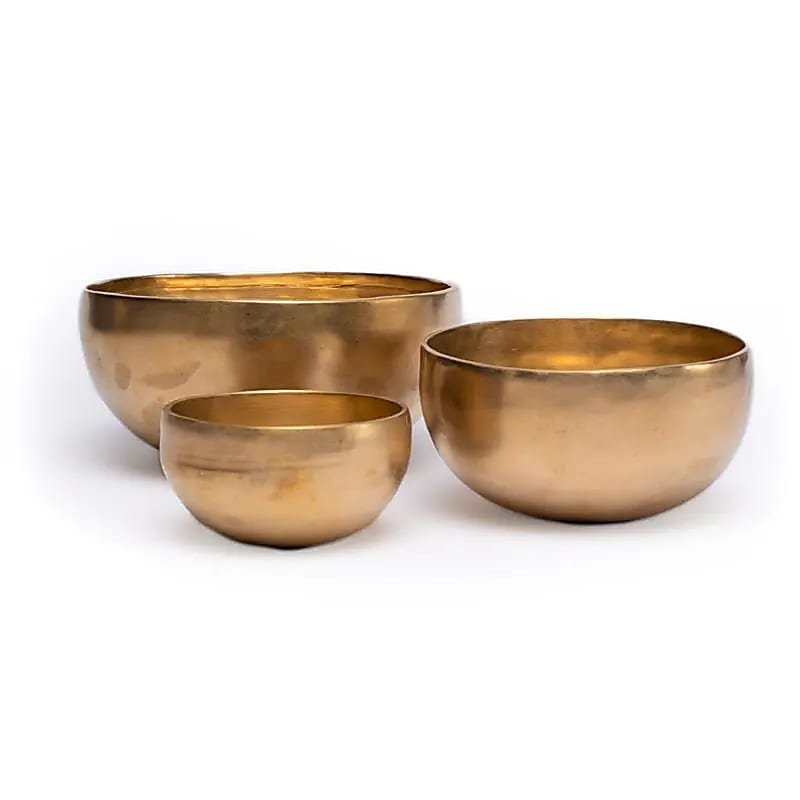
| Metal singing bowl | Cho-Pa bowls: deep, rich, with many overtones | from €71.99 (Cho-Pa, 14 cm) |
| Crystal singing bowl | pure tone with few overtones, tuned to 432 Hz | from €160.00 |
| Gong | Chao gong: the sound is quiet at first, then rises sharply | from €162.40 (mirror gong 40 cm), Chao gong from €200.50 |
| Tingshas | high, pure, long-lasting | €22.60 to €32.90 |
| Chime bar | pure, long-lasting | €28.40 (7-bar set €184.00) |
| Tuning fork (Tuning Fork 432 Hz) | pure, long-lasting tone at 432 Hz | €26.80 |
You will find all the instruments in the sections Singing Bowls and Tingshas and Bells. Sound instruments are currently held in a partner’s warehouse, so check the delivery time on the product page.
In what order should you play, and for how long?
There are no strict rules, but in the California study the instruments were played in a set order: tingshas, Tibetan bowls, bells, crystal bowls, gongs and then Tibetan bowls again, after which the sequence was repeated2. At home this can be simplified:
- Lie down or sit and listen to the silence for a few minutes.
- Mark the beginning with the sound of tingshas or a bell.
- Strike the singing bowl and let the sound die away completely before you strike it again. In the study, too, the sound of each bowl was allowed to die away2.
- If you have a crystal bowl, play it by running the mallet around the rim, and not too loudly, as the product description recommends13. Do not use a wooden mallet on it, as the product description warns12.
- If you have a gong, play it in the middle of the session, quietly and with a soft mallet.
- Return to the bowl, then at the end let the tingshas ring once more and close with silence.
- Do not rush to get up. In the study, participants were asked at the end to turn their attention back to their surroundings gradually and not to hurry2.
The session in the California study lasted about an hour2, but the usage recommendations for our 30 cm crystal bowl give a session length of 15 to 20 minutes12. At home, start with a shorter time. If there are two of you, one can play while the other lies down, and next time you can swap roles. If you play without a helper, play sitting down and leave as much silence between the sounds as the instrument rang for.
How loudly can you play without harming your hearing?
The World Health Organization (WHO) states that a sound of 80 decibels (dB) can safely be listened to for up to 40 hours a week. For louder sounds the safe time shortens rapidly: 90 dB, which WHO compares to a conversation held at a shout, can be listened to for 4 hours a week, and 100 dB, comparable to a hair dryer, for only 20 minutes a week. An ordinary conversation is about 60 dB and has no time limit5. For children, the WHO and International Telecommunication Union (ITU) standard for personal audio devices provides a more cautious limit: 75 dB for 40 hours a week6.
The US National Institute for Occupational Safety and Health (NIOSH) recommends a limit of 85 dBA for workplaces, as the average level over an eight-hour shift. The institute adds that noise is likely to be hazardous if you can talk to a person standing an arm’s length away only by raising your voice7. The US National Institute on Deafness and Other Communication Disorders (NIDCD) explains that sounds of up to 70 dBA are unlikely to cause hearing loss even after long exposure, but prolonged or repeated sound from 85 dBA upwards can cause it8.
A gong can be loud. In Yoga Journal Wakefield estimates that a gong usually sounds at 80 to 110 dB, but a large gong, struck hard, can exceed 120 dB, and the volume depends on the size of the gong, the force of the strike and the room. This is a specialist’s estimate, not measurement data. In her words, the recommended limit is unlikely to be exceeded if the gong does not sound continuously and the listener is not close to it9. So strike the gong gently and place the lying area as far from it as possible.
You can measure the volume with your phone. The free NIOSH Sound Level Meter app is available only for iOS devices, and according to the institute its accuracy is ± 2 dBA10. If the sound exceeds the NIOSH recommendation, Wakefield advises using ear protection9. The mallet also changes the sound: according to our product descriptions, a felt mallet gives a softer, warmer timbre than a suede one, while a crystal bowl is meant to be played with a rubber or silicone mallet.
When is it better not to hold a sound bath, or to stop one?
If your ears ring or your hearing seems muffled after a sound bath, this is a warning sign. WHO writes that after loud sounds hearing may become temporarily muffled or the ears may ring (tinnitus), and this often passes. NIDCD adds that tinnitus sometimes persists for a long time5,8. Next time play more quietly and for a shorter time, but if the ringing does not go away, WHO advises seeing a specialist5. If your ears hurt during the sound, Wakefield advises leaving the room9.
If you already have ringing in the ears (tinnitus) or increased sensitivity to sound, consult a doctor or an audiologist before a sound bath. Wakefield notes that negative reactions to sound have been observed in people with sound sensitivity and tinnitus9.
Do not place bowls on the body unless you have experience and confidence. Our metal Cho-Pa bowls weigh from 600 g to 5.6 kg14, the 30 cm Lotus crystal bowl about 4.4 kg13, and a crystal bowl is fragile. The crystal bowl descriptions say not to put your head inside the bowl and to keep the bowls at least 30 cm apart12,13.
Frequently asked questions
What is a sound bath?
It is a listening practice in which a person lies down and listens to the sounds of singing bowls, gongs, tingshas, bells and similar instruments. According to Dictionary.com, the English term “sound bath” was first recorded in this sense between 2005 and 2010.
What do you need for a sound bath at home?
You will need a quiet room with dim light, a yoga mat, a pillow, a blanket and one instrument with a long decay, such as a singing bowl. The beginning and the end can be marked with tingshas or a bell.
How long does a sound bath last?
The session described in the study lasted about an hour, but the usage recommendations for our 30 cm crystal bowl give 15 to 20 minutes. At home, start with a shorter time.
Can a sound bath harm hearing?
It can, if the sound is loud and long. WHO considers 80 dB safe for up to 40 hours a week and 100 dB for only 20 minutes a week. A gong can be very loud, so strike it gently, do not lie close to it, and measure the volume with a phone app.
Is the effect of a sound bath proven?
There is no convincing evidence. There are few studies; in the 2025 review the studies involved 12 to 81 people, and some had no control group. The authors of the 2020 systematic review write that singing bowl methods cannot currently be recommended, and the 2025 review also calls for more carefully designed studies.
Can a singing bowl be placed on the body?
Without experience it is better not to. Our metal Cho-Pa bowls weigh up to 5.6 kg, and crystal bowls are heavy and fragile. Put the bowl on a cushion or a rubber ring beside the lying area.
Sources (16)
- ↩ Dictionary.com, “Sound bath”: dictionary.com/browse/sound-bath
- ↩ T. L. Goldsby et al., “Effects of Singing Bowl Sound Meditation on Mood, Tension, and Well-being: An Observational Study”, Journal of Evidence-Based Complementary & Alternative Medicine 22(3), 2017: pmc.ncbi.nlm.nih.gov
- ↩ J. Stanhope, P. Weinstein, “The human health effects of singing bowls: A systematic review”, Complementary Therapies in Medicine 51, 2020: doi.org/10.1016/j.ctim.2020.102412
- ↩ F.-W. Lin, Y.-H. Yang, J.-Y. Wang, “Effects of Tibetan Singing Bowl Intervention on Psychological and Physiological Health in Adults: A Systematic Review”, Healthcare 13(16), 2025: pmc.ncbi.nlm.nih.gov
- ↩ WHO, “Deafness and hearing loss: Safe listening”, 06.03.2026: who.int
- ↩ WHO and ITU, “Safe listening devices and systems: a WHO-ITU standard”, 2019: who.int
- ↩ CDC, NIOSH, “Understand Noise Exposure”: cdc.gov/niosh
- ↩ NIDCD (NIH), “Noise-Induced Hearing Loss”, 16.04.2025: nidcd.nih.gov
- ↩ Laura Harold, “What to Do When Your Yoga Teacher Plays the Gong And It’s Ruining Your Life”, Yoga Journal, 17.01.2025 (S. Wakefield, Au.D., Nova Southeastern University): yogajournal.com
- ↩ CDC, NIOSH, “Sound Level Meter App”: cdc.gov/niosh
- ↩ British Library, Endangered Archives Programme, EAP1221/13/2/4, tingshas (ting shags), late 19th century: eap.bl.uk
- ↩ frequencies.lv, Crystal Singing Bowl 432 Hz + Bag (30 cm), usage recommendations: frequencies.lv
- ↩ frequencies.lv, Crystal Bowl Lotus Chakra 2, D note, 432 Hz (30 cm), description and usage recommendations: frequencies.lv
- ↩ frequencies.lv, Singing Bowl Cho-Pa, sizes and weight: frequencies.lv
- ↩ frequencies.lv, Crystal Hand Bowl 432 Hz (25 cm): frequencies.lv
- ↩ frequencies.lv, Chao gongs, description: frequencies.lv