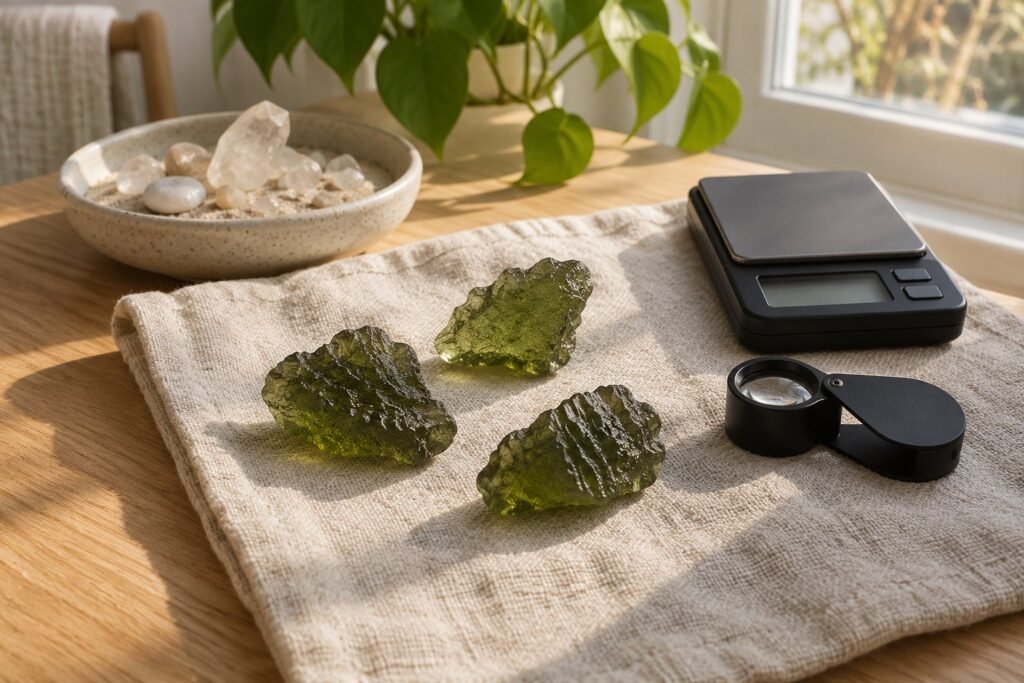
The easiest way to compare moldavite prices is per gram. In our shop at present (20 November 2026), moldavite from the Czech Republic costs from €59 to €169 per specimen, or from €35.96 to €40.54 per gram (€169 is the sale price; the regular price is €180). The price is set by weight, shape and surface texture, colour, locality and how little moldavite is extracted.
Figures from southern Czechia show just how little there is. The sand and gravel quarry near the village of Chlum nad Malší was the largest moldavite mine in operation when researchers visited it in 2022. According to the quarry geologist, 100,000 to 150,000 tonnes of sand and gravel are dug there each year, and each tonne contains on average 2.5 to 3 grams of moldavite. There, moldavite is a by-product, picked out by hand after washing and sieving1.
How much does moldavite cost per gram and how is it calculated?
The price per gram is calculated by dividing the item’s price by its weight in grams. Size alone is no basis for comparison, as moldavites come in different shapes. In our shop, for example, a specimen of about 3 cm weighs 4.4 g, while one of about 4.3 cm weighs 4.7 g. Cut gemstones are usually weighed in carats. For more on how weight affects the price of other crystals, see the article Crystal Prices.
Our shop prices on 20 November 2026 (price per gram calculated and rounded to the nearest cent):
| Specimen | Weight | Price | Price per gram |
|---|---|---|---|
| Moldavite ~1.6 cm | 1.5 g | €59.00 | €39.33 |
| Moldavite ~1.7 cm | 1.5 g | €60.00 | €40.00 |
| Moldavite ~2 cm | 1.48 g | €60.00 | €40.54 |
| Moldavite ~3 cm | 4.4 g | €160.00 | €36.36 |
| Moldavite ~4.3 cm | 4.7 g | €169.00 (sale price, regular price €180.00) | €35.96 (at the regular price: €38.30) |
The descriptions of all five specimens indicate origin in the Czech Republic and a grooved surface9. In our shop, the two largest specimens currently cost less per gram than the three smaller ones, even when the largest is calculated at the regular price. You cannot judge the whole market by five specimens, as the value of rough moldavite depends on size, shape and appearance2. You will find all available specimens in the Moldavite section.
Why is moldavite so rare?
Moldavite is a tektite, or natural glass, formed by a meteorite impact in what is now southern Germany about 14.8 million years ago1. It formed from melted terrestrial rocks, so it is not a meteorite. How moldavites came to be in the Czech Republic is explained in the article Stones from Space. Moldavite deposits are known only in Central Europe: South Bohemia, western Moravia, and the Cheb Basin in the Czech Republic, Lusatia in Germany, Waldviertel in Austria, and Lower Silesia in Poland1,3.
Czech researchers Milan Trnka and Stanislav Houzar estimated in 2002 that the impact produced at least a million tonnes of moldavite, but only about one hundredth, or around 10,000 tonnes, has survived to the present day. According to their estimates at the time, 10 to 20 million moldavites had been collected through organised and illegal digging, with a total weight of 30 to 60 tonnes3.
Today, moldavite is mainly extracted in the Czech Republic. The sediments in which it is found consist mostly of quartz and feldspar. At the Chlum nad Malší quarry, most moldavites weigh from 0.1 to 15 grams, and about 20% are larger. In 2022, another, smaller quarry opened near the village of Besednice, where moldavite is the only product extracted1.
Why has the price of moldavite risen over the years?
Moldavite was not always expensive. When the National Museum in Prague expanded its collection in the 1930s, moldavites were mostly regarded as ordinary glass, and they became truly valuable only around the mid-1960s. Interest in moldavite as a gemstone and collector’s item revived in the 1950s and 1960s, and demand has risen gradually since then1.
Czech mineralogist Jaroslav Hyršl wrote in 2015 in the journal Gems & Gemology that the price of moldavite had risen in recent years and that imitations had consequently become more widespread4. The gemmology education site International Gem Society (IGS) notes that moldavite is primarily a collector’s stone, but interest from the New Age movement has made it more widely available and more appealing to buyers2.
Did you know? The National Museum in Prague has the world’s largest publicly accessible moldavite collection. In 2023, it held 20,702 specimens from South Bohemia and 1,988 from Moravia, from 140 deposits in all1.
How do extraction restrictions in the Czech Republic affect supply?
In the Czech Republic, you may not dig for moldavite wherever you like. In the few deposits recognised by the mining authorities and documented by geologists, moldavite is state property. Elsewhere, extraction is not expressly prohibited, but you may not dig even on your own land without state permission1. Moldavite is extracted legally where permits exist, for example in the quarries near Chlum nad Malší and Besednice. In 2023, researchers wrote that the sand and gravel layers in these areas will probably keep the moldavite market supplied for several more years1.
Illegal digging is a widespread problem. Moldavite-bearing layers lie close to the surface, so holes up to 2 or 3 metres deep are dug in forests and fields, damaging tree roots and possibly becoming traps for animals1. In 2020, South Bohemian police explained that repeated digging after an environmental inspectorate ban is a criminal offence, punishable by up to two years in prison5. Czech Television reported in March 2023 that the Czech Environmental Inspectorate had issued 34 such bans in the previous year, compared with only a few eight years earlier. At that time, the Trhové Sviny municipality banned entry to some forests near the village of Nesměň from 1 March to the end of May, as the holes that had been dug had made the ground dangerous6. On 31 July 2026, South Bohemian police reported that police dog handlers from České Budějovice had caught more than a hundred diggers in the previous six months and imposed fines totalling over half a million Czech crowns7.
How do shape, surface and weight affect the price of moldavite?
IGS writes that the value of rough moldavite depends largely on shape, size and visual appeal2. Moldavite takes its shape in several stages: the melt breaks into droplets and solidifies in flight, river water moves the pieces, and finally groundwater etches the surface. Each deposit therefore has its own characteristic shapes1.
Some shapes are rare. Besednice moldavites are famous for their sharp, spiky protrusions, which is why they are known as “hedgehogs”8. A 2023 study calls this shape rare and fairly valuable, and it is created mainly by chemical etching after the moldavite has already been lying in sediments1. Drop-shaped and curved moldavites are also relatively rare1, whereas flat, plate-shaped pieces with rough edges are sold often2.
Weight is the second factor. In Trnka and Houzar’s 2002 review, the largest known moldavite came from Slavice in Moravia and weighed 258.5 g3, while the largest South Bohemian moldavite in the National Museum in Prague weighs 111 g1. Specimens in our shop weigh from 1.48 to 4.7 g. For cut moldavite, value is determined mostly by the quality of the cut2, and in jewellery cut moldavite is sometimes combined with Czech pyrope, which is one of the garnets1.
Do colour and locality affect the price of moldavite?
The sources give no single price scale by colour, but colour does affect how popular a moldavite is. Moldavite colour ranges from light green to brown. It is determined mainly by iron: the more iron, the browner the glass3. In South Bohemia, more than 80% of moldavites are bottle green or light green, while in Moravia, more than 90% are olive green to brown3. In 2015, Hyršl wrote that moldavites are popular for their pleasant green colour, mysterious origin and interesting etched surface4. Our encyclopedia page on moldavite also suggests looking for a rich bottle-green colour when choosing this stone.
The locality determines which shapes and colours of moldavite can be found there. Besednice is known for beautiful rough moldavites8, while in Moravia relatively larger and darker pieces are found nowadays3. For buyers, it is even more important to make sure that the locality is in Central Europe at all. IGS warns about so-called “African moldavite”: by definition, moldavite is found only in the Ries impact strewn field in Central Europe, and pieces sold under this name are most likely industrially produced glass2. Other natural glasses are found in Africa, for example Libyan Desert Glass, which is often light yellow-green2. In our shop, both glasses are in the Tektites section.
How can you avoid buying glass instead of moldavite?
The laboratory features by which a gemmologist distinguishes moldavite from glass are described in the article Stones from Space. Before and after buying, you can check some things at home that need no instruments:
- Price per gram. Divide the price by the weight. If “moldavite” is as cheap as quartz or coloured glass, be cautious: at the Chlum nad Malší quarry, a tonne of sand and gravel contains only a few grams of moldavite1, and as the price has risen, so has the number of imitations4. A high price does not prove that the stone is genuine either.
- Glass that is too clear and a shape that is too flawless. Moldavite usually has many gas bubbles and flow lines2, but bubbles can also be present in glass1. So-called “African moldavites” usually look clearer and have fewer inclusions than genuine moldavites2. Hyršl wrote about two large imitations whose shape was too flawless4.
- Locality. The seller should state the origin: the Czech Republic or another Central European location1,2. Even a stated origin cannot be verified without a laboratory. Green glass is sometimes given other names: in the collection of the German Gemmological Association (DGemG), one artificial glass that was studied had been donated as “green transparent obsidian”1. Genuine obsidian is volcanic glass, not moldavite.
- Seller information. Check whether the weight in grams, the size and the origin are stated. If the image is illustrative or shows several specimens, ask for a photo of the exact specimen.
- Weight at home. Use precise jewellery scales to check whether the weight matches the stated value, as the price per gram depends on it.
- Surface. By looking closely at the natural surface texture, moldavite can often be told apart from glass imitations1, but some imitations have an almost identical surface4.
None of these steps gives a certain answer. Even the National Museum in Prague, when reviewing its gemstone collection from 2016 to 2022, found several specimens of cut bottle glass1. Only a gemmological laboratory can give a definite answer, and for an expensive specimen it is worth ordering a test. General features for telling a natural stone from glass are summarised in the article How to Recognize a Genuine Crystal.
Frequently Asked Questions
How much does 1 gram of moldavite cost?
In our shop at present (20 November 2026), moldavite from the Czech Republic costs from €35.96 to €40.54 per gram: from €59 for a 1.5 g specimen to €169 (sale price, regular price €180) for a 4.7 g specimen. The price per gram is calculated by dividing the price by the weight in grams.
Why is moldavite so expensive?
Moldavite is found only in Central Europe, mainly in the Czech Republic. At the Chlum nad Malší quarry, a tonne of sand and gravel contains on average 2.5 to 3 grams of moldavite, and in the Czech Republic you may not dig without a permit. Demand for moldavite has risen gradually since the 1950s.
What is a “hedgehog” moldavite?
This is the name for Besednice moldavites with sharp, spiky protrusions, created mainly by chemical etching after the moldavite has already been lying in sediments. A 2023 study calls this shape rare and fairly valuable.
Can moldavite be checked at home?
At home, you can calculate the price per gram, weigh the specimen and see whether the glass is suspiciously clear and the shape too flawless. Only a gemmological laboratory can give a definite answer, as some imitations are almost indistinguishable from natural moldavites by appearance.
Is it allowed to dig for moldavite yourself in the Czech Republic?
Not without state permission, even on your own land. In recognised deposits, moldavite is state property. If the environmental inspectorate has banned digging and a person is caught doing it again, it is a criminal offence punishable by up to two years in prison.
Does African moldavite exist?
No. By definition, moldavite is found only in the Ries impact strewn field in Central Europe. Pieces sold as “African moldavite” are most likely industrially produced glass. Other natural glasses are found in Africa, for example Libyan Desert Glass.
Sources (9)
- ↩ T. Stephan, Š. Jaroměřský, L. Zahradníček, S. Müller, “Moldavite from Chlum, Czech Republic: Mining and Gem Properties”, The Journal of Gemmology 38(7), 2023, 696-707 (Gem-A), doi 10.15506/JoG.2023.38.7.696: dgemg.com (PDF)
- ↩ International Gem Society, “Moldavite Value, Price, and Jewelry Information”: gemsociety.org
- ↩ M. Trnka, S. Houzar, “Moldavites: a review”, Bulletin of the Czech Geological Survey 77(4), 2002, 283-302 (Czech Geological Survey): geology.cz (archive copy)
- ↩ J. Hyršl, “Moldavites: Natural or Fake?”, Gems & Gemology 51(1), 2015, Gem News International (GIA): gia.edu
- ↩ Czech Police, South Bohemian Regional Directorate, “Nelegální těžba vltavínů”, 20 August 2020: policie.gov.cz
- ↩ ČT24 (Czech Television), “Kvůli ilegálnímu kopání vltavínů platí zákaz vstupu do některých lesů u Trhových Svinů”, 3 March 2023: ceskatelevize.cz
- ↩ Czech Police, South Bohemian Regional Directorate, “Vltavínáři”, 31 July 2026: policie.gov.cz
- ↩ G. Lalous, review of the book “Real or Fake? Moldavites”, Gems & Gemology 52(4), 2016 (GIA): gia.edu
- ↩ frequencies.lv, category “Moldavite” and product pages (price, weight, size, origin), viewed on 20 November 2026: frequencies.lv