Moldavite
Tektite

Moldavite

Moldavite is a natural impact glass, traditionally associated with rapid transformation and intensity.

Hardness 5.5-7 Protect from water Protect from direct sunlight Fire
In brief

Moldavite is a tektite, or natural impact glass, which formed about 14.8 million years ago when a meteorite impact melted rocks on Earth. It is olive green to deep green, with a grooved surface and a hardness of 5.5 to 7 on the Mohs scale, and it is found mainly in South Bohemia in the Czech Republic. In the crystal community, moldavite is traditionally associated with change and spiritual growth.

Moldavite in our shop

Exhibit label

Name
Moldavite
Type
Natural glass
Mineral group
Tektite (natural impact glass)
Hardness
5.5-7 on the Mohs scale
Colour
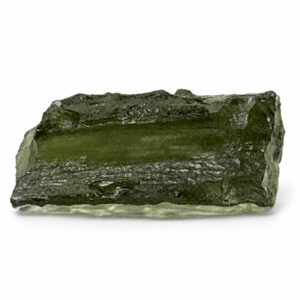
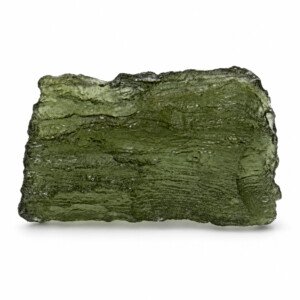
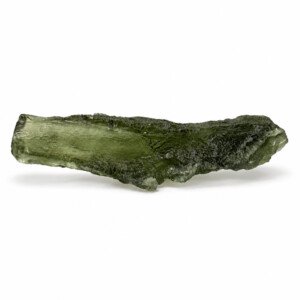
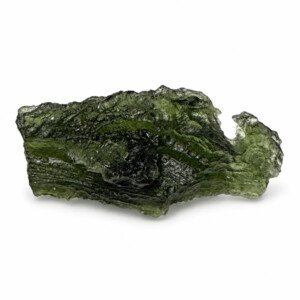
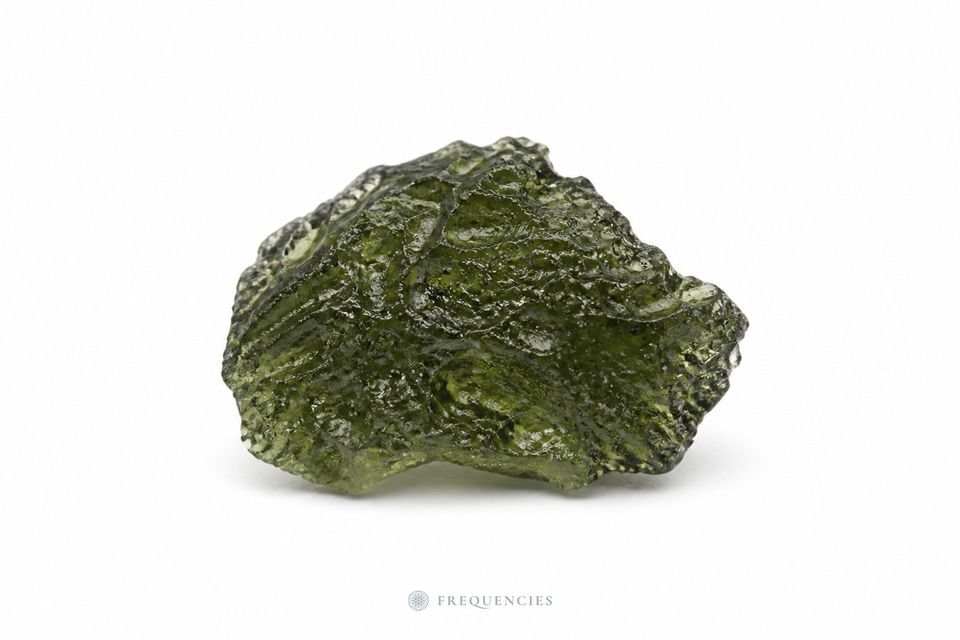
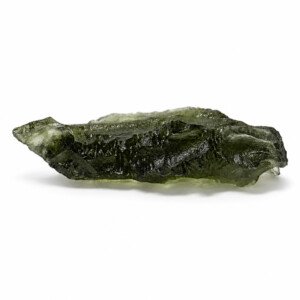
Olive green to deep green with a sculptural surface
Main locality
Czech Republic
Localities
Czech Republic
Planet
Uranus (tradition)

Mohs hardness scale

5.5-7out of 10

Moderately hard but brittle: it can chip on impact, and harder stones can scratch it. Wear it gently and store it separately.

Care

Water

Protect from water

Do not soak. If it needs cleaning, use warm soapy water and a soft cloth, then dry it immediately.

Sun

Protect from direct sunlight

Prolonged direct sunlight can affect the colour, surface or structure

Storage

Protect from knocks

Avoid: prolonged direct sunlight, harsh cleaning agents, strong knocks.

Note. Authentic moldavite is relatively rare; there are many imitations on the market.

In the crystal community, the following are used for cleansing: sage or palo santo smoke, the presence of selenite, sound vibrations, moonlight.

From geology to your shelf

  • How it forms. Moldavite is a natural glass that formed about 14.8 million years ago, when a large meteorite struck the site of today's Nördlingen Ries crater in southern Germany. The molten rock was thrown into the air, solidified in flight and fell over a wide strewn field. Most of the deposits are in South Bohemia in the Czech Republic, with fewer in Moravia, Austria and Germany.
  • Where the colour comes from. Moldavite is usually bottle green, olive green or greenish brown, and Moravian moldavites tend to be brownish. The grooved, "feathery" surface was produced by long etching in groundwater containing carbon dioxide and humic acids.
  • History. The name was introduced in 1836 by Zippe, after the German name of the Vltava river, Moldau. Prehistoric people in what is now the Czech Republic and Austria made tools from moldavite.
  • How to recognise a genuine stone.
    • Genuine moldavite almost always contains gas bubbles, often elongated, and flow lines.
    • Under magnification, worm-like lechatelierite inclusions can be seen, which industrial green glass does not have.
    • The natural surface is etched, with a fine pattern of grooves; polished moldavite over 2 carats, or a stone with no bubbles visible to the eye, is suspect.
  • Treatment and imitations. A large part of the "moldavite" offered on the market, especially online, is industrially made green glass, in some cases made from bottle glass. A laboratory is needed for a reliable identification.
  • How to choose. Look for a rich bottle-green colour, a pronounced natural surface pattern and visible bubbles or flow lines. Because moldavite is brittle (hardness 5.5-7), it is better suited to pendants and earrings than to rings.
  • Traditional meaning

    This is crystal tradition and symbolism, not a scientific or medical claim. The chakras, signs and elements match our product pages.

    Chakras

    Heart ChakraThird Eye ChakraCrown Chakra

    Moldavite is traditionally associated with the heart, third eye and crown chakras, as well as with intensity.

    Zodiac signs

    ♏︎Scorpio♒︎Aquarius

    In traditional crystal astrology, moldavite is often associated with people who value intensity and inner balance.

    Element

    Fire

    The element of fire traditionally gives this stone intensity and a balanced character.

  • Main symbolism: rapid transformation
  • Traditionally associated with rapid transformation and more conscious inner work
  • Traditionally associated with intensity and inner peace
  • In the crystal community, moldavite is traditionally associated with change and spiritual growth, and the story of its origin in a meteorite impact makes it a special gift. Many people hold moldavite in their hands during meditation or wear it as a pendant, often together with other crystals.
  • The traditional meaning of crystals has not been medically proven and does not replace the advice of a professional.

    Stories and legends

    Moldavite was created by the impact of a giant meteorite almost 15 million years ago.

    About 14.8 million years ago, a meteorite struck what is now Bavaria in Germany and formed the Nördlingen Ries crater, about 24 km wide. The rocks melted by the heat of the impact were thrown into the air and froze into green natural glass, whose furthest known deposits are in Poland, about 475 km from the crater. Moldavite is therefore not a piece of a meteorite, but Earth rock melted by the impact.

    The name comes from the German name of the Vltava river.

    In 1788, Josef Mayer, a professor at the University of Prague, was the first to describe scientifically the green stones from Týn nad Vltavou, calling them "chrysolites". In 1836 they were named moldavites, after the German name of the Vltava river, Moldau. Before their natural origin was understood, some people regarded them as slag from Bohemian glassworks.

    People of the Stone Age made tools from moldavite.

    In the territory of today's Czech Republic and Austria, prehistoric people split moldavite into sharp tools. Some of these finds are associated with the Aurignacian culture, which existed about 43,000 to 26,000 years ago. Tektites, including moldavite, have been used since prehistoric times for jewellery and rituals.

    Apollo astronauts trained in the crater where moldavite formed.

    The town of Nördlingen lies right inside the Ries crater, and its buildings are made of suevite, a rock formed in the meteorite impact. In August 1970, the Apollo 14 astronauts Alan Shepard and Edgar Mitchell trained here to become familiar with impact rocks before their flight to the Moon. The Apollo 17 crew later studied in the crater as well.
    Interesting facts

    • Moldavite is a natural impact glass, or tektite, that formed in a meteorite impact in Central Europe.
    • It is not a mineral in the classical sense, because it is a natural glass without a crystalline structure.
    • Moldavite is found mainly in the Czech Republic and the surrounding regions.

    How to use it

    • Wear it gently as jewellery traditionally associated with rapid transformation

    Pairs well with

    Frequently asked questions

    Is moldavite a meteorite?

    No. Moldavite is a tektite, or natural impact glass. About 14.8 million years ago a meteorite struck what is now southern Germany, melting Earth rocks and throwing them into the air, where they solidified into green glass. Moldavite therefore has no crystalline structure.

    How can you recognise genuine moldavite?

    Genuine moldavite has a naturally etched, grooved surface, and under a loupe it shows tiny gas bubbles, flow streaks and worm-like lechatelierite inclusions. Imitations are usually clearer green glass with few inclusions. Beware of "African moldavite": genuine moldavite is found only in Central Europe. Laboratory analysis gives complete certainty.

    Why is moldavite expensive?

    Because it is rare: moldavite is found in only one strewn field in Central Europe, mainly in South Bohemia in the Czech Republic. The price is determined by size, shape, a rich green colour and a pronounced natural surface pattern, and for cut stones also by the quality of the cut. A suspiciously cheap "moldavite" is often industrially made glass.

    What does moldavite symbolise?

    In the crystal community, moldavite is regarded as a symbol of rapid transformation and intensity. It is traditionally associated with the heart, third eye and crown chakras, the zodiac signs Scorpio and Aquarius, and the element of fire.

    Can moldavite be put in water?

    Soaking it is not recommended, so water-free methods are chosen for cleansing the crystal. If the stone needs to be cleaned, the International Gem Society recommends a soft brush, a mild detergent and warm water, but not steam or ultrasonic cleaning, because moldavite usually contains many inclusions.

    Is moldavite suitable for a ring?

    With caution. Moldavite has a hardness of about 5.5 to 7 on the Mohs scale and is a brittle natural glass, so it is easily scratched or chipped. It is better suited to pendants and earrings, but for a ring choose a setting that protects the edges of the stone.

    Where is moldavite found?

    Most moldavite comes from South Bohemia in the Czech Republic, with less found in Moravia, northern Austria and Germany. The name was introduced in 1836 after the German name of the Vltava river, Moldau, because the first scientifically described specimens were obtained near Týn nad Vltavou on the bank of the Vltava.

    Moldavite in our shop: more

    Read more

    Moldavite: Properties, Meaning, and How to Use It Daily

    Sources. Mineralogical data: GIA Gem Encyclopedia, Mindat, Encyclopaedia Britannica (frequencies.lv crystal database v2).
    Further information: en.wikipedia.org, geology.com.
    Shopping Basket
    Scroll to Top