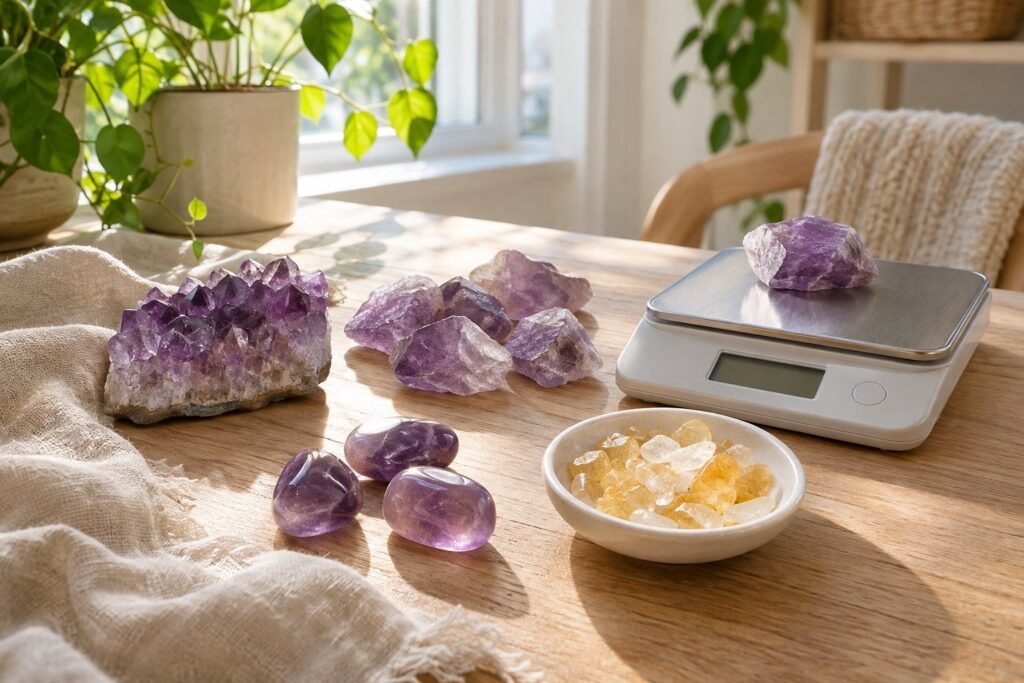
The price of a crystal is mainly determined by the rarity of the mineral, size and weight, colour and transparency, shape, treatment, and origin. In our shop currently (20 November 2026), a large pack of amethyst chips costs €0.08 per gram, amethyst druses range from €21 to €70, and moldavite about €36 to €41 per gram.
Thus, a gram of moldavite costs about 450 to 500 times more than a gram of amethyst chips. Both are natural materials and both are sold by weight. The difference comes from the same factors that determine the price of any crystal, beginning with how much of the mineral exists in nature.
Why does one crystal cost cents, but another tens of euros?
Amethyst, citrine, rock crystal, and rose quartz are varieties of quartz, and quartz is one of the most common minerals in the Earth’s crust. Some sources call it the most common mineral in the Earth’s crust, others the second most common after the feldspars13,14. The Gemological Institute of America (GIA) writes that amethyst is easily available and affordable, so it is also used in mass-market jewellery, and even high-quality citrine has a modest price1,2.
The price changes when supply changes. Amethyst was as expensive as ruby and emerald until the 19th century, when large deposits were discovered in Brazil6. To find out how perceptions of expensive and cheap stones have changed, read the article about gemstones and semi-precious stones.
At the other end of the scale are stones with only one or a few deposits. Tanzanite has only one deposit: the Merelani Hills in northern Tanzania, where it was first found in 19674. Moldavite is a natural glass formed 14.7 million years ago by a meteorite impact at the present-day Ries crater in southern Germany, and it is specifically moldavites from South Bohemia in the Czech Republic that are the best-known tektites used as gemstones5. In 2015, GIA reported that the price of moldavite had risen in recent years, and imitations have therefore appeared on the market5. How to tell moldavite from green glass is explained in the article Stones from Space, and all our moldavites with their weight in grams are in the Moldavite section.
How do size and weight affect the price of a crystal?
Faceted gemstones are weighed in carats, and one carat is 0.2 grams10. For many gemstones, the price per carat increases with size. GIA writes about ruby that the price per carat rises significantly as the stone gets larger, especially for higher quality stones3. This is not the case for amethyst and citrine: the price per carat does not rise sharply for larger stones, so a large amethyst is often chosen as the centre stone in jewellery1,2.
For collectable minerals, size matters too. The mineral reference site Minerals.net states that larger, well-formed specimens always command a higher price, and even large specimens of common minerals are usually more valuable9. However, the price per gram does not always rise with size, as our prices clearly show.
Our shop prices as of 20 November 2026 (price per gram calculated and rounded to the nearest cent):
| Product | Weight | Price | Price per gram |
|---|---|---|---|
| Amethyst chips 0.5-1.5 cm | 20 g | €4.00 | €0.20 |
| Amethyst chips 0.5-1.5 cm | 250 g | €20.00 | €0.08 |
| Citrine (Heat-Treated Amethyst), chips 0.5-1.5 cm | 250 g | €16.00 | €0.06 |
| Rock crystal chips 0.5-1.5 cm | 250 g | €17.50 | €0.07 |
| Amethyst druse ± 2×4 cm | 51 g | €21.00 | €0.41 |
| Amethyst druse ± 3×5 cm | 106 g | €32.00 | €0.30 |
| Amethyst druse with flat base ± 7×9 cm | 360 g | €70.00 | €0.19 |
| Moldavite ~2 cm | 1.48 g | €60.00 | €40.54 |
| Moldavite ~4.3 cm | 4.7 g | €169.00 | €35.96 |
Two things can be concluded from the table. First, price per gram can only be compared fairly within the same mineral and the same form: a druse is a whole specimen with crystals on a base, while chips are small pieces, so a gram of druse costs more. In our shop, a gram usually costs less in a larger pack or a larger druse than in a smaller one. Second, the difference between minerals runs to hundreds of times: even the cheapest gram of moldavite costs more than an entire 250 g pack of amethyst chips.
Did you know? The word carat comes from the carob, or ceratonia, seed. The US National Institute of Standards and Technology (NIST) writes that this measure was later standardised as 1/444 of an ounce and then as 0.2 grams10.
Why do colour and transparency change the price?
For coloured stones, colour is one of the most important price factors. For ruby, GIA calls colour the most significant value factor3. For amethyst, the highest value is placed on a strong reddish-purple or purple colour without visible colour zoning, while a brownish hue and visible zones significantly reduce value1.
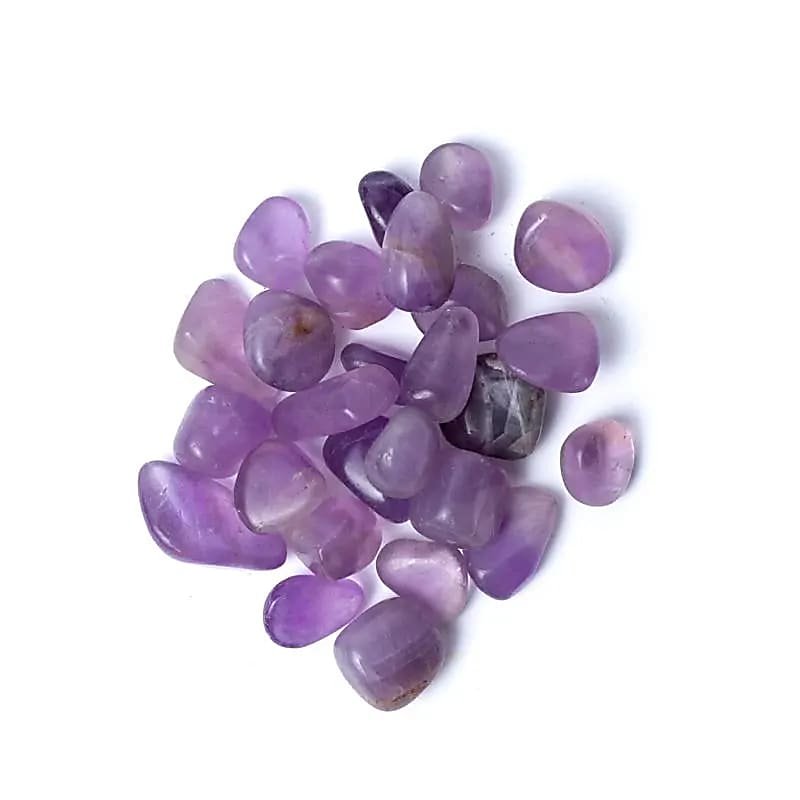
The second factor is clarity and transparency. Much of the faceted amethyst on the market is eye-clean, that is, free of inclusions visible to the naked eye, and a clean stone of the same colour is more valuable. Amethyst with visible inclusions but beautiful colour is usually cut as cabochons or beads1. The same applies to collectable minerals: the more transparent the specimen, the higher its value9.
With polished stones, the shade also varies from stone to stone within the same product. Our polished amethysts 2 to 4 cm range in colour from light lavender to deep purple, and each stone is different. If the product image shows several specimens, you will receive a similar, hand-selected piece.
What does shape cost: raw, polished, sphere or druse?
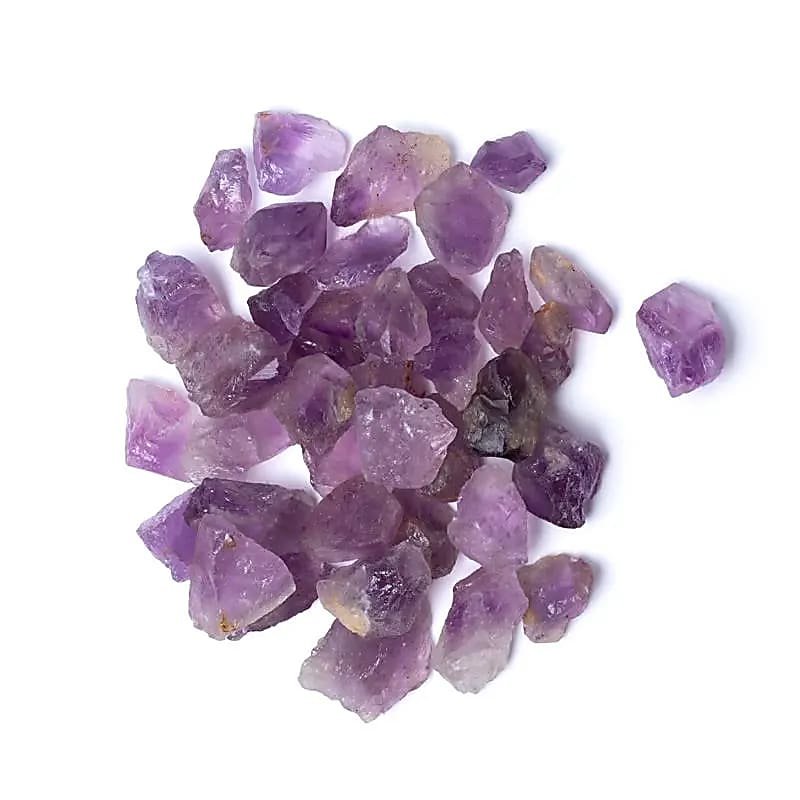
The shape shows how much work and material has been invested. Raw amethyst 2 to 4 cm in our shop currently (20 November 2026) costs €4.50, while polished amethyst of the same size costs €5.00. Polished stones are ground many at a time in a rotating barrel with abrasive and water, and, according to tumbling instructions, this takes several weeks16,17. Read more about this in the article about crystal shapes. The gemmology education site International Gem Society writes that, in the price of agate, labour and craftsmanship matter more than the raw material itself8.
A sphere requires a lot of material. If a sphere is ground from a cube, only π/6, or about 52%, of the cube’s volume remains, since the volume of a sphere is 4/3 πr³, while a cube with side 2r has a volume of 8r³18. A 4 cm rock crystal sphere currently costs €18.50, while a polished rock crystal 1 to 3 cm costs €1.90. Part of this difference is due to size, and part to lost material and labour.
Druses and geodes are valued as whole specimens. Minerals.net writes that crystals on a base are usually more valuable than similar individual crystals, but damage and cracks reduce value. If a specimen is glued, its value is lower, and this must always be disclosed to the buyer9. Our amethyst druses with a flat base weigh from 312 to 360 g and cost from €63 to €70.
How does treatment affect the price and why must it be stated?
A treated stone is still a natural mineral, but its price differs from that of an untreated stone of the same appearance. The most common types of treatment are heating, dyeing, and stabilisation.
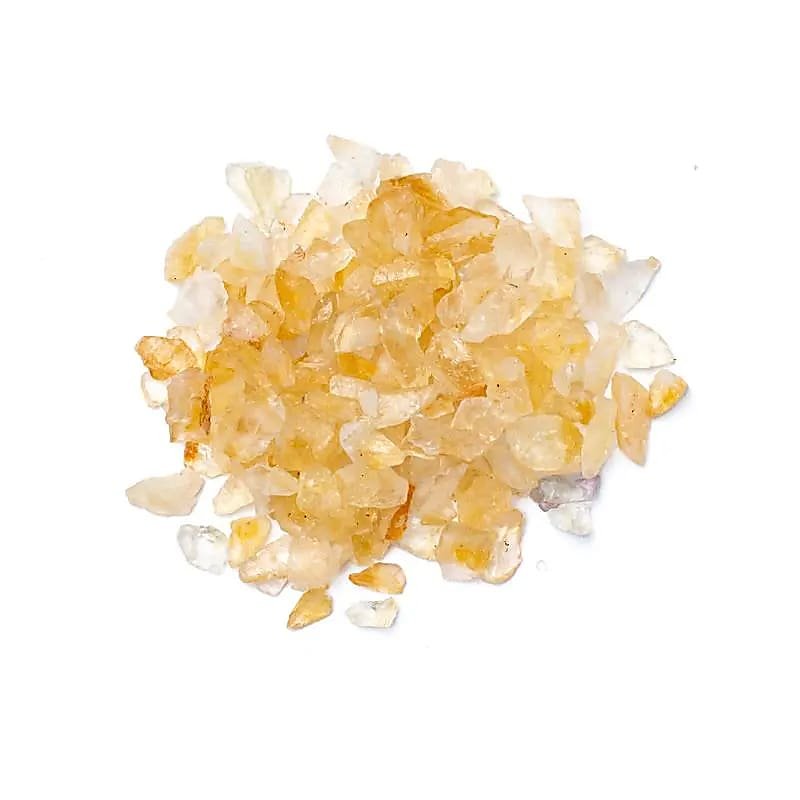
Heating. GIA writes that natural citrine is rare, and most citrine on the market is heated amethyst. Large Brazilian amethyst geodes are often heated to produce large citrine geodes2. Our citrine chips are named “Citrine (Heat-Treated Amethyst)”, and you can ask us about the origin of a particular stone. Citrine chips in a 250 g pack currently cost €16.00, while amethyst chips in the same pack cost €20.00.
Dyeing. Dyeing is an ancient method of treating agate that is still common, and many brightly coloured banded agates on the market are dyed. The International Gem Society stresses that treatments must be disclosed to the buyer8. For our agate plate, this is stated in the name: green, dyed.
Stabilisation. GIA writes that turquoise is usually impregnated with acrylic polymer or epoxy resin to stabilise it, and for dyed turquoise this is done in addition to dyeing7. The US Federal Trade Commission (FTC) guidelines for the jewellery industry regard failure to disclose a treatment as unfair or deceptive if the treatment is not permanent, requires special care or significantly affects the stone’s value11. To learn how to spot a dyed stone or glass imitation, read the article How to Recognize a Real Crystal.
How do origin, mining and transport shape the price?
The same mineral from a classic locality can cost much more than one from an ordinary locality, and Minerals.net names this as one of the value factors9. Our amethyst, citrine, and rock crystal chips, polished amethysts and rock crystals, as well as raw amethyst, come from Brazil.
The most important amethyst mining takes place in southern Brazil and northern Uruguay12. In northern Uruguay, in the Los Catalanes district, amethyst deposits have been known since 1750. Amethyst is also mined there underground. The largest geodes are up to 4 m high or 5 m wide and weigh up to 20 tonnes, and several mining companies employ hundreds of workers12.
The price also includes transport to Latvia and taxes. In Latvia, the price shown to the consumer must include value added tax and all other taxes19, and the standard VAT rate is 21%15. Our shop delivers free of charge to parcel lockers in the Baltics for orders of €30 or more.
How can you check whether a crystal’s price is fair?
- Compare products of the same mineral, the same form and a similar size, not a druse with chips.
- If weight is indicated, divide the price by the number of grams to see whether a larger pack is better value.
- Check whether the seller states the mineral, treatment and origin.
- Be wary if a rare stone such as moldavite is as cheap as quartz.
- Examine the specimen: damaged tips, cracks and glued repairs reduce value9.
All amethyst products with their size, and many also with their weight, are in the Amethyst section, and druses with weight in grams in the Druses and Geodes section.
Frequently asked questions
How much does amethyst cost?
In our shop currently (20 November 2026), polished amethyst 2 to 4 cm costs €5.00, raw amethyst 2 to 4 cm €4.50, amethyst chips from €4.00 per 20 g, and amethyst druses from €21 to €70 depending on size and weight.
Why is moldavite so expensive?
Moldavite is a natural glass formed by a meteorite impact 14.7 million years ago, and the best-known deposits are in South Bohemia, Czech Republic. In 2015, GIA reported that its price had risen in recent years. In our shop, moldavite currently costs about €36 to €41 per gram.
Is cheaper citrine fake?
Not always. Natural citrine is rare, and most citrine on the market is heated amethyst. It is still natural quartz, but the treatment must be stated. You can ask us about the origin of the citrine in our shop.
Which is more expensive: raw or polished crystal?
Usually polished, because polishing involves labour and some of the stone is lost during grinding. In our shop, raw amethyst 2 to 4 cm costs €4.50, while polished of the same size is €5.00. A sphere needs an especially large amount of material.
Does a larger crystal always cost more per gram?
No. For ruby, the price per carat increases significantly with size, but for amethyst and citrine it does not rise sharply. In our shop, larger amethyst druses and larger chip packs usually cost less per gram.
How many grams are in a carat?
One carat is 0.2 grams, so one gram is 5 carats. Faceted gemstones are weighed in carats, but crystals and mineral specimens are usually sold by grams or size.
Sources (19)
- ↩ GIA, Amethyst Quality Factors: gia.edu/amethyst-quality-factor
- ↩ GIA, Citrine: gia.edu/citrine
- ↩ GIA, Ruby Quality Factors: gia.edu/ruby-quality-factor
- ↩ GIA, Tanzanite: gia.edu/tanzanite
- ↩ GIA, Gems & Gemology, Spring 2015, Gem News: moldavites, natural and fake: gia.edu
- ↩ GIA, Amethyst: gia.edu/amethyst
- ↩ GIA, Gems & Gemology, Fall 2015, Gem News: impregnated and dyed turquoise: gia.edu
- ↩ International Gem Society, Agate Value, Price, and Jewelry Information: gemsociety.org
- ↩ Minerals.net, Mineral Value: minerals.net/research/mineral-value
- ↩ NIST, Precious Metals Conversion: nist.gov
- ↩ US Code of Federal Regulations, 16 CFR § 23.24, Disclosure of treatments to gemstones: law.cornell.edu
- ↩ IUGS Geoheritage, Deposits of amethysts of Los Catalanes Gemological District: iugs-geoheritage.org
- ↩ Geology.com, Quartz: geology.com/minerals/quartz.shtml
- ↩ EBSCO Research Starters, Quartz and silica: ebsco.com
- ↩ Value Added Tax Law, Article 41: likumi.lv
- ↩ Rocktumbler.com, Rock Tumbler Instructions: rocktumbler.com
- ↩ Rockhounding.org, How to Use a Rock Tumbler: rockhounding.org
- ↩ Wolfram MathWorld, Sphere: mathworld.wolfram.com/Sphere.html
- ↩ Cabinet of Ministers Regulation No. 178 of 18 May 1999 “Procedure for stating prices of goods and services”, point 4: likumi.lv