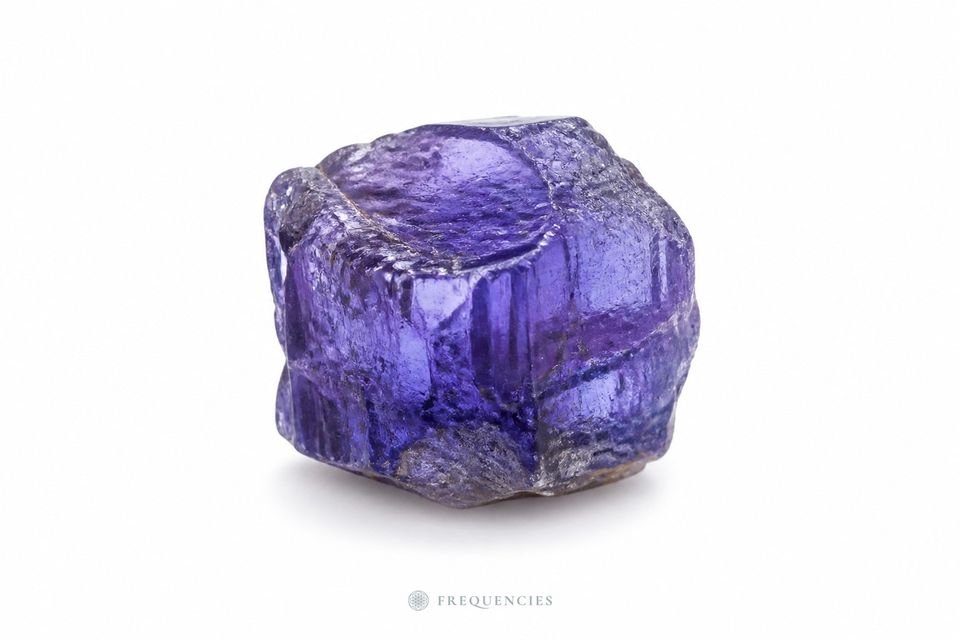
Tanzanite
A blue-violet variety of zoisite, traditionally associated with a broader outlook, clarity and gentle calm.
Tanzanite is the blue-violet variety of zoisite with a hardness of 6 to 7 on the Mohs scale. It was discovered in 1967 in northern Tanzania and is mined commercially in only one place in the world, the Merelani Hills near Kilimanjaro. Most tanzanite is heated to remove the brownish tone. In the crystal community, it is traditionally associated with a broader outlook and clarity.
Exhibit label
Mohs hardness scale
Moderately hard but brittle: it can chip on impact, and harder stones can scratch it. Wear it gently and store it separately.
Care
Water
A brief rinse in lukewarm water, then wipe dry.
Sun
The colour is stable in light; protect from great heat and rapid temperature changes.
Storage
Avoid: prolonged direct sunlight, harsh cleaning agents, strong knocks.
Note. Warm soapy water is safe. Do not use ultrasonic or steam cleaners, and protect from knocks and heat.
In the crystal community, the following are used for cleansing: sage or palo santo smoke, the presence of selenite, sound vibrations, moonlight.
Traditional meaning
This is crystal tradition and symbolism, not a scientific or medical claim. The chakras, signs and elements match our product pages.
Chakras
Tanzanite is traditionally associated with the third eye, throat and crown chakras, and it symbolises gentle calm.
Zodiac signs
In traditional crystal astrology tanzanite is associated with Sagittarius, Gemini and Libra, as well as with people who value gentle calm and inner balance.
Element
The air element in crystal traditions symbolises gentle calm and lightness, which the cool blue-violet tone of tanzanite recalls.
The traditional meaning of crystals has not been medically proven and does not replace the advice of a professional.
Interesting facts
- Tanzanite was found in 1967 in the Merelani area of northern Tanzania, and it was given its name in 1968 by Tiffany & Co.
- Most tanzanites are heat-treated: this removes the brownish tone and brings out the blue and violet.
- Tanzanite is one of the birthstones of December.
How to use it
- Wear it in jewellery as a symbol of calm and clarity
- Keep it close during meditation or quiet moments
- Place it in your work or relaxation area
- Choose it as a gift with symbolic meaning
Pairs well with
 Clear Quartz
 Selenite
 Rose Quartz
 Black Tourmaline
Frequently asked questions
What is tanzanite?
Tanzanite is the blue-violet variety of the mineral zoisite. It was found in 1967 in the Merelani area of northern Tanzania, and under the name tanzanite it was introduced to the market in 1968 by the jewellery firm Tiffany & Co.
Why is tanzanite so rare?
Because it is mined commercially in only one place in the world, the Merelani Hills in northern Tanzania near Kilimanjaro. For this reason tanzanite is sometimes described in the trade as rarer than diamond.
Is tanzanite heat-treated?
Almost always. Most tanzanites are heated to remove the brownish tone and bring out the blue and violet, and GIA regards this treatment as stable. A coating, which is not durable, and fracture filling, which can change over time, are also rarely encountered.
How can you recognise genuine tanzanite?
By its pleochroism. When genuine tanzanite is turned, three different colours can be seen in different directions of the crystal, mainly blue and violet tones. Imitations made of glass and other materials can be reliably told apart in a gemmological laboratory, so ask for a certificate for a valuable stone.
Can tanzanite be worn every day?
With care. A hardness of 6 to 7 on the Mohs scale and cleavage mean that tanzanite can split on impact, so GIA advises protecting it from rough wear and strong knocks. Earrings and pendants are safer for everyday wear than a ring.
May tanzanite be put in water?
Yes, in warm soapy water. GIA regards warm soapy water as always safe, but never recommends ultrasonic and steam cleaners for tanzanite. Protect it from great heat and rapid temperature changes too.
What does tanzanite symbolise?
Tanzanite symbolises a broader outlook, clarity and calm serenity, and it is one of the birthstones of December. In the crystal community it is associated with the third eye, throat and crown chakras, the air element and the signs of Sagittarius, Gemini and Libra.