
Heated citrine is amethyst whose purple colour has been turned yellow or orange by the heat of a kiln. Most of the citrine on the market is, in fact, heated amethyst. Natural citrine is rare. It is usually pale yellow, sometimes with a smoky hue, and its colour is uniform. Heated amethyst is usually recognised by a saturated orange or reddish tone and colour that has gathered at the crystal tips.
Chemically, both are the same quartz (SiO₂), with a hardness of 71. They differ in the origin of the colour, and that determines what the stone may be called and what is asked for it. The surest verdict comes from a gemmologist or a laboratory, but a good deal can also be spotted at home.
Why is citrine yellow?
Pure quartz is colourless. In amethyst, citrine, and smoky quartz, atoms of other elements have entered the crystal lattice, and in some varieties the colour forms only after natural radiation or heat5. GIA (Gemological Institute of America) explains the yellow to orange colour of citrine by a small iron impurity in the crystal structure1.
The Gemmological Association of Great Britain (Gem-A) writes that the causes of natural citrine’s colour are still not fully explained; it gives three possible explanations3. The first is an aluminium impurity together with natural radiation in the ground. Radiation knocks electrons out of some oxygen atoms, creating a colour centre that absorbs part of the light. Almost the same mechanism forms the colour of smoky quartz, so there is a gradual transition between the two, and some citrines have a smoky yellow or smoky orange tone3. The second explanation is tiny iron oxide particles, mainly goethite and hematite. In these, light is absorbed by charge transfer between oxygen and trivalent iron (Fe³⁺), making the stone look yellow3. The third explanation is heated amethyst.
Gem-A stresses that, strictly speaking, heated amethyst is not citrine. The World Jewellery Confederation CIBJO distinguishes between citrine and heated amethyst in its nomenclature books (Blue Books), but acknowledges that both are sold as citrine in the trade3.
How is amethyst turned into citrine, and at what temperature?
The purple colour of amethyst is also related to iron and colour centres created by radiation4,5. When heated, these centres disappear, and the purple colour fades4. Gem-A describes a simple method: crystals are buried in sand and heated over a fire or placed in a kiln at 250 to 500 °C for up to a few hours, depending on the type of amethyst3. This treatment is especially common for lighter Brazilian amethysts. Depending on the deposit, temperature, and environment, amethyst may first turn almost colourless and, in rare cases, green, and such quartz is called prasiolite or green quartz3. You can find raw and polished amethyst for comparison in our Amethyst section.
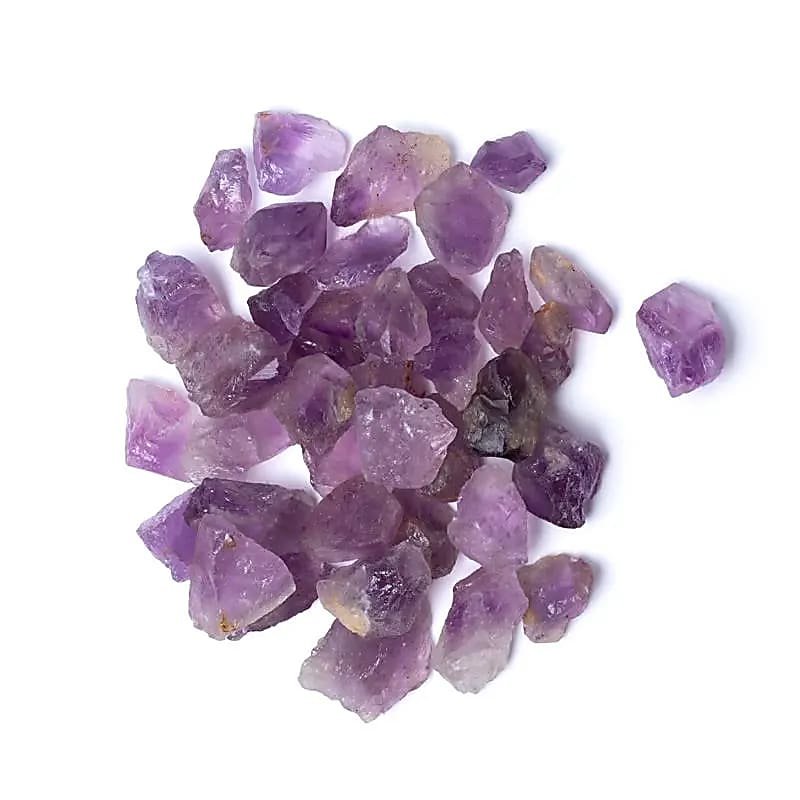
Researchers at the China University of Geosciences described an experiment in Scientific Reports in 2020 in which 20 amethyst samples from South Africa were heated from 300 to 600 °C, the temperature being raised by 20 degrees each time and held for 10 minutes4. Up to 420 °C, the purple colour gradually became lighter until the samples were almost colourless. From 420 to 440 °C, the prasiolite stage began, and above 440 °C the amethyst became citrine. The researchers concluded that the most suitable temperature for obtaining citrine is about 560 °C and that darker amethyst changes more when heated4. GIA adds that how saturated the resulting yellow is depends on the original tone of the amethyst2. In an experiment described in the GIA journal Gems & Gemology in 1981, Brazilian amethyst was heated for two hours, and the lighter parts turned yellow at 400 °C and all of it at 450 °C11. There is no single right temperature, because amethysts differ by deposit and original colour3,4.
Did you know? Gem-A writes that citrine in jewellery became far more common after amethyst deposits were found in Brazil at the start of the 19th century, because these citrines were heated amethysts3. A 1994 article in the GIA journal states that most market citrine is obtained by heating amethyst from the Marabá deposit in Brazil or from the state of Rio Grande do Sul and from Uruguay12. Large amethyst geodes from Brazil’s basalt fields are often heated in industrial furnaces and sold as citrine geodes or “cathedrals”1,6.
How can you tell heated citrine from natural citrine by appearance?
The first sign is the tone. Citrine produced by heating usually has far more orange or reddish tones, while natural citrine is most often pale yellow8. The magazine Rock & Gem describes the colour of natural citrine as pale yellow to soft golden honey, but considers a bright orange, reddish-brown or “burnt” tone a strong sign of heated amethyst7.
The second sign is the distribution of colour. In heated amethyst, the colour distribution typical of amethyst remains: the colour is more intense at the crystal tip, weaker at the base. In natural citrine, the colour is much more even throughout the crystal3. That is why a druse of heated amethyst often has a white or milky base with bright orange points7. Keep this in mind when looking at druses and geodes. Large geodes labelled as citrine are almost always heated amethysts6,8, while natural citrine, as Rock & Gem writes, is more often found as individual crystals or small groups7. A white base alone is not proof: even natural crystals from the Anahi mine usually have a milky base, and the colour becomes darker towards the tip12.
| Feature | Natural citrine | Heated amethyst |
|---|---|---|
| Tone | Pale to honey yellow, sometimes smoky3,7 | Saturated orange, reddish or reddish-brown7,8 |
| Colour distribution | Even throughout the crystal3 | More intense at the tips, weaker at the base3 |
| Druses and geodes | More often individual crystals or small groups7, base can be milky12 | Orange tips on a white or milky base, large geodes6,7 |
| Dichroism (with a dichroscope) | Weak to moderate, in two yellow tones3,12 | None3 |
| Inclusions and twinning | No features typical of amethyst | May have “tiger stripes” and Brewster bands3 |
| Availability | Rare1 | Most of what is on the market1 |
These features point to probability, not proof. A pale tone alone does not prove natural origin: GIA notes that lime-coloured citrine can be made by heating smoky quartz2, and chips of heated amethyst can also be pale yellow. General tests against glass and dyed stones are described in the article How to Recognize a Real Crystal.
What can only a gemmologist or laboratory determine?
A gemmologist’s main tool is the dichroscope. Gem-A writes that natural citrine is usually dichroic: from different directions, it appears in two slightly different yellow tones. Heated amethyst does not have this property. Lemon quartz, obtained from smoky quartz, shows weak yellow and yellow-green dichroism3.
The second tool is magnification and polarised light. Amethyst often has characteristic inclusions called tiger stripes, and it may grow as a twin of right- and left-handed quartz forms (the so-called Brazil law). In polarised light, symmetrical triangular patterns of dark bands, Brewster bands, are visible along the crystal axis. If these are seen in citrine, it may indicate heated amethyst3.
Synthetic citrine is harder. It has been grown by the hydrothermal method since the 1970s, and it is hard to tell apart using traditional gemmological instruments3. The main source of synthetic citrine is Russia, and many laboratories have equipment that can reliably distinguish natural from synthetic citrine6. Citrine is also imitated with glass and coated rock crystal3, glass ceramics, and synthetic corundum6.
Did you know? The colour of natural citrine is stable only under certain conditions. Gem-A writes that natural citrine can lose its colour above 350 °C3, but in a study described in the GIA journal, natural citrine from the Anahi mine lost its colour completely at 450 to 500 °C12. Do not put citrine in a sauna stove either, and for sunlight see our care table.
Why does natural citrine cost more?
The main reason is rarity. GIA writes that natural citrine is rare and most citrine on the market is heated amethyst1. Heating is relatively simple and effective3, and Geology.com calls it cheap. It adds that some buyers specifically look for citrine of natural colour and are willing to pay more for it6.
Colour also affects the price. Pale stones are common and inexpensive, but stones with saturated, even colour are rare and valuable6. Gem-A writes that the most valued is a saturated reddish-orange tone3, while GIA names a deep, brownish or reddish orange as the most popular at present1. Since a bright orange tone often indicates heating7, a beautiful colour alone does not tell you how rare the stone is.
Geology.com recommends that the seller inform the buyer if the origin of the colour is known, and honestly answer “we do not know” if it is not6. For what jewellery guidelines say about disclosing treatments, see the article on the features of a real crystal.
How is citrine named in our shop?
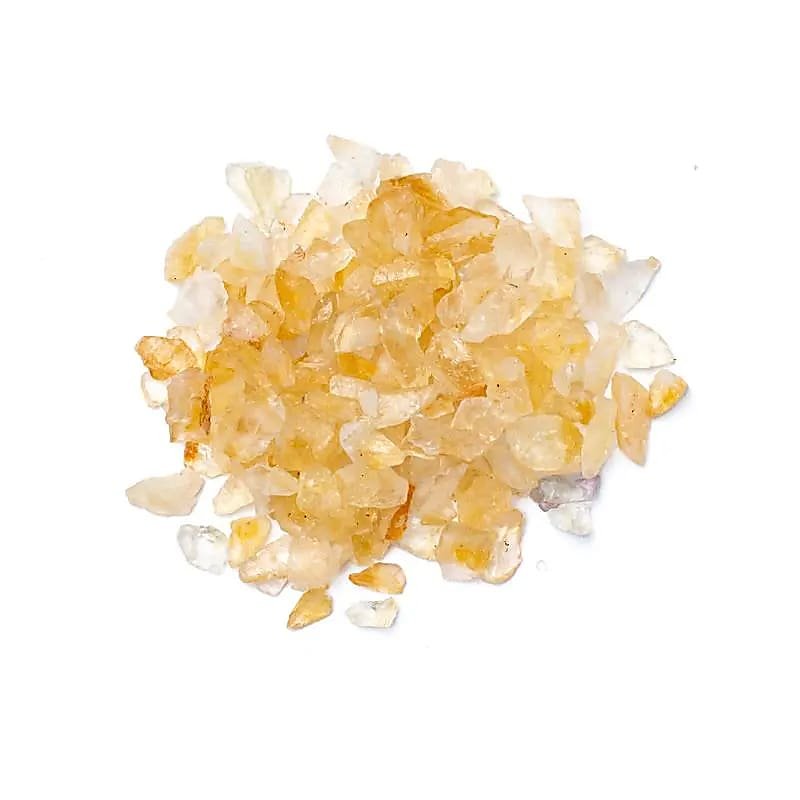
In our shop, raw citrine chips of 0.5 to 1.5 cm from Brazil are named “Citrine (Heat-Treated Amethyst)”. Currently (20 November 2026), 20 g costs €3.00, 50 g €5.50, 100 g €9.00, and 250 g €16.00. In the photo their colour ranges from pale yellow to golden, with some nearly colourless pieces.
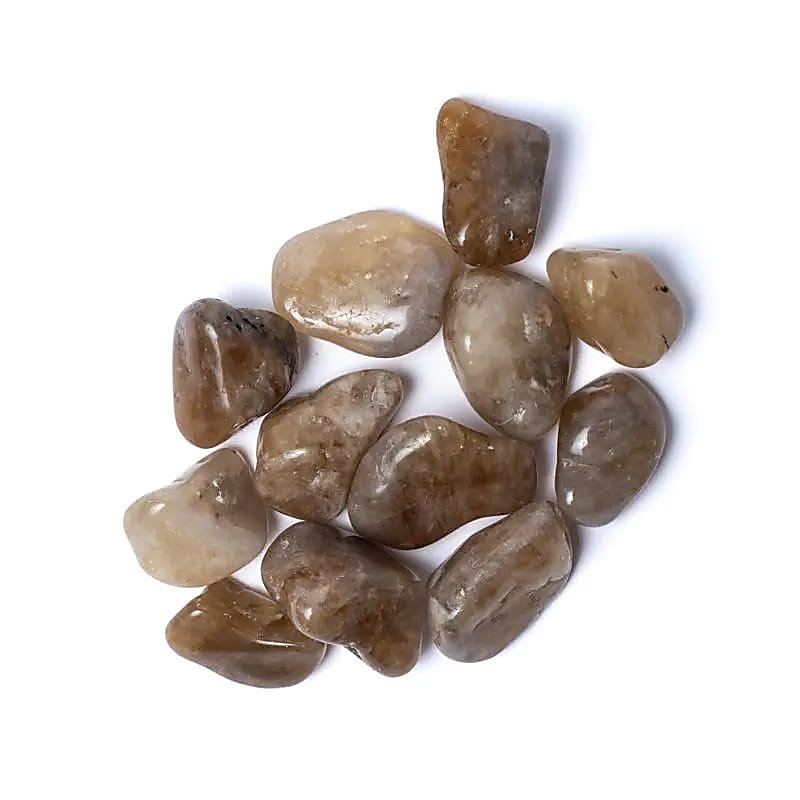
The polished citrine 4 to 5.5 cm, also from Brazil, currently costs €15.00 per piece. In the photo, its tone is smoky honey yellow, without a reddish hue. The product page does not specify the origin of the colour, and it cannot be determined by appearance alone, since citrine can also be made by heating smoky quartz2,8. You can ask us about the origin of a specific stone before purchase. Both products can be found in the Citrine section, and the encyclopedia page about citrine contains information about its deposits, hardness, and care.
In the crystal community, citrine is traditionally associated with joy and abundance, and many choose it for its sunny colour. It is also the November birthstone; read more in the article about birth month stones.
Where does the word “citrine” come from and what is ametrine?
Gem-A writes that the word citrine, for yellow quartz, was first written down by the German mineralogist Georg Bauer, better known as Georgius Agricola3,9. In his work “De Natura Fossilium” (1546), he wrote that in the light this quartz is yellow like the citrus fruit citron, so gem dealers call it citrina3. For the roots of the word, French citrin and Latin citrus, see also the article about stone names. Because of its yellow colour, citrine was long confused with topaz1.
Did you know? In Bolivia, amethyst and citrine colours can occur in the same crystal. Such two-coloured quartz is called ametrine, a word formed from “amethyst” and “citrine”1,6. Most of the ametrine mined commercially in the world comes from the Anahi mine in eastern Bolivia near the Brazilian border, which has been operated since 1989 by the company Minerales y Metales del Oriente6,12. Anahi is also one of the rare natural citrine deposits3,12.
Frequently asked questions
Is heated citrine a real crystal?
Yes. It is natural quartz, amethyst whose colour has been changed by heat. In strict gemmological terms, it is not citrine, so an honest seller states the treatment, for example in the name “citrine (heat-treated amethyst)”.
How can you recognise natural citrine?
Natural citrine is usually pale yellow or smoky yellow, and the colour is even throughout the crystal. A bright orange or reddish tone and colour concentrated at the tips often indicate heated amethyst. A gemmologist or laboratory can give a more reliable answer.
At what temperature does amethyst turn into citrine?
Sources differ. Gem-A mentions 250 to 500 °C depending on the type of amethyst. In the experiment described in the GIA journal, with two hours of heating, amethyst turned yellow at 400 to 450 °C, while in a 2020 study, with 10 minutes of heating, it did so above 440 °C, and the most suitable temperature was about 560 °C.
Why does a citrine druse have a white base?
Most often because it is a druse of heated amethyst. In amethyst crystals the colour is more intense at the tips than at the base, and this distribution remains after heating, so the tips turn orange while the base stays pale. A milky base can also occur in natural crystals, so it is not proof on its own.
Is natural citrine more expensive than heated citrine?
Usually yes, because natural citrine is rare and some buyers specifically seek natural colour. The price is also affected by colour saturation, clarity and size.
Sources (12)
- ↩ GIA (Gemological Institute of America), Citrine: www.gia.edu/citrine
- ↩ GIA, Citrine Quality Factors: www.gia.edu/citrine-quality-factors
- ↩ J. Hibou, Gem-A, “Understanding and Testing for Rare Natural Citrine”, 1 July 2022: gem-a.com
- ↩ R. Cheng, Y. Guo, “Study on the effect of heat treatment on amethyst colour and the cause of colouration”, Scientific Reports 10, 14927 (2020): doi.org/10.1038/s41598-020-71786-1
- ↩ G. R. Rossman, “The coloured varieties of the silica minerals”, Reviews in Mineralogy 29 (1994), Caltech: authors.library.caltech.edu/39062
- ↩ Geology.com, What Is Citrine: geology.com/gemstones/citrine
- ↩ Rock & Gem, Citrine Quartz Field Guide (2026): www.rockngem.com
- ↩ Amethyst Galleries, Citrine: galleries.com
- ↩ University of California Museum of Paleontology (Berkeley), Georgius Agricola (1494-1555): ucmp.berkeley.edu
- FREQUENCIES stone encyclopaedia, Citrine: frequencies.lv/enciklopedija/citrins
- ↩ K. Nassau, “Artificially Induced Colour in Amethyst-Citrine Quartz”, Gems & Gemology 17 (1), 1981, GIA: gia.edu (PDF)
- ↩ P. M. Vasconcelos, H.-R. Wenk, G. R. Rossman, “The Anahí Ametrine Mine, Bolivia”, Gems & Gemology 30 (1), 1994, GIA: gia.edu (PDF)