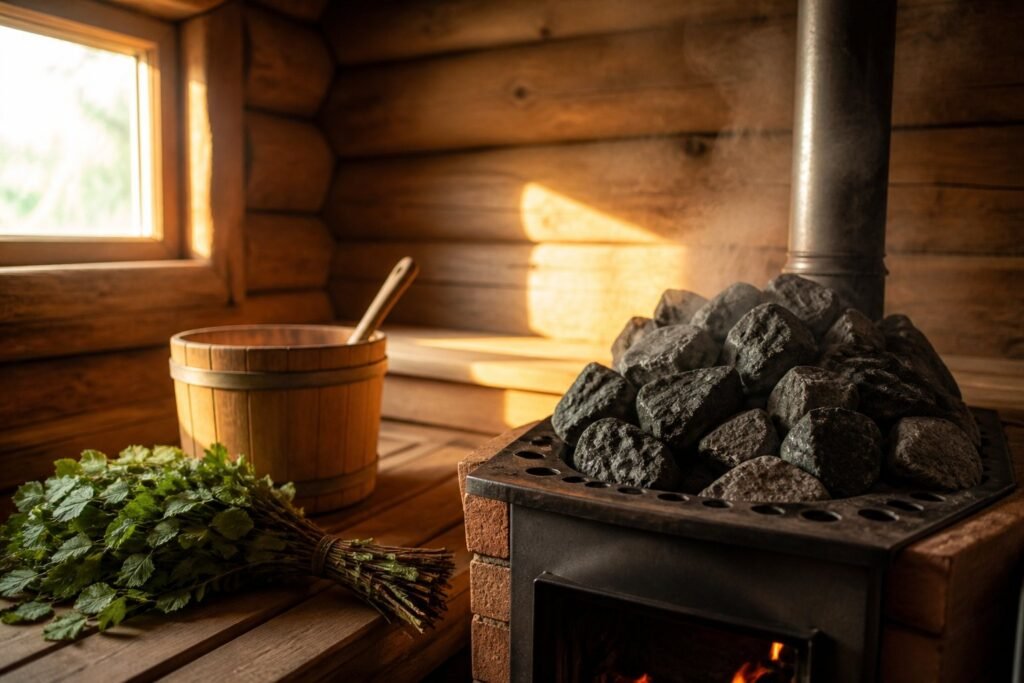
The Finnish heater manufacturer Harvia calls olivine diabase the most widely used sauna stone, and 40 to 70% of diabase is usually made up of the same mineral that crystal lovers know from the shelf as labradorite [1][2]. Yet in the heater this rock stands up to heat and water for a long time, while polished labradorite should be protected from sudden changes in temperature. The difference is explained by geology, above all by grain size, but for a sauna stone the density of the rock and the amount of quartz in it also matter.
What Sauna Stones Are Called and What Tradition Says About Them
In 2022 the Terminology Commission of the Latvian Academy of Sciences approved 17 sauna terms. One of them is pirts gars, literally “the spirit of the sauna”: the steam that rises in the steam room when water is poured onto the hot stones of the sauna heater. The water poured onto the stones is called pirts gara ūdens [3]. In 2025 the sauna tradition was added to Latvia’s National List of Intangible Cultural Heritage, and its description defines the Latvian sauna (pirts) as a building or room with a steam room, a bench (lāva) and a wood-fired stove with a heap of stones [4].
The tradition is an old one. The archaeologist Guntis Zemītis mentions evidence of a sauna at Talsi hillfort, which was inhabited from the 11th to the 14th century, while the earliest written records are in two 13th-century chronicles, the Livonian Chronicle of Henry and the Livonian Rhymed Chronicle. The folk song catalogue dainuskapis.lv holds more than 300 songs about the sauna, for example “Paldies, paldies pirts kūrējam / Paldies ūdens nesējam” (“Thank you, thank you to the one who heated the sauna / Thank you to the one who carried the water”) [4]. The heritage description stresses that in the Latvian tradition it is the stones of the stove that keep up the pirts gars, and that in many places people still choose local stones rather than bought volcanic rocks [4]. In shops and search engines, sauna stones are usually named after the rock: olivine diabase, gabbro-diabase, peridotite, vulcanite or jadeite.
Did you know? Finnish sauna culture was inscribed on the UNESCO Representative List of the Intangible Cultural Heritage of Humanity in 2020. Finland has 3.3 million saunas for 5.5 million people, and the Finns call the steam that comes from pouring water on the stones löyly [5]. The smoke sauna tradition of Võromaa, the Võru region of Estonia, had already been added to the same list in 2014 [6].
What a Sauna Stone Has to Withstand
In one fire safety test, the stones of an electric sauna heater reached about 320 °C in normal operation, but up to 427 °C when the thermostat and overheat protection had been disconnected [7]. In a sauna, water is poured onto the hot stones, and their surface cools rapidly. In a study of granite, rapid cooling damaged the rock far more than slow cooling, because it caused severe thermal shock [8]. Harvia writes that, because of the large swings in temperature, sauna stones slowly and gradually break down in use [2].
The second requirement is storing heat. The specific heat capacity of rocks is similar: about 0.84 kJ/(kg·K) for basalt and about 0.79 kJ/(kg·K) for granite [9], roughly five times lower than that of water, at about 4.18 kJ/(kg·K) [10]. So for the same volume in the heater, a denser stone stores more heat. Granite has a density of 2.6 to 2.8 g/cm³, sandstone only 2.1 to 2.4 g/cm³ [11], and the Finnish manufacturer puts the ability of olivine diabase to store and release heat well down to its high density [2].
Diabase and Gabbro: Labradorite’s Relatives in the Heater
Diabase is a dark grey to black, fine-grained igneous rock that solidified within the Earth’s crust without reaching the surface. In composition it is close to basalt and gabbro. In the United Kingdom it is called dolerite. Most of a diabase is usually made up of the plagioclase feldspar labradorite and the rest mainly of pyroxenes, most often augite, and some diabases also contain a little olivine [1].
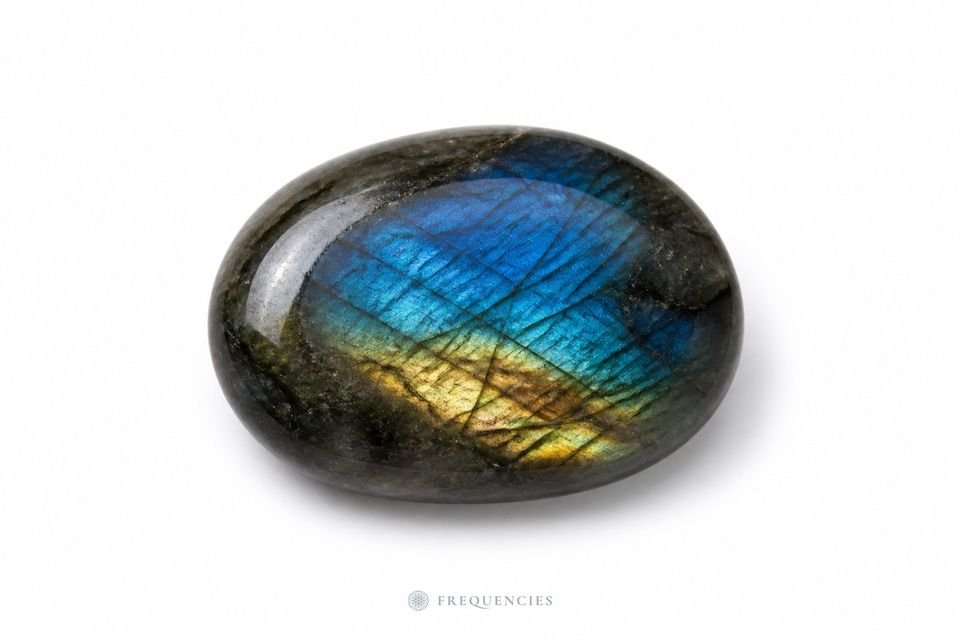
Labradorite has a pronounced cleavage, so polished stones should be protected from knocks and sudden changes in temperature [12]. In diabase the mineral grains are smaller than two millimetres and closely intergrown, so cleavage does not usually affect the strength of the rock to any great extent [1]. The same mineral that needs careful handling on the shelf becomes, in fine grains, part of a tough rock.
Gabbro is a coarse-grained rock of similar composition: plagioclase, usually labradorite or bytownite, and pyroxenes, most often augite. It is the most common rock in the deepest part of the oceanic crust, and polished gabbro is sold under the name “black granite” [13]. The name gabbro-diabase refers to a rock whose texture lies between that of gabbro and diabase [14]. Harvia sources its olivine diabase in Western Finland and checks its quality together with the Geological Survey of Finland, and stones intended for heavily used public saunas are pre-heated to about 1000 °C [2].
Peridotite: A Stone from the Earth’s Mantle
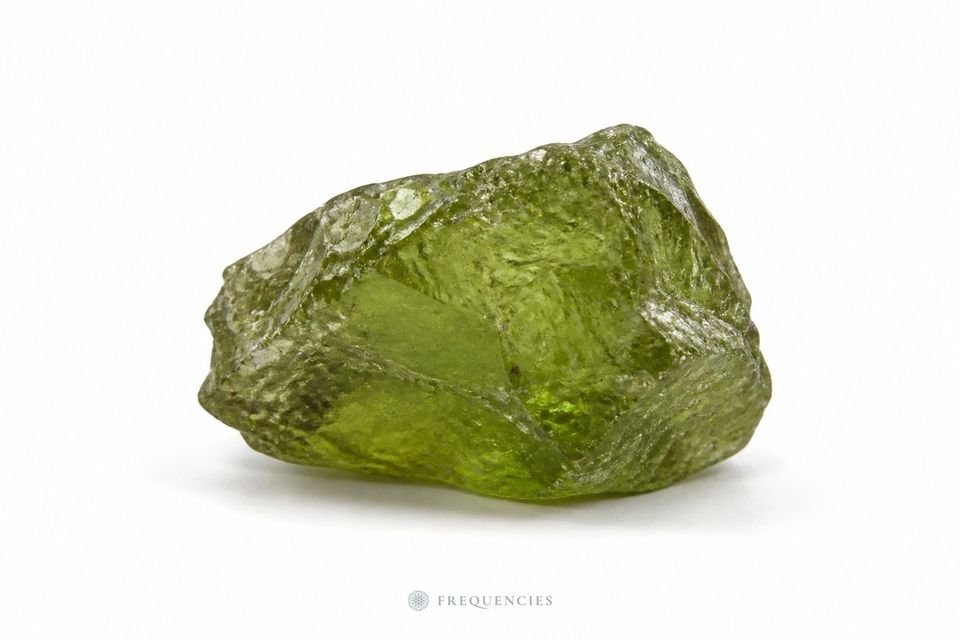
Peridotite is a coarse-grained, dark igneous rock whose main mineral is olivine. It contains very little quartz or feldspar, and for a non-metallic rock it has a high specific gravity. Geologists believe that much of the Earth’s mantle is made of peridotite [15]. The gem variety of olivine is peridot, which also forms in the Earth’s mantle and reaches the surface in volcanic rocks [16].
The Finnish Sauna Society (Suomen Saunaseura) uses black peridotite in its saunas, and the society’s head stoker, Ari-Pekka Paavola, describes it as a durable stone that stores heat well [17]. Harvia’s instructions name peridotite, olivine diabase, olivine and vulcanite as suitable materials for sauna stones, and only split or rounded stones may be put in the heater [18].
Jadeite: What This Name Means in a Sauna Stone Shop
The word “jade” is used for two different minerals: nephrite, which is an amphibole, and jadeite, which is a pyroxene. They were formally told apart only in 1863 [19]. Both are made of tiny, interlocking crystals, which is why GIA describes them as extremely tough [20]. Jadeite has a hardness of 6 to 7 on the Mohs scale and a density of 3.24 to 3.43 g/cm³, and in massive form it is very resistant to breaking [21]. For comparison, granite has a density of 2.6 to 2.8 g/cm³ [11]. Density and resistance to breaking are exactly what is wanted in a sauna stone too.
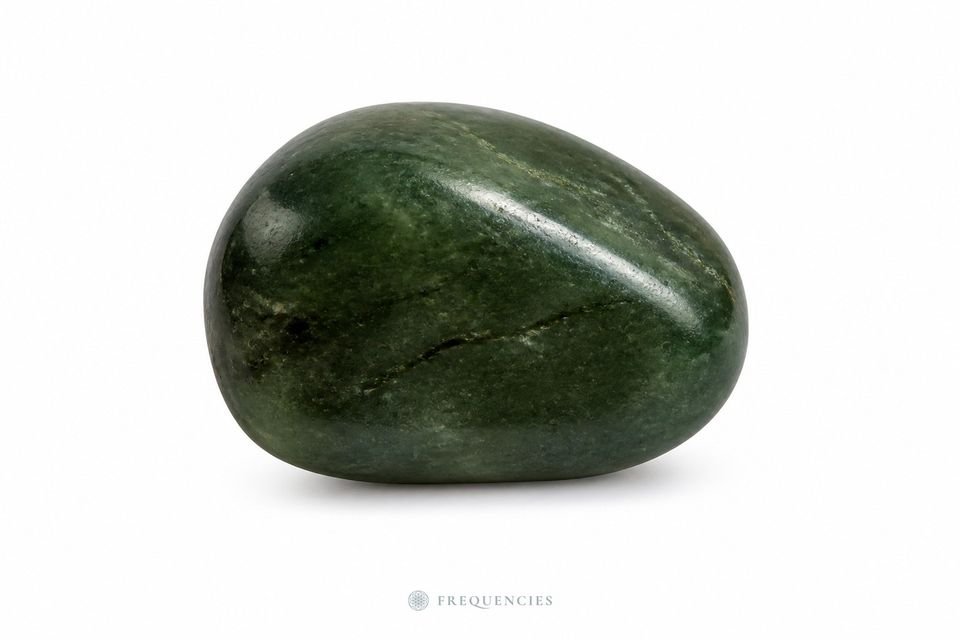
In a sauna stone shop, however, the name “jadeite” does not tell you how much of the mineral jadeite a particular stone contains or where it comes from, so it is worth asking the seller. Jadeite is not on Harvia’s list of suitable materials [18], so the instructions of your own heater’s manufacturer are what count. How to tell a natural stone from an imitation is explained in the article How to Recognise a Real Crystal.
Why Quartz and Granite Crack in the Heat
In a crystalline rock each mineral expands differently when heated, and this difference creates microcracks. In a study published in 2023, Devon granite from the United Kingdom containing 40% quartz was heated to various temperatures up to 800 °C. At just 200 °C the number of microcracks more than doubled. At 573 °C quartz changes from its α form to its β form, its volume changes abruptly and the number of cracks rises sharply. After heating to 800 °C, the tensile strength of the granite fell from 9 to less than 3 megapascals [22].
In the heater test mentioned above, the stones did not reach the 573 °C mark even with the thermostat disconnected [7], but microcracks in granite form at much lower temperatures [22], and the thermal shock caused by water makes the damage worse [8]. Granite consists mainly of quartz and feldspar [23], and Harvia offers red granite only as a decorative top layer, no more than one box per heater [2]. Quartzite consists almost entirely of quartz grains [24], and it is not on the manufacturer’s list of suitable materials [18].
Rock crystal, rose quartz, amethyst and citrine are varieties of quartz (SiO₂) [25]. Heat changes quartz in other ways too: most of the citrine on the market is heat-treated amethyst [26]. That is why rock crystal and rose quartz specimens belong on the shelf, not in the sauna heater.
Red Quartzite: Is Quartzite Suitable for a Sauna Heater
Quartzite is a rock, not a mineral. It usually forms when quartz-rich sandstone recrystallises during metamorphism [24]. In the Lithuanian Universal Encyclopedia (VLE), quartzite is a metamorphic rock containing more than 75% quartz [33], but Mindat adds that the name is also used for very hard, silica-cemented sandstone that has not been through metamorphism [34]. So the name alone does not tell you how a particular stone was formed. How quartzite forms and where to find it among Latvia’s field boulders is explained in the article Types of Rocks.
Red quartzite is coloured by iron, although the rock is usually white or grey [24]. Napoleon’s sarcophagus in Paris was made of red Shoksha quartzite from the shore of Lake Onega in Karelia [35]. On the crystal shelf quartzite often goes by another name: much of the material sold as aventurine is in fact quartzite [24], and red aventurine owes its reddish-brown tone to inclusions of hematite or goethite [36]. You will find all the varieties in the aventurine category.
Quartzite can withstand very high temperatures. VLE writes that it is used as a refractory material up to 1770 °C and as a building material with a compressive strength of 100 to 455 megapascals [33]. Quartzites are also used to make silica refractories, which bear loads well at high temperatures [37]. Britannica, however, writes that a refractory material must also withstand thermal shock, which occurs when a hot object is cooled rapidly [37], and in a sauna this happens every time water is poured onto the stones.
The weak point is the quartz itself, because its crystals expand differently in different directions. In a numerical model published in 2024, in which the quartzite consisted only of quartz, heating produced microcracks along the crystal boundaries, and above 200 °C the strength of the rock fell sharply [38]. In the fire safety test mentioned above, the stones of an electric heater reached about 320 °C in normal operation [7], well above this threshold. A high compressive strength does not mean that a stone will stand up to heating and splashes of water for long.
So put red quartzite in the heater only if it is sold specifically as a sauna heater stone and your heater manufacturer’s instructions allow it [18]. Do not put quartzite pebbles from a field or a beach in the heater: as with other field stones, their composition and hidden cracks are unknown.
River and Field Stones: Why They Are a Lottery
Latvia’s field boulders were brought by the glacier from Scandinavia, from the bed of the Baltic Sea and to a large extent from the territory of Estonia, and they include igneous, metamorphic and sedimentary rocks [27]. It is hard to judge the composition and hidden cracks of such a stone from its appearance. Paavola calls shore stones mere decoration: they crack easily and do not give good steam [17].
Limestone can also bring surprises. In 2020 Spanish researchers published an experiment in which they heated dark grey limestone containing pyrite, and from 400 °C upwards some samples exploded: the pyrite oxidised and released sulphur dioxide, which, together with the microcracks, rapidly raised the pressure inside the rock [28]. In the test with the thermostat disconnected, the heater stones reached 414 to 427 °C [7], so temperatures like these are possible in a faulty heater. Pyrite is a beautiful stone in a collection, but it too should be kept dry, because it oxidises in damp conditions [29]. If you like stones in their natural form, take a look at the raw stones.
How to Stack the Stones and When to Replace Them
Harvia recommends rinsing the dust off the stones before stacking them, not dropping them into the heater, stacking them evenly and loosely so that air can flow between them, placing elongated stones upright and not piling a high heap above the heater. The stones should be restacked at least once a year, and more often in a heavily used sauna. To check them, knock the stones against each other: if they crack and sound hollow, replace them, and clear the crumbled pieces out of the bottom of the heater [2]. The head stoker of the Finnish Sauna Society recommends replacing the stones of an electric heater every year and a half if the sauna is heated once a week, and at the latest when crumbled stone appears on the floor [17].
It is also a safety issue. In December 2023 Yle, Finland’s public broadcaster, reported on a fire in Hakunila in which five people died. The police named a damaged heater as the cause: the back wall of the stone compartment had bulged almost as far as the outer metal wall of the heater and blocked the cooling air gap. An expert from SPEK, the Finnish National Rescue Association, pointed out that in practice damage like this can only be noticed when the stones are restacked or replaced [30]. The size and amount of stones for each heater are set out in its instructions [18].
Which Crystals at Home Need Protecting from Heat and Steam
A sauna heater needs a dense, durable rock, but the heat and steam of a sauna are not suitable for a crystal collection. Opal contains water, and heat, very dry air or bright direct light can cause a network of fine cracks in it, so clean it only with lukewarm soapy water, without ultrasound or steam. Iolite has a distinct cleavage in one direction, so protect it from knocks, high heat and sudden changes in temperature. Fluorite is soft, with a hardness of 4, and should not be left in water for long [31]. A rock crystal sphere can focus the sun’s rays like a lens and set nearby objects alight, so do not put it on a sunny windowsill or near curtains [32].
Nor is the steam room any place for decorative stones such as selenite and amethyst. Selenite is gypsum with a hardness of 2 that slowly dissolves in water (about 2 g/l), so keep it dry and do not wash it [41]. Heat changes gypsum even more: heated to 120 to 180 °C, it loses part of its water of crystallisation. This is how plaster of Paris is made, a fine white powder that sets hard again after being moistened and left to dry [40]. The violet colour of amethyst comes from colour centres that heat destroys [39], so heated amethyst loses its colour, and if heated more strongly it turns yellow [42]. Mindat also warns that quartz crystals with large fluid or gas inclusions can crack when heated [39]. So the better place for selenite rods and amethyst clusters is a dry room, not the steam room.
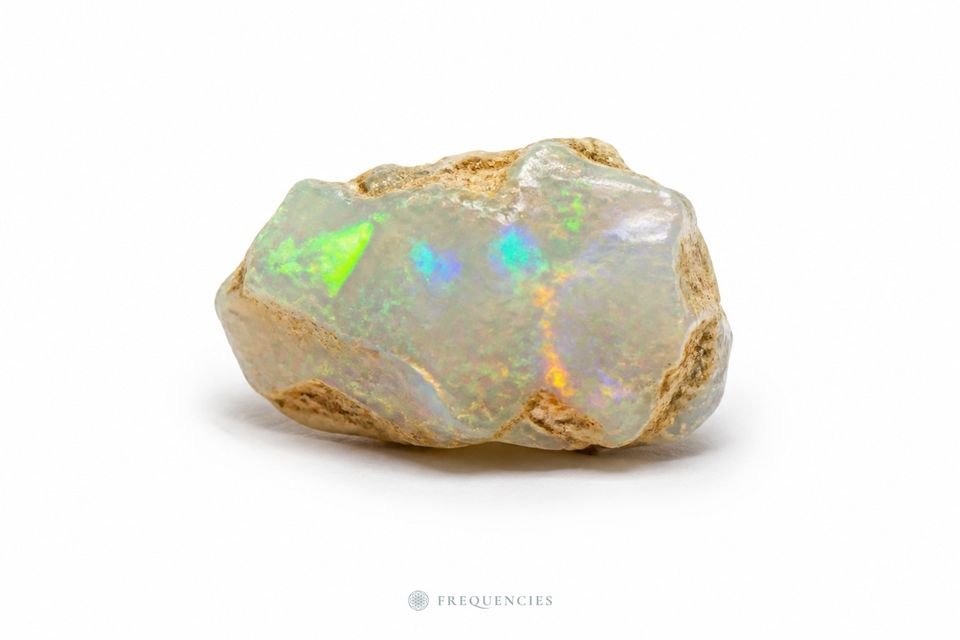
Care tips for all our stones are gathered in one place in our care table. If you would like to have in your collection the mineral that makes up most of the diabase in a sauna heater, take a look at our labradorite stones and compare them with the stones in your own sauna heater.
Frequently Asked Questions
What are sauna stones called?
In the trade, sauna stones are usually named after the rock: olivine diabase, gabbro-diabase, peridotite, vulcanite or jadeite. In Latvian, the steam that rises when water is poured onto hot heater stones is called pirts gars, “the spirit of the sauna”.
Which sauna stones should I choose?
The ones your heater manufacturer recommends. Harvia’s instructions list peridotite, olivine diabase, olivine and vulcanite as suitable, and only split or rounded stones go in the heater, while the size and amount are set out in the heater’s instructions.
Can river or field stones be put in a sauna heater?
It is not recommended. Latvia’s field boulders are very varied rocks of unknown composition, and the head stoker of the Finnish Sauna Society regards shore stones as mere decoration, because they crack easily.
How often should sauna stones be replaced?
Harvia recommends restacking the stones at least once a year and replacing any that have broken down. The head stoker of the Finnish Sauna Society recommends replacing the stones of an electric heater every year and a half if it is heated once a week, and sooner in a sauna that is used more often.
Are jadeite and nephrite the same?
No. Both are called jade, but jadeite is a pyroxene and nephrite is an amphibole, and they were formally told apart in 1863. Both are very tough, because they are made of tiny, interlocking crystals.
Why do sauna stones crack?
The stones heat up every time and cool rapidly when water is poured on them, but different minerals expand differently. This creates microcracks in the rock, and Harvia notes that because of the large swings in temperature even suitable stones gradually break down in use. In the fire safety test, the stones of an electric heater did not reach 573 °C, the temperature at which quartz changes form.
What is red quartzite?
Red quartzite is a rock made mainly of quartz grains, and it is coloured red by iron. Napoleon’s sarcophagus in Paris was carved from red Shoksha quartzite quarried in Karelia.
Can quartzite be put in a sauna heater?
Only if your heater manufacturer’s instructions allow it as a sauna stone. Quartzite is refractory, but a sauna stone must also withstand rapid cooling when water is poured on it, and in a numerical model heating produced microcracks even in a rock made of pure quartz. Quartzite is not on Harvia’s list of suitable materials.
Sources
- geology.com: Diabase: A dark-colored, fine-grained intrusive igneous rock
- Harvia (Finnish sauna heater manufacturer): Harvia sauna heater stones
- Terminology Commission of the Latvian Academy of Sciences (LZA), Decision No. 102, 12.04.2022 (Likumi.lv): Par pirts terminu saraksta apstiprināšanu [On approving the list of sauna terms]
- Latvian National Centre for Culture, National List of Intangible Cultural Heritage: Pirts tradīcija Latvijā [The sauna tradition in Latvia] (2025)
- UNESCO Intangible Cultural Heritage lists: Sauna culture in Finland (2020)
- UNESCO Intangible Cultural Heritage lists: Smoke sauna tradition in Võromaa (2014)
- Formby S., Burgoynes (fire investigation engineers), 2010, updated 2017: Sauna Fires
- Kumari W. G. P. et al., Geomechanics and Geophysics for Geo-Energy and Geo-Resources, 2019 (Monash University): An experimental study on tensile characteristics of granite rocks exposed to different high-temperature treatments
- The Engineering ToolBox: Specific Heat of Solids
- The Engineering ToolBox: Water: Specific Heat vs. Temperature
- The Engineering ToolBox: Densities of Solids
- FREQUENCIES stone encyclopedia: Labradorite
- geology.com: Gabbro: Igneous Rock
- Wikipedia (in Russian): Габбро-диабаз
- geology.com: Peridotite: Igneous Rock
- FREQUENCIES stone encyclopedia: Peridot
- Lammi M., Taloustaito.fi, 26.04.2018 (Ari-Pekka Paavola, stoker at the Finnish Sauna Society): Miten usein kiuaskivet pitää vaihtaa? [How often should sauna stones be changed?]
- Harvia, supplement to the instructions on suitable sauna heater stones (PDF on a distributor’s website, also in Latvian): Harvia WKLI22GESM Manual
- FREQUENCIES stone encyclopedia: Nephrite
- GIA (Gemological Institute of America): Jade Description
- Handbook of Mineralogy, Mineral Data Publishing (Mineralogical Society of America): Jadeite
- Alcock T., Bullen D., Benson P. M., Vinciguerra S., Heliyon 9, e13871, 2023: Temperature-driven micro-fracturing in granite: The interplay between microstructure, mineralogy and tensile strength
- geology.com: Granite: Igneous Rock
- geology.com: Quartzite: Metamorphic Rock
- FREQUENCIES stone encyclopedia: Quartz
- FREQUENCIES stone encyclopedia: Citrine
- LSM.lv, 10.05.2021 (Ģirts Stinkulis, associate professor at the University of Latvia): Kāpēc pavasarī tīrumos ik gadu rodas jauni laukakmeņi [Why new boulders appear in the fields every spring]
- Martínez-Ibáñez V. et al., Rock Mechanics and Rock Engineering 54, 2021 (online 2020; open access version, Universitat Politècnica de València): Temperature-Induced Explosive Behaviour and Thermo-Chemical Damage on Pyrite-Bearing Limestones: Causes and Mechanisms
- FREQUENCIES stone encyclopedia: Pyrite
- Yle Uusimaa, 21.12.2023: Hakunilan tulipalo opetti, että kiukaan kivet tulisi tarkastaa säännöllisesti [The Hakunila fire showed that sauna heater stones should be checked regularly]
- FREQUENCIES stone encyclopedia (data from GIA, Mindat, geology.com): Crystal care table: water, sun, hardness (opal, iolite, fluorite)
- FREQUENCIES stone encyclopedia: Rock crystal
- Visuotinė lietuvių enciklopedija (Lithuanian Universal Encyclopedia): kvarcitas
- Mindat.org: Quartzite
- Touret J., Bulakh A., 2017: From Russia with rocks: the tombstone of Napoleon
- FREQUENCIES stone encyclopedia: Red aventurine
- Encyclopaedia Britannica: Refractory
- Peng X., Zhou J., Gu K. et al., Geomechanics and Geophysics for Geo-Energy and Geo-Resources 10, 156, 2024: Numerical analysis of the influence of quartz crystal anisotropy on the thermal-mechanical coupling behavior of monomineral quartzite
- Mindat.org: Quartz (colour centres, quartz care)
- Encyclopaedia Britannica: Plaster of paris
- FREQUENCIES stone encyclopedia: Selenite
- FREQUENCIES stone encyclopedia: Amethyst