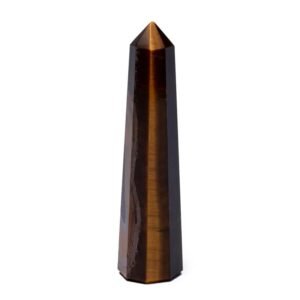
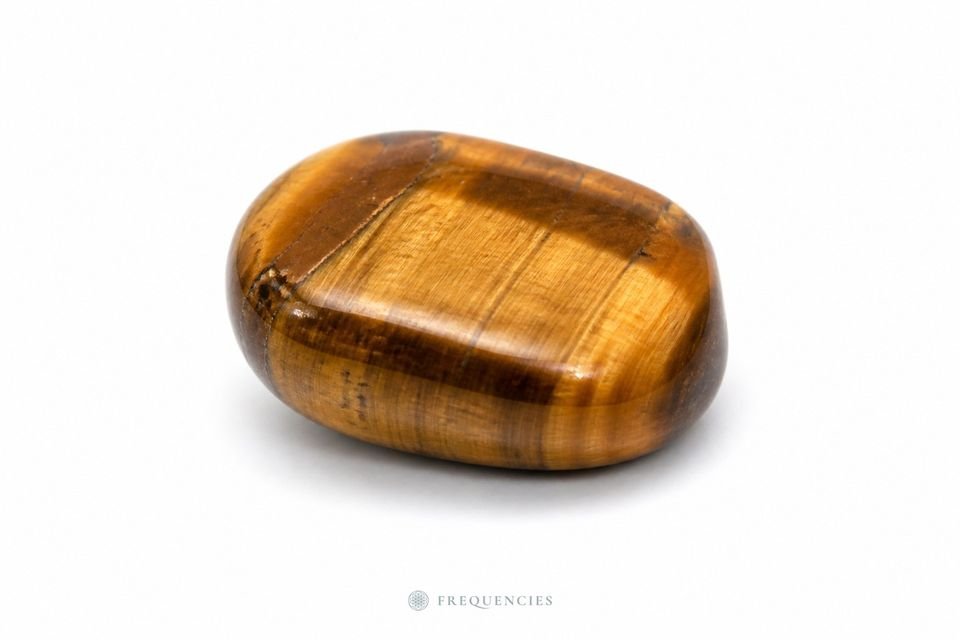
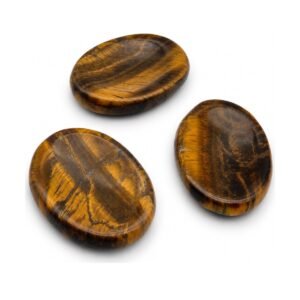
Tiger’s eye is quartz that has formed in place of bluish crocidolite fibres.
Crocidolite is a fibrous asbestos mineral, and quartz gradually replaces it, preserving the fibrous structure. The iron that dissolves in this process colours the quartz in golden-brown tones, but if the replacement is incomplete, the bluish-grey hawk’s eye results.
In 2003 scientists proposed a new explanation for the origin of tiger’s eye.
Peter Heaney and Donald Fisher wrote in the journal Geology that quartz had not entirely replaced the crocidolite: tiger’s eye formed as cracks repeatedly opened and filled with quartz, while the fibres remained enclosed in the quartz. This explanation prompted a scientific discussion, and comments and the authors’ reply were later published in the journal.
The main deposit of tiger’s eye is in the Northern Cape province of South Africa.
The classic specimens come from the upper reaches of the Orange River in western Griqualand, and the volume of these deposits makes tiger’s eye an accessible stone. Less important deposits are in Namibia, Australia, India and Thailand.
Tiger iron and Marra Mamba are relatives of tiger’s eye from South Africa and Australia.
Tiger’s eye tends to form together with hematite or limonite, and this banded material is called tiger iron; it is mined mainly in South Africa and Western Australia. Marra Mamba is a brightly multicoloured tiger’s eye from the Hamersley Range in Western Australia.


 Clear Quartz
 Selenite
 Rose Quartz
 Black Tourmaline