Emerald
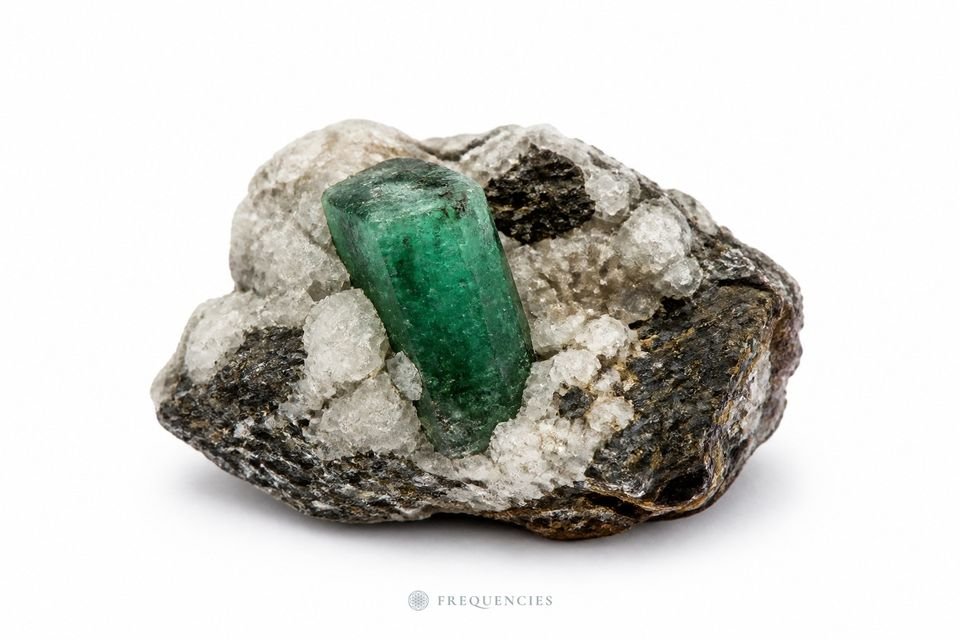
The green variety of beryl

Emerald

The green variety of beryl, traditionally associated with love, loyalty and the heart chakra.

Hardness 7.5-8 May be rinsed in water Protect from direct sunlight Earth
In brief

Emerald is the green variety of beryl, a cyclosilicate with a hardness of 7.5 to 8 on the Mohs scale. Its green colour comes from traces of chromium, vanadium and iron. It is found in Colombia, Brazil, Zambia, Pakistan and Afghanistan. Emerald is the birthstone for May, and in the crystal community it is regarded as a symbol of love, loyalty and growth and is associated with the heart chakra.

Emerald in our shop

Exhibit label

Name
Emerald
Type
Mineral
Mineral group
The green variety of beryl, a cyclosilicate (Be3Al2Si6O18)
Hardness
7.5-8 on the Mohs scale
Colour
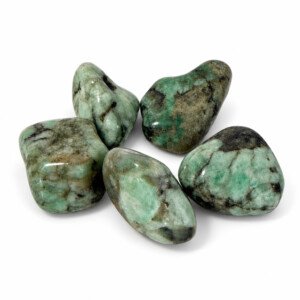
From bluish green to deep green; the colour is determined by traces of chromium, vanadium and iron. Polished commercial stones often have an opaque, deep green tone with inclusions
Main locality
Colombia
Localities
Colombia, Brazil, Zambia, Pakistan, Afghanistan
Planet
Venus (tradition)
Emeralds are very often treated: fissures that reach the surface are filled with oils, waxes or artificial resins to make them less visible (the amount of filler ranges from slight to significant). Paler emeralds with many fissures are also sometimes dyed green, and laboratory-grown emeralds are on the market too. Cheap polished emerald stones are usually opaque, lower-quality material. If you would like to know whether a particular stone is oiled or dyed, ask us.

Mohs hardness scale

7.5-8out of 10

A hard stone: it scratches glass and is durable in everyday wear. Even so, protect it from knocks.

Care

Water

May be rinsed in water

A brief rinse in lukewarm water, then wipe dry.

Sun

Protect from direct sunlight

The colour of emerald is stable in sunlight, but heat and prolonged light can affect the oil or resin filling in the fissures

Storage

Durable in everyday wear

Avoid: ultrasonic and steam cleaners, hot water and heat, harsh chemicals and solvents, strong knocks.

Note. GIA recommends cleaning emerald only with a soft brush in warm soapy water and never using an ultrasonic cleaner, because vibration and heat can force the filler out of the fissures. For dyed stones, cleaning products can dissolve the dye.

In the crystal community, the following are used for cleansing: a brief rinse in lukewarm water, the presence of selenite, sound vibrations, moonlight.

From geology to your shelf

  • How it forms. Emerald is the green variety of beryl, and it is rare because the beryllium needed for beryl and the chromium or vanadium that gives the green colour are usually found in different geological conditions. In Colombia emeralds formed in black organic-rich shale and limestone, where beryllium arrived with hydrothermal solutions, but elsewhere they form in contact metamorphism, where granitic magma meets rocks containing chromium or vanadium.
  • History. The name comes from an ancient Greek word meaning "green" (smaragdos); the first known emerald mines were in Egypt, and Cleopatra wore emeralds in her jewellery. The Incas used emeralds 500 years before the arrival of the Spanish conquistadors in the 16th century.
  • How to recognise a genuine stone.
    • Natural emeralds almost always have inclusions visible to the eye, known as the garden (jardin).
    • Synthetic emeralds are often cleaner and more even than natural ones at the same price, and under the microscope they show signs of growth.
    • The most common imitations are green glass, synthetic spinel, cubic zirconia and YAG.
    • "Yellow emerald" is a misleading name.
  • Treatment and imitations. Most cut emeralds have been treated with oils, waxes, polymers or resins that make fissures harder to notice, and this practice has existed for hundreds of years. Over time the fillers can change colour or break down, and steam or ultrasonic cleaning can wash them out.
  • How to choose. The most highly valued are bluish green to pure green, vividly saturated colours that are not too dark, with even colouring and good transparency. Inclusions visible to the eye are acceptable as long as they do not significantly impair transparency.
  • Traditional meaning

    This is crystal tradition and symbolism, not a scientific or medical claim. The chakras, signs and elements match our product pages.

    Chakras

    Heart Chakra

    Emerald is traditionally associated with the heart chakra, whose symbolic colour is green and which in crystal traditions symbolises love and loyalty.

    Zodiac signs

    ♉︎Taurus♊︎Gemini♈︎Aries

    In crystal astrology, emerald is most often attributed to Taurus, and also to Gemini and Aries; it is also the May birthstone.

    Element

    Earth

    The Earth element traditionally symbolises growth, constancy and a connection with nature, reflected in the deep green tone of emerald.

  • Main symbolism: love, loyalty and growth
  • In crystal traditions it symbolises renewal, wisdom and truthfulness
  • Traditionally associated with warmth of heart, loyalty and balanced relationships
  • Emerald is the May birthstone and a traditional gift for the 20th and 35th wedding anniversaries, because its colour symbolises the fresh green of spring. In the crystal community, emerald is traditionally associated with the heart chakra, the element of earth and the signs of Taurus, Gemini and Aries, and many people keep it close during meditation as a symbol of growth.
  • The traditional meaning of crystals has not been medically proven and does not replace the advice of a professional.

    Stories and legends

    The name emerald comes from an ancient Greek word meaning "green gemstone".

    The name comes from the ancient Greek smaragdos by way of the Latin smaragdus, and its meaning is "green" or "green gemstone". In the 1st century Pliny the Elder wrote in his Natural History that nothing is greener than an emerald.

    The first known emerald mines were in Egypt, and Cleopatra was famous for her passion for emeralds.

    GIA notes that the first known emerald mines were in Egypt and were worked from at least 330 BC until as late as the 18th century. Cleopatra was known for her passion for emeralds and used them in royal jewellery.

    Colombia has historically been the largest producer of emeralds, and the Spanish spread Colombian emeralds around the world.

    The Spanish conquistadors valued gold and silver more highly, so they traded South American emeralds for precious metals, and in this way emeralds reached the rulers of Europe and Asia. Colombia has historically been the largest producer of emeralds, and its main deposits are Muzo, Coscuez and Chivor. Colombian emeralds often contain three-phase inclusions with tiny salt crystals, liquid and a gas bubble.

    The emerald known as the Hooker Emerald was once worn by an Ottoman sultan.

    This 75.47-carat Colombian emerald was worn by the Ottoman sultan Abdulhamid II, set in a belt buckle. In 1911 it was bought at auction by Tiffany & Co., and in 1977 Janet Annenberg Hooker gave it to the Smithsonian Institution as a brooch, which is why the stone bears her name.
    Interesting facts

    • Emerald is a variety of beryl, and its green colour is determined by traces of chromium, vanadium and iron; aquamarine and morganite belong to the same mineral.
    • The first known emerald mines were in Egypt, and Cleopatra was known for her love of emeralds.
    • Emerald is the May birthstone and the gemstone of the 20th and 35th wedding anniversaries; the name comes from the ancient Greek word smaragdos, meaning "green gemstone".

    How to use it

    • Keep emerald on a desk or shelf as a green accent from nature
    • Choose it as a gift for people born in May or for a 20th wedding anniversary
    • Place it next to rose quartz in a spot where you want a warm atmosphere
    • Use it in quiet moments or during meditation as a symbol of the heart chakra

    Pairs well with

    Frequently asked questions

    What does emerald symbolise?

    Emerald symbolises love, loyalty and growth, and it is the May birthstone. In the crystal community it is associated with the heart chakra, the element of earth and the signs of Taurus, Gemini and Aries.

    How can you recognise a genuine emerald?

    By its inclusions. Natural emeralds almost always have inclusions visible to the eye, or a "garden" (jardin), whereas round air bubbles are often visible in green glass. For a valuable emerald, ask for a laboratory certificate that also states any treatment.

    Are emeralds oiled?

    Almost always. In most cut emeralds the fissures are filled with oil (often cedar oil), wax or resin to make them less visible, and this practice is hundreds of years old. An untreated emerald of similar quality is far more valuable.

    Why are emeralds so expensive?

    Because good emeralds are rare. The most highly valued are bluish green to pure green, vivid colours that are not too dark, as well as transparency, size and whether the stone is untreated. Cheap polished emeralds are usually opaque, lower-quality material.

    Is emerald suitable for everyday wear?

    Yes, with care. A hardness of 7.5 to 8 on the Mohs scale protects emerald from scratches, but because of inclusions and fissures it can chip on impact. It is better to take a ring off before sport and manual work.

    Can emerald be put in water?

    Yes, in warm soapy water. GIA recommends cleaning emerald with a soft brush, whereas hot water, steam and ultrasonic cleaners can force oil or resin out of the fissures.

    Can emerald be kept in the sun?

    Better not for long periods. The colour of emerald is stable in light, but heat and prolonged light can alter the oil or resin filling in the fissures, so do not leave jewellery in direct sunlight or next to a heater.

    Do laboratory-grown emeralds exist?

    Yes. Emeralds are grown by the hydrothermal and flux methods, and they have essentially the same chemical, physical and optical properties as natural ones. They can therefore be reliably told apart only in a gemmological laboratory.

    Sources. Mineralogical data: GIA Gem Encyclopedia, Mindat, Encyclopaedia Britannica (frequencies.lv crystal database v2), gia.edu, gia.edu, gia.edu, gia.edu, gia.edu, gia.edu, handbookofmineralogy.org, kerykeion.net, frequencies.lv.
    Further information: gia.edu, gia.edu, gia.edu, gia.edu.
    Shopping Basket
    Scroll to Top