Labradorite
Plagioclase feldspar

Labradorite

Labradorite is a stone traditionally associated with protection, intuition and inner trust.

Hardness 6-6.5 May be rinsed in water Sunlight is not harmful Air
In brief

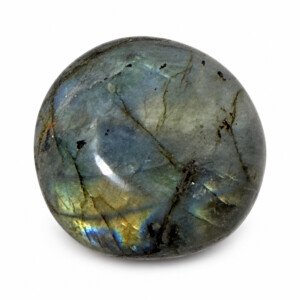
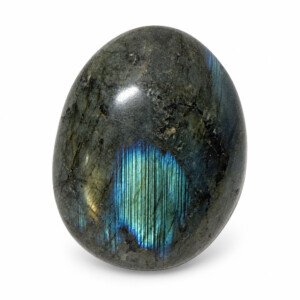
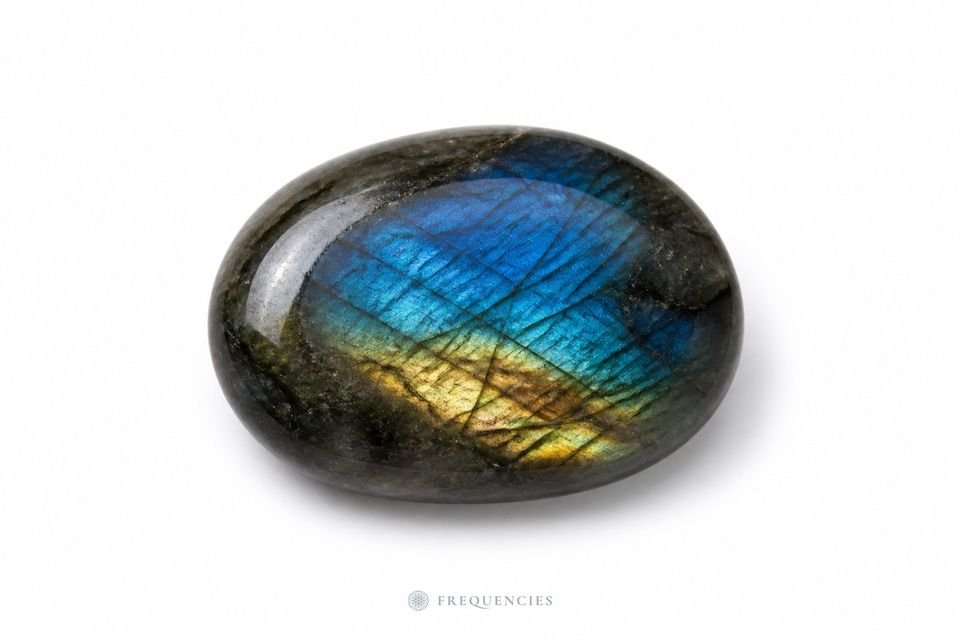
Labradorite is a plagioclase feldspar with a hardness of 6 to 6.5 on the Mohs scale, grey to dark with flashes of blue, green or gold. The shimmer is created by light interference in thin layers inside the stone and is called labradorescence. It is found in Madagascar, Canada and Finland. In the crystal community, labradorite is traditionally associated with intuition and change.

Labradorite in our shop

Exhibit label

Name
Labradorite
Type
Mineral
Mineral group
Plagioclase feldspar, (Ca,Na)(Al,Si)4O8
Hardness
6-6.5 on the Mohs scale
Colour
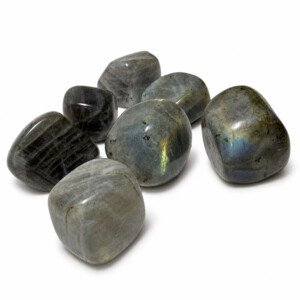
Grey to dark with blue, green or golden flashes of light
Main locality
Madagascar
Localities
Madagascar, Canada, Finland, Russia
Planet
Uranus (tradition)

Mohs hardness scale

6-6.5out of 10

Moderately hard but brittle: it can chip on impact, and harder stones can scratch it. Wear it gently and store it separately.

Care

Water

May be rinsed in water

A brief rinse in lukewarm water, then wipe dry.

Sun

Sunlight is not harmful

May be kept in a bright place.

Storage

Protect from knocks

Avoid: prolonged heat, harsh cleaning agents, strong knocks.

Note. If the stone is porous, dyed or has a softer surface, dry cleaning is the safer choice.

In the crystal community, the following are used for cleansing: a brief rinse under running water, the presence of selenite, sound vibrations, moonlight.

From geology to your shelf

  • How it forms. Labradorite is a feldspar of the plagioclase group. It most often forms in dark igneous rocks such as basalt, gabbro and norite, and it can be the main mineral in anorthosite. It is also found in gneiss formed by the metamorphism of these rocks.
  • Where the colour comes from. Labradorescence arises when light enters the stone and is reflected from thin internal twinning planes; different planes reflect different colours. That is why blue, green, golden or orange flashes appear only at a certain viewing angle.
  • History. It is named after Labrador in Canada, where a Moravian missionary found it in 1770 near Nain. The especially brilliant Finnish labradorite was named spectrolite by the head of the Geological Survey of Finland.
  • How to recognise a genuine stone.
    • The play of colour is uneven and appears or vanishes as the stone is turned; in coated glass the colour is often the same from all angles.
    • The base tone is usually dark grey, with metallic blue, green, yellow or reddish colours shining on it.
    • A transparent, milky bluish stone without true labradorescence may be opalite glass.
  • Treatment and imitations. Labradorite is usually not treated, but andesine coloured with copper by diffusion is sold under the name "red labradorite". Pale, transparent labradorite is sold as "rainbow moonstone".
  • How to choose. The stronger and broader the play of colour, the more valuable the stone; in the best stones the flash is visible when looking straight down, because they are cut parallel to the reflecting layers. Because labradorite has pronounced cleavage, check for cracks and chips.
  • Traditional meaning

    This is crystal tradition and symbolism, not a scientific or medical claim. The chakras, signs and elements match our product pages.

    Chakras

    Third Eye ChakraCrown Chakra

    Labradorite is traditionally associated with the Third Eye Chakra and Crown Chakra, and with inner trust.

    Zodiac signs

    ♌︎Leo♏︎Scorpio♐︎Sagittarius

    In traditional crystal astrology, labradorite is often associated with people who value self-trust and inner balance.

    Element

    Air

    The Air element is traditionally said to give this stone inner trust and a balanced character.

  • Main symbolism: protection and intuition
  • Traditionally associated with protection, intuition and mindful inner work
  • Traditionally associated with self-trust and inner peace
  • In the crystal community, labradorite is traditionally associated with intuition and change, and many people hold it in their hands during meditation while watching the play of colour. Labradorite spheres and slabs are often placed where daylight falls on them, because that is when the shimmer is most visible.
  • The traditional meaning of crystals has not been medically proven and does not replace the advice of a professional.

    Stories and legends

    Labradorite is named after the coast of Labrador in Canada.

    Around 1770, missionaries of the Moravian Church found boulders of this stone in Labrador. The first specimens came from the Nain area and Paul Island, which is still a type locality for labradorite. The name of the stone is a reminder of this Canadian coast.

    The shimmer of labradorite is produced by the interference of light inside the stone.

    Labradorite contains very thin layers of slightly different composition that reflect light and make it interfere, as in a soap bubble. The colour depends on the thickness of the layers, and the effect is visible when the spacing between them is roughly 128 to 252 nanometres. This phenomenon is called labradorescence, and it was named by the Danish mineralogist Ove Balthasar Bøggild.
    Interesting facts

    • Labradorite is named after Labrador in Canada: in 1770 it was found by missionaries on Paul Island near Nain.
    • The play of colour (labradorescence) is produced by the reflection of light from thin twinning layers inside the stone, not from the surface.
    • Labradorite with an especially brilliant play of colour is called spectrolite; this name is used for material from Finnish deposits.

    How to use it

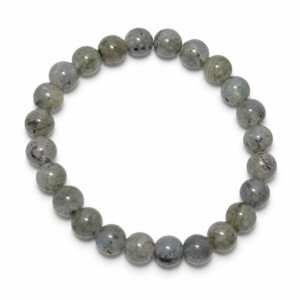
    • Wear it gently as jewellery traditionally associated with protection and intuition

    Pairs well with

    Frequently asked questions

    Why does labradorite shimmer?

    The shimmer is produced by the interference of light in very thin layers inside the stone, as in a soap bubble, and it is called labradorescence. That is why blue, green or golden flashes appear only at a certain angle, as the stone is turned.

    What does labradorite symbolise?

    In the crystal community, labradorite is associated with intuition, change and self-trust, and many people hold it in their hands during meditation while watching the play of colour. Traditionally it corresponds to the Third Eye and Crown Chakras, the Air element, and the signs of Leo, Scorpio and Sagittarius.

    How can real labradorite be recognised?

    In real labradorite the flash of colour is uneven and appears or vanishes as the stone is turned, whereas in coated glass the colour is often the same from all angles. The base tone is usually dark grey. A transparent, milky bluish stone without true labradorescence may be opalite glass.

    Is labradorite moonstone?

    No, although both are feldspars. Pale, transparent labradorite with a bluish shimmer is sold as rainbow moonstone, but mineralogically it is labradorite, not classic moonstone.

    May labradorite be washed in water?

    Yes, labradorite can be washed in warm soapy water and dried, but ultrasonic and steam cleaners are not recommended. It has pronounced cleavage, so protect the stone from knocks and sharp temperature changes.

    May labradorite be kept in the sun?

    Yes, a short time in the sun usually does not harm labradorite, and its shimmer is best seen in daylight. Even so, do not leave it for long in a hot place, such as a sunny windowsill, because heating is not recommended.

    Is labradorite suitable for everyday jewellery?

    Yes, if it is worn gently. Labradorite has a hardness of 6 to 6.5 on the Mohs scale, but because of its pronounced cleavage it can chip from knocks. Pendants and earrings are safer than rings, and before buying, check that the stone has no cracks.

    What determines the value of labradorite?

    Mainly the play of colour: the brighter and broader the labradorescence, the more valuable the stone. In the best stones the flash is visible when looking straight down. An especially brilliant labradorite from Finland, showing all the colours of the rainbow, is called spectrolite.

    Labradorite in our shop: more

    Read more

    Labradorite: Properties, Meaning, and How to Use It in Everyday Life

    Sources. Mineralogical data: GIA Gem Encyclopedia, Mindat, Encyclopaedia Britannica (frequencies.lv crystal database v2).
    Further information: geology.com, minerals.net, gia.edu, howtofindrocks.com.
    Shopping Basket
    Scroll to Top