Carnelian
Chalcedony variety

Carnelian

Carnelian is a stone traditionally associated with creative vitality, courage and activity.

Hardness 6.5-7 May be rinsed in water Sunlight is not harmful Fire
In brief

Carnelian is an orange-red variety of chalcedony, or microcrystalline quartz (SiO2), whose colour is caused by iron oxides. Its hardness is 6.5 to 7 on the Mohs scale, and it is found in India, Brazil, Uruguay and Madagascar. Serdolik is the Russian name for carnelian. In the crystal community, carnelian is traditionally associated with creative vitality and courage.

Carnelian in our shop

Exhibit label

Name
Carnelian
Type
Mineral
Mineral group
The orange-red variety of chalcedony (microcrystalline quartz), SiO2; the colour is produced by iron oxides
Hardness
6.5-7 on the Mohs scale
Colour
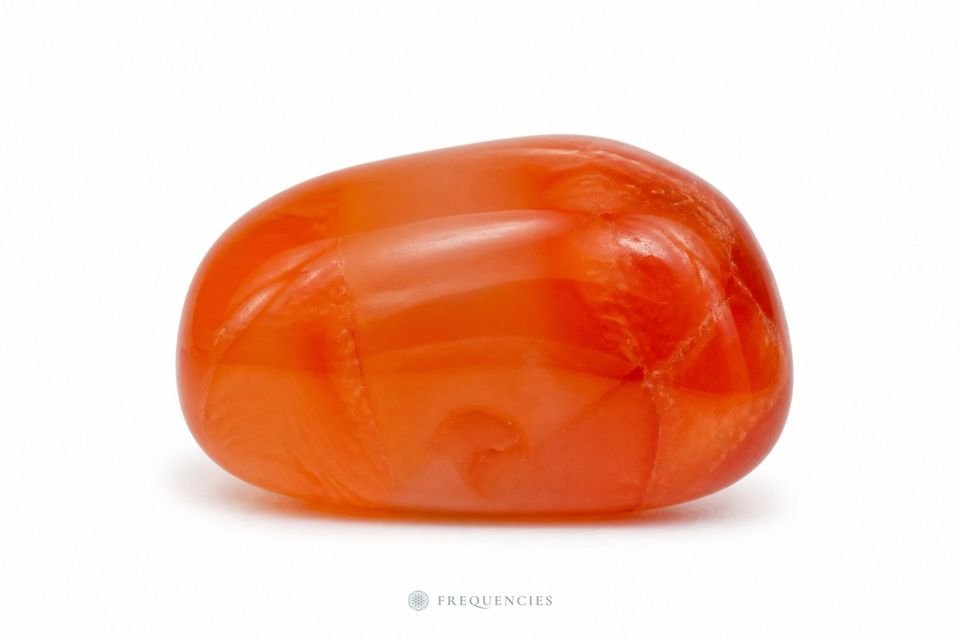
Warm orange to red-orange
Main locality
India
Localities
India, Brazil, Uruguay, Madagascar
Planet
Sun (tradition)
Carnelian is often heated to intensify the red tone, and some of the carnelian sold on the market is dyed white chalcedony or pale agate. Sources differ on how large a share has been treated.

Mohs hardness scale

6.5-7out of 10

Moderately hard: durable in everyday wear, but it can be scratched by harder stones. Store it separately.

Care

Water

May be rinsed in water

A brief rinse in lukewarm water, then wipe dry.

Sun

Sunlight is not harmful

May be kept in a bright place.

Storage

Durable in everyday wear

Avoid: prolonged heat, harsh cleaning agents, strong knocks.

Note. If the stone is porous, dyed or has a softer surface, dry cleansing is the safer choice.

In the crystal community, the following are used for cleansing: a brief rinse under running water, the presence of selenite, sound vibrations, moonlight.

From geology to your shelf

  • How it forms. Carnelian is the orange-red variety of chalcedony, microcrystalline quartz. Like agate, it forms when groundwater containing silicon dioxide deposits chalcedony in cavities in rock (often volcanic); the main deposits are in India, Brazil and Uruguay.
  • Where the colour comes from. The orange to red colour is produced by iron impurities, and heating makes this colour brighter. Carnelian is translucent to transparent, and it may contain lighter and darker zones or white agate bands.
  • History. Carnelian has been used as a gemstone since antiquity, and cameos and decorative objects are still carved from it.
  • How to recognise a genuine stone.
    • Carnelian lets light through, at least at the edges, whereas jasper is opaque.
    • Some of the "carnelian" on the market is heated or dyed ordinary agate or white chalcedony.
    • Fire opal is softer and more transparent, and amber is much softer than carnelian.
  • Treatment and imitations. Paler stones are often heated to make the colour redder, and some of the carnelian on the market is dyed white chalcedony or pale agate.
  • How to choose. Look for a translucent stone with a saturated, even orange-red colour. With a hardness of around 7, carnelian is suitable for everyday jewellery.
  • Traditional meaning

    This is crystal tradition and symbolism, not a scientific or medical claim. The chakras, signs and elements match our product pages.

    Chakras

    Sacral ChakraRoot Chakra

    Carnelian is traditionally associated with Sacral Chakra and Root Chakra energy, courage and activity.

    Zodiac signs

    ♈︎Aries♌︎Leo♍︎Virgo

    In traditional crystal astrology, carnelian is often associated with people who value courage, activity and inner balance.

    Element

    Fire

    The Fire element is traditionally said to give this stone courage, activity and a balanced character.

  • Main symbolism: creative vitality
  • Traditionally associated with creative vitality and mindful inner work
  • Traditionally associated with courage, activity and inner peace
  • In the crystal community, many people keep carnelian in the workplace or a creative corner as a symbol of energy and courage, and it is a popular symbolic gift for someone starting a new project. Traditionally carnelian is associated with the Root and Sacral Chakras, the Fire element, and the signs of Aries, Leo and Virgo.
  • The traditional meaning of crystals has not been medically proven and does not replace the advice of a professional.

    Stories and legends

    The name carnelian most likely comes from the cornelian cherry, not from the word for "flesh".

    The older form "cornelian" comes from medieval Latin corneolus, derived from Latin cornum, the red berry of the European cornelian cherry (Cornus mas). Later, because of the colour of the stone, the spelling was influenced by Latin carnem ("flesh"), and the form "carnelian" arose.

    The Greeks and Romans favoured carnelian for rings and seals.

    Encyclopaedia Britannica notes that carnelian was highly valued in Greek and Roman rings and seals. Ancient engravings (intaglios) have often kept their polish better than many harder stones.

    In ancient Egypt the red of carnelian had a dual meaning.

    The Egyptians associated red both with blood, and so with energy and strength, and with the desert and Set, the god of chaos, and red was also a symbol of the power of the sun. In Middle Kingdom jewellery the red of carnelian is often combined with the blue-green of turquoise and the deep blue of lapis lazuli.

    Etched carnelian beads from the Indus Valley reached the Royal Tombs of Ur.

    Craftsmen of the Harappan civilisation in the Indus Valley developed a technique for etching white patterns into carnelian beads with alkali. Such beads have been found in the Royal Tombs of Ur in Mesopotamia, dated to roughly 2600 to 2500 BC. Researchers regard them as important evidence of ancient trade between the Indus Valley, Mesopotamia and Egypt.
    Interesting facts

    • The colour of carnelian is produced by iron oxides; it is easily made redder by heating, even by the warmth of the sun.
    • Hot wax does not stick to carnelian, which is why seals were made from it in antiquity.

    How to use it

    • Wear it every day as jewellery traditionally associated with creative vitality

    Pairs well with

    Frequently asked questions

    Is carnelian agate?

    Not quite. Carnelian is an orange-red variety of chalcedony, or microcrystalline quartz, as agate is. If white bands are visible in the stone, it is also called carnelian agate. Its hardness is 6.5 to 7 on the Mohs scale, so carnelian is suitable for everyday jewellery.

    What does carnelian symbolise?

    In the crystal community, carnelian is associated with creative vitality and courage, and many people keep it in the workplace or a creative corner. Traditionally it corresponds to the Root and Sacral Chakras, the Fire element, and the signs of Aries, Leo and Virgo.

    Are carnelian and serdolik the same thing?

    Yes. Serdolik is the Russian name for carnelian, and both words refer to one and the same orange-red chalcedony. Sard is similar too, but it is usually darker and more brownish, and the boundary between the two is not strictly defined.

    Why is carnelian orange?

    The orange to red-brown colour of carnelian is produced by hematite, an iron oxide finely dispersed in the chalcedony. On heating, the tone of the iron compounds becomes brighter, which is why many stones are heated to obtain a more saturated red tone.

    How can real carnelian be recognised?

    Real carnelian lets light through, at least at the edges, whereas jasper is opaque and amber is much softer. Some of the carnelian sold on the market is heated or dyed agate or white chalcedony, so it is worth asking the seller about treatment before buying.

    May carnelian be put in water?

    Yes, carnelian can be rinsed briefly under running water, and GIA recommends cleaning most coloured gemstones with warm water, mild soap and a soft brush. If the stone is dyed or porous, it is safer to choose cleaning without water.

    May carnelian be kept in the sun?

    Yes, a short time in the sun usually does not harm carnelian. Even so, do not leave it for long in a hot place, because heat changes the tone of the iron oxides, and it is precisely by heating that carnelian is made redder in the trade.

    Read more

    Carnelian: Properties, Meaning, and How to Use It in Daily Life

    Sources. Mineralogical data: GIA Gem Encyclopedia, Mindat, Encyclopaedia Britannica (frequencies.lv crystal database v2).
    Further information: geology.com, geology.com, minerals.net, minerals.net.
    Shopping Basket
    Scroll to Top