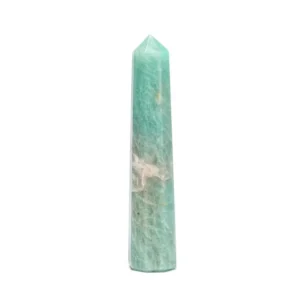
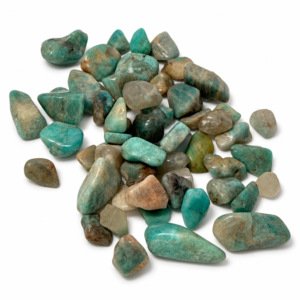
Amazonite
Microcline

Amazonite

A soft bluish green feldspar, traditionally associated with calm communication and emotional balance.

Hardness 6-6.5 May be rinsed in water Protect from direct sunlight Earth Water
In brief

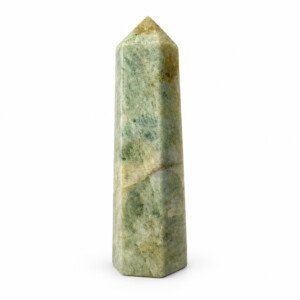
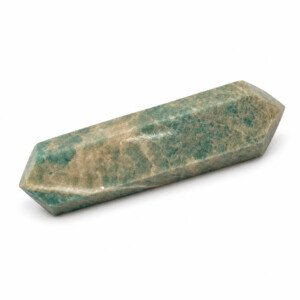
Amazonite is the bluish-green variety of microcline, a potassium feldspar (KAlSi3O8), with a hardness of 6 to 6.5 on the Mohs scale, often with white streaks. It is named after the Amazon River, although no deposits are known in its vicinity. In the crystal community, amazonite is traditionally associated with calm, open communication and honesty.

Amazonite in our shop

Exhibit label

Name
Amazonite
Type
Mineral
Mineral group
Microcline (potassium feldspar), KAlSi3O8
Hardness
6-6.5 on the Mohs scale
Colour
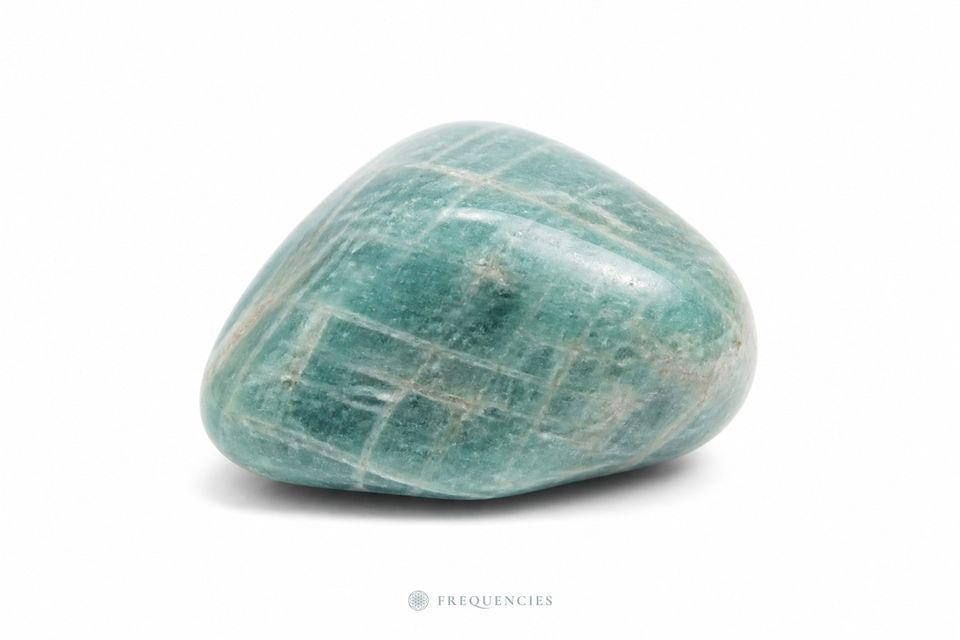
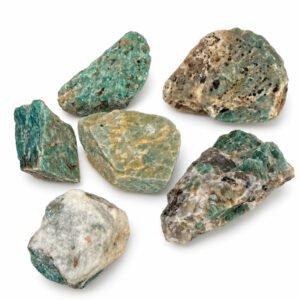
Bluish green to greenish, often with white streaks or cloud-like zones
Main locality
Madagascar
Localities
Brazil, Madagascar, Russia, USA, Peru
Planet
Uranus, Venus (tradition)

Mohs hardness scale

6-6.5out of 10

Moderately hard: durable in everyday wear, but it can be scratched by harder stones. Store it separately.

Care

Water

May be rinsed in water

A brief rinse in lukewarm water, then wipe dry.

Sun

Protect from direct sunlight

Prolonged direct sunlight can affect the colour, surface or structure

Storage

Durable in everyday wear

Avoid prolonged direct sunlight, harsh cleaning agents and strong knocks.

Note. Amazonite is relatively hard, but prolonged sunlight can affect its colour and surface.

In the crystal community, the following are used for cleansing: a brief rinse under running water, the presence of selenite, sound vibrations, moonlight.

From geology to your shelf

  • How it forms. Amazonite is the greenish blue variety of microcline, a potassium-rich feldspar. Well-formed crystals are usually found in granite pegmatites, veins and other cavities. Known localities include Colorado (around Pikes Peak) and the Ilmen Mountains near Miass in Russia.
  • Where the colour comes from. The greenish blue colour is linked to lead and water impurities in the feldspar structure together with natural radiation. Studies also mention other elements, so the colour is most likely the result of several factors.
  • History. It is named after the Amazon River, although no amazonite deposits are known in its vicinity. It was used in jewellery in ancient Egypt and Mesopotamia more than 3,000 years ago.
  • How to recognise a genuine stone.
    • White streaks of quartz or feldspar and uneven colour are often visible.
    • Unlike aventurine, amazonite has no glittering flakes, while nephrite is usually glossier and without white streaks.
    • Dyed imitations are usually an even, unnaturally bright tone, and the dye collects in cracks and pits.
  • Treatment and imitations. Amazonite is not usually treated. A misleading trade name is "Amazon jade", although it is not jade.
  • How to choose. The most highly valued colour is a saturated, deep green or bluish green, while greyish and very pale stones are less valuable. Because amazonite has two directions of perfect cleavage, check for cracks and chips.
  • Traditional meaning

    This is crystal tradition and symbolism, not a scientific or medical claim. The chakras, signs and elements match our product pages.

    Chakras

    Heart ChakraThroat Chakra

    Amazonite is traditionally associated with warm but clear self-expression and emotional balance.

    Zodiac signs

    ♍︎Virgo

    In crystal astrology, amazonite is associated with Virgo, and it is often chosen by people for whom a calm and honest conversation matters.

    Element

    EarthWater

    The Water element is traditionally associated with gentleness, and the Earth element with stability in communication.

  • Main symbolism: harmonious communication
  • Traditionally associated with truthful self-expression and the link between the heart and throat chakras
  • Traditionally associated with calm and balanced self-expression
  • In the crystal community, amazonite is traditionally associated with calm, open communication and truthfulness. Many people place it on a desk or by the entrance to the home, and it is a popular gift for colleagues and friends at the start of a new job.
  • The traditional meaning of crystals has not been medically proven and does not replace the advice of a professional.

    Stories and legends

    The name amazonite is linked to the Amazon River, but its origin is unclear.

    The name comes from the Amazon River in South America, but it is not clear whether the green stones brought from there were really amazonite. Amazonite was described as a separate mineral only in the 18th century. Mineralogically it is greenish blue microcline, a mineral of the feldspar group.

    Amazonite jewellery was made in ancient Egypt.

    Amazonite has been used in jewellery for more than three thousand years, and it has been found among the antiquities of ancient Egypt and Mesopotamia. The Egyptians of the Bronze Age obtained it in the area of Gebel Migif in the Eastern Desert. The stone is not described, however, in the writings of the ancient authors.

    The colour of amazonite is still a puzzle to scientists.

    A 1985 study explained the bluish green colour by lead and water in the feldspar structure. Later studies also mention rubidium, thallium and iron, so the colour is most likely produced by a combination of several factors. The colour saturation differs greatly between localities.

    The most famous amazonite specimens come from the Urals and Colorado.

    In the early modern period amazonite was obtained almost exclusively around Miass in the Ilmen Mountains in the Urals. Later, world-famous crystals, often together with smoky quartz, were found around Pikes Peak in Colorado, USA. Localities are also known in Australia, China, Mongolia, Ethiopia, South Africa, Sweden and elsewhere.
    Interesting facts

    • Amazonite belongs to the feldspar family, like moonstone and labradorite.
    • Amazonite is named after the Amazon River in South America, although no amazonite deposits are known in the Amazon region.
    • High-quality amazonite often has a pleasant, almost tropical bluish green tone.

    How to use it

    • Wear it as an everyday piece of jewellery with a soft bluish green tone

    Pairs well with

    Frequently asked questions

    What is amazonite?

    Amazonite is the greenish blue variety of microcline, or potassium-rich feldspar (KAlSi3O8). It belongs to the feldspar family, like moonstone and labradorite. The name comes from the Amazon River, although no amazonite deposits are known in its vicinity.

    What does amazonite symbolise?

    In the crystal community, amazonite is associated with calm, open communication and truthfulness. It is linked to the heart and throat chakras, the Earth and Water elements and the sign of Virgo, and it is a popular gift for colleagues and friends at the start of a new job.

    Why is amazonite green?

    The bluish green colour is linked to lead and water impurities in the feldspar structure together with natural radiation. Studies also mention rubidium, thallium and iron, so the colour is most likely produced by a combination of several factors.

    How can you recognise genuine amazonite?

    Genuine amazonite often shows white streaks and uneven colour. Unlike aventurine, it has no glittering flakes. Dyed imitations are an even, unnaturally bright tone, and the dye collects in cracks and pits. The name "Amazon jade" is misleading, because amazonite is not jade.

    Can amazonite be put in water?

    Yes, a brief wash in warm soapy water followed by immediate drying is fine. Amazonite contains lead impurities, so do not put it in drinking water or water bottles. Because of its pronounced cleavage, do not use ultrasonic or steam cleaning.

    Does amazonite fade in the sun?

    Yes, it can fade. Prolonged direct sunlight can affect the colour and surface of amazonite, so keep it in the shade and do not leave it on a sunny windowsill.

    How hard is amazonite?

    Amazonite has a hardness of 6 to 6.5 on the Mohs scale. It has two directions of perfect cleavage, so protect it from knocks in jewellery and check for cracks and chips before buying.

    What determines the value of amazonite?

    Mainly the colour. The most highly valued is a saturated, deep green or bluish green tone, while greyish and very pale stones are less valuable. Amazonite is not usually treated.

    Amazonite in our shop: more

    Read more

    Amazonite: Properties, Meaning, and How to Use It in Daily Life

    Sources. Mineralogical data: GIA Gem Encyclopedia, Mindat, Encyclopaedia Britannica (frequencies.lv crystal database v2).
    Further information: geology.com, en.wikipedia.org, minerals.net, rocktumbler.com.
    Shopping Basket
    Scroll to Top