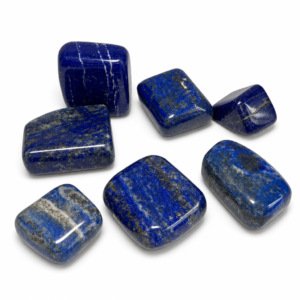
Lapis Lazuli
Rock

Lapis Lazuli (Lazurite)

Lapis lazuli (lazurite) is a rock traditionally associated with truth, wisdom and depth.

Hardness 5-6 Protect from water Protect from direct sunlight Air
In brief

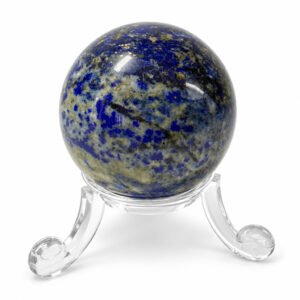
Lazurite, or lapis lazuli, is a rock consisting mainly of the blue mineral lazurite with inclusions of calcite and pyrite, and its hardness is 5 to 6 on the Mohs scale. The colour is deep blue with white or golden inclusions, and the main deposit is in Afghanistan. In the crystal community, it is seen as an ancient symbol of royalty and the heavens, associated with wisdom and truth.

Lapis Lazuli in our shop

Exhibit label

Name
Lapis Lazuli (Lazurite) · Lapis Lazuli
Type
Rock
Mineral group
A rock; the main mineral is lazurite (IMA since 2021: Na7Ca(Al6Si6O24)(SO4)(S3)·H2O), often with calcite and pyrite
Hardness
5-6 on the Mohs scale
Colour
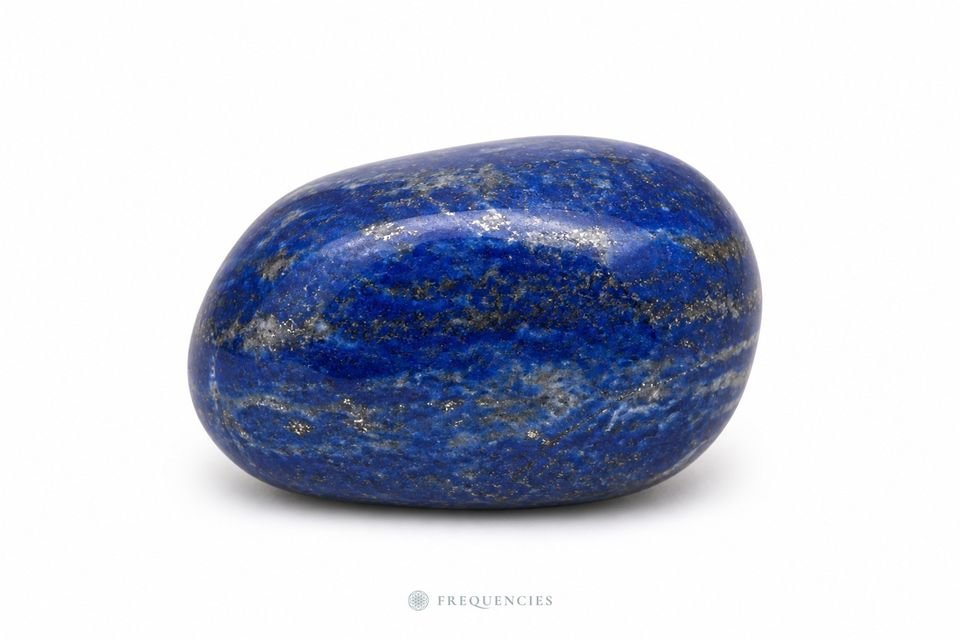
Deep blue with white or golden inclusions
Main locality
Afghanistan
Localities
Afghanistan, Chile, Russia, Pakistan
Planet
Jupiter (tradition)
Lapis lazuli is often dyed to make the colour more even, and impregnated with wax or plastic; there are also imitations on the market, such as dyed howlite or magnesite.

Mohs hardness scale

5-6out of 10

Moderately hard: durable in everyday wear, but it can be scratched by harder stones. Store it separately.

Care

Water

Protect from water

Do not soak. If it needs cleaning, use warm soapy water and a soft cloth, then dry it immediately.

Sun

Protect from direct sunlight

Prolonged direct sunlight can affect the colour, surface or structure

Storage

Durable in everyday wear

Avoid: prolonged direct sunlight, harsh cleaning agents, strong knocks.

Note. A porous material; prolonged contact with water and chemicals is not recommended.

In the crystal community, the following are used for cleansing: sage or palo santo smoke, the presence of selenite, sound vibrations, moonlight.

From geology to your shelf

  • How it forms. Lapis lazuli is not a mineral but a metamorphic rock, whose blue colour is given by the mineral lazurite (at least 25 %); the rock also contains calcite and pyrite. It forms near igneous intrusions, where limestone or marble has been transformed by contact metamorphism or hydrothermal processes.
  • Where the colour comes from. The bright blue colour is produced by lazurite, a sulphur-bearing silicate mineral. The white areas are calcite, and the golden specks are pyrite.
  • History. The name comes from the Persian word "lajward" and medieval Latin "lazulum" (sky). The Badakhshan mines in Afghanistan have been worked for more than 6,000 years, and they are the oldest known commercial sources of gemstones. Titian and Vermeer used ultramarine pigment ground from lazurite in their paintings.
  • How to recognise a genuine stone.
    • Natural lapis lazuli has randomly scattered pyrite specks and white areas of calcite; the Gilson imitation lacks the natural random pattern.
    • "Swiss lapis" is jasper dyed blue; in dyed material, too, the dye collects in cracks and can colour a cotton bud moistened with acetone.
    • Sodalite is similar, but it usually lacks the golden pyrite specks.
  • How to choose. A uniform, deep blue or violet-blue colour is the most prized. A lot of white calcite, grey patches or a large amount of pyrite lowers the value, whereas finely, evenly scattered pyrite is acceptable.
  • Traditional meaning

    This is crystal tradition and symbolism, not a scientific or medical claim. The chakras, signs and elements match our product pages.

    Chakras

    Throat ChakraThird Eye Chakra

    Lapis lazuli is traditionally associated with the Third Eye Chakra and Throat Chakra, and with depth.

    Zodiac signs

    ♍︎Virgo♎︎Libra♐︎Sagittarius♒︎Aquarius

    In traditional crystal astrology, lapis lazuli is often associated with people who value depth and inner balance.

    Element

    Air

    The Air element is traditionally said to give this stone depth and a balanced character.

  • Main symbolism: truth and wisdom
  • Traditionally associated with truth, wisdom and mindful inner work
  • Traditionally associated with depth and inner peace
  • In the crystal community, lapis lazuli is traditionally associated with wisdom and truth, and it is an ancient symbol of royalty and the heavens. Many people place it on a writing desk or in a library and hold it in their hands during meditation.
  • The traditional meaning of crystals has not been medically proven and does not replace the advice of a professional.

    Stories and legends

    Lapis lazuli has been mined in Afghan mines for more than 6,000 years.

    Lapis lazuli was mined in the Sar-i Sang mines in Badakhshan, in north-eastern Afghanistan, as early as the 7th millennium BC. GIA calls these mines in the Bactria region the oldest known commercial sources of gemstones in the world, and they are still working. The name comes from the Persian word "lajward", from which the word for the colour blue also arose in many languages.

    Lapis lazuli adorns the funerary mask of Tutankhamun.

    In ancient Egypt lapis lazuli was highly prized, and the funerary mask of the pharaoh Tutankhamun (1341 to 1323 BC) is inlaid with it. Earlier still, a dagger with a lapis lazuli handle and inlaid vessels were found in the tombs of Sumerian rulers at Ur. The stone was also highly prized in China, Greece and Rome.

    In the Renaissance, ultramarine cost as much as gold.

    The pigment ultramarine, whose name means "beyond the sea" because it was brought by sea from Asia, was made from ground lapis lazuli. In the Renaissance the finest ultramarine was sometimes valued as highly as gold, and it was saved for the robes of the Virgin Mary. Vermeer used it for the blue tone of the turban in "Girl with a Pearl Earring".

    A prize was announced in France for the invention of artificial ultramarine.

    In 1824 the Society for the Encouragement of National Industry in France announced a prize of 6,000 francs for whoever created artificial ultramarine. In 1826 the process was developed by Jean-Baptiste Guimet, and in 1828 Christian Gmelin published his method. After that the blue colour became many times cheaper.
    Interesting facts

    • Lapis lazuli is not a single mineral but a rock whose main constituent is lazurite.
    • Historically, the ultramarine pigment, which was very costly in art, was obtained from lapis lazuli.
    • The golden specks in many specimens are usually pyrite.

    How to use it

    • Wear it every day as jewellery traditionally associated with truth and wisdom

    Pairs well with

    Frequently asked questions

    What does lapis lazuli symbolise?

    Lapis lazuli is an ancient symbol of royalty and the heavens, and in the crystal community it is associated with wisdom and truth. Traditionally it corresponds to the Throat and Third Eye Chakras, the Air element, and the signs of Virgo, Libra, Sagittarius and Aquarius.

    How does lapis lazuli differ from lazurite?

    Mineralogically, lazurite is the blue mineral, whereas lapis lazuli is a rock consisting mainly of lazurite with an admixture of calcite, pyrite and diopside. In everyday use and in our shop, both names are used for one and the same stone.

    How can real lapis lazuli be recognised?

    In dyed lapis lazuli the dye collects in cracks, and a cotton bud moistened with acetone may pick up colour in an inconspicuous spot. Imitations of dyed jasper and howlite, as well as Gilson material, are usually too uniform, without the random pattern of natural lapis lazuli. Sodalite is similar too, but it usually lacks the golden pyrite specks.

    What are the golden specks in lapis lazuli?

    The golden specks are usually pyrite, whereas the white veins and patches are most often calcite. Finely, evenly scattered pyrite is acceptable, but a lot of white calcite or a large amount of pyrite lowers the value of the stone.

    May lapis lazuli be put in water?

    Not for long. Lapis lazuli can be porous or treated with wax or dye, so do not soak it. GIA recommends cleaning it with warm soapy water and a soft cloth, then drying it immediately, and not using steam or ultrasonic cleaning.

    May lapis lazuli be kept in the sun?

    Better not in prolonged direct sunlight. GIA notes that heat can damage the surface and wax coating of treated lapis lazuli, so do not keep it on a sunny windowsill or near heaters.

    Was paint made from lapis lazuli?

    Yes. The costly pigment ultramarine, whose name means "beyond the sea", was made from ground lazurite. In the Renaissance ultramarine was sometimes valued as highly as gold, and Vermeer used it in "Girl with a Pearl Earring".

    Where is lapis lazuli mined?

    The most famous mines are in Badakhshan, Afghanistan, where lapis lazuli has been mined for more than 6,000 years, and GIA calls them the oldest known commercial sources of gemstones. Lapis lazuli is also mined in the Andes in Chile and in Siberia near Lake Baikal.

    Lapis Lazuli in our shop: more

    Read more

    Lapis Lazuli: Properties, Meaning, and How to Use It in Daily Life

    Sources. Mineralogical data: GIA Gem Encyclopedia, Mindat, Encyclopaedia Britannica (frequencies.lv crystal database v2).
    Further information: geology.com, minerals.net, en.wikipedia.org, gia.edu.
    Shopping Basket
    Scroll to Top