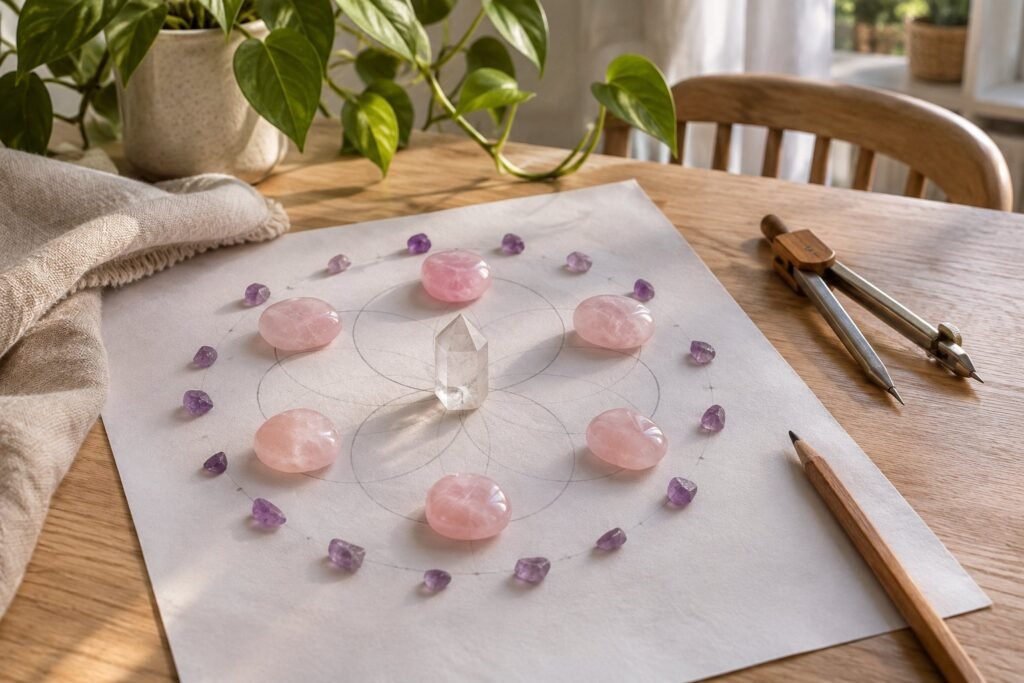
A crystal grid is an arrangement of stones in a geometric pattern: one larger stone is placed in the centre and smaller stones are arranged symmetrically around it, often on paper or cloth with a diagram of circles. It is a modern practice of the crystal community, in which a grid is made as a symbol of one’s intention. It is made in eight steps, from the intention to the photograph.
Expensive stones are not needed for a grid. It matters more to know which stones must not be left in sunlight or damp, and how to place the grid if there are small children or animals at home.
What is a crystal grid and where does this practice come from?
The crystal grid (in Latvian, kristālu režģis) is a modern custom of the crystal community, and whole books have been published about it. In 2017 the English author Judy Hall published “The Ultimate Guide to Crystal Grids”, which contains more than 50 grids built on specific geometric templates1.
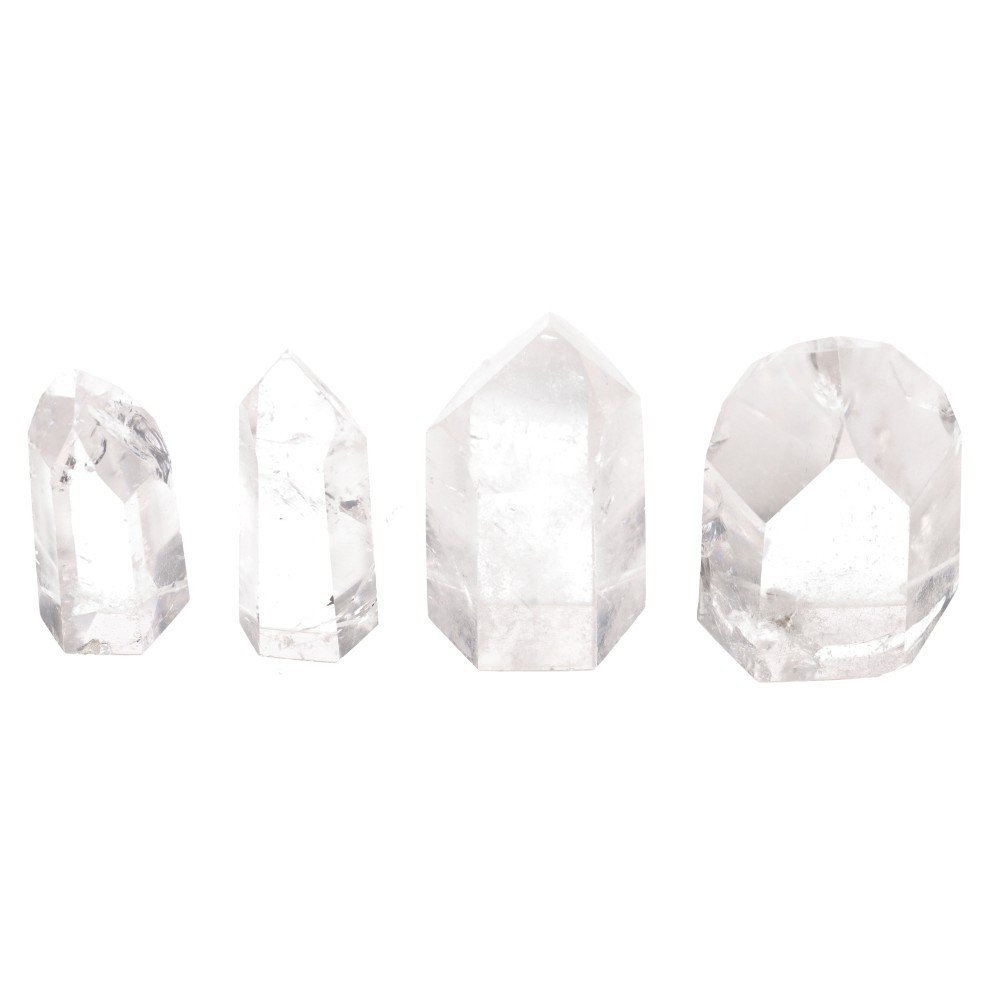
A grid usually has three parts. The central stone sits in the middle of the figure, the stones of the inner ring lie between the centre and the edge, and the stones of the outer ring mark the boundary of the grid2. Our encyclopaedia says that in the crystal community clear quartz is regarded as a universal stone that can be placed together with other crystals, and many people put it at the centre of the grid4.
There is little research on the effects of crystals5. Christopher French, a psychologist at Goldsmiths, University of London, carried out two studies with students, each with 80 volunteers. The participants relaxed for five minutes holding either a real quartz crystal or a glass imitation that looked identical. Many reported unusual sensations, but these did not depend on whether the crystal was real, and French concluded that they were caused by suggestion5,17. The results were presented at the European Congress of Psychology in Rome in 1999 and at the British Psychological Society conference in Glasgow in 2001, but they have not been published in a peer-reviewed journal17. An EBSCO review states that the effects of crystals are not confirmed by carefully conducted clinical studies6. A grid is therefore a tradition and a reminder of one’s intention on the table, not a method with proven effects.
What do you need for a crystal grid?
- Base: a white sheet of paper, a pair of compasses and a pencil, or a ready-made cloth with a pattern of circles. A ready-made diagram is not obligatory, but it makes the stones easier to place3.
- Central stone: a point, a small cluster, a sphere or the largest stone. A community guide calls a point ideal for the centre, but a polished stone also works2.
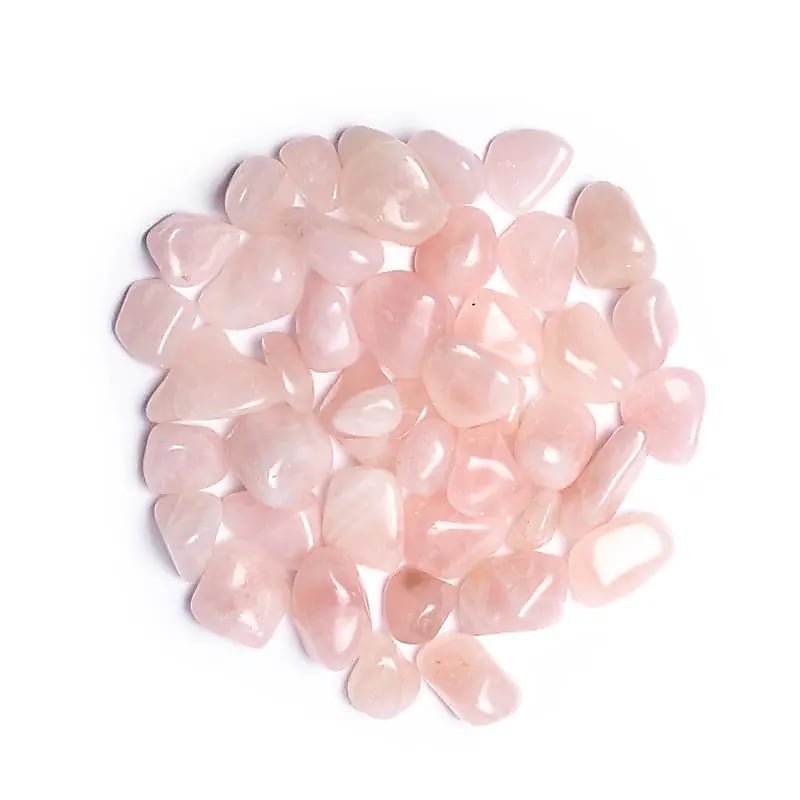
- Stones for the rings: one ring needs 4, 6 or 8 stones of similar size.
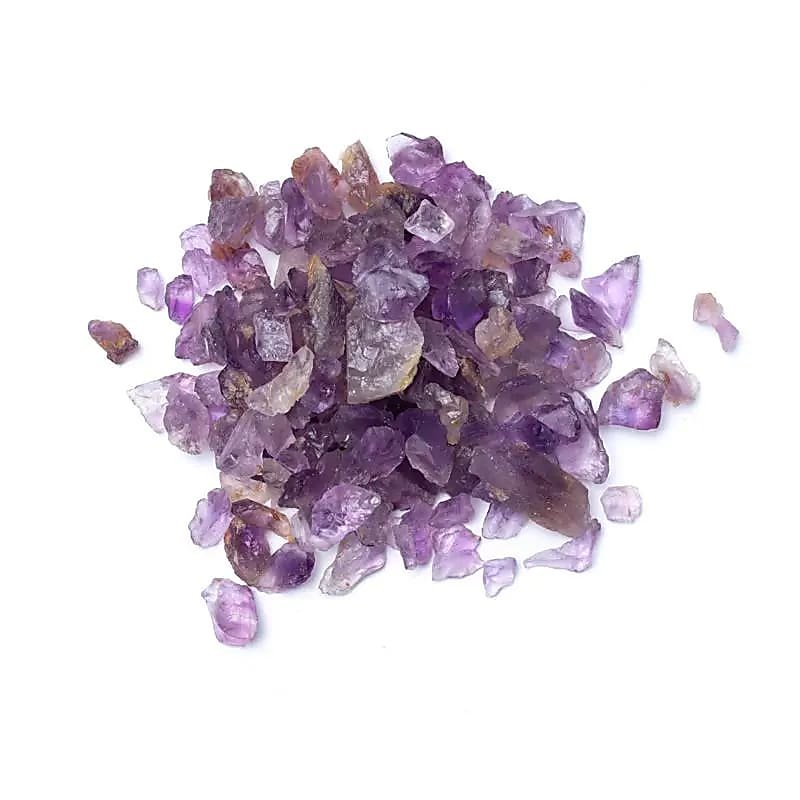
- Chips can be used if you want to fill the lines between the stones or make a circle around the grid.
- A clear quartz point or a selenite wand can be used for the closing, if you wish3.
The size ratio is simple: the central stone should be visibly larger than the others. On an A4 sheet, for example, a point of 5 to 6 cm works in the centre, polished stones of 2 to 3 cm in the rings and chips of 0.5 to 1.5 cm in the lines. In our shop currently (20 November 2026), a partially polished amethyst point of 5 cm costs €16.50, and polished clear quartz of 1 to 3 cm costs €1.90. You will find smaller polished quartz points of 2 to 3 cm and other points in the Points and Wands section.
How do you make a crystal grid step by step?
- Intention. Write it in one sentence. Community guides recommend writing in the present tense, as if it has already happened, and putting the note under the central stone2,3.
- Location. Choose a level surface where nobody will touch the grid, such as a shelf or a chest of drawers3. Place the grid away from direct sunlight and damp.
- Stones. Wipe the dust off the stones. Before making a grid, many crystal lovers cleanse the stones symbolically with selenite, sound, smoke or moonlight3. To find out which methods suit each stone, read the article How to Cleanse Crystals.
- Base. Draw a circle. Without changing the opening of the compasses, put the point on any spot on the line of the circle, mark where the pencil arc crosses the circle, and move the point to the new mark. In this way you get exactly six marks on the circle, and they are the vertices of a regular hexagon, because the side of such a hexagon equals the radius of the circle7.
- Center. Set the central stone in the middle of the circle, above the note.
- Inner ring. Set stones of the same kind at the six points. A community guide recommends using stones of one kind, or of one group, in a single ring2.
- Outer ring. A community guide recommends that the number of outer stones matches the symmetry of the figure: six for a hexagon, four for a cross, eight for an octagon2. Points can be turned with the tip towards the centre or away from it. In the community, points facing the centre are chosen for work on oneself, and outward-facing points for external goals2.
- Closing. Many people use a clear quartz point or a selenite wand to trace an imaginary line from the centre to each stone and back3. Then photograph the grid: if you need to move it, you will be able to put it together again in exactly the same way3.
It is easier to keep the symmetry if you work from the centre outwards and fill opposite points in pairs.
What roles do the stones have in a grid, and which diagram should you choose?
| Role | Where to place it | Which shape suits it | Example |
|---|---|---|---|
| Central stone | In the centre of the figure, above the note with the intention | A point, a small cluster, a sphere or the largest stone | An amethyst or quartz point |
| Inner ring stones | Between the centre and the edge, symmetrically | Polished stones of one kind or small points | 6 polished rose quartz stones |
| Outer ring stones | At the edge of the figure, 4, 6 or 8 according to the symmetry | Polished stones or points with the tip pointing inwards or outwards | 6 small pieces of black tourmaline |
| Chips | In lines between the stones or in a circle around the grid | Chips 0.5 to 1.5 cm | Amethyst chips |
The simplest diagram is a circle with six points, made with a pair of compasses. If you put the compass point on each of the six points and draw a circle of the same radius, then together with the first circle you get the Seed of Life: seven identical circles with sixfold rotational symmetry8. Extending the same pattern gives the Flower of Life with 19 circles, whose centres lie on a triangular lattice and whose radius equals the distance between neighbouring centres9. Both names arose in modern times8,9. A triangle, a square or an octagon also works for a grid. For another form of sacred geometry, the torus, see the article Torus: Symbol of Sacred Geometry.
Did you know? Euclid had already proved that the side of a regular hexagon inscribed in a circle is equal to the radius of the circle. Book IV, Proposition 15 of his “Elements” describes how to inscribe a regular hexagon in a circle, and its corollary states that the side of the hexagon equals the radius of the circle7. A hexagonal grid can therefore be drawn without a ruler and without measuring.
You will find polished stones for the rings in the Polished Stones section. In our shop currently (20 November 2026), rose quartz of 2 to 4.5 cm costs €5.90 and polished amethyst stones of 2 to 4 cm cost €5.00.
How do you choose stones according to their traditional meanings?
In the crystal community, stones for a grid are chosen according to the intention, and our encyclopaedia describes the symbolism of each stone. For a grid devoted to relationships, rose quartz is often chosen, as it is regarded as a symbol of love and tenderness3. Amethyst symbolises peace and spiritual clarity, and many people put it in a meditation corner.
For an abundance grid, a community guide recommends citrine, which the community regards as a symbol of optimism and abundance3. Natural citrine is rare, and most of the citrine available on the market is heat-treated amethyst16. Our citrine chips are sold under the name “Citrine (Heat-Treated Amethyst)”, and you are welcome to ask us about the origin of a particular stone. The same guide also mentions pyrite for an abundance grid, traditionally associated with prosperity and determination3.
If the intention of the grid is stability and grounding, the community tends to put black tourmaline or smoky quartz in the outer ring3. In the community black tourmaline is a symbol of stability and security, so many people also place it by the front door of the home. For a new beginning many choose green aventurine, which symbolises luck, optimism and new opportunities. The community associates clear quartz with clarity and amplification4.
These meanings are beliefs and traditions, not proven properties of stones. Choosing by colour or appearance is also a good basis. To find out how to choose your first crystal, see the article How to Choose a Crystal. In our shop currently (20 November 2026), 20 g of rose quartz or citrine chips costs €3.00, and 20 g of amethyst chips costs €4.00. You will find all the chips in the Chips section.
Which stones in a grid are harmed by sunlight and damp?
If a grid stays in one place for several weeks, dust collects on the stones, and some stones can also be affected by light and damp. GIA writes that some amethysts can lose colour in prolonged intense light11. Our care table also advises protecting rose quartz, citrine, smoky quartz, amazonite, fluorite and selenite from direct sunlight10.
A sunny windowsill is unsuitable for a grid for one more reason. Clear quartz spheres and other transparent round crystals can gather the sun’s rays like a lens and set fire to nearby objects10. If you put a sphere in the centre, place the grid further back in the room.
Damp harms other stones. Selenite is gypsum: after contact with water its surface can become matt or begin to dissolve. Pyrite can oxidise in damp conditions, and calcite, fluorite and malachite should not be soaked10. So do not make a grid in the bathroom or next to flower pots that you water. Wipe the dust from such stones with a dry, soft cloth10.
If you use a selenite plate as a base, bear hardness in mind. Selenite has a Mohs hardness of 2, while quartz has 710, so amethyst or clear quartz slid across selenite leaves scratches. Set the stones down on selenite; do not slide them. To find out how hardness is tested and compared, see the article Mohs Hardness Scale.
How do you place a grid if there are small children or animals at home?
For a young child, chips and small polished stones are small parts. Canadian toy regulations prohibit, in toys intended for children under three years of age, parts that fit completely inside a test cylinder with an internal diameter of 31.7 mm12. US regulations prohibit toys and articles intended for children under three whose small parts pose a risk of choking, inhalation or swallowing13. Crystals are not toys, but this size is useful for comparison: chips of 0.5 to 1.5 cm and polished stones of up to 3 cm are smaller than the diameter of that cylinder.
It is a risk for dogs as well. Cornell University College of Veterinary Medicine lists stones among the objects that dogs often swallow, and most such stomach and intestinal blockages require surgery. It recommends keeping small objects out of dogs’ reach14.
If there are small children or animals at home, place the grid on a high shelf or in a display cabinet with doors. If that is not possible, make the grid only from large stones, without chips. When you take the grid apart, count the stones against the photograph so that none is left on the floor. If you suspect that a child has swallowed a stone, contact a doctor immediately. If an animal may have swallowed a stone, contact a vet as soon as possible15.
Frequently asked questions
What is a crystal grid?
It is an arrangement of stones in a geometric pattern, with one larger stone in the centre and smaller stones arranged symmetrically around it. It is made in the modern crystal community as a symbol of one’s intention. There is no scientific evidence for the effects of crystals.
How many stones does a crystal grid need?
There is no fixed number. A simple hexagonal grid needs only a central stone and six stones around it, seven in total. If you add an outer ring, it has 4, 6 or 8 stones, depending on the symmetry of the figure.
Does a crystal grid need a Flower of Life base?
No. A simple circle with six points drawn with a pair of compasses, or a triangle or a square, will also do. The Seed of Life is seven identical circles and the Flower of Life is a pattern of 19 circles, and both names arose in modern times.
How long should a crystal grid be left in place?
There is no single rule. One community guide advises keeping a grid for as long as it feels right, but leaving grids for fulfilling intentions from the new moon to the full moon. If a grid stays up for a long time, check that the stones are not in direct sunlight and wipe off the dust.
Can a crystal grid be made in a home with small children?
Yes, provided the grid is somewhere children cannot reach. Chips and small polished stones pose a choking and swallowing risk for children under three, so put the grid on a high shelf or make it only from large stones.
Sources (17)
- ↩ Quarto (Fair Winds Press), Judy Hall, “The Ultimate Guide to Crystal Grids”, 2017: quarto.com
- ↩ Mysticryst, “Anatomy of a Crystal Grid: Center Stone, Way Stones, Outer Stones” (community guide): mysticryst.com
- ↩ Crystals.com, “How to Make a Crystal Grid: Step-by-Step Guide” (community guide): crystals.com
- ↩ FREQUENCIES Stone Encyclopedia: clear quartz: frequencies.lv/enciklopedija/kalnu-kristals/
- ↩ M. Heid, “You Asked: Do Healing Crystals Actually Work?”, Time, 05.10.2017: time.com
- ↩ D. J. Ladouceur, “Crystal healing”, EBSCO Research Starters: ebsco.com
- ↩ Euclid, “Elements”, Book IV, Proposition 15 (D. E. Joyce, Clark University): mathcs.clarku.edu
- ↩ Wolfram MathWorld, “Seed of Life”: mathworld.wolfram.com/SeedofLife.html
- ↩ Wolfram MathWorld, “Flower of Life”: mathworld.wolfram.com/FlowerofLife.html
- ↩ FREQUENCIES Stone Encyclopedia, care table (water, sun, hardness): frequencies.lv/enciklopedija/kopsana/
- ↩ GIA, Amethyst Care and Cleaning Guide: gia.edu/amethyst-care-cleaning
- ↩ Canadian Toy Regulations (SOR/2011-17), Section 7 and Schedule 1 “Small Parts Cylinder”: laws-lois.justice.gc.ca
- ↩ US Code of Federal Regulations, 16 CFR § 1501.1: law.cornell.edu
- ↩ Cornell University College of Veterinary Medicine, “Gastrointestinal Foreign Body Obstruction in Dogs”: vet.cornell.edu
- ↩ VCA Animal Hospitals, “Ingestion of Foreign Bodies in Cats”: vcahospitals.com
- ↩ GIA, Citrine Description: gia.edu/citrine-description
- ↩ C. French, “Romance in the stones? The power of crystals vs the power of suggestion”, The Skeptic, 21.04.2021 (author’s description of both studies): skeptic.org.uk