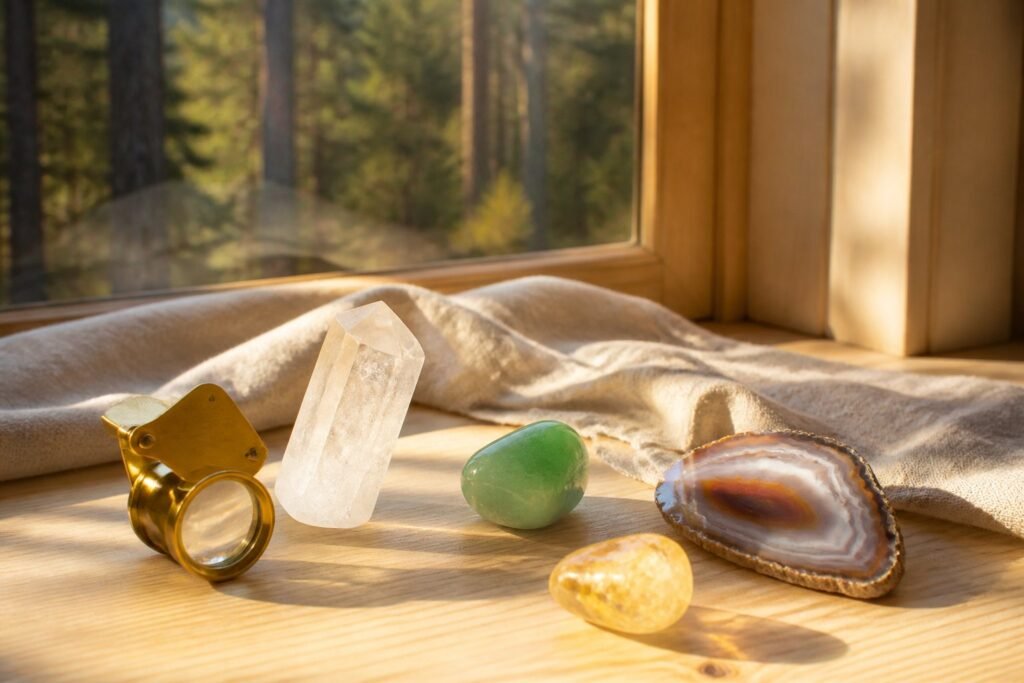
Natural citrine is rare, and most citrine available on the market is heated amethyst. A large portion of moldavite sold online is industrially produced green glass, while cheap “turquoise” often turns out to be dyed howlite. Many imitations can be detected without a laboratory: all you need is your palm, a magnifying glass, and eight signs you can check at home without damaging the stone.
1. Temperature: Quartz stays cool in the palm longer
Take the stone in your palm and pay attention to the first seconds. Quartz conducts heat several times better than glass, so rock crystal, amethyst, or rose quartz will feel cool for longer, while glass warms up quickly. Plastic and resin feel warm from the first touch. The safest way is to compare: hold the stone to be tested in one hand and a known piece of quartz or a glass object that has been in the same room in the other.
There are exceptions to this test. Selenite is gypsum with low thermal conductivity, so even natural selenite does not feel as cold as quartz. A warm sensation alone does not prove the stone is fake.
2. Inclusions and Bubbles: What Is Visible Inside the Stone
Turn the stone towards the light. In natural quartz, inclusions are irregular: tiny cracks, cloudy areas, or needles of other minerals, as in rutilated quartz. Round air bubbles and a completely uniform interior indicate glass. Irregular inclusions suggest natural origin, but a perfectly clear and suspiciously cheap rock crystal may be glass.
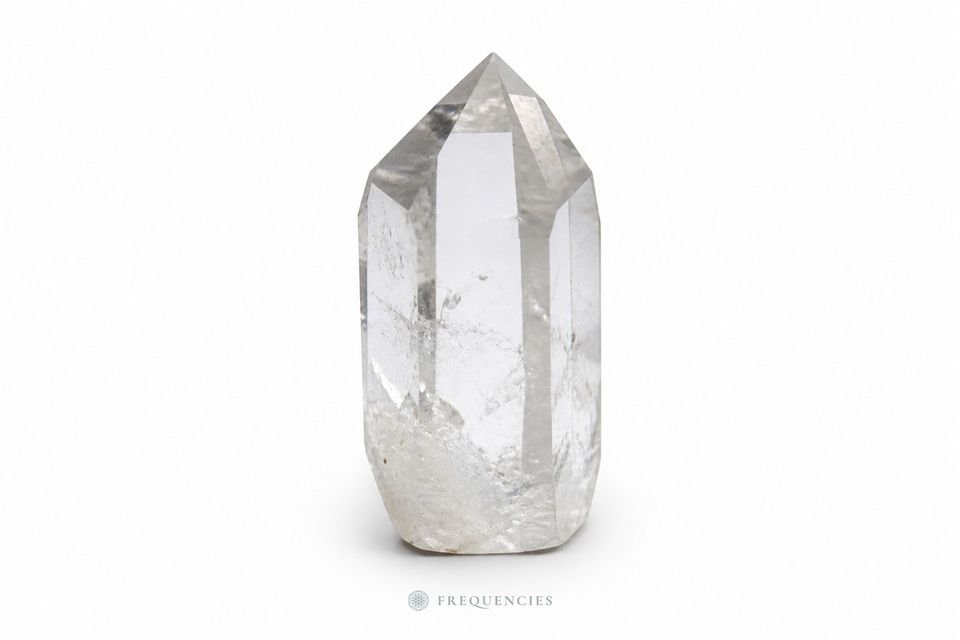
Bubbles have an important exception: natural glasses. Moldavite formed about 15 million years ago from a meteorite impact, and genuine moldavite almost always contains gas bubbles, often elongated, as well as flow lines. Moldavite without visible bubbles is suspicious. Obsidian is also a natural volcanic glass, but brightly blue, green, or red transparent “obsidian” is often artificial glass.
3. Color: Too Uniform or Accumulated in Cracks
Natural color usually has zones and transitions. Amethyst often shows angular darker and lighter areas, and natural agate bands have varying widths and tones. In dyed stones, the dye accumulates in pores, cracks, and pits, making them look darker than the rest of the surface, while a chip or drill hole may reveal an uncolored interior. However, yellow-brown deposits in cracks can also be natural iron compounds.
Bright blue, pink, violet, or green agate is usually dyed, as such colors are almost never found in nature. Classic agate dyeing methods were developed in the early 19th century in the German town of Idar-Oberstein. Even uniformly black onyx on the market is mostly dyed chalcedony: the stone is soaked in hot sugar solution, then in hot sulfuric acid, and carbon remains in the pores, coloring it black. A similar method was described by Pliny the Elder in Roman times.
If the stone is not valuable, you can rub it in an inconspicuous spot with a cotton swab moistened with acetone. Color on the cotton means the stone is dyed, but a clean swab does not prove anything.
4. Weight and Luster: Resin and Plastic Are Lighter
Weight is the quickest way to notice artificial materials. Natural malachite is heavy, with a density of about 3.6 to 4.05 g/cm³, but resin and plastic imitations are noticeably lighter in hand. Polished hematite feels distinctly heavy, while plastic “rose quartz” is lighter than the real one. However, lightness alone proves nothing: real shungite, due to its high carbon content, is unusually light, about 2 g/cm³. Therefore, compare the weight to what is typical for that specific stone.
The second clue is luster. Quartz has a bright vitreous luster, while turquoise is waxy to semi-vitreous, so a shiny glass-like “turquoise” is suspicious.
5. Price: If a Rare Stone Costs Like a Souvenir
The rarer the stone, the higher the price. Moldavite is found only in small areas of Central Europe, and extensive mining in the Czech Republic has already greatly depleted reserves. Therefore, much of the “moldavite” offered on the market, especially online, is industrially produced green glass, sometimes even bottle glass, and faceted moldavite over 2 carats is already suspicious. The same applies to turquoise: untreated turquoise is rare, and much of the turquoise available on the market is stabilized with polymer or reconstructed from turquoise chips and binder, the so-called block turquoise.
A low price is not always a bad sign. Quartz is one of the most common minerals on Earth, so rock crystal or rose quartz may cost little. Suspicion arises with a cheap rare stone or a flawless specimen at a price that does not match its size or quality.
6. Seller Information: Name, Treatment, Origin
An honest seller will tell you three things without being asked: what mineral it is, whether the stone has been treated, and where it comes from. For example, the US Federal Trade Commission (FTC) jewelry guidelines consider it misleading to omit treatment if it is not permanent, requires special care, or significantly affects the stone’s value. In an online store, this information must be included in the product description. These guidelines also do not allow a lab-grown stone or imitation to be called only by the gemstone name without clear indication.
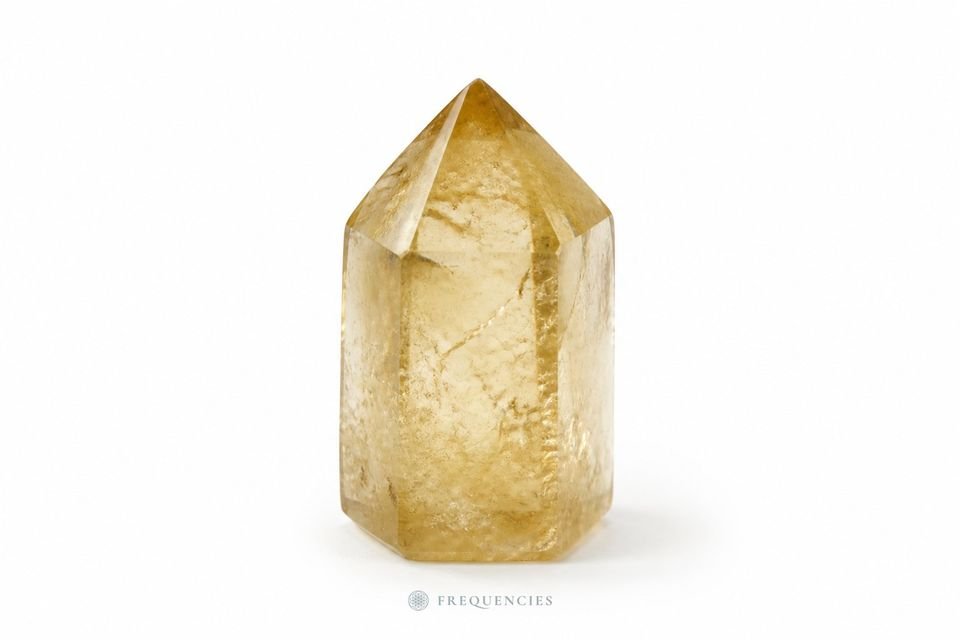
Be careful with trade names that sound like expensive stones. “Swiss lapis” is blue-dyed jasper, “Mexican onyx” is banded calcite or aragonite, which is much softer than chalcedony onyx, “rainbow moonstone” is light labradorite, and “Amazon nephrite” is actually amazonite.
In our stone encyclopedia, treatments are stated openly. On the citrine page, it is written that both natural citrine and heated amethyst are available in the store, and in the citrine section the heated stone is named “Citrine (Heated Amethyst)”. Howlite in turquoise color is labeled as dyed, and many stone pages have sections “How to recognize the real one” and “Treatment and imitations”.
7. Magnifier: Tenfold Magnification at Home
The Gemological Institute of America (GIA) evaluates diamond clarity at 10x magnification, and such a strong magnifier is suitable for home use. Hold the magnifier close to your eye and bring the stone closer until it is in sharp focus. Look for:
- round bubbles and swirling streaks characteristic of glass;
- glue lines on the sides, revealing a composite stone, such as an opal doublet or triplet;
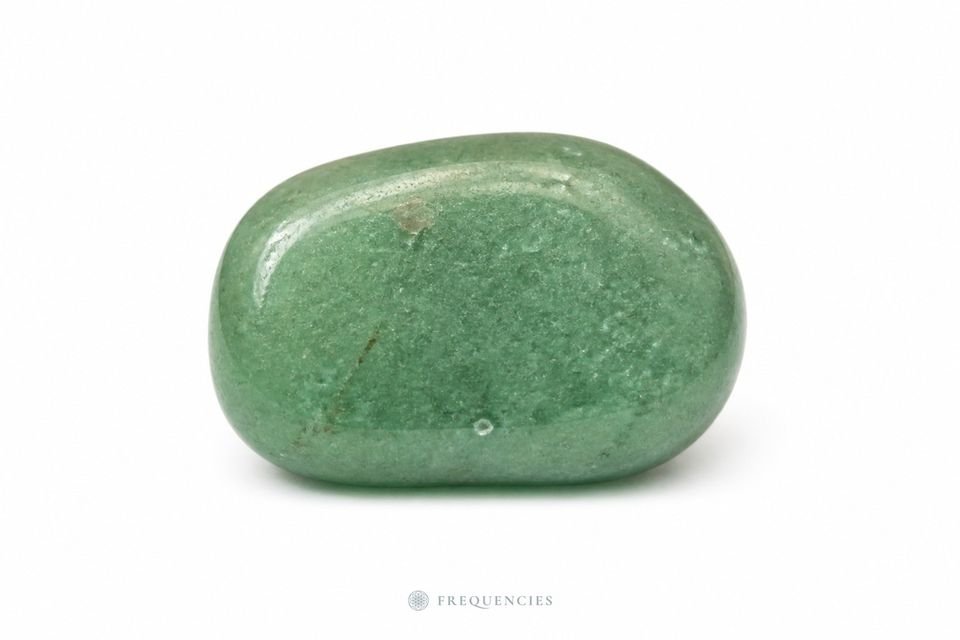
- sparkles: the shimmer of natural green aventurine is fine and often weak, but bright, evenly scattered copper-colored sparkles indicate glass known as goldstone;
- pattern: in natural lapis lazuli, pyrite dots and white calcite spots are randomly scattered, but Gilson imitation lacks this random pattern.
A magnifier is also useful if someone has already scratched the stone: a real scratch is a groove in the surface, but a mark that can be wiped off with a finger is just an imprint from a softer material.
8. Hardness: What Can Be Determined Without Damaging the Stone
Of all eight signs, only the hardness test can damage the stone, so do not scratch polished stones, spheres, or jewelry. Often, knowing the numbers is enough. On the Mohs scale, a fingernail has a hardness of about 2 to 2.5, quartz 7, and ordinary glass about 5 to 6. Quartz scratches ordinary glass, but glass does not scratch quartz. If you want to test an untreated stone, drag its sharp edge across the bottom of an old glass jar: the scratch will remain on the glass, not on the crystal.
Hardness differences are also significant between stones that are often confused. Howlite has a hardness of 3 to 3.5, turquoise 5 to 6, while fluorite (4) is much softer than similar-colored amethyst (7). Selenite (hardness 2) can be scratched even by a fingernail, so scratching is not suitable for its testing; for storage and cleaning, see the care table.
Hematite and pyrite have their own home test with unglazed porcelain: hematite leaves a reddish-brown streak, while pyrite leaves a greenish-black one. Drag the stone with its hidden side, as the streak is the stone’s own powder.
Most Common Imitations and Treatments
Treatment and imitation are not the same. Heated amethyst is still natural quartz, and dyed agate is natural agate, but opalite and goldstone are glass. A properly named treated stone is a regular product, but an imitation with a natural stone’s name is misleading.
| What is offered | What it is | How to spot it |
|---|---|---|
| “Opalite”, sometimes sold as moonstone | Industrially produced glass | Uniform milky bluish sheen from all angles, no inclusions |
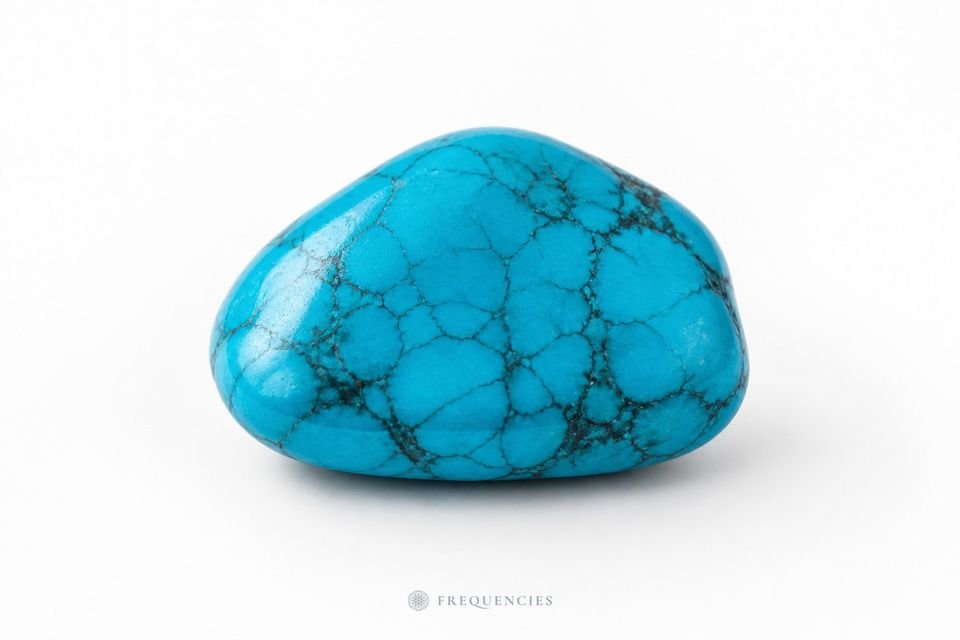
| Cheap, uniformly blue turquoise | Dyed howlite or magnesite | White interior on the back or in the drill hole; color can be removed with acetone or alcohol |
| Bright blue, pink, or violet agate | Dyed agate | Color accumulated in cracks, uncolored interior in a chip |
| Intensely orange citrine, druse with a white base | Heated amethyst | Reddish tone, color most intense at crystal tips |
| Brightly sparkling “aventurine” | Goldstone, glass with copper particles | Bright, evenly scattered copper-colored sparkles |
| Amethyst or citrine without indication of origin | May be hydrothermally grown synthetic quartz | Cannot be distinguished at home; on the market since at least 1970, laboratory can determine for sure |
| Malachite with shiny black swirls | Resin or reconstructed malachite | Lighter, bubbles and cavities in the surface |
| “Magnetic hematite” | Hematine, artificial material | Strongly magnetic, natural hematite is only weakly magnetic |
Resin should be mentioned separately. The market offers reconstructed malachite from crushed natural malachite with resin. “Aura” quartz, on the other hand, is natural quartz coated with a layer of vaporized metal, so it is treated, not fake.
Lab-grown quartz is not exotic. Billions of quartz crystals are used in watches, radios, and television oscillators, and most quartz used in electronics is lab-grown. Synthetic amethyst is chemically identical to natural, so only a laboratory can reliably distinguish it, and the problem arises when it is sold as naturally sourced.
Did you know? The word “aventurine” originally referred to glass, not stone. According to legend, Italian glassmakers accidentally mixed copper particles into molten glass, and the sparkling material was named after the Italian expression meaning “by chance”. The similar natural quartz was named later, after the glass. Thus, the glass now sold as goldstone and imitating aventurine once gave its name to the stone itself.
If you have doubts about a stone, open its page in the stone encyclopedia: there you will find hardness, care, and for many stones, also the signs by which a natural stone can be distinguished from an imitation.
Frequently Asked Questions
How to check at home if a crystal is real?
Compare the stone’s temperature with a known piece of quartz, examine it with a 10x magnifier, check if the color has accumulated in cracks, and assess the weight and price. No home test is one hundred percent certain, so for an expensive stone, a gemological laboratory provides a reliable answer.
Is a heated or dyed stone a fake?
No, if the treatment is disclosed. Heated amethyst is natural quartz, and dyed agate is natural agate. It is misleading if the treatment is omitted or glass and dyed howlite are sold under the name of a natural stone.
How to distinguish rock crystal from glass?
Quartz stays cool in the hand longer, has irregular inclusions, and a hardness of 7, so it scratches ordinary glass. Round air bubbles and a completely uniform interior indicate glass.
Is citrine real if it is heated amethyst?
It is real quartz whose yellow or orange color is obtained by heating. Natural citrine is rare, and most citrine on the market is heated amethyst, which an honest seller calls citrine (heated amethyst).
How to recognize fake turquoise?
Suspicious signs are an overly uniform blue color, low price, and shiny glassy luster. In dyed howlite or magnesite, a white interior can be seen in the drill hole or on the back. Even real turquoise is often stabilized with polymer, and this treatment must be indicated by the seller.
Is a real crystal always cold?
No. Stones from the quartz group stay cool in the hand longer than glass or plastic, but selenite is gypsum with low thermal conductivity, so even natural selenite feels warmer in the hand.
Sources
- FREQUENCIES stone encyclopedia
- FREQUENCIES stone encyclopedia: Citrine
- FREQUENCIES stone encyclopedia: Howlite in turquoise color
- frequencies.lv/produkta-kategorija/kristali/kvarcs/citrins/
- gia.edu/citrine
- gia.edu/gia-about/4cs-clarity
- gemsociety.org/article/thermal-properties-gems/
- gemsociety.org/article/glass/
- galleries.com/minerals/property/thermal.htm
- gem-a.com/gem-hub/recognise-dyed-gemstones/
- geology.com/gemstones/moldavite/
- geology.com/gemstones/aventurine/
- geology.com/minerals/quartz.shtml
- geology.com/minerals/mohs-hardness-scale.shtml
- geology.com/minerals/streak-test.shtml
- minerals.net/mineral/howlite.aspx
- ecfr.gov/current/title-16/chapter-I/subchapter-B/part-23
- gia.edu/lapis-lazuli (imitations, including dyed jasper “Swiss lapis”)