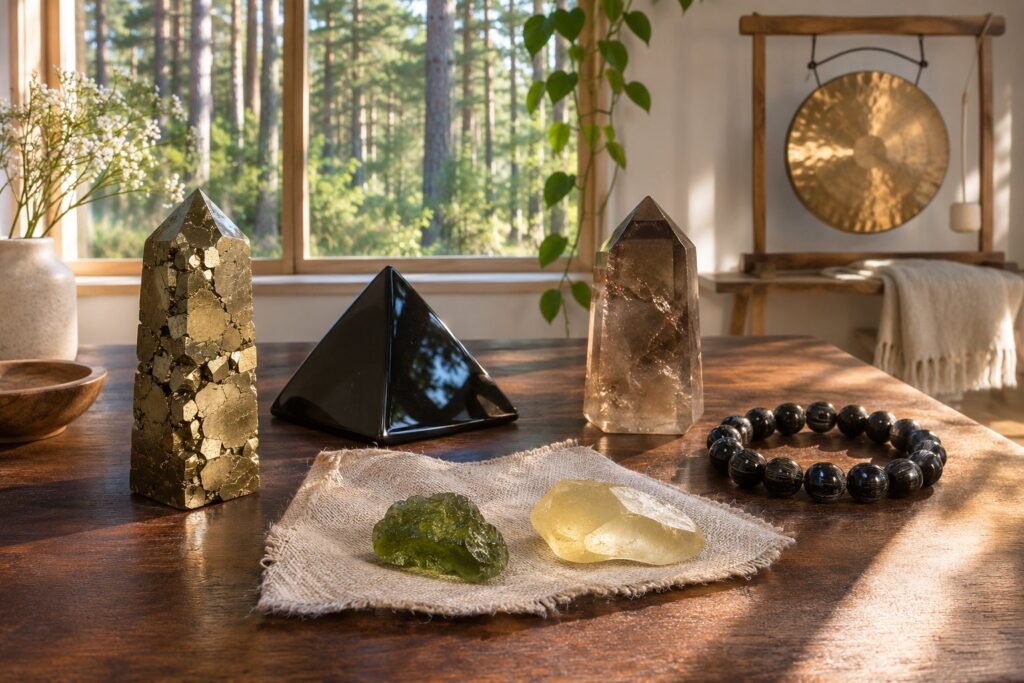
A man who already owns a good watch and a fully stocked tool cabinet can be given a piece of green glass that formed about 15 million years ago, when an asteroid about 1.5 km across struck what is now Bavaria [1]. A gift like this comes with a story to tell at the table, and it takes up little space. Ideas start at €12.50, and all prices were checked on 8 November 2026.
How to Choose a Gift for the Man Who Has Everything
If he buys himself everything he wants, give him something he would hardly buy for himself: an object with an origin story that fits on a desk or a shelf. Impact glass suits a science and space enthusiast, pyrite and obsidian suit a history lover, and a sound instrument suits a musician. The table lists the ideas by price [2].
| Gift | Current price | Suitable for |
|---|---|---|
| Tourmaline bracelet | €12.50 | everyday wear |
| Raw pyrite ≈2×7 cm | €18.00 | a natural stone lover |
| Dorje bell 11 cm | €22.20 | someone interested in Asian culture |
| Obsidian pyramid 4×4 cm | €25.00 | the desk |
| Polished smoky quartz point 153 g | €25.00 | the shelf |
| Tuning fork 432 Hz | €26.80 | a music lover |
| Pyrite obelisk ~10 cm | €31.00 | the desk |
| Libyan desert glass ~1.5 cm | €36.00 | a collector |
| Moldavite ~1.6 cm | €59.00 | a space enthusiast |
| Mirror gong 40 cm | €162.40 | a musician and the interior |
Delivery to parcel lockers in the Baltic States is free for orders from €30, and items from our warehouse arrive within 1 to 3 working days. Sound instruments are kept in the supplier’s warehouse, and their delivery takes about 15 working days, or three weeks [2], so if they are for Christmas, order them by the end of November.
Pyrite: Fool’s Gold That Sparks
Pyrite is iron sulfide (FeS2) and the most common sulfide mineral. Its name comes from the Greek word pyr, meaning fire, because pyrite gives off sparks when struck against metal or another hard material. For this reason, it was also used in the ignition mechanisms of early firearms. Because of its brass-yellow colour, metallic lustre and weight, inexperienced gold prospectors mistook it for gold, which is why it is called fool’s gold, although pyrite does often form together with real gold [3].
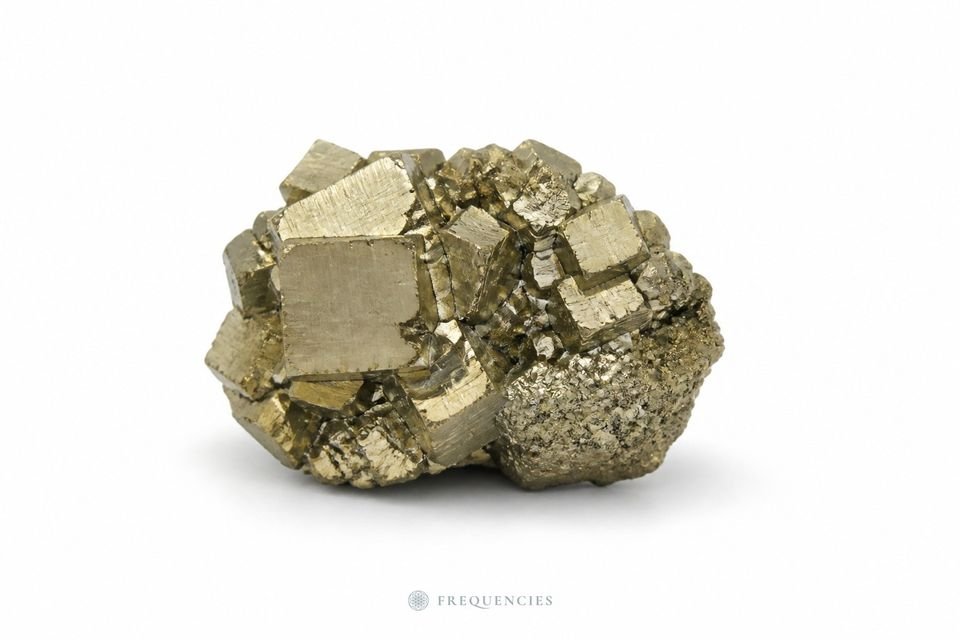
The pyrite obelisk from India is about 10 cm tall, weighs 79 g and currently costs €31. Raw pyrite from Peru (≈2×7 cm) with a natural, shiny metallic surface currently costs €18 [2]. Pyrite oxidises in damp conditions and loses its lustre, so keep it somewhere dry, not in the bathroom [4].
Obsidian: Volcanic Glass Used for Knives and Mirrors
Obsidian is volcanic glass that forms when lava cools so quickly that its atoms have no time to arrange themselves into crystals. It breaks with a conchoidal fracture and sharp edges, so ancient peoples made knives, arrowheads and scrapers from it. Obsidian was one of the first materials that humans set out to obtain deliberately [5]. In antiquity, polished obsidian was also used as a mirror [4]. Read about the Aztec obsidian mirror linked to the Elizabethan scholar John Dee in the article History of Crystal Balls.
The obsidian pyramid from Mexico (4×4 cm, ≈43 g) currently costs €25 [2]. Its hardness is only 5 to 5.5, so store it away from harder stones and take care not to drop it [4].
Cosmic Impact Glass: Moldavite and Libyan Desert Glass
Both are often called stones from space, but they are not meteorites. They are natural glass formed from terrestrial rocks melted by the impact of a cosmic body.
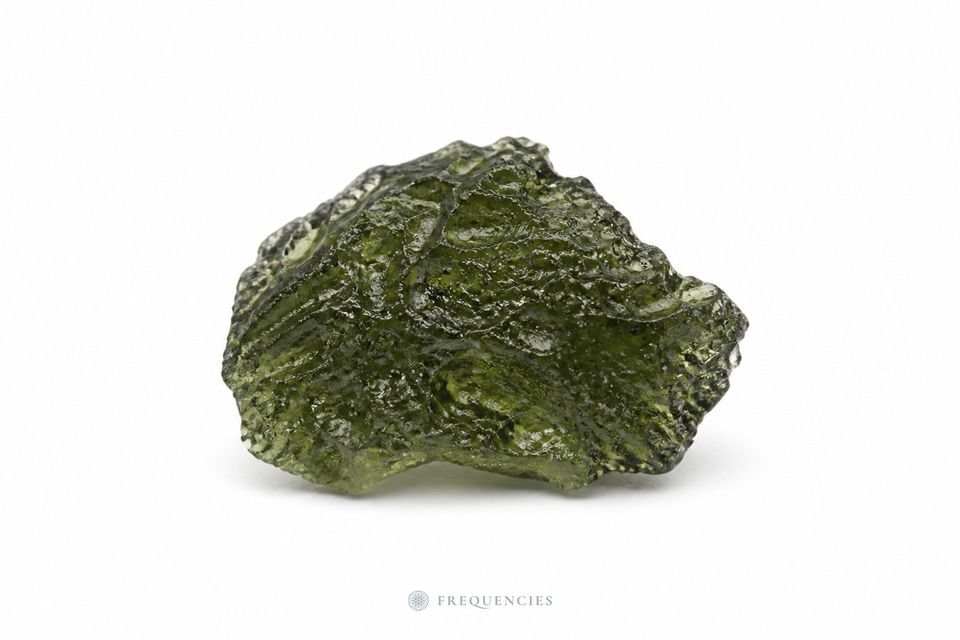
Moldavite formed about 15 million years ago, when an asteroid about 1.5 km across struck what is now Bavaria and created the Nördlinger Ries crater, about 25 km in diameter [1]. High-precision argon dating puts the age of moldavite at about 14.8 million years [6]. The impact hurled the molten rock through the atmosphere as far as several hundred kilometres, which is why moldavite is considered a tektite. It is found mainly in South Bohemia and Moravia in the Czech Republic [1, 7].
Libyan desert glass is impact glass, not a tektite. Mindat classifies it as an impact melt rock [8]. It is about 28.5 million years old and lies among the dunes in the south-western part of the Great Sand Sea in Egypt, near the Libyan border. No crater has been found there, but in 2019 researchers discovered shock-deformed quartz in the bedrock of the same area. The authors consider this a sign of a physical impact and conclude that the crater has almost completely eroded since then [9]. In the same year, another study found traces of the high-pressure mineral reidite in zircon grains in the glass, which shows that the glass cannot have formed from an airburst alone [10].
This glass was already valued in ancient Egypt. Howard Carter discovered Tutankhamun’s tomb in 1922, and one of the pectorals found there features an 18×28 mm scarab that was long thought to be chalcedony. Only in 1998 did a gemmological analysis of its refractive index confirm that it is Libyan desert glass [11].
In our shop, moldavite currently costs from €59 (≈1.6 cm, 1.5 g) to €169 (≈4.3 cm, 4.7 g), while Libyan desert glass costs €34 (≈2 cm) and €36 (≈1.5 cm) [2]. Fake moldavites are known to be on the market [7], so check the features: genuine moldavite almost always contains gas bubbles and flow lines, often shows worm-like lechatelierite inclusions under magnification, and its natural surface is etched with a fine pattern of grooves [4]. You will find all available specimens in the shop section Tektites.
Did you know? In August 1970, NASA held geology field training for the Apollo 14 and Apollo 17 astronauts at the Ries crater so that they could learn to recognise impact crater rocks [12]. The Gothic St George’s Church in Nördlingen, with its tower known as Daniel, is the best-known example of the impact rock suevite being used as a building stone [13]. Tiny diamonds have also been found in suevite [14].
Smoky Quartz and Shungite: Dark Accents for the Desk
If he likes dark tones, take a look at smoky quartz. Most smoky quartz is naturally coloured, but some is produced by irradiating colourless quartz in a laboratory. Smoky quartz has a hardness of 7, like all quartz [4]. A polished smoky quartz point from Brazil (6 cm, 153 g) currently costs €25 [2].
Shungite is a black, carbon-containing material. Its value depends on its carbon content and lustre: the shiny varieties are rarer, while the matt rock is common. Shungite can leave dark marks, so do not put it on light-coloured fabrics [4]. The Sakkara shungite pyramid from Karelia (5×5 cm) currently costs €23 [2].
Natural Stone Bracelets for Men
With a bracelet, check the size first. Our pyrite and labradorite bracelets measure about 16 cm around [2], which suits a slimmer wrist. Compare this with his watch strap or a bracelet he already wears. If you do not know his size, a safer choice is the tourmaline bracelet on an elastic cord in a universal size.
- Tourmaline bracelet made from black tourmaline chips, currently €12.50.
- Pyrite bracelet with 6 mm beads from Brazil, currently €13.80.
- Labradorite bracelet with 8 mm beads from Madagascar, showing blue and green flashes in the light, currently €17 (regular price €19.84).
It is best to take the pyrite bracelet off before a shower or a swim, as moisture can dull the pyrite’s lustre [2]. You will find all bracelets in the bracelet category.
Gong, Tuning Fork or Dorje Bell: A Gift You Can Hear
A gong is a round metal disc, usually with a turned-back rim, and it is mostly struck in the centre. Britannica writes that gongs were depicted in China as early as the 6th century and were in use in Java by the 9th century at the latest, and that the word “gong” itself comes from Javanese. Western orchestras play the flat Chinese gong, called the tam-tam [15].
Our Chao gong is also called a tam-tam. It is made of copper and tin and has a turned rim, and its sound starts softly and then swells rapidly. It comes with a beater, and you can choose a 40, 50 or 80 cm gong, currently from €200.50. The mirror gong with a polished, mirror-like surface (40 cm) currently costs €162.40 [2]. Other models are in the gong category.
For a smaller gift, there is a tuning fork tuned to 432 Hz (18 cm, 85 g, aluminium alloy), currently €26.80, or a handmade Dorje bell from Nepal (11 cm, brass, engraved), currently €22.20 [2]. In Tibetan Buddhism, the ritual object called the dorje (Sanskrit vajra), a word meaning both thunderbolt and diamond, is often used together with a bell, known in Tibetan as the drilbu [16]. Our Dorje bell is exactly this kind of bell [2]. All these instruments are kept in the supplier’s warehouse, so if they are Christmas gifts, order them by the end of November.
Frequently Asked Questions
What should you give a man who has everything?
The best choice is an object with a story that he would hardly buy himself, such as moldavite or Libyan desert glass formed by a cosmic impact, a pyrite obelisk, an obsidian pyramid or a gong.
Is moldavite a meteorite?
No. Moldavite is natural glass formed from terrestrial rock that was melted about 15 million years ago by an asteroid impact at the site of today’s Ries crater in Germany. The molten rock flew hundreds of kilometres, which is why moldavite is called a tektite.
Why is Libyan desert glass not a tektite?
Mindat and many researchers classify it as impact glass: it is found in a limited area of Egypt’s Western Desert, where the impact itself most likely took place, although no crater has been found there. Tektites, such as moldavite, are impact melt that was thrown out and landed far from the crater.
What should you give if you do not know his taste?
Choose a gift card worth €10 to €500. It arrives by email straight after payment, together with a printable PDF, is valid for 12 months and has no delivery charge.
Sources
- Bavarian Environment Agency (Bayerisches Landesamt für Umwelt), “Nördlinger Ries: Fakten”: www.lfu.bayern.de/geologie/meteorite/ries/fakten/index.htm
- FREQUENCIES product pages (prices, sizes, origin and availability checked 08.11.2026): frequencies.lv/veikals/
- Geology.com, “Pyrite”: geology.com/minerals/pyrite.shtml
- FREQUENCIES stone encyclopedia: pyrite, obsidian, moldavite, Libyan desert glass, smoky quartz, shungite (based on data from GIA, Mindat, geology.com): frequencies.lv/enciklopedija/
- Geology.com, H. M. King, “Obsidian”: geology.com/rocks/obsidian.shtml
- M. Schmieder et al., “A high-precision 40Ar/39Ar age for the Nördlinger Ries impact crater, Germany”, Geochimica et Cosmochimica Acta 220 (2018), 146-157: doi.org/10.1016/j.gca.2017.09.036
- Mindat.org, “Moldavite”: www.mindat.org/min-10860.html
- Mindat.org, “Libyan Desert Glass”: www.mindat.org/min-39796.html
- C. Koeberl, L. Ferrière, “Libyan Desert Glass area in western Egypt: Shocked quartz in bedrock points to a possible deeply eroded impact structure in the region”, Meteoritics & Planetary Science 54 (2019), 2398-2408 (University of Vienna): ucrisportal.univie.ac.at/en/publications/libyan-desert-glass-area-i…
- A. J. Cavosie, C. Koeberl, “Overestimation of threat from 100 Mt-class airbursts? High-pressure evidence from zircon in Libyan Desert Glass”, Geology 47 (2019), 609-612: doi.org/10.1130/G45974.1
- R. Simon, “The curious history of Tutankhamun’s scarab”, Aegyptus et Pannonia 9 (2025), Hungarian Academy of Sciences Library Repository: real.mtak.hu/237314/
- UNESCO Global Geopark Ries, “Science: Meteorite and impact research in the Ries Crater”: en.geopark-ries.de/wissenschaft/
- Baden-Württemberg Office for Geology, Raw Materials and Mining (LGRB), LGRB-Nachrichten 2024/01 “Suevit”: www.lgrb-bw.de/sites/default/files/download_pool/lgrbn_2024_01.pdf
- Bavarian Environment Agency, “Suevit: Gestein des Jahres 2024”: www.lfu.bayern.de/geologie/gestein_des_jahres/2024/index.htm
- Encyclopaedia Britannica, “gong”: www.britannica.com/art/gong-musical-instrument
- Encyclopaedia Britannica, “vajra”: www.britannica.com/topic/vajra