
If you lived in 17th-century Courland, in western Latvia, you would most probably call October veļu mēnesis, “the month of souls”, November salnas mēnesis, “the month of night frosts”, and December vilku mēnesis, “the wolf month”. The ancient Latvian month names were first printed in 1649 [1][2], and each of them hides an observation of nature, a farming task or a tradition of honouring the ancestors.
Who First Published the Latvian Month Names
The Latvian month names were first published alongside the Latin ones by Paul Einhorn, superintendent of Courland, in his work “Historia Lettica” in 1649 [1][2]. The academician Jānis Stradiņš writes that Einhorn’s works were really instructions for other pastors on how to fight paganism and Catholicism, and that they were printed in very small runs. Even so, it was Einhorn who provided the first substantial material on Latvian ethnography and ancient beliefs [3].
Did you know? According to Stradiņš, Einhorn (1590 to 1655) died in the pulpit of Holy Trinity Church in Jelgava while preaching a sharp sermon against the introduction of the new-style calendar [3]. So the man who first published the Latvian month names spoke out against a change of calendar in his last sermon.
Twelve Ancient Month Names: A Table
The second column gives Einhorn’s names from 1649, and the word “jeb” (“or”) means that the month already had two names at the time. The third column gives variants from the calendar for 1817 published in Vidzeme, a region of northern Latvia [4], the list from LSM, Latvia’s public broadcaster [5], and the Latvian dictionary Tēzaurs [6].
| Month | Einhorn, 1649 [1] | Other recorded names | What the name reveals |
|---|---|---|---|
| January | ziemas mēnesis (winter month) | sala mēnesis (frost month) [5], jauna gada mēnesis (new year month) [4] | midwinter and frost |
| February | sveču mēnesis (candle month) | meteņu, puteņu, sala mēnesis (Meteņi, blizzard, frost month) [6] | Candlemas on 2 February |
| March | sērsnu jeb baložu mēnesis (snow-crust or dove month) | pavasara mēnesis (spring month) [4] | sērsna is a crust of snow that forms when the moist top layer freezes |
| April | sulu mēnesis (sap month) | sulu mēnesis in 1817 as well [4] | sap starts to flow faster in the trees |
| May | lapu jeb sējas mēnesis (leaf or sowing month) | ziedoņa mēnesis (blossom-time month) [6] | leaves unfolding and sowing |
| June | ziedu mēnesis (flower month) | vasaras mēnesis (summer month) [4], papuves mēnesis (fallow month) [6] | time of blossoming |
| July | siena jeb liepu mēnesis (hay or lime-tree month) | siena mēnesis in 1817 as well [4] | haymaking and lime blossom |
| August | suņu jeb rudzu mēnesis (dog or rye month) | labības mēnesis (grain month) [4] | harvesting rye and other grain |
| September | sila jeb viršu mēnesis (pine-heath or heather month) | rudens mēnesis (autumn month) [4], Miķeļu mēnesis (Michaelmas month), sēņmēnesis (mushroom month) [6] | heather flowers in the pine heaths |
| October | veļu jeb zemliku mēnesis (month of souls or of offerings to the dead) | lietus mēnesis (rain month) [4], rudens mēnesis (autumn month) [6] | remembering the dead ancestors |
| November | salnas mēnesis (month of night frosts) | salnu mēnesis (month of night frosts) [5] | night frosts and the first hard frost |
| December | vilku mēnesis (wolf month) | ziemas mēnesis (winter month) [4] | the darkest time of the year |
Where the Names Come From: Nature, Work and Ancestors
Aīda Rancāne, a researcher at the University of Latvia, explains that the ancient names capture the most significant natural phenomena or the most important festivals and rituals. In her view, sulu mēnesis, the sap month, is linked to the time when sap starts to flow faster in the trees, while pļaujas mēnesis or siena mēnesis, the mowing or hay month, is named after the work done at that time [7]. Many of the words need explaining even to Latvians today. Sērsna is the crust that forms on the snow cover when its moist top layer freezes, and it gave March its name, sērsnu mēnesis. Sils is a pine forest on sandy soil, where heather also grows in the ground cover [6].
Both of Einhorn’s October names lead back to the ancestors. In Latvian mythology veļi are the souls of the dead or underworld spirits who live in the afterworld, while zemlikas are a meal offered to the spirits of the dead and also the time when this meal is set out for them [6]. Latvia’s neighbours, the Lithuanians, still use their old month names today. Rūta Muktupāvela, associate professor at the Latvian Academy of Culture, points out that their November is lapkritis, the month of falling leaves, and that even Lithuanians themselves do not always understand why March, kovas, is named after a bird [7][17].
Why the Names Differ from Source to Source
The first reason is the way time itself was counted. Rancāne explains that the ancient months followed the phases of the Moon: a month began when the thin crescent of the new Moon appeared in the sky and lasted about 29 to 30 days. This is why the ancient months do not match today’s months, and every two or three years a thirteenth month, a festival month, was added to the twelve [7]. In Rancāne’s words, keeping such a calendar meant constantly watching sunrises, sunsets, the turning points of the Moon and the appearance of the constellations [7].
The second reason is time and place. Einhorn was superintendent of Courland, whereas the Vidzeme calendar for 1817 calls March pavasara mēnesis (spring month), October lietus mēnesis (rain month) and December ziemas mēnesis (winter month) [4]. The third reason is the choices made by modern compilers. The LSM list for children calls January sala mēnesis, the frost month [5], but in Tēzaurs sala mēnesis is a synonym for February [6]. So the only thing that can be said with certainty is which name was recorded in which source.
The Season of Souls (veļu laiks): A Tradition of Remembering the Ancestors
The season of souls (veļu laiks) is most often taken to be the period from Michaelmas to Martinmas or to All Saints’ Day on 1 November, but Guntis Pakalns, a researcher at the Archives of Latvian Folklore, points out that in the descriptions it is above all a story about October [8]. LSM quotes a history of the church in Courland published in 1767, which says that the season of souls, zemlikas or Dieva dienas (“God’s days”) was celebrated for four weeks, from 29 September to 28 October. During this time people did no work, and above all did not thresh grain, because they believed that grain threshed then would not sprout [9].
The same account describes the feast. The food was laid out on the floor of a separate, carefully swept room, and in the evening the master of the house, holding a burning pine splint, called out loudly to his dead parents, relatives and friends to come and eat and drink. When the spirits had eaten, he chopped through the splint on the threshold with an axe and told them to go back, but not across the fields [9]. Andris Kapusts, chairman of the board of the Latvian Folklore Society, adds that the souls were invited not to the table where the living sat but to the threshing barn, the sauna or the granary [9]. At Martinmas the spirits were driven away with rattling and chanting, and the season of souls came to an end [10].
Today Aīda Rancāne suggests not looking for a particular day but setting aside an evening for memories, a visit to the cemetery and preparing a meal [10]. Pakalns invites people to light a candle, leaf through the family album and tell their children and grandchildren who their ancestors were [8].
The Winter Months: Wolf Month, Winter Month and Candle Month
In Einhorn’s list December is vilku mēnesis (wolf month), January ziemas mēnesis (winter month) and February sveču mēnesis (candle month) [1][2]. The sources do not explain directly why December was named after the wolf. LSM writes that the cold mornings of the month of night frosts are followed by the darkest time of the year, the wolf month [7]. In the National Encyclopedia of Latvia the folklorist Aīda Rancāne mentions that at Christmas, in some places, wolves were symbolically driven off by throwing sticks into the forest to protect the farm from them [18]. December also has the longest night of the year: in 2026 the winter solstice falls on 21 December, Riga time [19][20]. How the ancient Latvians celebrated the solstice is described in the article Winter Solstice 2026.
The name ziemas mēnesis is related to Christmas, which in Latvian is Ziemassvētki, the “winter festival”. Rancāne writes that both in the root of the word and in its symbolic meaning Ziemassvētki are closely tied to one of the months of the ancient calendar, the Winter Month, and together they mark the height of winter [18]. Einhorn used this name for January [1][2], but in the Vidzeme calendar for 1817 the winter month is December, while January is jauna gada mēnesis, the new year month [4]. Modern lists also call January sala mēnesis, the frost month [5]. How people poured fortunes and foretold the future at the turn of the year is described in the article Fortune Pouring and Other New Year Traditions.
In Einhorn’s list February is sveču mēnesis, the candle month [1][2], and the Vidzeme calendar for 1817 calls it the same [4]. In Tēzaurs February is also meteņu mēnesis (the month of Meteņi, the Latvian Shrovetide), puteņu mēnesis (blizzard month) and sala mēnesis (frost month) [6]. The name candle month echoes Candlemas (Sveču diena) on 2 February. Its beliefs and candle pouring are described in the article Candlemas on 2 February.
As the ancient months began with the new Moon [7], the winter months can also be counted by the Moon: all the new moon and full moon dates for 2027 in Riga time are in the article Moon Phases 2027. The 2027 Moon Phase Calendar shows the whole year on one page, and you can mark up to eight days that matter to you on it [21].
Did you know? Salomon Gubert, pastor of Nītaure and Mālpils, recorded in his work “Stratagema oeconomicum, oder Ackerstudent” how the peasants counted the year: “From Christmas to Candlemas is 6 weeks”. The year was then divided into stretches up to the feast of St Philip and St James, St James’s Day, Michaelmas, Martinmas and Christmas again. Together that makes 51 weeks, and with another 8 days added, “the whole year is full” [1].
Full Moon Names in the American and English Tradition
In the English-speaking world, the full moon names published by the American Old Farmer’s Almanac are popular. This is a different culture, not a Latvian tradition. The almanac says that the names come from Native American, colonial American and other North American traditions, but January’s Wolf Moon is most likely an English name brought over by European settlers [11].
| Month | The Old Farmer’s Almanac (US) | In Latvian |
|---|---|---|
| January | Wolf Moon | Vilku mēness |
| February | Snow Moon | Sniega mēness |
| March | Worm Moon | Tārpu mēness |
| April | Pink Moon | Rozā mēness (after the phlox flowers) |
| May | Flower Moon | Ziedu mēness |
| June | Strawberry Moon | Zemeņu mēness |
| July | Buck Moon | Briežu mēness |
| August | Sturgeon Moon | Stores mēness |
| September | Corn Moon | Kukurūzas mēness |
| October | Hunter’s Moon | Mednieku mēness |
| November | Beaver Moon | Bebru mēness |
| December | Cold Moon | Aukstuma mēness |
Some of the coincidences are striking. The Anishinaabe name for March, Snow Crust Moon, means the moon of the snow crust, just like the Latvian sērsnu mēnesis. The Ojibwe Sugar Moon in March marks the time when maple sap runs, much like the Latvian sulu mēnesis, the sap month, in April. For the Cree and Assiniboine peoples November is the Frost Moon, just like Einhorn’s salnas mēnesis, the month of night frosts [11]. The almanac also writes that some tribes who counted time by the Moon added an extra month every few years so that the calendar would not drift away from the seasons [11]. In 2026 the Hunter’s Moon falls on 26 October and the Beaver Moon on 24 November, and the Beaver Moon will also be a supermoon, the first of three in a row [12][13].
The Moon in Stones: Moonstone and Selenite
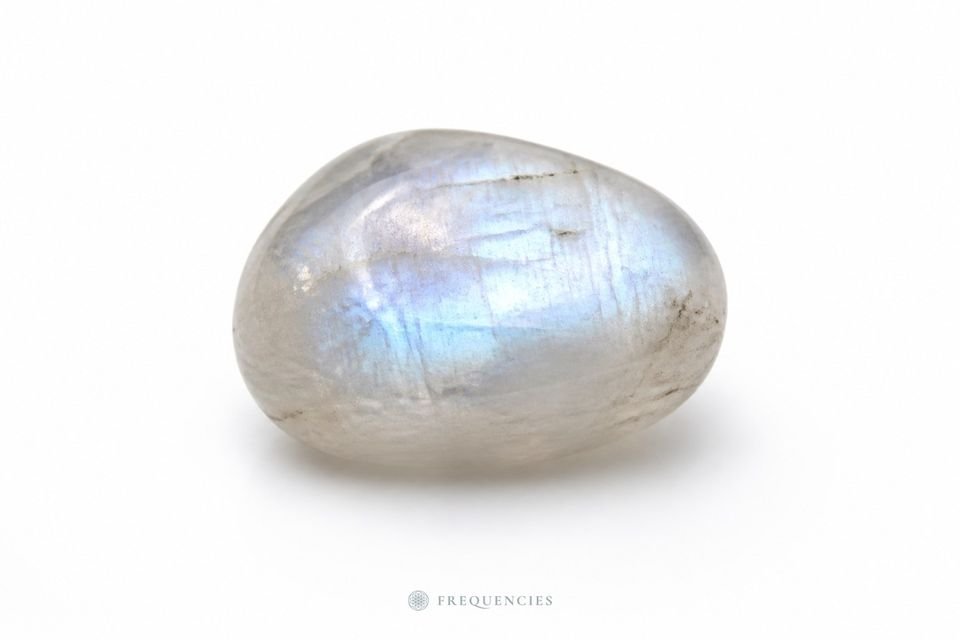
Moonstone is a feldspar in which orthoclase alternates with thin layers of albite [14]. This structure scatters light, and a soft glow seems to glide across the stone. GIA calls this phenomenon adularescence and compares it to a full moon shining through a thin veil of high cloud. In Hindu mythology moonstone is said to be made of solidified moonbeams [15]. Moonstone has a hardness of 6 to 6.5 and its lustre is easily damaged, so store the stone carefully and do not expose it to heat for long [14]. You will find polished stones and a bracelet in the Moonstone category.
The name selenite comes from the Greek word for the Moon, because it was once believed that this mineral waxed and waned with the phases of the Moon [16]. It is a very soft gypsum with a hardness of 2, which should never be soaked in water and should be cleaned only with a dry cloth [16]. For a Moon theme there is a crescent moon selenite dish, and other selenite forms, from rods to lamps, are in the Selenite category.
Many crystal lovers cleanse their stones in the light of the full moon by putting them on a windowsill. If you do this too, take them off in the morning before the sun falls on them. Amethyst and rose quartz can fade in prolonged sunlight, and a clear rock crystal sphere acts like a lens in the sun [14]. What each stone needs is summarised in the care table, and you can read about modern birthstones in the article Birth Month Stones.
Frequently Asked Questions
Which month is the month of souls?
The month of souls (veļu mēnesis) is October. In 1649 Paul Einhorn called it veļu jeb zemliku mēnesis, and both names are linked with remembering the dead ancestors: veļi are the souls of the dead, and zemlikas is a meal offered to the spirits of the dead.
What did the ancient Latvians call January?
In Einhorn’s 1649 list January is ziemas mēnesis, the winter month. Modern lists also call it sala mēnesis, the frost month, while in the Vidzeme calendar for 1817 it is jauna gada mēnesis, the new year month.
What did the ancient Latvians call December?
In Paul Einhorn’s 1649 list December is vilku mēnesis, the wolf month, and modern lists call it the same. In the Vidzeme calendar for 1817 December is ziemas mēnesis, the winter month.
What did the ancient Latvians call February?
In Einhorn’s list February is sveču mēnesis, the candle month, as it is in the Vidzeme calendar for 1817. In Tēzaurs February is also called meteņu mēnesis, puteņu mēnesis and sala mēnesis (the Meteņi, blizzard and frost month).
Why did the ancient Latvians have 13 months in some years?
The ancient months followed the phases of the Moon and lasted about 29 to 30 days. Twelve such months are about 11 days shorter than a solar year, so every two or three years a thirteenth month, a festival month, was added.
When is the season of souls?
The season of souls is most often taken to run from Michaelmas to Martinmas or to All Saints’ Day on 1 November. Folklore records speak about October most of all.
What is the October full moon called?
In the American Old Farmer’s Almanac the October full moon is the Hunter’s Moon (Mednieku mēness in Latvian). In 2026 it falls on 26 October. In the Latvian folk calendar October is veļu mēnesis, the month of souls.
Sources
- G. Jaunmuktāne (Latvian Academic Library). Kalendāri, laika zīmes [Calendars, signs of time]. Latvijas Vēstnesis, 19.10.2004, No. 165
- G. Jaunmuktāne. No kalendāru vēstures [From the history of calendars]. In the collection Izmērītais laiks un telpa [Measured Time and Space], University of Latvia Academic Press
- J. Stradiņš (Latvian Academy of Sciences). Par zinātni par Latviju un latviešiem [On the study of Latvia and the Latvians]. Latvijas Vēstnesis, 2.11.2007, No. 177
- 12 gada mēnešu vārdi. Ieskats Vidzemes kalendārā 1817. gadam [The names of the 12 months: a look at the Vidzeme calendar for 1817]. LSM.lv, Latvian Radio and National Library of Latvia, 2019
- Sveču, sērsnu, vilku… jeb senie latviešu mēnešu nosaukumi [Candle, snow-crust, wolf… or the ancient Latvian month names]. LSM.lv, 2018
- Tēzaurs, Institute of Mathematics and Computer Science, University of Latvia, entries: sērsna, sils, zemlikas, veļi, veļu mēnesis, sala mēnesis, sveču mēnesis, meteņu mēnesis, puteņu mēnesis, vilku mēnesis, ziemas mēnesis, viršu mēnesis, lapu mēnesis, ziedu mēnesis
- P. Vilsone. Klāt salnu mēnesis [The month of night frosts is here]. LSM.lv, Latvian Radio, 2013 (A. Rancāne, R. Muktupāvela)
- I. Upīte. Veļu laiks atcerei un pārdomām par paaudžu pēctecību [The season of souls, a time to remember and reflect on the succession of generations]. LSM.lv, 2014 (G. Pakalns, Archives of Latvian Folklore)
- I. Strazdiņa. Veļu laiks un Halovīns: folkloristi skaidro kopīgo un atšķirīgo [The season of souls and Halloween: folklorists explain what they share and how they differ]. LSM.lv, 2024
- S. Liepiņa. Veļu laikā folkloras pētnieces mudina atcerēties savus senčus [In the season of souls, folklore researchers urge us to remember our ancestors]. LSM.lv, ReTV, 2021
- C. Boeckmann. Full Moon Names. The Old Farmer’s Almanac
- Full Moon in October 2026: Hunter’s Moon. The Old Farmer’s Almanac
- Full Moon in November 2026: Beaver Moon. The Old Farmer’s Almanac
- FREQUENCIES stone encyclopedia: moonstone, amethyst, rose quartz, rock crystal (structure, care)
- Moonstone History and Lore. Gemological Institute of America (GIA)
- FREQUENCIES stone encyclopedia: selenite (name origin, hardness, care)
- Kovas. Lithuanian Wikipedia
- A. Rancāne. Ziemassvētki, latviešu tradicionālajā kultūrā [Christmas in Latvian traditional culture]. National Encyclopedia of Latvia, National Library of Latvia (updated 29.05.2026)
- Seasons in Riga: equinoxes and solstices in Riga time. timeanddate.com
- Earth’s Seasons and Apsides. US Naval Observatory (USNO), Astronomical Applications Department
- FREQUENCIES. 2027 Moon Phase Calendar with Your Special Days (product description)