In 2027, there will be 12 full moons but 13 new moons, and August will even have two new moons, on 2 and 31 August [1][2]. All dates and times are given in Riga time, and we have checked each of them against both timeanddate.com and US Naval Observatory (USNO) data.
Full Moon 2027: All Dates and Times
At full moon, the Moon and the Sun are on opposite sides of the Earth, and the side of the Moon facing us is fully lit. This is why the full moon rises around sunset and sets around sunrise. The main phases of the Moon are precise moments, so the table also gives the clock time [3].
| Month | Full moon | Riga time | Name in the American almanac [4] |
|---|---|---|---|
| January | 22 January, Friday | 14:17 | Wolf Moon |
| February | 21 February, Sunday | 1:23 | Snow Moon |
| March | 22 March, Monday | around midday* | Worm Moon |
| April | 21 April, Wednesday | 1:27 | Pink Moon |
| May | 20 May, Thursday | 13:59 | Flower Moon |
| June | 19 June, Saturday | 3:44 | Strawberry Moon |
| July | 18 July, Sunday | in the evening* | Buck Moon |
| August | 17 August, Tuesday | in the morning* | Sturgeon Moon |
| September | 16 September, Thursday | 2:03 | Harvest Moon, traditionally also Corn Moon |
| October | 15 October, Friday | 16:47 | Hunter’s Moon |
| November | 14 November, Sunday | early morning* | Beaver Moon |
| December | 13 December, Monday | in the evening* | Cold Moon |
* For these full moons, the times in timeanddate.com and USNO data differ by one minute, so the table shows only the day and the time of day [1][2].
The names come from The Old Farmer’s Almanac, an American almanac. The almanac traces their origin to Native American, colonial American and other North American traditions, not to Latvian tradition [4]. The almanac traditionally calls the September full moon the Corn Moon, while the Harvest Moon is the full moon closest to the September equinox. It usually falls in September, but about once every three years in October [4]. In 2027, the equinox is on 23 September, so the Harvest Moon will be on 16 September [4][5]. Old Latvian month names, such as the Candle Month and the Wolf Month, are collected in the article The Month of Souls, Frosts and Wolves.
New Moon 2027: All Dates and Times
At new moon, the Moon is between the Sun and the Earth. It rises and sets together with the Sun, so it cannot be seen at night. If the Sun, Moon and Earth line up exactly at that moment, a solar eclipse occurs somewhere on Earth [3]. The times of all 13 new moons in timeanddate.com and USNO data match to the minute [1][2]. You will find the Moon’s position for every day, in Riga time, in our Moon calendar.
| New moon | Riga time | Note |
|---|---|---|
| 7 January, Thursday | 22:24 | |
| 6 February, Saturday | 17:56 | annular solar eclipse, not visible in Latvia [9][10] |
| 8 March, Monday | 11:29 | |
| 7 April, Wednesday | 2:51 | first new moon after the switch to summer time |
| 6 May, Thursday | 13:58 | |
| 4 June, Friday | 22:40 | |
| 4 July, Sunday | 6:02 | |
| 2 August, Monday | 13:05 | total solar eclipse, partial in Latvia [9][10] |
| 31 August, Tuesday | 20:41 | second new moon in August [1] |
| 30 September, Thursday | 5:36 | |
| 29 October, Friday | 16:36 | |
| 28 November, Sunday | 5:24 | |
| 27 December, Monday | 22:12 |
Riga Time, Clock Changes and Dates in Other Countries
Up to 28 March and from 31 October, the tables show Latvian winter time (EET, UTC+2), and between these dates Latvian summer time (EEST, UTC+3). In 2027, the clocks go forward on Sunday 28 March at 3:00 and back on Sunday 31 October at 4:00 [6]. This follows the EU directive under which summer time in all member states begins on the last Sunday in March and ends on the last Sunday in October at 1:00 GMT [7].
The full moon is a single moment for the whole Earth, but its date depends on the time zone [3]. In Riga, the February full moon is on 21 February at 1:23, but in Universal Time it is still 20 February at 23:23, and that is the date you will see in UK calendars, for example [1][2]. The same applies to the April and September full moons and the 7 April new moon: in Universal Time, they still fall on the previous day [1][2]. If you compare dates with tables from other countries, check which time zone they were compiled for.
Supermoon, Blue Moon and Two New Moons in August
The closest full moon of the year will be on 22 January. The Moon will reach the closest point of its orbit, or perigee, the evening before, on 21 January shortly before midnight, at about 357,300 km from Earth, and it will come no closer than this in 2027 [8]. The full moon will follow less than 15 hours later, and timeanddate.com labels it a supermoon [1]. The same source calls the most distant full moons of the year, on 18 July and 17 August, micromoons [1].
The 20 May full moon is the seasonal blue moon. In spring, from the 20 March equinox to the 21 June solstice, there will be four full moons, and the third of them is called the blue moon [1][5]. August will have two new moons, and in English the second new moon in a calendar month is called a Black Moon [1].
The lunar cycle is not always the same length either. On average, it lasts about 29.5 days [3], but in 2027 the cycle from one new moon to the next will range from just over 29 days and 7 hours in July to almost 29 days and 20 hours in January [1].
Eclipses 2027: What Will Be Visible in Latvia
On the night of 20 to 21 February, at full moon, there will be a penumbral lunar eclipse, visible in Riga from about 23:00 to 3:00 [9]. In a penumbral eclipse, the Moon passes only through the faint outer part of the Earth’s shadow, so it is hard to notice. The best time to look is around maximum eclipse, at about 1:00 at night [9].
On Monday 2 August, around midday, a partial solar eclipse will be visible in Riga: for about an hour and a half, the Moon will cover a small part of the Sun’s disc [9]. On the same day, the total eclipse will be visible along a narrow path crossing southern Spain, Morocco, Algeria, Libya, Egypt, Saudi Arabia, Yemen and Somalia, and the longest total phase will last 6 minutes and 23 seconds [10]. Never look at the Sun without eclipse glasses that meet the ISO 12312-2 standard, as ordinary sunglasses, no matter how dark, are not safe [11].
Several records of Latvian folk beliefs are devoted to eclipses. In Jelgava, people believed that during a lunar eclipse a bucket of clean water should be placed by the window to make things easier for the Moon [12].
The Moon in Latvian Beliefs
Did you know? As early as 1764, the German-language publication “Gelehrte Beiträge zu den Rigischen Anzeigen” wrote that perhaps no other nation arranged its work as carefully by the Moon as the Latvians [12]. The folklorist Aīda Rancāne explains that the ancient months followed the phases of the Moon: the first day of the month was when a thin crescent of the new Moon appeared in the sky, and a month lasted about 29 to 30 days [13].
Pēteris Šmits’s collection “Latvian Folk Beliefs” contains more than 150 records about the Moon [12]. A record from Vecpiebalga says that during the new moon you should do the kinds of work from which you expect success and growth, while one from Burtnieki says that nothing should be planted during the waning moon. In Embūte, people believed that on first seeing the new moon you should rub the money in your pocket without taking it out, so that you would have plenty of it all month [12].
One belief is directly linked to stones. A record from Ikšķile says: while looking at the full moon, pick up the stone that is under your left foot at that moment and put it under your pillow for the night. Then, it is said, your future bridegroom will appear that night, but you must not speak all evening [12]. A widespread taboo forbade pointing a finger at the Moon: 26 records from different parts of Latvia mention it, and almost half of them warn that the finger would rot [12]. One record calls the Moon the Gypsy and the boys’ sun [12]. All of these are folk beliefs, not advice.
Moon Stones and the Full Moon in the Crystal Community
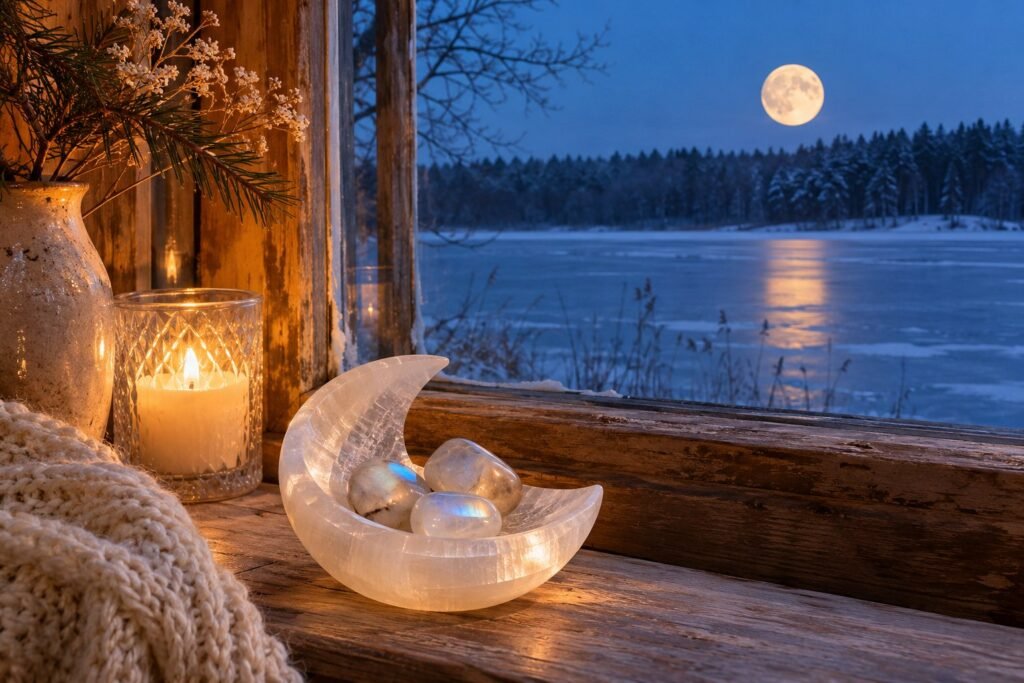
In our encyclopedia, the Moon, as a traditional planet, is linked with selenite, moonstone and milky quartz [14]. The name selenite comes from the Greek word for the Moon, and Mindat attributes it to the mineral’s soft, moonlight-like sheen [16]. Moonstone is a feldspar in which orthoclase alternates with thin layers of albite, while so-called rainbow moonstone is actually a pale labradorite [14]. You will find polished stones in the Moonstone category, and selenite bowls, lamps and candle holders in the Selenite category.

Many crystal lovers put their crystals on the windowsill on the night of the full moon to cleanse them. If you follow this community practice, the table will help you choose the night, but take the stones in the next morning before the sun reaches them. Amethyst and rose quartz can fade in prolonged sunlight, while a transparent rock crystal sphere can concentrate the sun’s rays like a lens and set nearby objects alight [14]. Selenite should not be washed; clean it only with a dry cloth. The care needs of each stone are summarised in the care table.
2027 Moon Phase Calendar for the Wall
If you would like to see the whole year on one page, take a look at the 2027 Moon Phase Calendar: it shows every day of the year with the shape the Moon will have in the sky over Latvia [15]. You can mark up to 8 days that matter to you: each one gets a gold circle, and the date with your own text (up to 24 characters) is printed at the bottom of the calendar [15].
There are three layouts: Grid, Circle and Rows. Each comes in dark turquoise with gold or in a light paper colour. The calendar measures 30 × 40 cm or 50 × 70 cm and is available unframed or in a black, white or oak frame, printed on matt 189 g/m² paper [15]. The calendar is made to order in Latvia, currently costs from €34, and is delivered to your address, not to a parcel locker [15].
Frequently Asked Questions
When is the full moon in January 2027?
The January full moon is on Friday 22 January at 14:17 Riga time. It will be the closest full moon of the year, which timeanddate.com calls a supermoon.
How many full moons will there be in 2027?
There will be 12 full moons and 13 new moons in 2027. August will have two new moons, on 2 and 31 August.
When is the full moon in May 2027?
The May full moon is on Thursday 20 May at 13:59 Riga time. It is the seasonal blue moon, because spring will have four full moons and this is the third of them.
When is the first new moon of 2027?
The first new moon of 2027 is on Thursday 7 January at 22:24 Riga time, and the last is on 27 December at 22:12.
Will an eclipse be visible in Latvia in 2027?
On the night of 20 to 21 February, a penumbral lunar eclipse, which is hard to notice, will be visible in Latvia. On 2 August, around midday, a partial solar eclipse will be visible. Look at the Sun only through eclipse glasses that meet the ISO 12312-2 standard.
Why does the full moon date sometimes differ in foreign calendars?
The full moon is a single moment for the whole Earth, but the date depends on the time zone. For example, the February full moon is on 21 February at 1:23 in Riga, but in Universal Time it is still 20 February.
Why the 2026 winter solstice falls on 21 December and how Latvians marked it is explained in Winter Solstice 2026.
Sources
- timeanddate.com. Moon Phases 2027, Lunar Calendar for Riga, Latvia (times in Riga time, special events, Moon cycle length)
- United States Naval Observatory (USNO), Astronomical Applications Department. Phases of the Moon, 2027 (times in Universal Time)
- timeanddate.com. Phases of the Moon (phase explanations)
- C. Boeckmann. Full Moon Names. The Old Farmer’s Almanac
- timeanddate.com. Seasons, Equinoxes and Solstices for Riga (2027 equinoxes and solstices)
- timeanddate.com. Daylight Saving Time Changes 2027 in Riga
- Directive 2000/84/EC of the European Parliament and of the Council on summer-time arrangements
- timeanddate.com. Moon Distances 2027 (location Riga)
- timeanddate.com: Eclipses visible in Riga, 2 August 2027 Partial Solar Eclipse in Riga, Penumbral Lunar Eclipses
- NASA Eclipse Web Site (F. Espenak): Solar Eclipses 2021 to 2030, Lunar Eclipses 2021 to 2030
- NASA. Eclipse Safety
- P. Šmits. Latvian Folk Beliefs (1940 to 1941), digital version by the Institute of Mathematics and Computer Science, University of Latvia: Moon (Nos. 20174, 20178, 20181, 20189 to 20214), new Moon (Nos. 20305, 20319), full Moon (No. 20338), waning Moon (No. 20340)
- P. Vilsone. Klāt salnu mēnesis. LSM.lv, Latvian Radio, 2013 (A. Rancāne)
- FREQUENCIES Stone Encyclopedia: selenite, moonstone, milky quartz, labradorite, amethyst, rose quartz, rock crystal (composition, traditional planet, care)
- FREQUENCIES. 2027 Moon Phase Calendar with Your Special Days, product page (viewed 08.11.2026)
- Mindat.org, Hudson Institute of Mineralogy. Selenite (origin of the name)