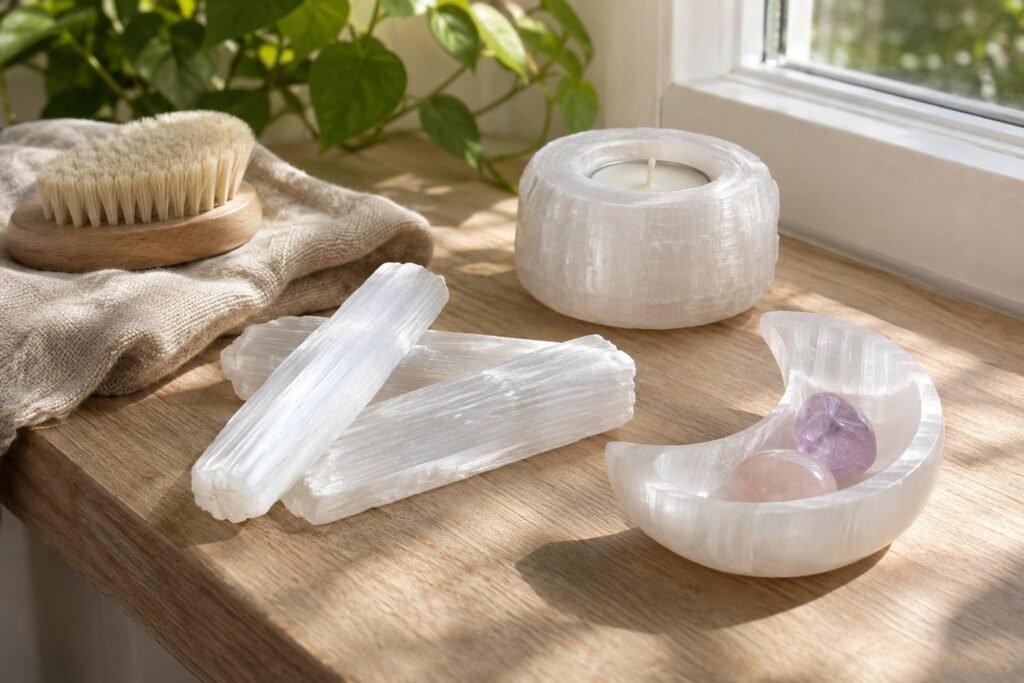
Selenite is a variety of gypsum, or calcium sulfate dihydrate, with a hardness of 2 on the Mohs scale. It is slightly soluble in water, so selenite should not be placed in water or salt; instead, dust should be wiped off with a dry, soft brush or cloth. In the crystal community, selenite is symbolically “cleansed” with sound and “charged” in moonlight, but this is a belief, not a proven effect.
Rods, spheres, hearts, candle holders, and moon bowls are all made from the same mineral, so their care is identical. Lamps have their own specifics (bulb, cord, weight), which you can read about in the article Selenite Lamp.
What are selenite items made of and why are they so sensitive?
Selenite is gypsum, calcium sulfate with two water molecules: CaSO4·2H2O. According to the Handbook of Mineralogy, water makes up about 21% of the mineral’s mass1. This water is part of the mineral itself, and when heated, gypsum loses it: PubChem data shows it loses some water at 128 °C and all of it at 163 °C2.
Gypsum’s hardness is 1.5 to 2, and it varies slightly depending on direction1. A fingernail has a hardness of 2 to 2.53, so a nail can leave a mark on selenite. To learn how to compare hardness at home, see the article Mohs Hardness Scale. Gypsum is slightly soluble in water: at 20 °C, about 2 g dissolves per litre4. This may not sound like much, but it is the surface that dissolves, and after washing, the silky shine becomes matte5. Salt dissolves much better in water, and the differences between the two minerals are compared in the article Salt Lamp or Selenite Lamp.
In the trade, selenite most often means fibrous gypsum, also known as satin spar, from which rods, spheres, and candle holders are made5. Gypsum has a splintery fracture1, and geology.com notes that the durability of satin spar and alabaster ornaments is limited by their low hardness7. Therefore, protect rods and spheres from drops and impacts, as also indicated in our rod descriptions8. The selenite rods, sphere, hearts, and candle holders in our store are from Morocco8. To learn how gypsum forms and where it is found in Latvia, see the article Gypsum Stone and Selenite in Latvia, and for mineral properties and symbolism, see the selenite page in the encyclopedia.
How to remove dust from selenite and how to store it?
Wipe dust off with a dry, soft cloth or clean with a soft brush5. Do not use cleaning agents or wet wipes, as the encyclopedia recommends avoiding aggressive cleaning agents and water for selenite5. Sources differ on using a damp cloth. The Crystals.com guide states that if necessary, selenite can be wiped with a dry or slightly damp cloth9, and two of our product descriptions also allow a slightly damp cloth8, but our care table does not recommend water for selenite at all10. A dry cloth is safer. If a sticky stain remains on the surface, moisten only the corner of the cloth and dry the spot immediately.
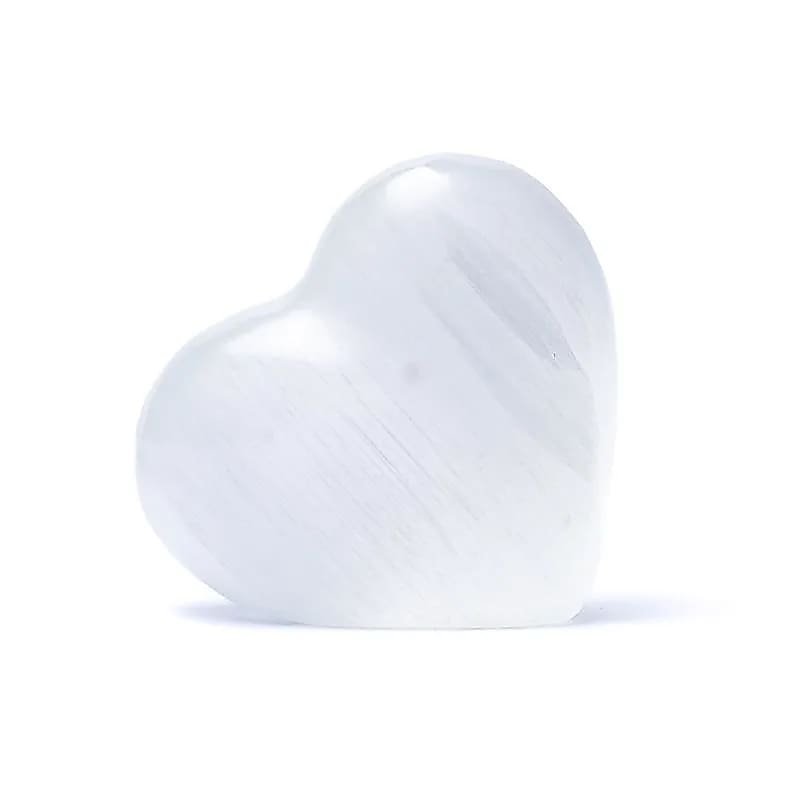
Do not scrape dirt with your nail, as a nail is as hard or harder than gypsum1,3. Keep this in mind when storing selenite. Clear quartz, amethyst, and rose quartz are varieties of quartz, and quartz has a hardness of 73. In the same box or pouch, they can scratch selenite, so wrap selenite in soft fabric and store it in a dry place, not in the bathroom or on a cold windowsill. If you have small children or pets at home, read the article Are Crystals Safe for Pets and Children, which also discusses selenite in water bowls.
You will find rods of various lengths in the selenite rods category. Currently (20 November 2026), they cost from €3.50 (6 to 8 cm) to €9.10 (12 to 15 cm).
How to cleanse selenite and what should not be done with it?
“Cleansing” selenite in the crystal community is a symbolic custom. Only methods where the stone does not come into contact with water, salt, or heat are suitable for selenite.
| Method | For selenite | Why |
|---|---|---|
| Running water, soaking | No | Gypsum dissolves in water (about 2 g per litre), and the surface becomes matte4,5 |
| Salt or saltwater | No | Saltwater is water, but dry salt (halite) has a hardness of 2 to 2.5, the same or higher than gypsum, so grains can scratch the surface11,1 |
| Burying in soil | No | Soil is moist and contains sand grains |
| Direct sunlight | With caution | The care table recommends protecting selenite from prolonged sun and heat10,5 |
| Moonlight | Yes, indoors | Nothing touches the stone; outdoors, dew or rain can moisten it |
| Incense, sage, or palo santo smoke | Yes, if the stone is not in the flame | Heated gypsum loses water, some of it already at 128 °C2 |
| Sound (bowl, bell) | Yes | Nothing touches the stone |
| Dry brush or cloth | Yes | Recommended cleaning method5 |
| Storage | In a dry place, separately | Quartz and other harder stones scratch gypsum3 |
Which community methods are suitable for other stones can be read in the article How to Cleanse Crystals. Some crystal enthusiasts consider selenite to be a stone that does not need to be cleansed. Crystals.com writes that selenite is traditionally considered one of the rare minerals that cleanse themselves9. Not everyone agrees. Crystal community teacher Ashley Leavy, in a 2021 mindbodygreen article, nevertheless recommended cleansing selenite from time to time, for example, with sound or moonlight12. Science does not confirm these beliefs: an EBSCO review states that there is no evidence for the theories of crystal effects in rigorous clinical or other scientific studies13.
How to charge selenite according to crystal community customs?
The Crystals.com table lists moonlight as a way to “charge” selenite9. Leavy also recommends moonlight for cleansing selenite: leave it in direct moonlight on a full moon night, as the stone is named after the Greek moon goddess Selene12. The Greek word selēnē means the Moon5.
Practically, this is done as follows: on the evening of the full moon, place the selenite indoors on a windowsill or table by a window where the moon is visible. Do not leave it outside, as dew and rain are still water. In winter, condensation often accumulates on a cold window pane14, so place a dry cloth under the stone and remove the selenite in the morning, before the sun shines on it. Full moon dates in Riga time are given in the article Moon Phases 2027.
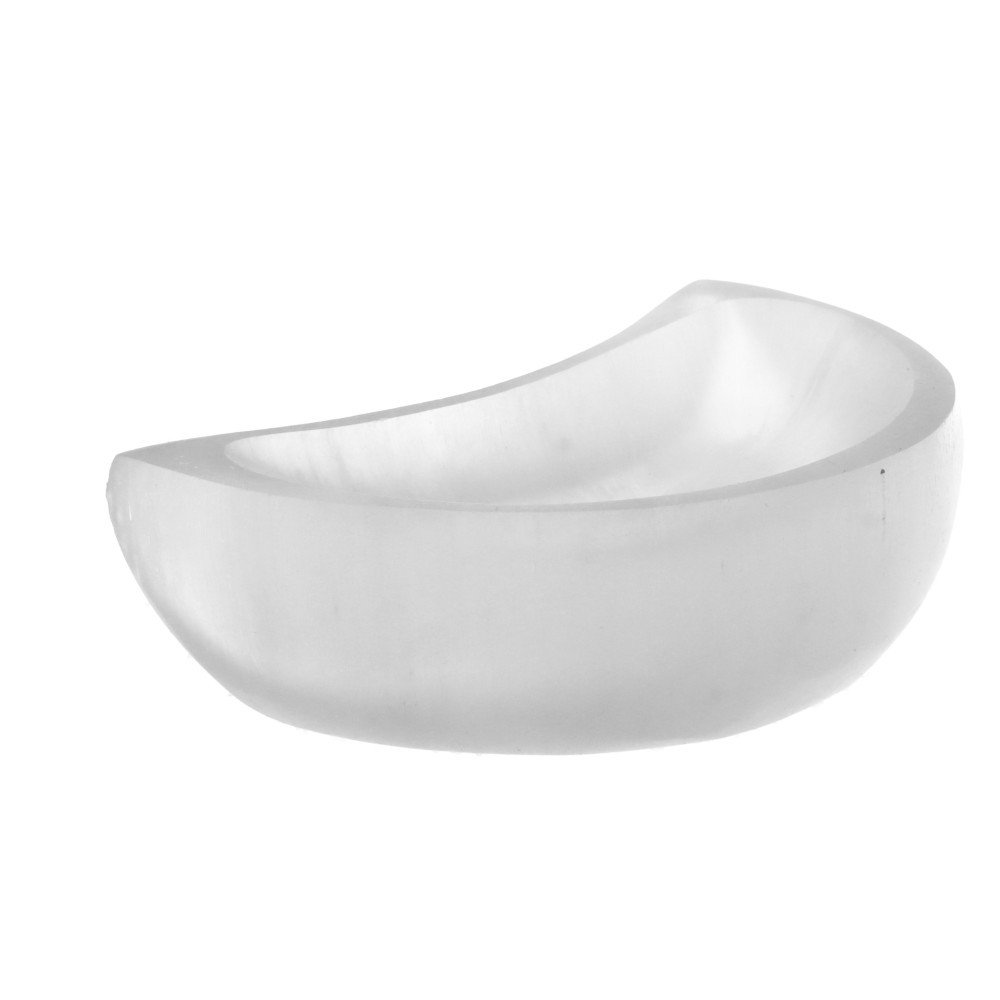
Selenite is also used for the symbolic “charging” of other stones. Crystals.com recommends placing crystals on a selenite plate or in a selenite bowl for four or more hours9. A small moon bowl is also suitable for this purpose, where you can place rings or small crystals8. Place stones and jewellery gently, do not drop or slide them, as harder stones can scratch selenite. Currently (20 November 2026), a 6 cm selenite moon bowl costs €17.00, and an 8 cm selenite sphere €31.00.
Can you burn a candle in a selenite candle holder?
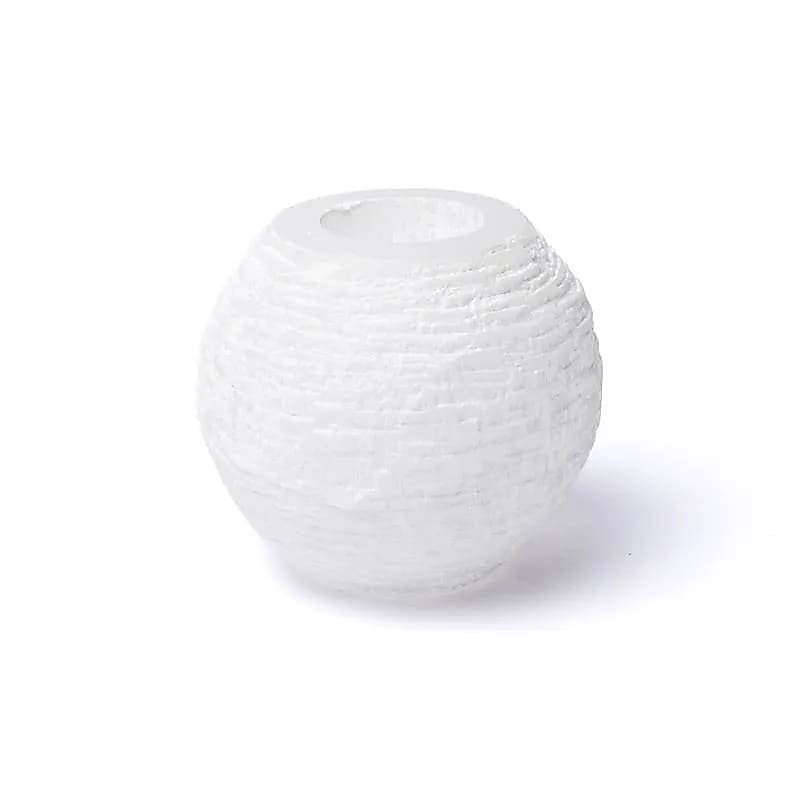
Yes. Our heart-shaped and round selenite candle holders are designed for tea lights, and all candle holder descriptions include an important safety rule: never leave a burning candle unattended8. The flame must not touch the stone itself, as heated gypsum loses its crystal water, some of it already at 128 °C2.
The U.S. Fire Administration recommends placing candles in stable holders where they cannot be easily knocked over, keeping them at least 30 cm (12 inches) away from anything flammable, and extinguishing them when you leave the room or go to sleep. The administration does not recommend using burning candles in bedrooms and bathrooms at all15. If you only want light, the administration suggests considering battery-operated candles with no flame15, and these can also be placed in a selenite candle holder if the size fits.
You will find candle holders in the selenite candle holder category. Currently (20 November 2026), the heart-shaped candle holder ±8×7×5 cm costs €11.77, the round candle holder ±7×7×7 cm €21.00, and the “Snowball” candle holder ±10×10 cm €24.00.
How to recognise genuine selenite and what it is confused with?
According to the U.S. Geological Survey, selenite is the name for colourless, transparent gypsum crystals, while satin spar is fibrous gypsum with a silky lustre6. In commerce, both are often called selenite5. Thus, a white fibrous rod with a silky luster is not a fake: it is the same mineral gypsum, just in a different form6,5. At home, you can check some features without instruments.
- Hardness. In an inconspicuous place, such as the bottom of the base, gently scratch with a fingernail. Gypsum will show a scratch, as its hardness is 1.5 to 2, while a nail is 2 to 2.51,3,6. Calcite, with a hardness of 3, is not scratched by a nail16,3.
- Warmth. Gypsum has low thermal conductivity, so it does not feel as cold in the hand as quartz5. This feature alone is not enough, and the reasons are explained in the article How to Recognise a Genuine Crystal.
- Weight. Gypsum has a density of 2.31 g/cm³, calcite 2.71 g/cm³, and ulexite 1.96 g/cm³1,16,17. Calcite of the same size is about one-sixth heavier than gypsum, but this difference is hard to feel by hand. At the University of Waterloo, ulexite and gypsum were distinguished in a liquid with a density of 2.1 g/cm³, where ulexite floats and gypsum sinks18.
- Plates. Transparent selenite has perfect cleavage in one direction, so it splits into thin plates. Thin plates are slightly flexible but not elastic: when bent, they do not return to their original shape1.
Selenite is also often confused with ulexite, known as “TV stone” (television stone). This is a completely different mineral, a boron compound NaCaB5O6(OH)6·5H2O, whose parallel fibres conduct light like optical fibre17. University of Waterloo (Canada) authors Jeffrey Shallit and Earth Sciences Museum curator Peter Russell reported that at mineral shows and online, fibrous gypsum, apparently from Morocco, is also sold as ulexite18. They suggest a simple test: place a piece polished on both sides on a newspaper. Through ulexite, letters are readable even at a 30° angle, but through satin spar, they blur at a 10° angle and are unreadable at a 20° angle18. Ulexite often has white, brownish, or black inclusions, while satin spar can be almost clear but more often has internal cracks18.
The name satin spar is also sometimes used for fibrous calcite20. It differs from gypsum by its higher hardness (3), perfect rhombohedral cleavage16, and reaction with hydrochloric acid: calcite fizzes rapidly in cold hydrochloric acid, while gypsum does not react19,6. The acid test is a laboratory method and should not be done at home with your own item. Calcite is described in our encyclopedia on the calcite page, and there is a separate page for orange calcite.
Pure gypsum is colourless or white, but the Handbook of Mineralogy states that impurities can colour it yellow, yellow-brown, blue, pink, brown, reddish-brown, grey, or black1. In our store, polished orange selenite stones are described as orange selenite (satin spar) with a hardness of 2, but the origin of the colour is not specified in the description8. Care for them is the same as for white selenite. You will find all selenite items in the selenite category.
Frequently Asked Questions
Can selenite be washed in water?
No. Gypsum dissolves in water, about 2 g per litre at 20 °C, and after washing, the silky surface may become matte. Clean selenite with a dry, soft cloth or brush.
Does selenite need charging?
Opinions in the crystal community differ: some believe selenite cleanses itself, others place it in full moonlight from time to time. This is a belief, and the effects of crystals are not scientifically proven.
Can selenite be kept in the sun?
Better not for long periods. Our care table recommends protecting selenite from direct sun and heat, and heated gypsum loses its crystal water, some of it already at 128 °C.
How to distinguish selenite from ulexite?
Place a piece polished on both sides on a newspaper. Through ulexite, letters are readable even at a 30° angle, but through fibrous gypsum, they blur at a 10° angle. Gypsum is also heavier: its density is 2.31 g/cm³, ulexite’s is 1.96 g/cm³.
Why has selenite become matte?
A matte surface can occur if selenite is washed or left in moisture for a long time, for example, on a windowsill where condensation accumulates, because gypsum dissolves in water. Therefore, store selenite in a dry place and clean it only dry.
Can a tealight candle be placed in a selenite candle holder?
Yes, our heart-shaped and round selenite candle holders are designed for tea lights. The flame must not touch the stone, never leave the candle unattended, and leave at least 30 cm of free space around it from anything flammable.
Sources (20)
- ↩ Handbook of Mineralogy (Mineral Data Publishing), Gypsum: composition, hardness, cleavage, density, colours: handbookofmineralogy.org/pdfs/gypsum.pdf
- ↩ PubChem (NIH), Calcium Sulfate: water loss when heated: pubchem.ncbi.nlm.nih.gov/compound/24497
- ↩ Geology.com, Mohs Hardness Scale: hardness of nail and quartz: geology.com/minerals/mohs-hardness-scale.shtml
- ↩ PubChem (NIH), Calcium Sulfate Dihydrate: solubility in water: pubchem.ncbi.nlm.nih.gov/compound/24928
- ↩ FREQUENCIES stone encyclopedia: selenite: frequencies.lv/enciklopedija/selenits
- ↩ C. F. Withington, M. C. Jaster, “Selected Annotated Bibliography of Gypsum and Anhydrite in the United States and Puerto Rico”, U.S. Geological Survey (USGS), Bulletin 1105, 1960, p. 2: selenite, satin spar, hardness, reaction with hydrochloric acid: pubs.usgs.gov/bul/1105/report.pdf
- ↩ Geology.com, Gypsum: satin spar and alabaster in ornaments: geology.com/minerals/gypsum.shtml
- ↩ frequencies.lv selenite product descriptions (Store API, 20 November 2026): frequencies.lv/produkta-kategorija/selenits
- ↩ Crystals.com, “How to Cleanse & Charge Crystals: The Complete Guide”, 24 August 2026 (crystal community guide): crystals.com/blogs/news/how-to-cleanse-and-charge-crystals
- ↩ FREQUENCIES stone encyclopedia, care table: frequencies.lv/enciklopedija/kopsana
- ↩ Handbook of Mineralogy (Mineral Data Publishing), Halite: hardness: handbookofmineralogy.org/pdfs/halite.pdf
- ↩ S. Regan, “How To Use Selenite For Deep Energetic Cleansing, From Crystal Experts”, mindbodygreen, 14 October 2021 (crystal community opinion): mindbodygreen.com/articles/selenite
- ↩ EBSCO Research Starters, “Crystal healing”: ebsco.com/research-starters/complementary-and-alternative-medicine/crystal-healing
- ↩ frequencies.lv, “Selenite Lamp: How to Choose Size, Light, and Placement at Home”: frequencies.lv/selenita-lampa
- ↩ U.S. Fire Administration (FEMA), “Candle Fire Safety”: usfa.fema.gov/prevention/home-fires/prevent-fires/candle
- ↩ Handbook of Mineralogy (Mineral Data Publishing), Calcite: hardness and density: handbookofmineralogy.org/pdfs/calcite.pdf
- ↩ Handbook of Mineralogy (Mineral Data Publishing), Ulexite: composition, density, optical fibres: handbookofmineralogy.org/pdfs/ulexite.pdf
- ↩ J. Shallit, P. Russell, “Ulexite or Satin Spar Gypsum? The Scoop on Television Stone”, University of Waterloo: cs.uwaterloo.ca/~shallit/ulexite/tvstone.html
- ↩ Geology.com, “The Acid Test for Carbonate Minerals and Rocks”: calcite reaction with cold hydrochloric acid: geology.com/minerals/acid-test.shtml
- ↩ L. J. Spencer, “The ‘Satin Spar’ of Alston in Cumberland; and the Determination of Massive and Fibrous Calcites and Aragonites”, Mineralogical Magazine, vol. 11, no. 52, 1897, doi:10.1180/minmag.1897.011.52.05: cambridge.org