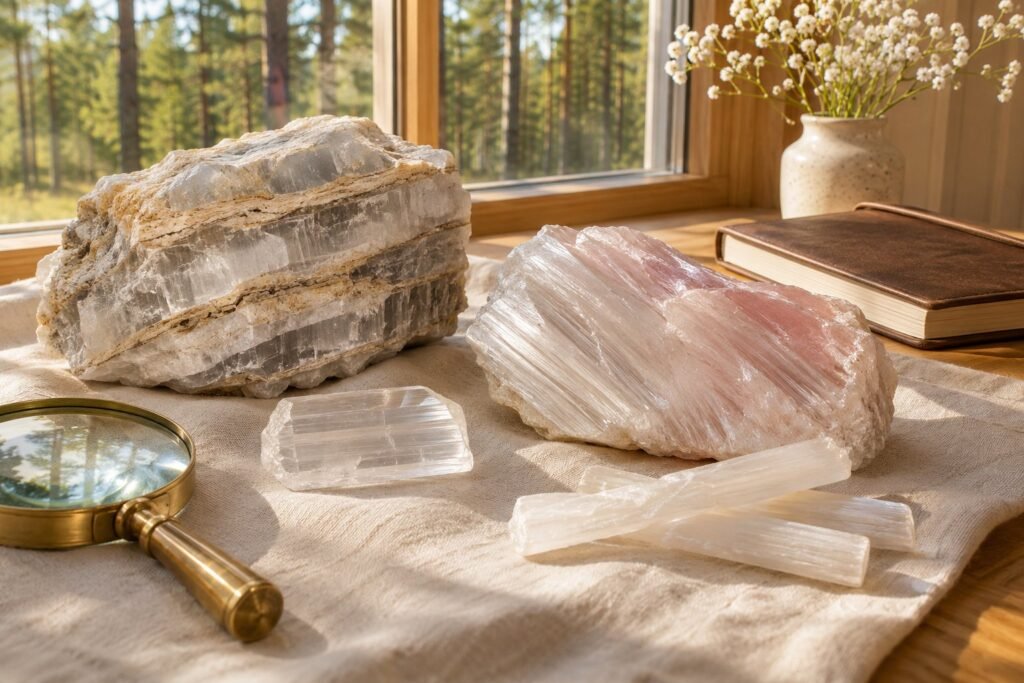
At the end of March 2021, the ground gave way on a forest road near Salaspils, opening a pit that was 7 metres deep at its centre [1, 2]. The void under the road had been created by groundwater dissolving the gypsum rock [1, 2]. In Latvia, only the gypsum rock of the Upper Devonian Salaspils Formation is of practical importance [3]. Selenite lamps and rods are made of the same mineral, gypsum, but the selenite in our shop comes from Morocco [13].
Gypsum Rock, Gypsum and Selenite: Which Is Which
Gypsum rock is a sedimentary rock dominated by the mineral gypsum [3]. Gypsum is a hydrous calcium sulfate, CaSO₄·2H₂O, and the most common sulfate mineral. Its name comes from the Greek word γύψος (gypsos), meaning plaster [4]. Mindat distinguishes three varieties: clear crystals are called selenite, parallel fibrous aggregates are called satin spar, and the dense, fine-grained mass is called alabaster [4]. Britannica adds that fibrous satin spar has a silky lustre [5].
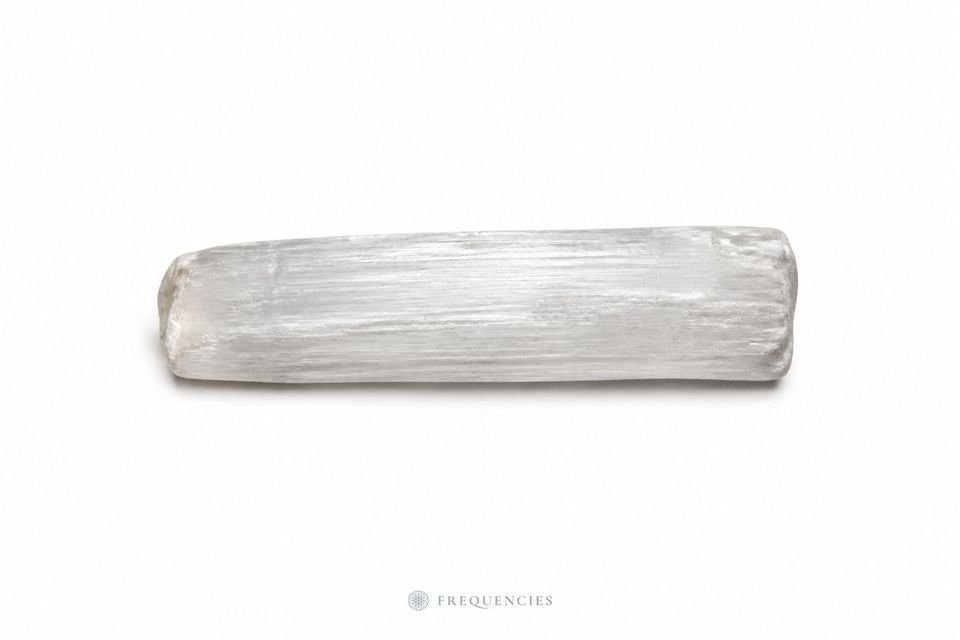
Mindat traces the name “selenite” to the Greek word σελήνη, meaning Moon. This refers either to the mineral’s white, moonlight-like reflections or to the light that shines through thin gypsum plates, which were once used in windows. Mindat also notes that the word “selenite” is mostly a synonym for gypsum, although historically it referred specifically to the transparent variety [6]. In the trade, fibrous satin spar is often called selenite too [7]. How the fibres give a lamp its silky glow and how to care for selenite are explained on the selenite page of our encyclopedia and in the article Selenite Lamp.
How Latvian Gypsum Rock Formed
In Latvia, gypsum rock suitable for quarrying lies in the Upper Devonian Salaspils Formation. It formed in a hot, dry climate, when water evaporated from shallow marine lagoons, the salt concentration rose and calcium sulfate precipitated [8]. According to Dainis Ozols’s book “Minerals and Rocks of Latvia”, anhydrite, an anhydrous calcium sulfate, was deposited first, and only later, deep underground, did it take up water and recrystallise as gypsum [9]. Pale blue anhydrite is sold in shops under the name angelite, and our encyclopedia notes that its surface, too, turns into gypsum and goes matt in damp conditions [7]. Britannica notes that when anhydrite turns into gypsum, the volume of the rock increases by 30 to 50% [5].
In the Salaspils area, this formation is 10 to 15 m thick. Gypsum makes up about half of its section, dolomitic gypsum and gypsiferous dolomite a quarter, and the rest is dolomite, dolomitic marl and clay [1]. In the Salaspils Formation, gypsum occurs only where the ancient lagoons lay: near Salaspils, Saulkalne and Saurieši, Jūdaži and Mālpils, and around Skaistkalne [8]. Ozols also mentions gypsum rock near Tukums and in eastern Vidzeme [9]. How gypsum rock fits in among the other sedimentary rocks is explained in the article Types of Rocks.
Gypsum Rock Deposits in Latvia
The report of the Latvian Environment, Geology and Meteorology Centre (LVĢMC) for 2019 to 2021 lists six known gypsum rock deposits: Saurieši, Salaspils, Skaistkalne, Saulkalne, Zvejnieki and Liepmeži. The gypsum rocks of the Salaspils Formation are widespread in the Riga region and in Bauska and Alūksne municipalities. The earliest report on gypsum rock research in the State Geological Fund dates from 1944 [3].
The Latvian Cabinet of Ministers has designated two of them as deposits of national importance. The Salaspils deposit in Salaspils Parish covers 102.1 ha, and its gypsum rock is intended for making gypsum products, cement and finishing materials. The Skaistkalne deposit in Bārbele, Skaistkalne and Kurmene parishes covers 174.5 ha and is intended for making cement, building plaster and finishing materials. On 1 January 2005, the reserves of the Skaistkalne deposit were almost five times those of the Salaspils deposit: about 22.0 and 4.5 million cubic metres respectively [10].
Extraction: Saurieši Worked Out, Gypsum Quarried at Salaspils
The Saurieši deposit has been fully worked out, and at present gypsum is quarried in Latvia only at the Salaspils deposit [8]. According to LVĢMC data, 0.16 million cubic metres of gypsum rock were extracted in 2020 and 0.17 million cubic metres in 2021 [3, 12], and the largest producer in 2021 was SIA “KNAUF” [3]. The report for 2022 does not cover gypsum rock because no extraction data were submitted [11], but in 2023, 0.16 million cubic metres were extracted [12].
In the Salaspils quarry, the formation comes almost right up to the surface. Karušs and co-authors, citing the book “Mineral Resources of Latvia” (1997) by V. Kuršs and A. Stinkule, state that the productive layer of the Salaspils deposit contains on average 87.4% gypsum [1]. Because of quarrying, the groundwater level in the quarry has been lowered by more than 20 metres [1]. Britannica writes that about three quarters of mined gypsum is calcined and used for building plaster, or plaster of Paris, plasters and boards. Uncalcined gypsum is added to Portland cement to slow down its setting and is also used as a fertiliser and as a filler in paper [5].
Gypsum Crystals in Latvia: Fibres, Plates and Celestine
In the Saurieši quarry, Ozols described layers of white, yellowish and pink fibrous gypsum and brownish platy gypsum alternating with layers of dolomite and marl. Fibrous gypsum is an aggregate of parallel crystals that grew in cracks in the rock, and Ozols singles out as especially beautiful the finely fibrous aggregates with perfectly parallel needle-like crystals. Saurieši also has intergrowths of grey-brown platy crystals, and the largest face of platy gypsum crystals is shaped like a parallelogram [9].
Fibrous gypsum is the same satin spar from which the selenite rods sold in shops are usually made [4, 7]. The selenite rods, spheres and lamps in our shop come from Morocco [13], and we do not sell Latvian gypsum. You will find all selenite items in the selenite category and the fibrous rods in the rods section.
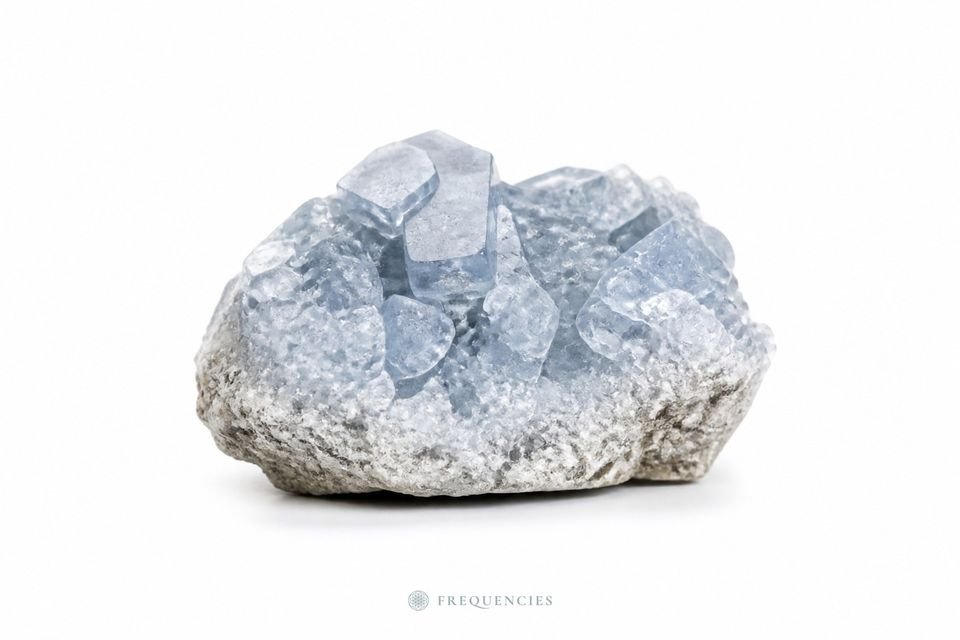
In the fibrous gypsum rock of Saurieši and Nāvessala, Ozols also describes bluish-grey, cone-shaped celestine inclusions that look like nails. The book also has a picture of a pyrite specimen from the Saurieši quarry. Ozols calls gypsum one of the best minerals for a collection, but one that needs particularly careful handling [9]. Gypsum has a hardness of 2 [4] and can be scratched with a fingernail [14]. How to store soft stones is shown in the care table.
Karst: Why Gypsum Rock Disappears Underground
Gypsum dissolves readily in water: at 20 °C, 2.4 g of gypsum dissolves in a litre of water, and it dissolves up to 100 times faster than carbonate rocks such as limestone and dolomite [1]. Geologists call the dissolution of these rocks, and the hollows, funnels and sinkholes it creates, karst [15]. In Latvian, karsts also means “hot”, but the geological term has nothing to do with temperature: it comes from the Dinaric Highlands [15].
Latvia’s gypsum karst areas lie near Gaujiena and Allaži and between Baldone and Skaistkalne [16]. The University of Latvia geologist Kristaps Lamsters explained that sinkholes form where gypsum rock lies close to the surface and groundwater dissolves it [2]. In Latvia, they are seen most often at Skaistkalne, says Ģirts Stinkulis, Associate Professor at the University of Latvia [17]. The Salaspils sinkhole formed 900 m south-west of the Salaspils gypsum quarry and had a volume of at least 45 cubic metres. The researchers suggest that the groundwater level, lowered because of the quarry, sped up the dissolution, because surface water that does not yet contain dissolved sulfate can then flow into the gypsum layer [1]. The Salaspils karst sinkhole is Latvia’s geosite of the year for 2026 [15].
The protected natural monuments include the Skaistkalne karst sinkholes in Bauska Municipality and the Ezernieki karst sinkholes in Allaži Parish [18]. The Skaistkalne karst area covers about 225 km² and extends into Lithuania. Because of the gypsum rock, the groundwater of the Salaspils Formation there contains 1.1 to 1.3 g of sulfates per litre. Some of the sinkholes can be seen from trails, and the most remarkable are usually said to be Liepu Dobe, Audžu Dobe, Kugurdobe and Lielā Baltā Dobe [19]. Damaging a natural monument and extracting mineral resources on its territory are prohibited [20], so do not collect samples there. Keep away from fresh sinkholes: in Salaspils, the overhanging layer of earth above the pit collapsed within a year, and the pit became almost as wide as the road [1].
Did you know? The sulfur springs of Ķemeri are also linked to gypsum rock. Ozols writes that the hydrogen sulfide there forms from deeper-lying gypsum rocks through the action of sulfate-reducing bacteria, and as the hydrogen sulfide oxidises, a pale yellow sulfur sediment is deposited where the springs emerge [9]. Mineral waters containing calcium sulfate and hydrogen sulfide also flow out in Baldone and Bārbele [8], and the Bārbele hydrogen sulfide spring is a protected natural monument [18].
If the glow of selenite appeals to you, take a look at the selenite lamp category. We deliver orders from €30 free of charge to parcel lockers in the Baltic States.
Frequently Asked Questions
Where is gypsum rock extracted in Latvia?
At present, gypsum is quarried in Latvia only at the Salaspils deposit, and the Saurieši deposit has already been fully worked out. According to LVĢMC data, 0.16 million cubic metres of gypsum rock were extracted in 2023.
What is gypsum rock made of?
The main mineral is gypsum, or hydrous calcium sulfate, CaSO₄·2H₂O. In the Salaspils area, gypsum makes up about half of the section of the Salaspils Formation, dolomitic gypsum and gypsiferous dolomite a quarter, and the rest is dolomite, marl and clay. The productive layer of the Salaspils deposit contains on average 87.4% gypsum.
Are selenite and gypsum the same?
Yes, they are the same mineral. Mindat calls clear gypsum crystals selenite, the fibrous variety satin spar, and the dense, fine-grained mass alabaster. In the trade, what is sold as selenite is often satin spar.
What is gypsum rock used for?
Most gypsum is calcined and used for building plaster, plasters and boards. Uncalcined gypsum is added to cement to slow down its setting. The Salaspils deposit is intended for making gypsum products, cement and finishing materials, and the Skaistkalne deposit for making cement, building plaster and finishing materials.
Why do karst sinkholes form in Latvia?
Gypsum dissolves in water up to 100 times faster than limestone and dolomite. Where gypsum rock lies close to the surface, groundwater washes out voids, and the ground above them collapses. Sinkholes are seen most often at Skaistkalne, but they also occur around Allaži and Salaspils.
Sources
- J. Karušs, P. Džeriņš, K. Lamsters, J. Ješkins, Ģ. Stinkulis, “Limitations in detectability of air-filled gypsum karst cavity by electrical resistivity tomography: a case study from the Baltic Devonian sedimentary basin”, Estonian Journal of Earth Sciences, 72(2), 2023: doi.org/10.3176/earth.2023.84
- LSM.lv, 29.03.2021, “A karst sinkhole has formed in Salaspils: collapse on a forest road” (University of Latvia Assoc. Prof. K. Lamsters): www.lsm.lv/raksts/zinas/latvija/salaspili-izveidojusies-karsta-krit…
- LVĢMC, “Summary report on the extraction and reserves of mineral resources and changes in them (2019-2021)”, gypsum rock page: videscentrs.lvgmc.lv/files/Zemes_dziles/Kopsavilkuma_parskats_2021.pdf
- Mindat.org, “Gypsum”: www.mindat.org/min-1784.html
- Encyclopaedia Britannica, “gypsum”: www.britannica.com/science/gypsum
- Mindat.org, “Selenite” (origin and meaning of the name): www.mindat.org/min-5527.html
- FREQUENCIES stone encyclopedia: selenite, angelite, celestine (data from GIA, Mindat, geology.com): frequencies.lv/enciklopedija/selenits/
- Ģ. Stinkulis, “Mineral resources in Latvia”, National Encyclopedia (updated 03.02.2025): enciklopedija.lv/skirklis/26079
- D. Ozols, “Minerals and Rocks of Latvia”, Latvian Petroglyph Centre, 2008 (on the Nature Conservation Agency website): gypsum, celestine, sulfur, evaporites: www.daba.gov.lv/lv/media/1745/download
- Cabinet of Ministers Regulation No. 321 (08.05.2012) “Regulations on mineral deposits of national importance”, point 1.1 (in force): likumi.lv/ta/id/247498
- LVĢMC, “Summary report” for 2022 (note on gypsum rock data): videscentrs.lvgmc.lv/files/Zemes_dziles/Kopsavilkuma_parskats_2022.pdf
- LVĢMC, “Summary report on the extraction and reserves of mineral resources and changes in them (2020-2023)”, 2024: videscentrs.lvgmc.lv/files/Zemes_dziles/Kopsavilkuma%20p%C4%81rskat…
- frequencies.lv, selenite product pages, for example, “Selenite Lamp 37cm 3.5kg” and “Selenite Rods +8-10cm” (origin: Morocco), viewed 08.11.2026: frequencies.lv/products/selenita-lampa-37cm-35kg/, frequencies.lv/products/selenita-stieni-8-10cm-3/
- Encyclopaedia Britannica, “Mohs hardness”: www.britannica.com/science/Mohs-hardness
- LSM.lv, 23.01.2026, “Salaspils karst sinkhole chosen as the 2026 geosite of the year”: www.lsm.lv/raksts/dzive-stils/vide-un-dzivnieki/23.01.2026-par-2026…
- University of Latvia, “Resource distribution”: gypsum rock and limestone distribution areas in Latvia (V. Zelčs, based on “Latvia’s Subsurface Resources”, 1997): www.lu.lv/fileadmin/user_upload/lu_portal/projekti/vpp/mali_latvija…
- LSM.lv, 17.02.2026, “Fortunately, no casualties. How did the Salaspils karst sinkhole and other similar places in Latvia form?” (Ģ. Stinkulis, A. Dēliņa): www.lsm.lv/raksts/dzive-stils/vide-un-dzivnieki/17.02.2026-labi-ka-…
- Cabinet of Ministers Regulation No. 461 (14.07.2022) “Regulations on protected geological and geomorphological natural monuments”, point 1: likumi.lv/ta/id/334009
- Nature Conservation Agency, “Geological Natural Monument Skaistkalne Karst Sinkholes”, description (surveyed by A. Markots and A. Dēliņa, 2015): www.daba.gov.lv/lv/media/4518/download
- Cabinet of Ministers Regulation No. 264 (16.03.2010) “General protection and use regulations for specially protected nature territories”, point 40: likumi.lv/ta/id/207283