
Polished hematite and black onyx may seem similar in the palm, but hematite is an iron ore, and a stone of the same size is about twice as heavy: according to Mindat data, hematite’s density is 5.26 g/cm³, while onyx’s density is 2.6 to 2.65 g/cm³ [11, 4]. Black tourmaline is a mineral, obsidian is volcanic glass, and shungite is a carbon-containing material from Karelia. Most of them can be told apart at home with your eyes, your palm, a magnet and a torch, without damaging the stone.
Five Black Stones in One Table
Two of the five are not minerals. Obsidian is natural glass, and the word shungite refers to both nearly pure amorphous carbon and carbon-containing rock [8, 9]. Mineral databases do not assign them a single hardness or density, so these figures are not listed in the table.
| Stone | What it is | Mohs hardness | Density, g/cm³ | Lustre | Main feature |
|---|---|---|---|---|---|
| Black tourmaline (schorl) | mineral from the tourmaline group | 7 to 7.5 | 3.18 to 3.22 | vitreous to resinous | prisms with longitudinal striations |
| Black onyx | chalcedony or microcrystalline quartz | 6.5 to 7 | 2.6 to 2.65 | waxy | uniformly black or with straight bands |
| Obsidian | volcanic glass | slightly harder than window glass | no single value | vitreous | smooth, curved fracture with sharp edges |
| Shungite | amorphous carbon or carbon-containing rock | no single value | no single value | submetallic | carbon content from over 5% to about 98% |
| Hematite | mineral, iron oxide | 5 to 6 | 5.26 | metallic | reddish-brown streak, heavy |
The data in the table come from Mindat, GIA and Britannica [1, 2, 4, 5, 7, 8, 9, 10, 11]. These figures also allow you to compare weight: black tourmaline is about one fifth heavier than onyx of the same size, while hematite weighs twice as much [1, 4, 11].
How to Test a Black Stone Without Damaging It
In the experience of GIA gemmologists, black opaque stones are among the hardest to identify, as any porous material can be dyed, and in most cases a definite answer needs laboratory equipment [6]. At home, you can check five features that do not damage the stone.
- Shape and fracture. Black tourmaline crystals are prisms with longitudinal striations, while obsidian breaks with smooth, curved surfaces and sharp edges [7, 8, 14]. In a polished sphere or pyramid, these features are no longer visible.
- Weight in the palm. Compare the stone with an onyx of similar size: hematite will feel noticeably heavier in your hand, and black tourmaline also weighs slightly more.
- Lustre. Hematite shines like metal, onyx has a waxy lustre, black tourmaline’s is vitreous to resinous, and obsidian shines like glass [1, 4, 8, 11].
- Magnet. Bring the stone close to a strong magnet or to a compass needle at rest. The black iron mineral magnetite pulls the compass needle strongly [14]. Mindat notes that the strongly magnetic jewellery sold as “magnetic hematite” is an artificial material containing no natural hematite [12]. The GIA laboratory has also come across magnetic natural hematite, so a magnet gives a clue, not proof [6].
- Light through a thin edge. GIA recommends shining a strong, narrow beam of light on the thinnest edge of the stone and viewing it under magnification. A black stone may turn out to be green, brown or red there; hematite looks reddish-brown in oblique light, and the bands of black onyx are sometimes visible only at a thin edge [6].
Two classic geologists’ tests do damage the stone. You see the streak colour by drawing the stone across unglazed porcelain, but this rubs powder off the stone, so GIA advises doing it carefully and only on a corner that does not show [6]. Hardness, too, is tested by scratching, so do not scratch polished stones, spheres or jewellery. Some black materials conduct electricity, which you can check with an ordinary multimeter, but GIA warns that graphite inclusions in other stones conduct current too [6]. You will find the general signs that tell natural stone from glass and plastic in the article How to Recognise a Real Crystal.
Did you know? The sand on Latvian beaches sometimes has blue-black streaks. Tiny grains of iron-bearing minerals have collected in them: magnetite, titanomagnetite, ilmenite and chromite. In the book “Minerals and Rocks of Latvia”, Dainis Ozols writes that magnetite can easily be separated from these sands with a strong magnet [14].
Black Tourmaline: Striations and a Triangular Cross-Section
Black tourmaline, or schorl, is a sodium iron tourmaline, and Britannica calls it iron tourmaline [1, 3]. Its crystals are slender prisms with lengthwise striations, and in cross-section the prism is a triangle with convex sides [14]. On the Mohs scale, its hardness is 7 to 7.5 [2]. The origin of the name and care tips can be found on the black tourmaline page in the encyclopedia.
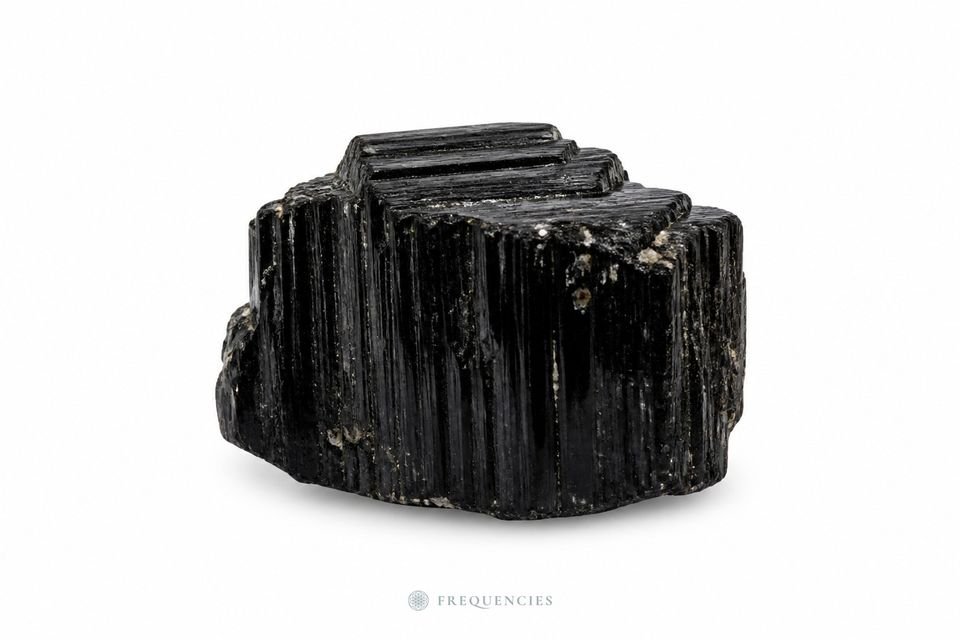
In a polished sphere the striations cannot be seen, so compare weight and lustre instead: schorl is heavier than onyx, and its lustre is vitreous to resinous [1]. If you do test the streak on a rough chip, schorl’s streak is greyish white to bluish white, while hematite’s is reddish-brown [1, 11].
According to Britannica, tourmaline resists weathering well, so it accumulates in sediments [3]. In Latvia, microscopic tourmaline grains occur in sands and sandstones, but tiny crystals in field boulders are rare. Dainis Ozols stresses that finding a tourmaline specimen in a Latvian field boulder would be a real stroke of luck [14]. Black tourmaline spheres, chips and bracelets are in the Tourmaline category.
Black Onyx and Black Agate: Usually Dyed Chalcedony
Mindat explains that, strictly speaking, onyx is banded, usually black-and-white agate, and describes the traditional method by which onyx is said to have been made: the stone was soaked for months in honey or a sugar solution and then in concentrated sulfuric acid, which turned the sugar-soaked bands black [4]. GIA researchers call the black onyx popular on the market treated black chalcedony and explain that an even black colour is often achieved by dyeing porous material [6]. Their article includes a photograph of two pieces from the same slab of chalcedony: one has been dyed black, the other has stayed its natural light grey [6].
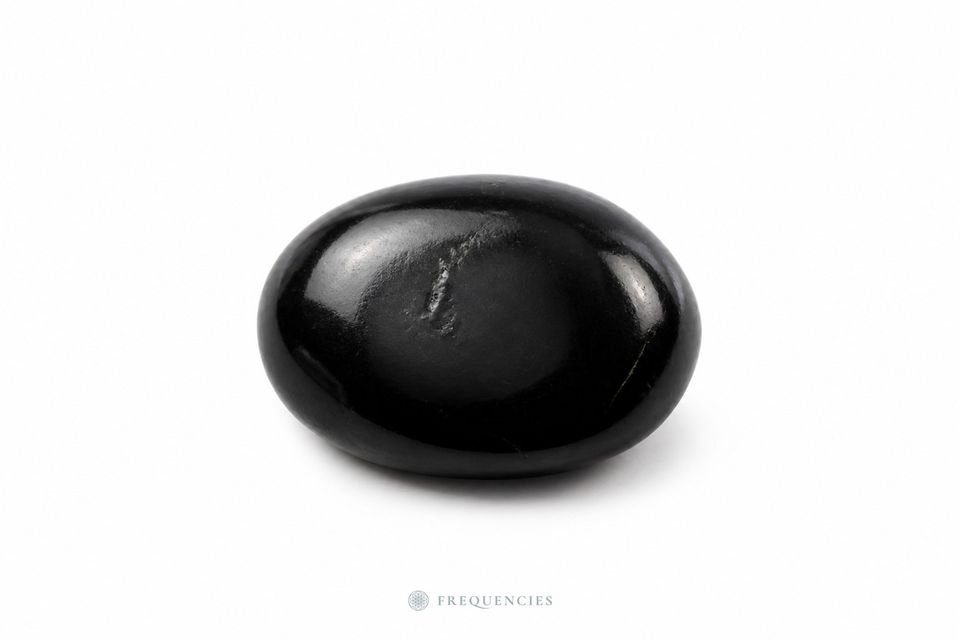
Black agate and black onyx are in composition one and the same chalcedony, or microcrystalline quartz, with a hardness of 6.5 to 7 [5]. Banded calcite, called Mexican onyx or onyx marble, is also sold under the name onyx, although it is a carbonate, not quartz [4]. How Pliny the Elder described dyeing and how it was perfected in Idar-Oberstein is explained in the article Cameo and Intaglio.
The black onyx and black agate in our shop are polished stones from Brazil. We have not had them tested in a laboratory, so assume that their even black colour has most likely been achieved by dyeing, as is usual on the market. The care table advises against soaking dyed chalcedony or cleaning it with chemicals [16].
Obsidian: Volcanic Glass with Sharp Edges
Obsidian is an igneous rock in the form of natural glass. It forms when viscous lava cools so quickly that it has no time to crystallise [8, 15]. Britannica writes that obsidian contains about 65 to 80% silicon dioxide and usually less than 1% water, that its lustre is vitreous and that it is slightly harder than window glass [8]. Obsidian is usually pitch black, but hematite can give it a red or brown tint, and tiny gas bubbles create a golden sheen [8]. Mindat adds that the first mirrors made by humans were polished pieces of obsidian [7].
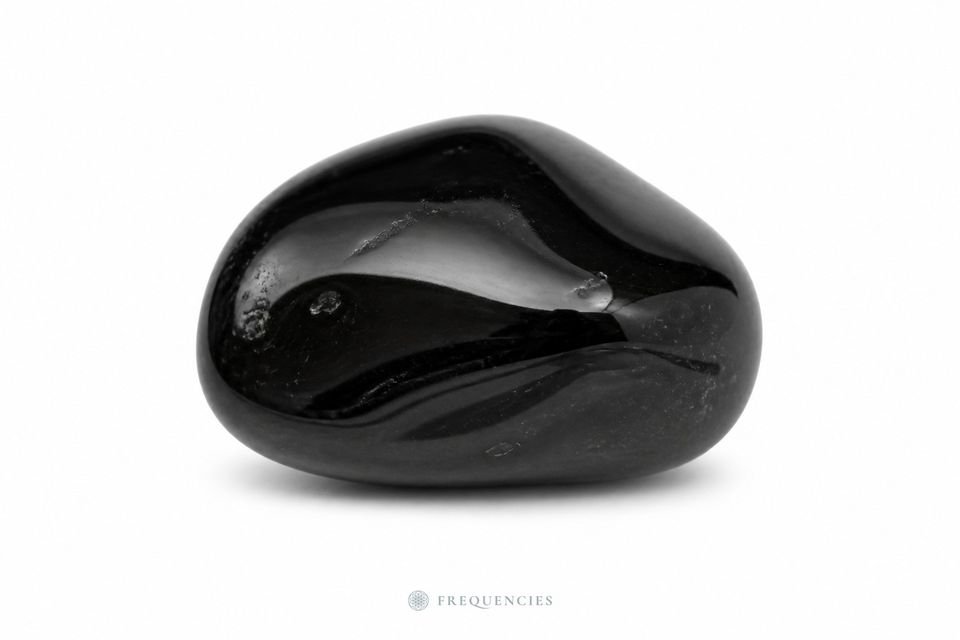
What sets obsidian apart from factory-made glass is its inclusions. GIA gemmologists have observed that man-made glass tends to contain gas bubbles, while in natural volcanic glass they are drawn out, and there are also inclusions of iron and titanium oxides [6]. You can see them with a loupe by shining a strong light through a thin edge. Why obsidian is not a mineral is explained in the article Mineral, Rock or Crystal, and you can read about the Aztec obsidian mirror linked to John Dee in the article on the history of crystal balls. Our obsidian category includes a pyramid from Mexico (4×4 cm), currently €25.
Shungite: Carbon from the Shores of Lake Onega
Mindat notes that the word shungite is used in two senses. In the first, it is shiny, nearly pure amorphous carbon: it was described in 1879 from samples from the village of Shunga by Lake Onega, and they contained about 98% carbon [9]. In the second sense, it is a metamorphosed Precambrian oil shale of algal origin, containing more than 5% carbon [10]. Both materials are found mainly in Karelia, and fullerenes are present in shungite only in traces, 0.0001 to 0.001% [9].
So the carbon content of shungite items can vary widely. Why shungite should not be put in drinking water, and what the trade calls elite shungite, is explained on the shungite page in the encyclopedia. Our shungite pyramid, polished stones and bracelet come from Karelia.
Hematite: A Heavy Stone with Red Powder
Hematite is iron oxide Fe2O3 and the world’s most important iron ore, as it contains 70% iron and is widely distributed [13]. Crystalline hematite is steel grey to black with a metallic lustre, while fine-grained, earthy hematite is rust red [11]. The streak is usually reddish-brown [11], and soft, earthy hematite is called red ochre and used as a pigment [13]. The history of this pigment is described in the article Stones from Which Paints Were Made.
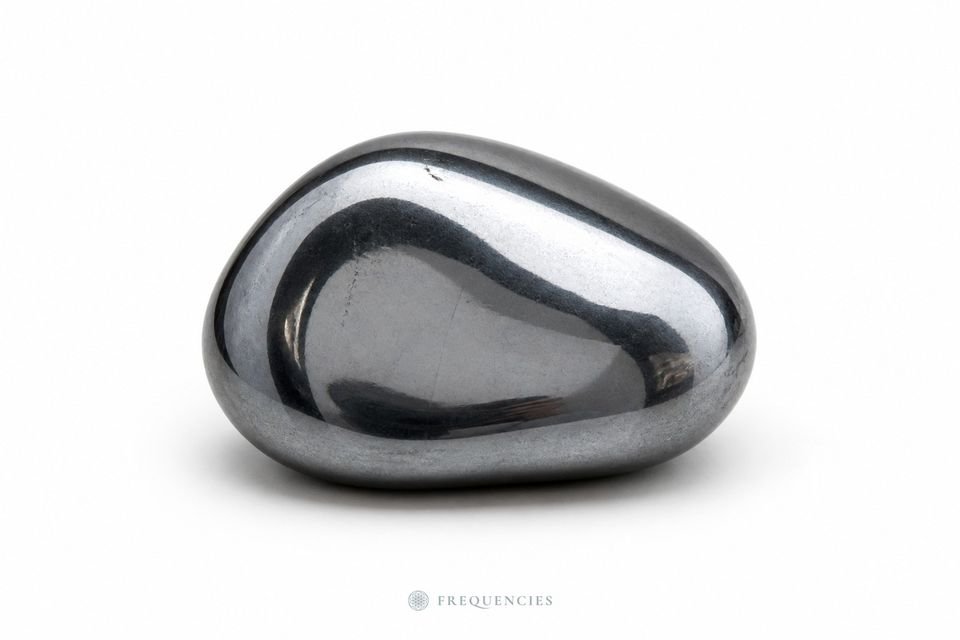
The “magnetic hematite” popular in jewellery is a different material. Mindat describes it as an artificial magnetic material containing no natural hematite at all, and in one piece of jewellery that was tested it turned out to be a ceramic barium and strontium ferrite magnet [12]. If hematite beads are strongly attracted to a magnet, they are most likely not made from natural hematite.
In Latvia, hematite is found as earthy aggregates and grainy crusts in dolomite cavities together with calcite, and in the most attractive samples, hematite crusts are next to calcite crystals [14].
Care and Symbolism
The five black stones need different care. Onyx and black tourmaline can be rinsed briefly, shungite should be kept away from water, and hematite can be washed briefly, but long soaking is not recommended. Which stones should not be exposed to water and salt is explained in the article How to Cleanse Crystals. Raw obsidian can have sharp edges, so store it carefully. The care needs of all stones are summarised in the care table [16].
In the crystal community, black stones are often considered symbols of grounding and stability, and many keep them on their desk or shelf. This is a tradition, not a scientific claim, and you will find the symbolism of each stone on its page in the stone encyclopedia.
Frequently Asked Questions
How can you tell black tourmaline from obsidian?
Raw black tourmaline has prisms with longitudinal striations and a triangular cross-section, while obsidian is glass and breaks with smooth, curved surfaces and sharp edges. Polished stones are harder to tell apart, and a definite answer comes from a gemmological laboratory.
Is black onyx dyed?
Usually yes. GIA refers to the black onyx commonly found on the market as treated black chalcedony, and an even black colour is often achieved by dyeing a porous stone. Even when dyed, it remains chalcedony with a hardness of 6.5 to 7 on the Mohs scale.
Which black stone is magnetic?
Magnetite and the artificial “magnetic hematite”, which contains no natural hematite, are strongly magnetic. Some natural hematite also reacts to a magnet, so a magnet gives a clue, not proof.
Why is hematite so heavy?
Hematite is iron oxide containing 70% iron, and its density is 5.26 g/cm³. Onyx of the same size weighs about half as much.
Is shungite a mineral?
No. This word refers to both nearly pure amorphous carbon and carbon-containing oil shale from Karelia, and Mindat describes the former as a mineraloid.
What is volcanic glass?
It is natural glass that forms when lava cools so quickly that it has no time to crystallise. The best-known volcanic glass is obsidian: it is usually black, with a vitreous lustre and sharp edges.
Sources
- Mindat.org, “Schorl” (composition, hardness, density, lustre, streak): www.mindat.org/min-3578.html
- GIA Gem Encyclopedia, “Tourmaline” (hardness): www.gia.edu/tourmaline
- Encyclopaedia Britannica, “Tourmaline”: www.britannica.com/science/tourmaline-mineral
- Mindat.org, “Onyx” (definition, traditional dyeing, onyx marble): www.mindat.org/min-2999.html
- Mindat.org, “Chalcedony”: www.mindat.org/min-960.html
- M. L. Johnson, S. F. McClure, D. G. DeGhionno, “Some Gemological Challenges in Identifying Black Opaque Gem Materials”, Gems & Gemology 32(4), 1996, pp. 252-261 (GIA): www.gia.edu/dam/migrated-assets/docs/doc1/Some-Gemological-Ch…
- Mindat.org, “Obsidian”: www.mindat.org/min-8519.html
- Encyclopaedia Britannica, “Obsidian”: www.britannica.com/science/obsidian
- Mindat.org, “Shungite (1)”: www.mindat.org/min-11040.html
- Mindat.org, “Shungite (2)”: www.mindat.org/min-55988.html
- Mindat.org, “Hematite”: www.mindat.org/min-1856.html
- Mindat.org, “Magnetic Hematite”: www.mindat.org/min-35948.html
- Encyclopaedia Britannica, “Hematite”: www.britannica.com/science/hematite
- D. Ozols, “Minerals and Rocks of Latvia”, Latvian Petroglyph Centre, 2008 (on the Nature Conservation Agency website): www.daba.gov.lv/lv/media/1745/download
- Encyclopaedia Britannica, “Volcanic glass”: www.britannica.com/science/volcanic-glass
- FREQUENCIES stone encyclopedia: black tourmaline, black onyx, shungite, hematite, obsidian and the care table: frequencies.lv/enciklopedija/kopsana/