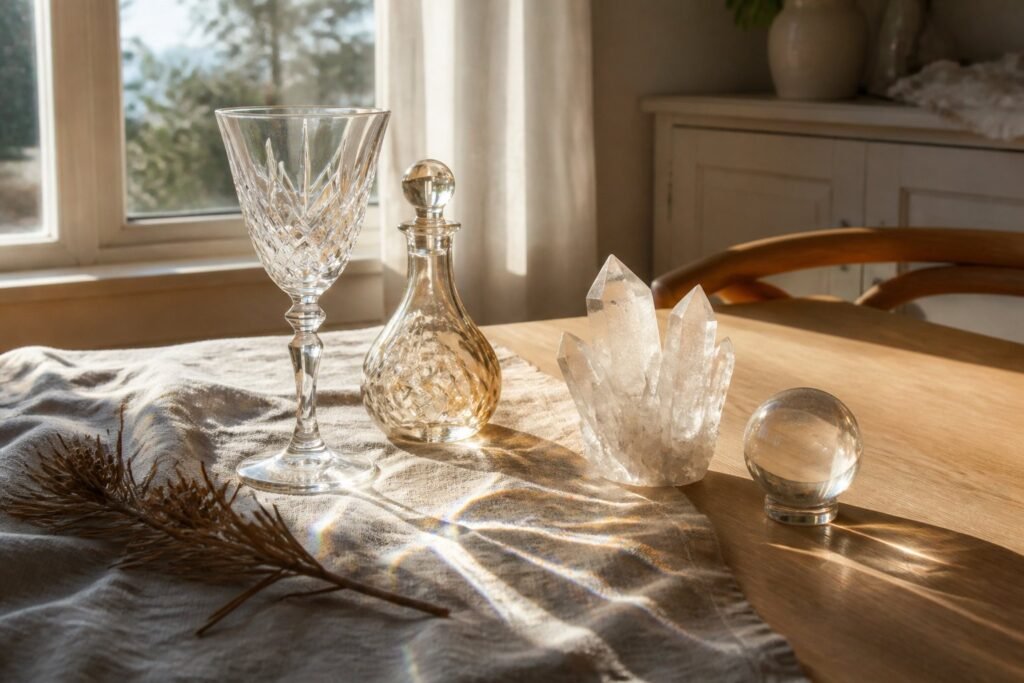
In Latvia, a glass may only be sold as top-quality crystal if its glass contains at least 30% lead oxide [1]. Thus, crystal glasses are usually glass with a special composition, while rock crystal is a naturally grown mineral. Glassmakers borrowed the name of the stone as early as the 15th century, and since then the word “crystal” has meant two completely different things.
Rock Crystal and Crystal Glass: The Difference Is in the Atomic Structure
Rock crystal is transparent quartz. It is a mineral with the formula SiO2, its crystal system is trigonal, and its hardness on the Mohs scale is 7 [2]. Quartz atoms form a regular crystal lattice. Quartz also includes amethyst, citrine, rose quartz and smoky quartz, which are its colored varieties [3]. Glass is formed differently: the molten mass cools so quickly that the atoms do not have time to arrange themselves into a crystal lattice, and the material remains amorphous [4].
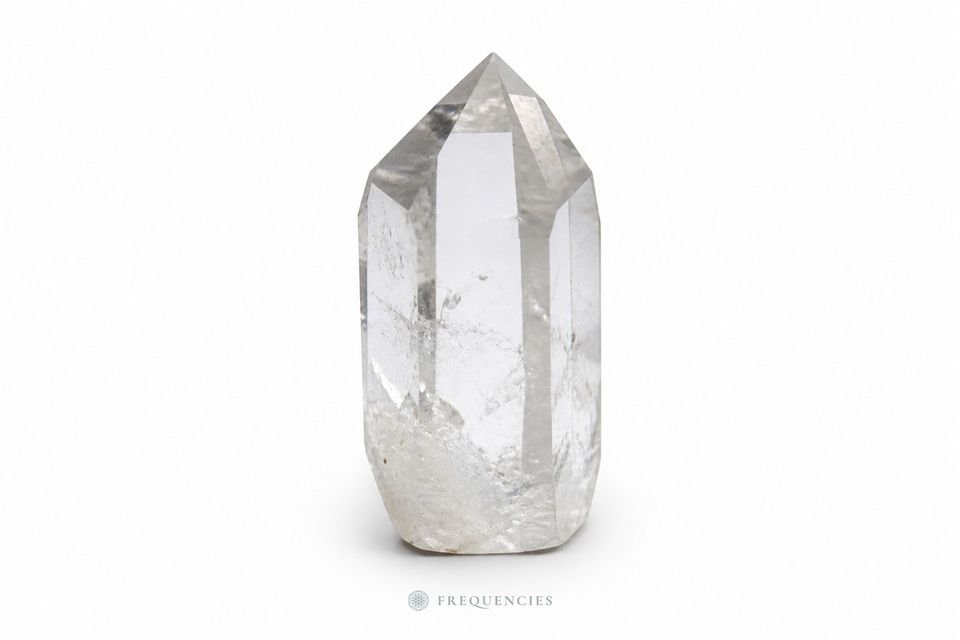
Both are united by quartz: it is the main raw material for glass, and sands suitable for glass factories in some deposits naturally contain 98% or more quartz [2]. When high-purity quartz sand is melted and cooled quickly enough, crystals do not form and transparent amorphous silicon dioxide is produced [5]. The Tēzaurs dictionary explains crystal glass as glass with exceptional transparency, special brilliance, clear sound, and a strong ability to refract light [6]. Compare the properties of the mineral on the encyclopedia pages rock crystal and quartz.
Cristallo: How Venetian Glass Got the Name of Rock Crystal
In the mid-15th century, on the island of Murano in the Venetian lagoon, glassmaker Angelo Barovier created a new glass recipe. The glass was called cristallo because it resembled rock crystal: it was clear and transmitted light well, while elsewhere in Europe glass at that time was brownish or greenish [7]. Cristallo was melted from quartz sand or pebbles and ash obtained from the coastal plants Salsola kali and Salicornia. The yellow-green tint caused by iron impurities was reduced with manganese oxide [7].
Plant ash was brought from Egypt and Syria, later also from Spain, and the Venetian government restricted its availability to maintain Murano’s monopoly on the production of the new glass [7]. The history of Czech crystal begins later. At the beginning of the 17th century, the gem cutter Caspar Lehmann in Prague, under Emperor Rudolf II, transferred the engraving of gemstones onto glass using copper and bronze wheels [8]. At the end of the century, a heavy, brilliant potash and lime glass was developed in Bohemia, called Bohemian crystal. It was cheaper and more brilliant than cristallo, and could be cut and engraved just like rock crystal [7][8].
Lead Crystal and Ravenscroft’s Raven
English merchant George Ravenscroft established a glass workshop in London’s Savoy district in 1673 and invited skilled Italian glassmakers [9]. The first glass tended to develop a fine network of cracks, so lead oxide was added to the mixture. Ravenscroft advertised the new, improved lead crystal in the London Gazette in October 1676 [9]. Lead glass refracted light strongly, was softer than other glasses of the time, and almost free of defects. It quickly transformed the English glass industry, and exports to the continent further reduced Venice’s dominance [7].
Did you know? To distinguish the new glass from others, a contract with the Glass Sellers Company stipulated that each glass must include a raven’s head, in English “raven”, just like the beginning of Ravenscroft’s surname. The London Museum holds a goblet fragment with a round seal showing a raven’s head, attached upside down to the stem [9].
Crystal Glasses According to EU and Latvian Regulations: Four Categories
The EU Crystal Glass Directive 69/493/EEC was adopted on 15 December 1969 and is still in force [10]. In Latvia, the same four groups are defined by Cabinet Regulation No. 78 “Regulations on the Labelling of Glass Products”, which came into force on 1 July 2000 and applies to glass products with Combined Nomenclature code 7013 [1]. The groups are described in Annex 1 of the regulation as follows [1]:
| Name | Metal Oxides | Density | Other Requirement | Label |
|---|---|---|---|---|
| Top-quality crystal 30% | lead oxide at least 30% | at least 3.00 | refractive index at least 1.545 | round gold-colored label |
| Lead crystal 24% | lead oxide at least 24% | at least 2.90 | refractive index at least 1.545 | round gold-colored label |
| Crystal glass | zinc, barium, lead and potassium oxides separately or together at least 10% | at least 2.45 | refractive index at least 1.520 | square silver-colored label |
| Crystal glass | barium, lead and potassium oxides separately or together at least 10% | at least 2.40 | surface hardness by Vickers 550 ± 20 | triangular silver-colored label |
These names may only be used for products that meet the description. If a similar name is in a trademark or company name, the crystal glass group must be indicated in highlighted print next to it, or, if the product does not meet any group, its actual properties must be stated. Compliance is checked by the Consumer Rights Protection Centre, and if the label does not match the analysis, the costs are borne by the manufacturer or seller [1].
Lead crystal may gradually become a thing of the past. The European Commission’s delegated decision of 12 August 2026 on crystal glass packaging, such as perfume bottles and luxury beverage bottles, states that the crystal glass industry has committed to discontinue the production of lead crystal by 31 December 2028 [11]. The decision applies to packaging, but the document also mentions the industry’s transition to lead-free crystal glass [11].
Swarovski Crystals: Precisely Cut Glass
The Swarovski company was founded in Austria in 1895 by Daniel Swarovski. His father was a glass cutter in Bohemia, and after the 1883 International Electricity Exhibition in Vienna, Daniel invented an electric crystal cutting machine [12]. The factory was established in Wattens, Tyrol, where water was important for hydroelectric power generation [12]. Swarovski crystals are still produced in Wattens, and the company does not disclose the recipe, including the ratio of quartz, sand and minerals [13].
On its professional page, Swarovski itself calls its material crystal glass and states that in the Advanced Crystal formula, lead is not added and its content does not exceed 40 ppm [14]. Thus, Swarovski crystals are precisely cut glass, not gemstones or naturally grown crystals.
Strass and Rhinestone: From Rhine Rock Crystal to Glass
In Latvian dictionaries, a sparkling glass stone is called strass. The Tēzaurs dictionary explains it as an artificial stone made of crystal with lead admixture, which resembles a gemstone in brilliance [15]. In colloquial speech, the form strazi is also used. The name comes from the surname of the 18th-century jeweler Georges Frédéric Strass: the French dictionary Trésor de la langue française mentions him as the inventor of this gemstone imitation, and the word appears in French texts as early as 1746 [16].
In English, similar stones are called rhinestone, meaning “Rhine stone”. Originally, this referred to gemstones cut from rock crystal found in the Rhine, but nowadays the word denotes colorless cut glass for jewelry, including glass with a foil or silver layer on the back to imitate diamond [17].
How to Distinguish Rock Crystal from Glass
At home, rock crystal can be distinguished from glass by four features [3]:
- Hardness. Rock crystal has a hardness of 7, so it scratches ordinary glass, but glass does not scratch quartz. Scratch only in an inconspicuous place.
- Temperature. Quartz stays cool in the hand longer, while glass warms up faster.
- Inclusions. Round air bubbles and a completely homogeneous interior indicate glass, while natural quartz has irregular inclusions.
- Price. A completely flawless and unusually cheap piece may be glass.
The most common imitations of rock crystal are glass and material pressed from quartz powder with resin, while laboratory-grown quartz cannot be distinguished with home tests [3]. You will find more features in the article How to Recognize a Real Crystal. See natural specimens in the section Rock Crystal, and spheres in the section Spheres. A transparent stand is included as a gift with a 4 cm rock crystal sphere. However, do not keep a transparent sphere on a sunny windowsill, as it collects sunlight like a lens [3]. Find other care tips in the care table.
Natural Glass and Crystal Singing Bowls
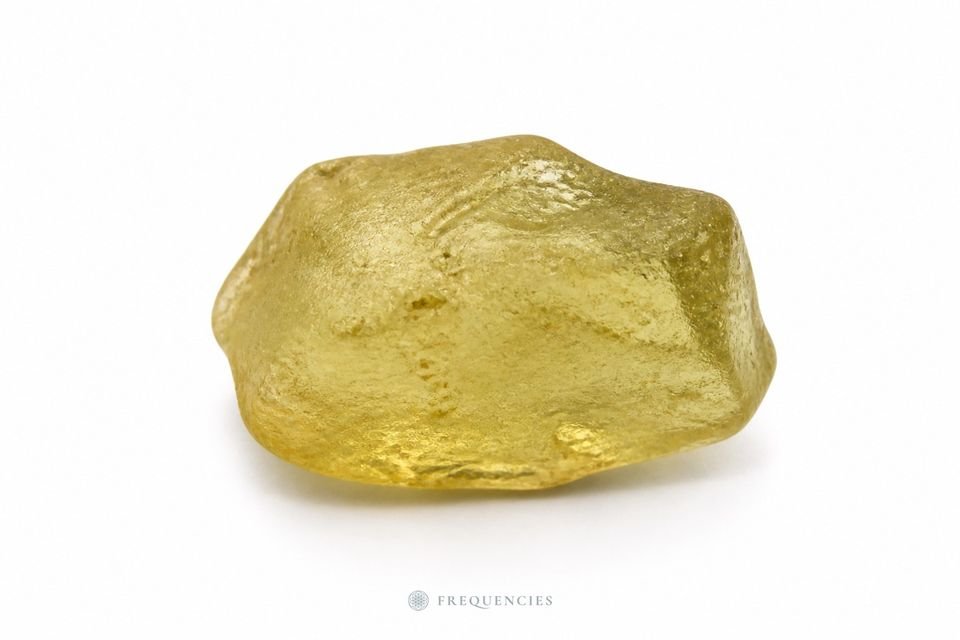
Nature also produces glass without a glassmaker. Obsidian forms when lava cools so quickly that atoms do not have time to form a crystal lattice, and the composition of most obsidian is similar to granite and rhyolite [4]. Libyan desert glass is a natural impact glass made of almost pure silicon dioxide, with visible gas bubbles and white cristobalite spherules [3]. Moldavite is a tektite or natural impact glass with bubbles and flow lines, but much of the “moldavite” offered online is industrially produced green glass [3]. You will find both natural glasses in the section Tektites.
Quartz glass also includes crystal singing bowls. Sound artist Anastasia Clarke, in a 2023 conference paper, summarizes manufacturers’ descriptions: the bowls are made from high-purity crushed quartz, heated in a centrifugal mold, and one manufacturer specifies a purity of 99.992% [18]. Stories from sellers she cites say that the first such bowls were quartz crucibles used to grow silicon crystals for microchips [18]. Melted and rapidly cooled quartz no longer forms a crystal lattice, but becomes transparent amorphous silicon dioxide, or quartz glass [5].
Therefore, in terms of composition, a crystal bowl is almost pure quartz, but in structure it is closer to Libyan desert glass than to a cluster of rock crystal. Clarke writes that such a bowl gives a stable, clear tone that is closer to a sine wave than the sound of bronze bowls, as it contains fewer overtones [18]. See our bowls in the section Crystal Singing Bowls, and compare other stone shapes in the article Crystal Shapes.
Frequently Asked Questions
Is Czech crystal real crystal?
No, it is glass. The name originated at the end of the 17th century, when brilliant potash and lime glass began to be produced in Bohemia, cut and engraved like rock crystal. In Latvia, crystal glass group names may only be used if the glass composition and properties meet the regulations.
Are Swarovski crystals gemstones?
No. They are precisely cut crystal glass produced in Wattens, Austria. Swarovski itself calls its material crystal glass, and in the Advanced Crystal formula, lead is not added.
How much lead is in lead crystal?
Latvian regulations require at least 24% lead oxide for lead crystal and at least 30% for top-quality crystal. In crystal glass, zinc, barium, lead and potassium oxides separately or together must be at least 10%.
How to distinguish rock crystal from glass?
Rock crystal has a hardness of 7, so it scratches ordinary glass. It stays cool in the hand longer, and its inclusions are irregular, while round air bubbles and a completely homogeneous interior indicate glass.
What is strass?
Strass are cut glass stones that resemble gemstones in brilliance. The name comes from the surname of the 18th-century jeweler Strass, and in colloquial speech they are also called strazi.
What are crystal singing bowls made of?
From high-purity quartz, which is melted and formed into a bowl shape in a centrifugal mold. After melting, quartz no longer forms a crystal lattice, so the bowl is quartz glass in structure.
Sources
- Cabinet Regulation No. 78 “Regulations on the Labelling of Glass Products” (29 February 2000), Annex 1, likumi.lv
- H. M. King. Quartz, Geology.com
- FREQUENCIES Stone Encyclopedia: rock crystal, obsidian, Libyan desert glass, moldavite (hardness, how to recognize, imitations)
- H. M. King. Obsidian, Geology.com
- What is fused silica? How is fused silica made? Elkem
- Tēzaurs.lv: kristālstikls (LU MII)
- M. Martin. Liquid Light: 500 Years of Venetian Glass, National Gallery of Victoria, 2019
- Bohemian glass, Encyclopaedia Britannica
- Goblet, George Ravenscroft, 1677 to 1681, London Museum collection
- Council Directive 69/493/EEC (15 December 1969) on the approximation of the laws of the Member States relating to crystal glass, EUR-Lex
- European Commission delegated decision C(2026) 5778 of 12 August 2026 on crystal glass packaging, EU Council document 12487/26
- The History of Swarovski, Swarovski
- Swarovski Products FAQs: What is Swarovski crystal?, Swarovski
- Ingredient Brand and Signature Features: Advanced Crystals, Swarovski ReCreated, Swarovski
- Tēzaurs.lv: strass (LU MII)
- STRASS: étymologie, Trésor de la langue française informatisé, CNRTL (ATILF, CNRS)
- Rhinestone, Encyclopaedia Britannica
- A. Clarke. Shard-Speakers: An Inquiry into the History, Sonic Properties, and Musical Possibilities of Quartz Crystal Singing Bowls. NIME 2023 (author from New York University)