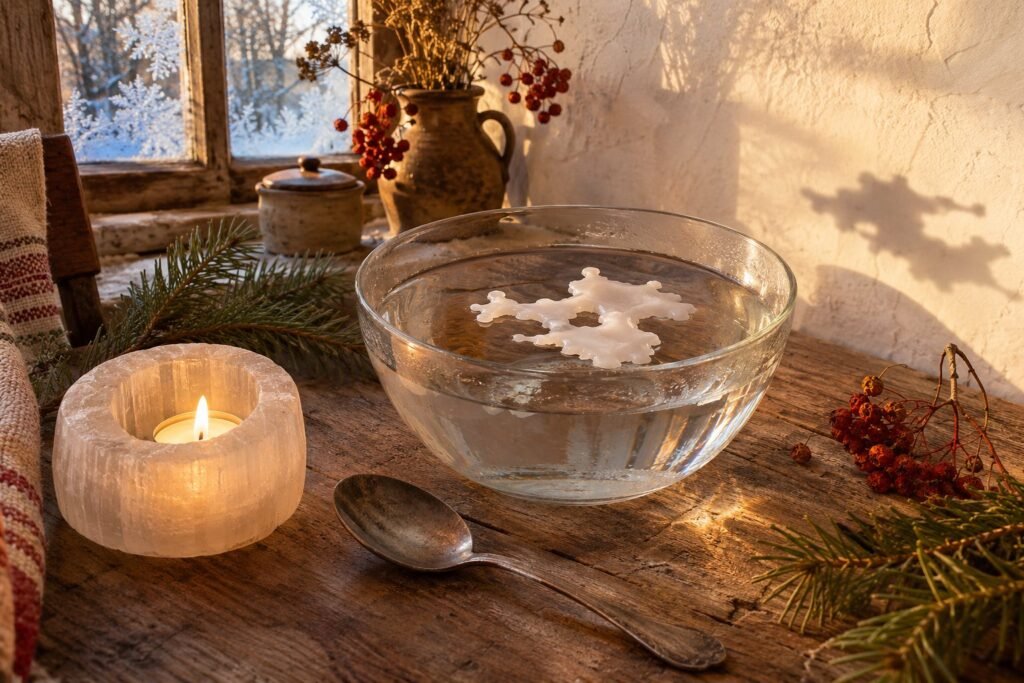
As early as 1839, the newspaper “Latviešu Draugs” wrote: “There is a good deal of foolery with fortune pouring, where melted wax or tin is credited with the powers of a prophet” [1]. The custom is still alive today, only now wax is often poured instead of lead: since 1 March 2018, lead may not be placed on the market for the general public in the European Union [3][4][5].
How fortunes were poured in the past: tin, lead, wax and a shadow on the wall
Records from different regions of Latvia describe a similar method. On New Year’s Eve or New Year’s night, tin, lead or wax was melted over a fire in a small vessel or a spoon and quickly poured into cold water, where the melt set into some shape [1][10]. A record from Rēzekne says that the melt could also be poured onto sand [1]. The Krēsliņš folklore collection says that young people melted down old tin spoons, buttons and lead [10].
In 1927, pupils of Riga Primary School No. 6 recorded that before pouring, you had to call out the name of the person whose fortune was being poured [10]. In Sabile, fortunes were poured on New Year’s night between eleven and twelve o’clock [10]. The finished casting was held up to the fire and its shadow on the wall was studied [10], because, as a belief recorded in Plāņi puts it, “only from it can you tell what has come out” [1].
A record from Latgale says that when seeing in the New Year, people would say: “You must go to the sauna and wash off the mud of the old year, so that the new year brings a better life”. In the evening, they poured fortunes and “also seriously believed” in them [1].
What the figures in fortune pouring mean
The meanings differ from place to place, but similar figures recur in the lists made by pupils and folklore collectors. These are beliefs, not predictions.
| Figure | What it meant in beliefs | Where or in which collection it was recorded |
|---|---|---|
| Key | a household of one’s own | Rencēni [10] |
| Needle | a tailor or seamstress | Rencēni, Ance [10] |
| Hammer | a blacksmith | Riga, Rencēni, Ance [10] |
| Ring or altar | marriage | Ance, Jelgava Teachers’ Institute collection [10] |
| Crown | a daughter marrying that year | Mērdzene [1] |
| Money | profit or a merchant | Rencēni, Ance [10] |
| Ship | a sailor | Rencēni [10] |
| Threshing machine | a prosperous year | J. Krūmiņš’s description [10] |
| Coffin or cross | death | Nīca, Snēpele, Valgunde [1], Riga [10] |
Many of the meanings concern a future trade: in the Rencēni list, an awl means a shoemaker, a barrel a cooper or brewer, and a lantern a tinsmith [10]. The meanings are not the same everywhere: the Rencēni pupils read a cockerel as a bell-ringer, while the Ance pupils read it as a teacher [10]. A casting could be read in different ways, which is why J. Krūmiņš’s description says that understanding the fortune “takes a wise head” [10].
Other New Year divination customs and beliefs
Fortune pouring is only one of the ways of telling fortunes at the turn of the year. In her entry in the National Encyclopedia of Latvia, Aīda Rancāne writes that the 12 days after Christmas are called the holy evenings, when people ask riddles, sing, tell folk tales and practise divination [11]. New Year falls right in this period.
- Plate lifting. In Džūkste, various objects were placed under plates: whoever lifted the keys would become master of the house, whoever lifted the crown would marry, and whoever lifted a birch twig would get a thrashing [1].
- Slipper throwing. Farmhands threw a slipper over their shoulder, while the girls kicked it towards the door. If it landed with its toe pointing towards the door or outside, it was taken to mean leaving home or getting married [10].
- Peas. In many places, people believed that you should eat peas on New Year’s Eve so that you would not have to cry in the new year, but in Vecmokas and Mālpils, for example, the exact opposite was recorded: eating peas would mean a lot of crying [1].
- Fish scales in the wallet. People also believed that you would have money all year if you ate fish on New Year’s Eve or New Year’s Day and put the scales in your wallet [1].
- Bottle neck and needle. In Dole, on New Year’s night, people sat on the neck of a bottle and threaded a needle while the others did everything they could to startle the sitter into toppling over. Whoever managed it would have a lucky year [1].
- Mumming. A record from Puze says that people also went mumming on New Year’s Eve, while in Latgale people went “gypsying” from New Year’s Day to Epiphany [1].
Fortune pouring has also featured at a winter event at the Latvian Ethnographic Open-Air Museum: the National Encyclopedia of Latvia has a photograph from the museum’s winter ball on 26 December 2012 with the caption “Fortune pouring, or divination” [11].
Why lead kits can no longer be sold to consumers in the EU
Commission Regulation (EU) 2016/1179 of 19 July 2016 classified lead in the European Union as a Category 1A reproductive toxicant. For lead in massive form (particle diameter 1 mm or larger), the generic concentration limit of 0.3% applies, while a specific concentration limit of 0.03% was set for lead powder. The regulation has applied since 1 March 2018 [2].
Commission Regulation (EU) 2017/1510 of 30 August 2017 added lead to Appendix 5 of Annex XVII to the REACH Regulation, also with effect from 1 March 2018 [3]. Entry 30 of Annex XVII applies to this list: these substances may not be placed on the market, or used, for supply to the general public, whether as substances, as constituents of other substances or in mixtures, where their concentration is equal to or greater than the limit; for lead in massive form, it is 0.3% [2][4]. The packaging of lead supplied to professionals must be marked “Restricted to professional users” [4]. The regulation is directly applicable in all member states, including Latvia [3].
In March 2018, the Finnish Safety and Chemicals Agency, Tukes, explained that it was Regulation (EU) 2017/1510 that had banned placing lead on the market for consumers from the beginning of that month [5]. The German consumer magazine ÖKO-TEST writes that all lead pouring kits exceed the 0.3% limit many times over, so they have not been on sale in the EU since 2018 [8].
The reason is safety. Stiftung Warentest explains that heating lead gives off toxic fumes that people breathe in. Lead from the figures gets onto hands, small children tend to put the figures in their mouths, and splashes of molten metal can cause serious burns [9].
Did you know? Finland has the same custom: New Year “tin” pouring. In December 2017, Tukes warned that traditional Finnish New Year tin can contain more than 95% lead and urged people to pour beeswax or sugar instead [6][7].
If you still have an old lead kit at home, do not melt it. ÖKO-TEST writes that lead figures must not be put in household waste, as they are hazardous waste [8].
Fortune pouring with wax and other safer options
Wax is nothing new in fortune pouring. A record from Rauna says that fortunes are poured “both with lead and with wax”, and in Mērdzene people looked for a crown in the wax casting [1]. In 2021, an author at LSM.lv, the Latvian public broadcasting news site, grated paraffin wax off a candle and melted it in a small metal dish [12].
- Get ready a bowl of ice-cold water, a spoon, a candle, candle ends and newspaper to protect the table [8].
- Tukes considers melting beeswax in a water bath the safest option [6]. ÖKO-TEST recommends melting candle ends in a water bath beforehand and setting small pieces in an ice cube tray, then on New Year’s Eve holding a piece on a spoon over a candle flame [8].
- When the wax has melted, pour it out quickly, holding the spoon just above the water. Do not dip the spoon into the water, or the wax will set on it [8].
- Take out the figure and look at it from all sides. The LSM.lv author noticed that a figure turned upside down looked much more unusual [12]. Hold it up to a candle and watch its shadow on the wall, as people did in the past [1][10].
Hot wax can burn, so when children take part, an adult should melt and pour it. If the wax catches fire, never put it out with water [6]. If you choose sugar, Tukes warns that hot sugar causes severe burns and recommends keeping a bucket of water and a fire extinguisher close by [6].
If you have a tin kit, check what it is made of. Stiftung Warentest writes that only pure or food-grade tin is completely lead-free, while the casting tin sold for figures usually contains lead as well; for children, it recommends candle wax [9]. You can do without heat by using egg white: Arvīds Aizsils’s collection records that fortunes were also poured with an egg, by pouring the separated white into cold water [10].
New Year’s Eve at home: candles, a mirror and crystal symbols
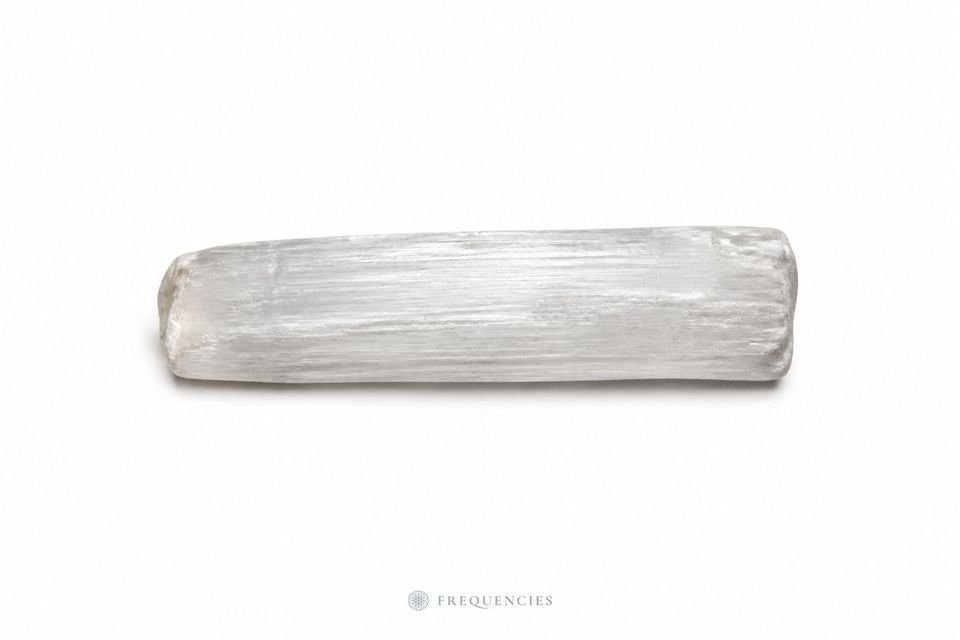
Traditional fortune pouring needed a fire to melt the metal over and light to watch the shadow by. Today, a tea light in a stable holder is enough for both, for example in one of our selenite candle holders or our other candle holders. By candlelight, selenite glows softly, and its name comes from the Greek word for “Moon” [13].
Mirrors were used in divination too. In New Year’s Eve beliefs, people gazed into a mirror by the light of three candles [12], and in antiquity polished obsidian was used as a mirror [13]. What divination with a crystal and a black mirror looked like in the time of Elizabeth I is described in the article on the history of crystal balls.
In Šmits’s collection, the New Year divinations are grouped by theme: harvest, suitors, death and weather, while the food beliefs talk a great deal about money [1]. For similar themes, the crystal community has its own symbols: citrine symbolises optimism and abundance, rose quartz love and gentleness, and aventurine is traditionally associated with luck and calm growth. Rock crystal is a symbol of clarity in crystal tradition [13]. This is symbolism, not a promise.
The birthstone for January is garnet, so a small polished garnet makes a good gift for someone born in January; you will find the full list in the article Birthstones by Month [13]. If you would like to note down the most important days of the coming year on New Year’s Eve, you can mark up to 8 dates with a gold circle and your own text in the 2027 Moon Phase Calendar [13].
Frequently Asked Questions
What is fortune pouring?
Fortune pouring is an old way of telling fortunes on New Year’s Eve and New Year’s night. Melted tin, lead or wax is poured into cold water, and from the figure that forms, or its shadow on the wall, people try to guess what the coming year will bring. It is a tradition and a festive game, not a prediction.
Why is lead no longer sold for fortune pouring?
Since 1 March 2018, lead may not be placed on the EU market for the general public as a substance or in mixtures if the concentration of lead in massive form is 0.3% or higher. This is laid down in entry 30 of Annex XVII to the REACH Regulation, together with Commission Regulation (EU) 2017/1510 of 30 August 2017, which added lead to Appendix 5 of that annex. So, as ÖKO-TEST writes, lead pouring kits are no longer on sale in the EU.
What can you use for fortune pouring instead of lead?
Tukes and ÖKO-TEST recommend beeswax or candle wax. Pure or food-grade tin can also be used, but casting tin for figures usually contains lead. If you want to do without heat, you can pour egg white into cold water.
What do the figures in fortune pouring mean?
The meanings differ from place to place. In folklore records, a key means a household of one’s own, a ring marriage, a needle a tailor or seamstress, and a coffin or cross death. These are beliefs, not predictions.
When are fortunes poured?
Fortunes are usually poured on New Year’s Eve or New Year’s night. In Sabile, it was recorded that fortunes were poured between eleven and twelve o’clock at night.
What should be done with old lead figures?
Do not melt them or give them to children. ÖKO-TEST writes that lead figures must not be put in household waste, as they are hazardous waste. Ask your local waste management company where to hand them in.
Sources
- P. Šmits. Latvian Folk Beliefs (1940 to 1941), digital version by the Institute of Mathematics and Computer Science, University of Latvia: New Year, Nos. 10680, 10685 to 10698, 10719 to 10730, 10741, 10744, 10813, 10899 to 10912, 10915
- Commission Regulation (EU) 2016/1179 of 19 July 2016 amending Regulation (EC) No 1272/2008 (classification of lead, recital 4, applicable from 1 March 2018)
- Commission Regulation (EU) 2017/1510 of 30 August 2017 amending the Appendices to Annex XVII to the REACH Regulation as regards CMR substances (OJ L 224, 31.8.2017; lead in point 3 of the Annex, applicable from 1 March 2018)
- Regulation (EC) No 1907/2006 of the European Parliament and of the Council (REACH), consolidated version 22.06.2026: Annex XVII, entries 28 to 30 and Appendix 5
- Tukes (Finnish Safety and Chemicals Agency). Lyijy ja bisfenoli-A kiellettyjä kuluttajakemikaaleissa, 09.03.2018
- Tukes. Vala tinan sijaan uutena vuotena sokeria tai mehiläisvahaa, 20.12.2017
- Yle News. Safety watchdog: Use beeswax or sugar instead of tin for New Year’s Eve tradition, 30.12.2017
- B. Wintermantel. Wachsgießen als Silvester-Orakel: So geht’s. ÖKO-TEST, 30.12.2025
- Stiftung Warentest. Bleigießen: Besser bleifrei ins Neue Jahr, 01.12.2021
- Archives of Latvian Folklore, Institute of Literature, Folklore and Art of the University of Latvia (LFMI), digital archive garamantas.lv: Riga Primary School No. 6 collection, 1927, J. and B. Krēsliņš collection, Nos. 197 and 198, Sabile Primary School collection, Nos. 1851 and 1852, Rencēni Primary School collection, LFK 116, 11475, Ance Primary School collection, No. 1168, Jelgava Teachers’ Institute collection, Nos. 63145 to 63160, Riga Secondary School No. 2 collection, Nos. 30392 and 30395, J. Krūmiņš, Ancient New Year Traditions and Customs, No. 26682, Arvīds Aizsils collection, No. 28199
- A. Rancāne. Christmas in Latvian Traditional Culture. National Encyclopedia, National Library of Latvia (updated 29.05.2026)
- G. Evelone. Divination with a dog, a needle and paraffin. An insight into traditions and a forecast for Latvia. LSM.lv, 31.12.2021
- FREQUENCIES Stone Encyclopedia: selenite, obsidian, citrine, rose quartz, aventurine, garnet, rock crystal (names, history, symbolism in crystal tradition); Birthstones by Month; 2027 Moon Phase Calendar, product page (viewed 08.11.2026)