
Yes, stones do grow, just slowly and not in the same way as plants. In Mexico’s Naica Cave, gypsum crystals grew in hot water at about the thickness of a hair every hundred years, and the largest reached 11.4 meters in length [1][2]. This is the same mineral used to make selenite lamps and candle holders.
Do stones grow? Crystals grow, and they grow from the outside
A crystal is a substance in which atoms are arranged in a strict, repeating order. It begins to grow when more of a substance is dissolved in water than the water can hold, and the excess particles attach to an existing crystal [3]. That’s why a crystal only grows from the outside, layer by layer, and its smooth faces reflect the atomic order inside. How this order determines a stone’s shape is explained in the article on crystal shapes.
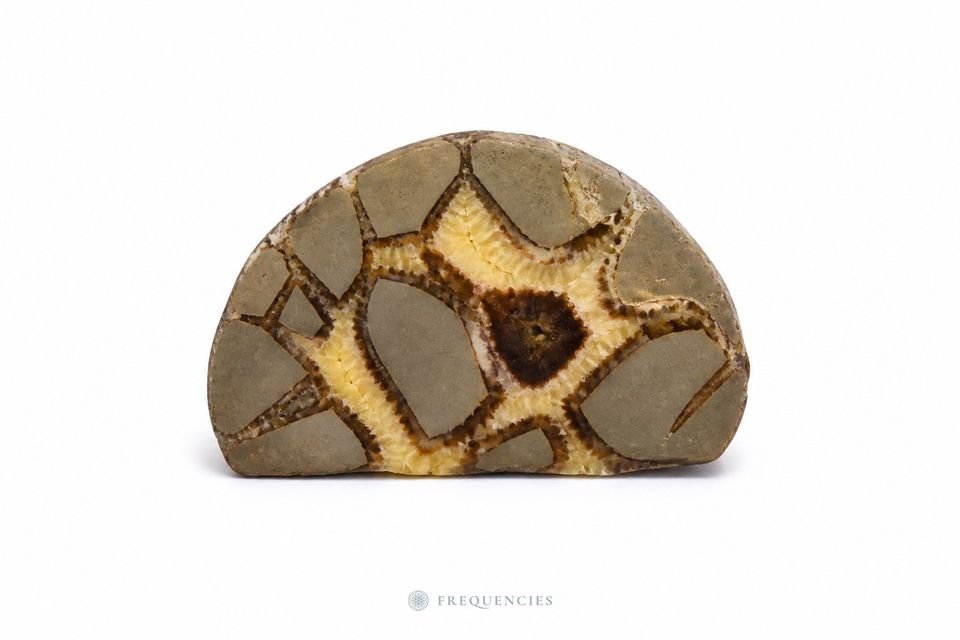
There are also stones that grow as a whole formation. A concretion forms in sediments around a core, such as a fossil or a mineral grain: water deposits a cementing substance around it, and the concretion grows from the center outward [4]. Such a formation is a septarian, whose cracks were later filled with calcite [5]. In caves, stalactites grow: a drop at the ceiling loses carbon dioxide, a thin layer of carbonate is deposited on its surface, and each stalactite begins to grow as a hollow tube [6].
Crystals most often form in nature in three ways:
| Origin | What happens | Examples |
|---|---|---|
| Magma | Molten rock cools, and atoms arrange into crystals | granite quartz and feldspar, tourmaline, aquamarine |
| Water solution in cracks and cavities | Water, often hot, deposits dissolved substances | rock crystal, amethyst, pyrite |
| Evaporating salty water | Water evaporates, and the dissolved mineral remains | rock salt or halite, gypsum, selenite |
A fourth way is metamorphism: an existing rock is transformed by heat, and new minerals form in it. This is how lapis lazuli forms: in limestone or marble near magma intrusions, the mineral lazurite replaces part of the rock [7].
From magma: granite, pegmatites, and obsidian
The slower magma cools, the larger the crystals grow. Granite solidifies deep beneath the earth’s surface, and its grains of quartz, feldspar, and mica are large enough to be seen with the naked eye [8]. Obsidian is the opposite example: lava cooled so quickly that atoms did not have time to arrange into a crystal lattice, resulting in volcanic glass [9]. That’s why obsidian is a mineraloid, not a mineral, and its fracture has sharp edges.
The largest magma crystals grow in pegmatites. At the end of magma solidification, water accumulates in it, dissolving ions. In water, they move much more freely than in melt, so crystals grow large [10]. Some of the world’s finest deposits of tourmaline, aquamarine, and topaz have been found in pegmatites, and kunzite, a pink variety of spodumene, is also found there [5][10]. One spodumene crystal in the Etta mines in South Dakota, USA, was 42 feet or about 12.8 meters long and yielded about 90 tons of spodumene [10]. It was even longer than the largest crystal in Naica.
From hot water: rock crystal and pyrite
Many minerals grow from hot water flowing through cracks in rocks. Such a solution carries dissolved substances, and as the temperature or water composition changes, these are deposited on the walls of cracks and cavities. This is how the famous quartz deposits in Arkansas formed: the US Geological Survey describes them as cavity fillings deposited by upward-flowing hydrothermal solutions [11]. The clearest rock crystal there is at the tips of crystals that grew undisturbed [11].
People have learned to imitate this natural process. Most quartz crystals for electronics and optics are now grown in laboratories from superheated water in which silicon dioxide is dissolved [12]. Synthetic amethyst is grown in a similar way, available on the market since at least 1970 and chemically identical to natural [5]. To learn how to distinguish a natural stone from glass and other imitations, read the article How to Recognize a Real Crystal.
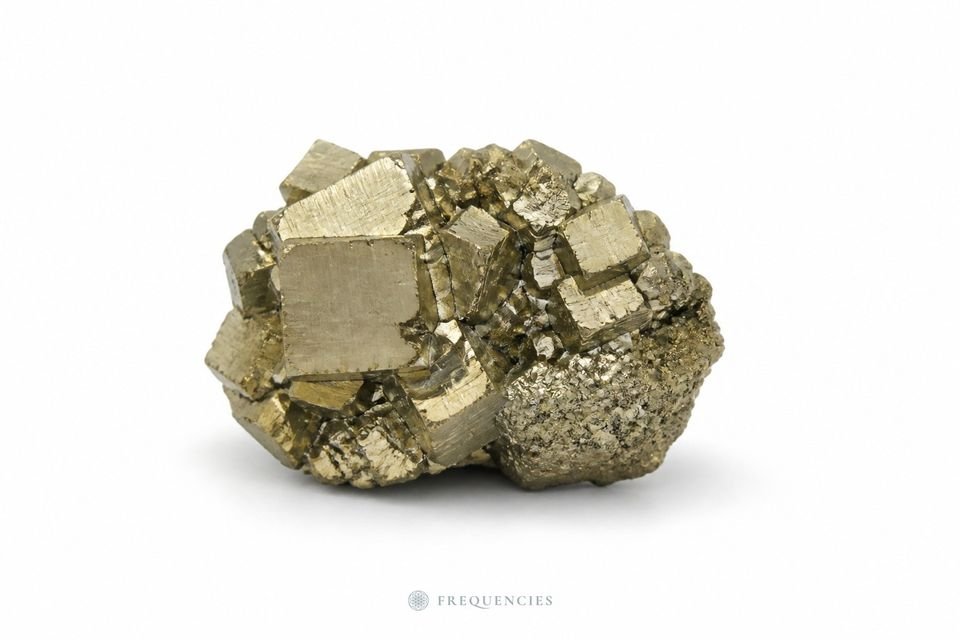
The growth history of some crystals can be seen. In phantom quartz, one crystal has grown over another, and inside you can see a ghostly outline of the previous stage [13]. Pyrite forms at both high and low temperatures, and in sediments it requires iron, sulfur, and an environment with little oxygen, so it is often found in dark, organic-rich shales and coals [14]. You will find unprocessed pyrite and amethyst specimens with natural faces in the Unprocessed Stones section.
Amethyst geodes: why is the inside of the stone hollow?
A geode is a round stone with a cavity whose walls are lined with crystals on the inside. In volcanic rocks, this cavity is often a gas bubble that remained in the lava when its surface solidified [4]. Later, water flowing through the rock deposited layers of agate in the cavity and then quartz crystals, which grew from the walls toward the center [4]. That’s why a geode is hollow: first there was a void, and crystals gradually filled it, but often not completely.
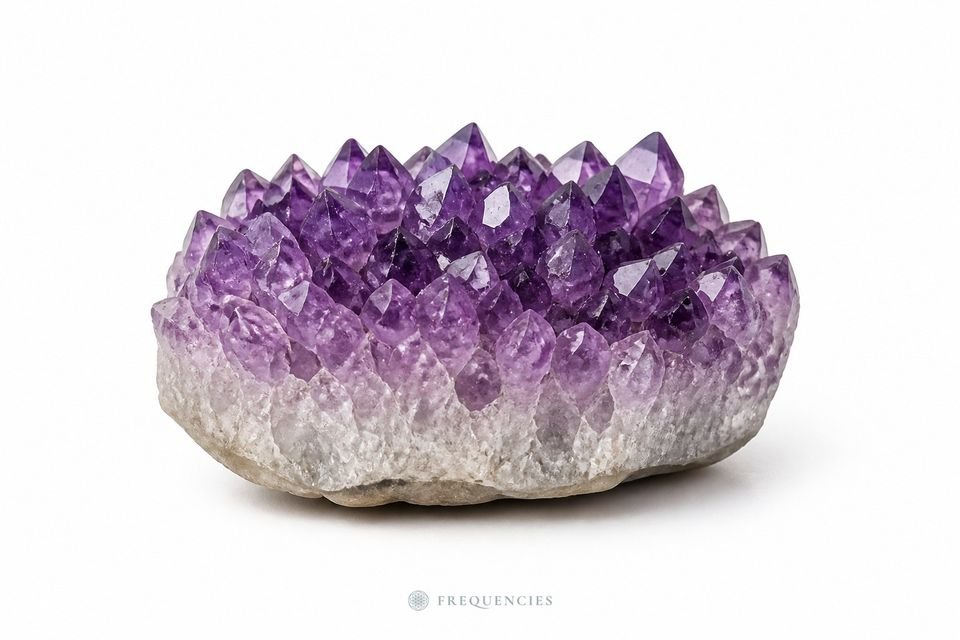
The most famous amethyst geodes come from southern Brazil and neighboring Uruguay, where they are found in basalt lava flows [4]. In 2024, a research group led by the University of Göttingen discovered that Uruguayan geode amethyst crystallized at surprisingly low temperatures, only 15 to 60 °C, from water similar in composition to groundwater [15]. Some geodes there are more than five meters high [15]. The violet color of amethyst is given by iron impurities in quartz together with natural radiation from surrounding rocks [16]. When amethyst is heated, its color changes, and most citrine on the market is heat-treated amethyst [5].
Prolonged sunlight can fade the violet hue of amethyst, so do not place druses on a sunny windowsill [5]. You can view amethyst druses, also with a flat base, in the Druses and Geodes section.
From evaporating water: rock salt and selenite
When salty water evaporates, the dissolved substances remain and crystallize. Halite or rock salt usually forms in dry climates where seawater evaporates, and today it forms, for example, in the Great Salt Lake in the USA and the Dead Sea [17]. In halite, sodium and chloride ions are arranged in a cubic lattice, so cubic crystals grow from a salt solution [3][17].
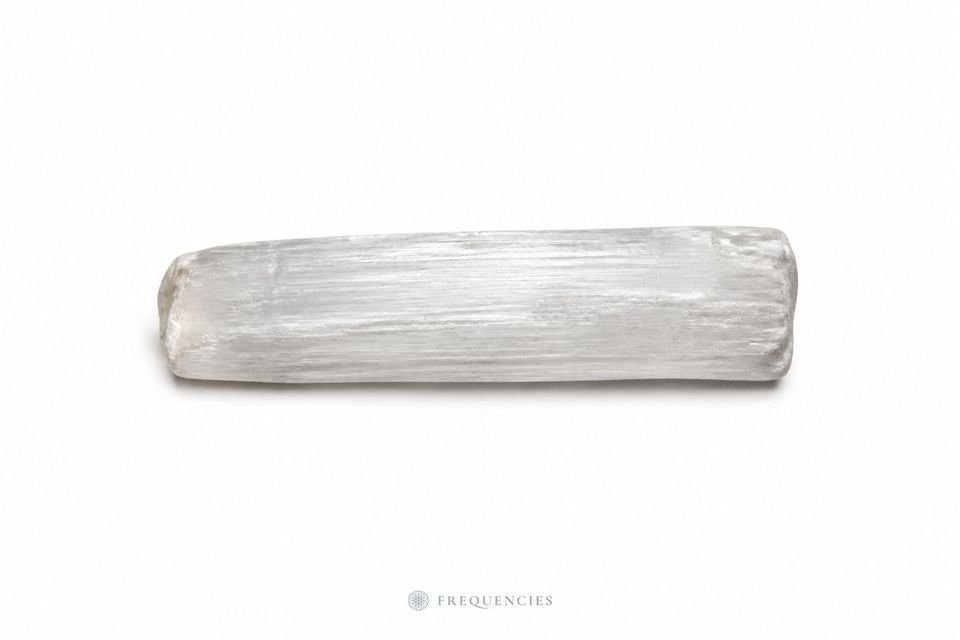
Gypsum is the most common sulfate mineral, and in sedimentary layers it is often found together with halite and anhydrite [18]. The clear variety of gypsum is called selenite, while the fibrous variety is called satin spar, and it is from satin spar that selenite rods and lamps are usually made [5]. In the High Atlas of Morocco near Marrakesh, there are large deposits of rock salt and gypsum in Triassic period layers [19], and our shop’s lamps are also made from natural Moroccan selenite. Since gypsum dissolves slowly in water, about 2 grams per liter, clean selenite only with a dry cloth [5]. For advice on choosing a lamp and where to place it, read the article Selenite Lamp, and you will find all selenite items in the Selenite section.
Naica Cave: why did crystals there grow to 11 meters long?
The Naica mines in northern Mexico, Chihuahua state, are among the world’s most significant lead and silver deposits [20]. In 2000, two miner brothers, while drilling a tunnel nearly 300 meters deep, discovered a limestone cave filled with giant gypsum crystals crisscrossing the space [20][21]. The cave was named Cueva de los Cristales, or Cave of the Crystals. Its crystals are up to 11 meters long and up to a meter thick, much larger than any gypsum crystal previously found [20].
For a long time, it was unclear how such giants could have grown. In 2007, Spanish and Mexican researchers determined that the crystals grew in water about 54 °C warm, low in salt, just below the 58 °C threshold where anhydrite and gypsum solubility are equal [20]. Below this threshold, anhydrite, which had previously been deposited in the mines, became unstable and slowly dissolved, constantly releasing calcium and sulfate into the water, from which gypsum grew [20][22]. The solution was only slightly supersaturated, so few new crystal seeds formed, and the material accumulated on the same few crystals [20].
The crystals grew extremely slowly. In 2011, researchers measured in the laboratory that the slowest Naica gypsum growth rate is 14 femtometers per second, that is, about one nanometer or a billionth of a meter per day [23]. At this rate, one millimeter grows in just over 2,200 years [23]. The Spanish National Research Council compared this to the thickness of a hair in a hundred years and estimated that some cave crystals have grown for almost a million years [1]. According to a 2009 survey by Proyecto Naica researchers, the largest crystal measures 11.40 meters in length, about 5 cubic meters in volume, and an estimated mass of about 12 tons [2]. The often-cited 12 meters is a rounded figure, while the 55 tons mentioned in popular sources [22] is several times higher than the estimate calculated from the measured volume.
Did you know? Just a few degrees determined whether giants or thousands of tiny crystals would grow in the cave. Researchers’ calculations show that at 44 to 45 °C, new crystals would begin to form within a few months or even days [20]. That’s why in the Sword Cave, Cueva de las Espadas, which is closer to the surface and cooler, many more but smaller crystals grew [20].
The cave had air hotter than 40 °C and 90 to 100% humidity, so every visit risked heatstroke [21]. Mine pumps kept the water level hundreds of meters below natural [20], and in October 2015, when mining ended, the cave was allowed to flood again [24]. As early as 2007, researchers wrote that under water, the crystals would resume growing, but people would no longer have access to them [20].
Salt crystals at home: a simple experiment
You can also observe crystal growth in the kitchen, and it’s a good experiment to do with children. You will need non-iodized table salt, distilled water, a glass jar, and a shallow saucer [3].
- An adult places a metal spoon in the jar so the glass does not crack from the heat, pours in hot water, and adds salt by the teaspoon, stirring until the salt no longer dissolves and begins to accumulate at the bottom. This is a saturated solution [3][25].
- Once the solution has settled, carefully pour the clear part into the saucer, leaving the undissolved salt in the jar [3].
- Place the saucer in a warm place where it will not be disturbed, and observe it daily. As the water evaporates, the solution becomes supersaturated, and after a few days or a week, crystals will appear [3].
- Examine them with a magnifying glass. Salt crystals are cubic because sodium and chloride ions in halite are arranged in straight rows and columns [3].
- For a larger crystal, choose the most beautiful cube, tie it to a thread, and suspend it in fresh saturated solution, securing the thread to a pencil over the glass. The crystal will grow for several days or weeks [3].
Because of the hot water, an adult prepares the solution, and children touch the jar only after it has cooled to room temperature [25]. Do not eat the salt crystals and wipe surfaces after the experiment. The same principle works in nature: in the Naica Cave, only slightly supersaturated solution and almost constant temperature for hundreds of thousands of years allowed a few giants to grow instead of many small crystals [20][22].
Frequently Asked Questions
Are crystals alive?
No. A crystal grows because new atoms from the surrounding solution or melt attach to its surface. It has no cells or metabolism, and it does not reproduce like living beings.
How fast do crystals grow?
The speed varies greatly. Salt crystals in a saucer appear in a few days, but Naica gypsum grew about the thickness of a hair in a hundred years, and according to researchers, some cave crystals have grown for almost a million years.
Why is the inside of a geode hollow?
The cavity existed before the crystals: in volcanic rocks, it is often a gas bubble in solidified lava. Water deposited agate and quartz in the cavity, crystals grew from the walls toward the center, and often did not fill it completely.
How big is the largest crystal in the Naica Cave?
The largest measured crystal in the Cave of the Crystals is 11.40 m long, has a volume of about 5 m³, and an estimated mass of about 12 tons. The often-cited 12 meters is a rounded figure, while the 55 tons mentioned in popular sources is several times higher than the estimate based on the measured volume.
Is a selenite lamp made from the same mineral as the Naica crystals?
Yes, both are gypsum CaSO4·2H2O. Naica grew clear selenite, but lamps are usually made from the fibrous variety of gypsum, satin spar, which gives the silky glow.
Sources
- CSIC (Spanish National Research Council). Un estudio del CSIC mide la velocidad de crecimiento de los cristales gigantes de Naica (press release, 13.09.2011). https://csic.es/sites/default/files/d7/noticias/Nota%2520de%2520prensa_159.pdf
- Badino, G. et al. The Naica Caves Survey. 15th International Congress of Speleology, 2009. https://laventa.it/documenti/naica-ics2009_36847.pdf
- Penn State MRSEC. Growing Crystals (children’s activity). https://www.mrsec.psu.edu/education-outreach/public/nano-activities-kids/liquid-metal/growing-crystals
- Geology.com. Geodes: How Do They Form? https://geology.com/articles/geodes/
- FREQUENCIES Stone Encyclopedia: septarian, kunzite, amethyst, citrine, selenite (data checked against GIA, Mindat, geology.com). https://frequencies.lv/enciklopedija/
- U.S. National Park Service. Speleothems. https://www.nps.gov/subjects/caves/speleothems.htm
- Geology.com. Lapis Lazuli. https://geology.com/gemstones/lapis-lazuli/
- Geology.com. Granite. https://geology.com/rocks/granite.shtml
- Geology.com. Obsidian. https://geology.com/rocks/obsidian.shtml
- Geology.com. Pegmatite. https://geology.com/rocks/pegmatite.shtml
- Engel, A. E. J., 1946. The quartz crystal deposits of western Arkansas. Economic Geology 41(6) (USGS publication database). https://www.usgs.gov/publications/quartz-crystal-deposits-western-arkansas-0
- Geology.com. Quartz. https://geology.com/minerals/quartz.shtml
- Minerals.net. Quartz. https://www.minerals.net/mineral/quartz.aspx
- Geology.com. Pyrite. https://geology.com/minerals/pyrite.shtml
- University of Göttingen. Mystery of Uruguay’s amethyst geodes (press release, 01.10.2024). https://uni-goettingen.de/en/3240.html?id=7555
- HyperPhysics (Georgia State University). Amethyst (citing Mineralogical Society of America). https://hyperphysics.gsu.edu/hbase/Minerals/amethyst.html
- Geology.com. Halite. https://geology.com/minerals/halite.shtml
- Geology.com. Gypsum. https://geology.com/minerals/gypsum.shtml
- Deposits Magazine. Triassic salt in the High Atlas of Morocco (2016). https://depositsmag.com/2016/11/17/triassic-salt-in-the-high-atlas-morocco/
- García-Ruiz, J. M. et al. Formación de megacristales naturales de yeso en Naica, México. Boletín de la Sociedad Geológica Mexicana, 2007 (Spanish version of article in Geology 35(4)). https://www.redalyc.org/pdf/943/94320861005.pdf
- National Geographic Magazine. Neil Shea, Cave of Crystal Giants (2008, archive copy). https://web.archive.org/web/20090906092603/https://ngm.nationalgeographic.com/2008/11/crystal-giants/shea-text/1
- National Geographic. Giant Crystal Cave’s Mystery Solved (2007). https://www.nationalgeographic.com/science/article/giant-crystal-cave-mexico-mystery-solved
- Live Science. Cave’s Giant Crystals Take Eons to Grow (about Van Driessche et al., PNAS 2011). https://www.livescience.com/30772-giant-crystals-grow-slowly.html
- Wikipedia. Cave of the Crystals. https://en.wikipedia.org/wiki/Cave_of_the_Crystals
- Salt Association (UK). How to Grow a Salt Crystal. https://saltassociation.co.uk/education/chemistry-salt/how-to-grow-salt-crystal/