
If you lived in 17th-century Courland, you would most likely call October the month of spirits, November the month of frost, and December the month of wolves. The ancient Latvian month names were first printed in 1649 [1][2], and each one hides an observation of nature, a rural task, or an ancestral honoring tradition.
Who First Published the Latvian Month Names
The Latvian month names, alongside the Latin ones, were first published by the superintendent of Courland, Paul Einhorn, in his work “Historia Lettica” in 1649 [1][2]. Academic Jānis Stradiņš writes that Einhorn’s works were more like instructions for other pastors on how to combat paganism and Catholicism, and they were printed in very small numbers. However, it was Einhorn who provided the first broader materials on Latvian ethnography and ancient beliefs [3].
Did you know? According to Stradiņš, Einhorn (1590 to 1655) died in the pulpit of Jelgava Holy Trinity Church while delivering a sharp sermon against the introduction of the new-style calendar [3]. Thus, the person who first published the Latvian month names, in his final sermon, stood against changing the calendar.
Twelve Ancient Month Names: Table
The second column shows Einhorn’s 1649 names, and the word “jeb” means that the month already had two names at that time. The third column contains variants from the 1817 Vidzeme calendar [4], the LSM list [5], and the Tēzaurs dictionary [6].
| Month | Einhorn, 1649 [1] | Other Recorded Names | What the Name Reveals |
|---|---|---|---|
| January | winter month | frost month [5], new year month [4] | mid-winter and frost |
| February | candle month | meteņi, blizzard, frost month [6] | Candlemas on February 2 |
| March | snow crust or pigeon month | spring month [4] | snow crust is a snow cover crust formed when the moist top layer freezes |
| April | sap month | sap month also in 1817 [4] | sap starts to flow more rapidly in trees |
| May | leaf or sowing month | blossom month [6] | leaf budding and sowing |
| June | flower month | summer month [4], fallow month [6] | time of blooming |
| July | hay or linden month | hay month also in 1817 [4] | haymaking and linden blossoms |
| August | dog or rye month | grain month [4] | harvesting rye and other grains |
| September | pine forest or heather month | autumn month [4], Miķeļi month, mushroom month [6] | heather blooms in pine forests |
| October | spirits or offering month | rain month [4], autumn month [6] | remembrance of deceased ancestors |
| November | frost month | frost month [5] | frosts and first freeze |
| December | wolf month | winter month [4] | darkest time of the year |
Origins of the Names: Nature, Work, and Ancestors
Researcher Aīda Rancāne from the University of Latvia explains that the ancient names include the most significant natural phenomena or the most important festivals and rituals. In her view, sap month is associated with the time when sap starts to flow more rapidly in trees, while harvest or hay month is named after the work done at that time [7]. Many words require explanation even for modern Latvians. Snow crust is the crust of the snow cover that forms when the moist top layer of snow freezes, and from this comes the March name snow crust month. A pine forest is a pine woodland on sandy soil, with heather also growing in the undergrowth [6].
Both of Einhorn’s October names lead to ancestors. In Latvian mythology, spirits are the souls of the dead or underworld beings living in the afterlife, while offerings are food for the spirits of the dead and also the time when this food is placed for them [6]. Neighboring Lithuanians still use ancient month names today. Associate professor Rūta Muktupāvela of the Latvian Academy of Culture notes that their November is “lapkritis,” the month of falling leaves, and that even Lithuanians themselves do not always understand why the month “kovas” (March) is named after a bird [7][17].
Why Month Names Differ in Various Sources
The first reason is the method of timekeeping itself. Rancāne explains that the ancient months followed the phases of the Moon: the month began when a thin new crescent appeared in the sky and lasted about 29 to 30 days. Therefore, the ancient months do not correspond to modern months, and every two or three years a thirteenth, festival month was added to the twelve months [7]. According to Rancāne, maintaining such a calendar required constant observation of sunrises, sunsets, lunar cycles, and the appearance of constellations [7].
The second reason is time and place. Einhorn was the superintendent of Courland, but in the 1817 Vidzeme calendar, March is called the spring month, October the rain month, and December the winter month [4]. The third reason is modern selection. The LSM list for children calls January the frost month [5], but in Tēzaurs, frost month is a synonym for February [6]. Therefore, one can only confidently state which name is recorded in which source.
The Time of Spirits: Ancestral Remembrance Tradition
The time of spirits is most widely considered to be from Miķeļi (Michaelmas) to Mārtiņi (Martinmas) or to All Saints’ Day on November 1, but researcher Guntis Pakalns from the Latvian Folklore Repository notes that most descriptions refer to October [8]. LSM cites a 1767 history of the Courland church, which states that the time of spirits, offerings, or God’s days was celebrated for four weeks, from September 29 to October 28. During this time, people did not work, especially did not thresh grain, as it was believed that threshed grain would not sprout [9].
The same record describes a feast. Food was placed on the ground in a separate, carefully swept room, and in the evening the head of the household, holding a burning splinter, loudly invited deceased parents, relatives, and friends to come eat and drink. When the spirits had eaten, he broke the splinter on the threshold with an axe and told them to go back, but not across the fields [9]. Andris Kapusts, chairman of the Latvian Folklore Society, adds that spirits were not invited to the same table as the living, but to the threshing barn, bathhouse, or granary [9]. At Martinmas, the spirits were driven away with clanging and chanting, and the time of spirits ended [10].
Today, Aīda Rancāne recommends not seeking a specific day, but dedicating an evening to memories, visiting graves, and preparing a meal [10]. Pakalns encourages lighting a candle, flipping through the family album, and telling children and grandchildren about their ancestors [8].
Full Moon Names in American and English Tradition
In the English-speaking world, full moon names published by the American calendar The Old Farmer’s Almanac are popular. This is a different culture, not a Latvian tradition. The Almanac writes that the names come from Native American, colonial American, and other North American traditions, but the January Wolf Moon is most likely of English origin, brought by European settlers [11].
| Month | The Old Farmer’s Almanac (USA) | Latvian Equivalent |
|---|---|---|
| January | Wolf Moon | Wolf Moon |
| February | Snow Moon | Snow Moon |
| March | Worm Moon | Worm Moon |
| April | Pink Moon | Pink Moon (after phlox flowers) |
| May | Flower Moon | Flower Moon |
| June | Strawberry Moon | Strawberry Moon |
| July | Buck Moon | Buck Moon |
| August | Sturgeon Moon | Sturgeon Moon |
| September | Corn Moon | Corn Moon |
| October | Hunter’s Moon | Hunter’s Moon |
| November | Beaver Moon | Beaver Moon |
| December | Cold Moon | Cold Moon |
Some coincidences are surprising. The Anishinaabe people’s March name Snow Crust Moon means the month of snow crust, just like the Latvian snow crust month. The Ojibwe March Sugar Moon marks the time when maple sap flows, similar to the Latvian sap month in April. For the Cree and Assiniboine peoples, November is Frost Moon, just like Einhorn’s frost month [11]. The Almanac also writes that some tribes who counted time by the Moon added an extra month every few years to keep the calendar in line with the seasons [11]. In 2026, the Hunter’s Moon is on October 26, and the Beaver Moon is on November 24, which will also be a supermoon, the first of three in a row [12][13].
The Moon in Stones: Moonstone and Selenite
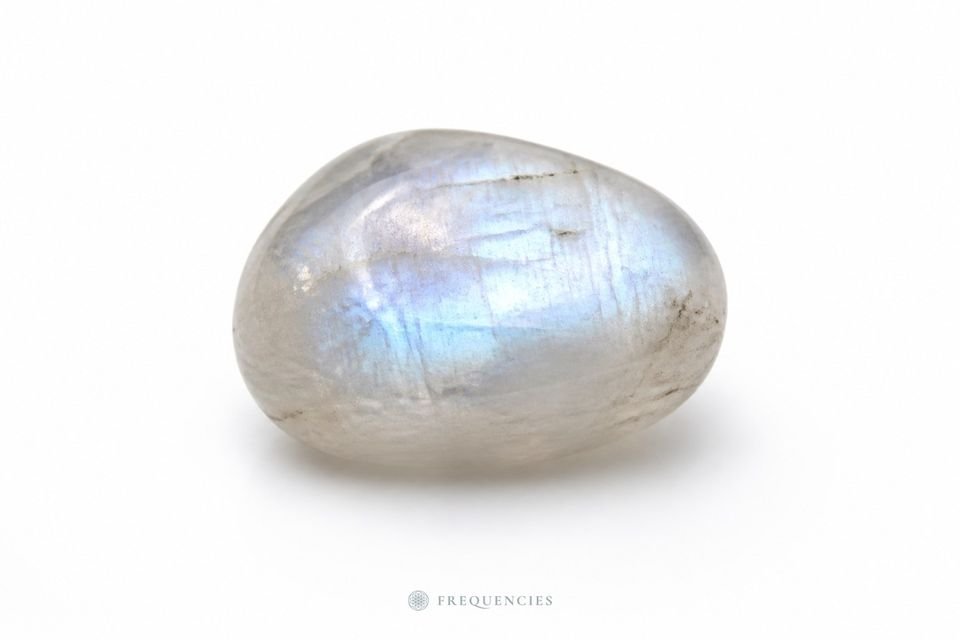
Moonstone is a feldspar in which orthoclase alternates with thin layers of albite [14]. This structure scatters light, and a gentle sheen glides over the stone’s surface. GIA calls this phenomenon adularescence and compares it to a full moon shining through a thin veil of high clouds. In Hindu mythology, moonstone is made of solidified moonbeams [15]. Moonstone has a hardness of 6 to 6.5, and its sheen is sensitive, so the stone should be stored carefully and not heated for long periods [14]. You will find polished stones and bracelets in the Moonstone category.
The name of selenite comes from the Greek word meaning Moon, as it was once believed that this mineral waxes and wanes with the phases of the Moon [16]. It is a very soft gypsum with a hardness of 2, which should not be soaked in water and should be cleaned only with a dry cloth [16]. For the moon theme, see the selenite bowl in the shape of a crescent moon, and other selenite forms, from rods to lamps, are in the Selenite category.
Many crystal lovers cleanse crystals in the light of the full moon by placing them on the windowsill. If you choose this community practice, remove the stones in the morning before the sun reaches them. Amethyst and rose quartz can fade in prolonged sunlight, while a transparent rock crystal sphere acts as a lens in the sun [14]. The requirements for each stone are summarized in the care table, and you can read about modern birth month stones in the article Birth Month Stones.
Frequently Asked Questions
Which month is the month of spirits?
The month of spirits is October. In 1649, Paul Einhorn called it the month of spirits or the month of offerings, and both names are associated with the remembrance of deceased ancestors: spirits are the souls of the dead, and offerings are food for the spirits of the dead.
What did the ancient Latvians call January?
In Einhorn’s 1649 list, January is the winter month. In modern lists, it is also called the frost month, and in the 1817 Vidzeme calendar, it is the new year month.
Why did the ancient Latvians have 13 months in some years?
The ancient months followed the phases of the Moon and lasted about 29 to 30 days. Twelve such months are about 11 days shorter than the solar year, so every two or three years a thirteenth, festival month was added.
When is the time of spirits?
The time of spirits is most often considered to be from Miķeļi to Mārtiņi or to All Saints’ Day on November 1. Folklore records mostly refer to October.
What is the name of the October full moon?
In the American calendar The Old Farmer’s Almanac, the October full moon is the Hunter’s Moon. In 2026, it is on October 26. In the Latvian folk calendar, October is the month of spirits.
Sources
- G. Jaunmuktāne (Latvian Academic Library). Calendars, time signs. Latvijas Vēstnesis, 19.10.2004, No. 165
- G. Jaunmuktāne. From the history of calendars. Collected articles Measured Time and Space, LU Academic Press
- J. Stradiņš (Latvian Academy of Sciences). On science about Latvia and Latvians. Latvijas Vēstnesis, 2.11.2007, No. 177
- 12 month names. A look at the Vidzeme calendar for 1817. LSM.lv, Latvian Radio and National Library of Latvia, 2019
- Candle, snow crust, wolf… or ancient Latvian month names. LSM.lv, 2018
- Tēzaurs, LU Institute of Mathematics and Computer Science, entries: sērsna, sils, zemlikas, veļi, veļu mēnesis, sala mēnesis, viršu mēnesis, lapu mēnesis, ziedu mēnesis
- P. Vilsone. The frost month has arrived. LSM.lv, Latvian Radio, 2013 (A. Rancāne, R. Muktupāvela)
- I. Upīte. The time of spirits for remembrance and reflection on generational succession. LSM.lv, 2014 (G. Pakalns, Latvian Folklore Repository)
- I. Strazdiņa. The time of spirits and Halloween: folklorists explain the common and the different. LSM.lv, 2024
- S. Liepiņa. During the time of spirits, folklore researchers encourage remembering one’s ancestors. LSM.lv, ReTV, 2021
- C. Boeckmann. Full Moon Names. The Old Farmer’s Almanac
- Full Moon in October 2026: Hunter’s Moon. The Old Farmer’s Almanac
- Full Moon in November 2026: Beaver Moon. The Old Farmer’s Almanac
- FREQUENCIES Stone Encyclopedia: moonstone, amethyst, rose quartz, rock crystal (structure, care)
- Moonstone History and Lore. Gemological Institute of America (GIA)
- FREQUENCIES Stone Encyclopedia: selenite (name origin, hardness, care)
- Kovas. Wikipedia in Lithuanian