Libyan Desert Glass
Natural impact glass

Libyan Desert Glass

A rare yellow natural glass from the Sahara, traditionally associated with willpower and change.

Hardness 6-6.5 May be rinsed in water Sunlight is not harmful Fire
In brief

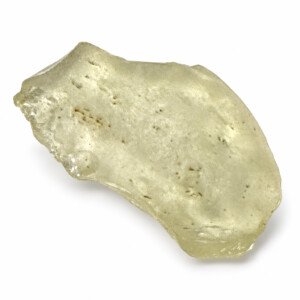
Libyan Desert Glass is a natural, almost pure silica glass that formed when a meteorite impact melted sandy rock. Its colour ranges from pale yellow to honey shades, and its hardness is 6 to 6.5 on the Mohs scale. The main deposit is in Egypt. In the crystal community, it is traditionally associated with solar symbolism, highlighted by the story of Tutankhamun's scarab.

Libyan Desert Glass in our shop

Exhibit label

Name
Libyan Desert Glass
Type
Natural glass
Mineral group
Natural impact glass (almost pure silicon dioxide, chiefly lechatelierite)
Hardness
6-6.5 on the Mohs scale
Colour
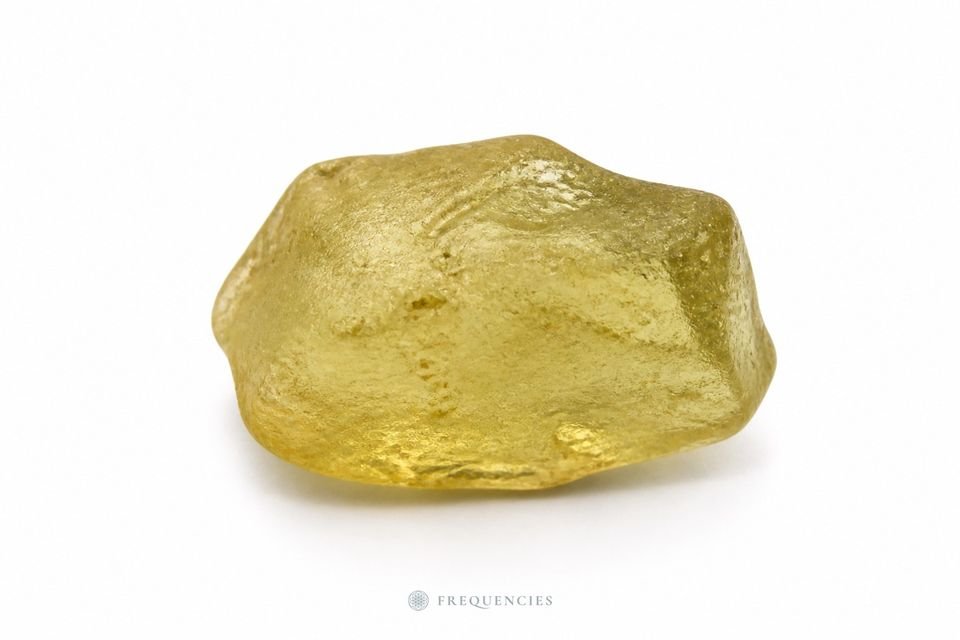
Pale yellow, lemon yellow to honey or greenish yellow, transparent to milky cloudy, often with a wind-smoothed surface
Main locality
Egypt
Localities
Egypt, Libya
Planet
Sun (tradition)

Mohs hardness scale

6-6.5out of 10

Moderately hard: durable in everyday wear, but it can be scratched by harder stones. Store it separately.

Care

Water

May be rinsed in water

A brief rinse in lukewarm water, then wipe dry.

Sun

Sunlight is not harmful

May be kept in a bright place.

Storage

Durable in everyday wear

Avoid: falls onto hard surfaces, sharp temperature changes, abrasive cleaning agents.

Note. Like any glass, it can chip or crack on impact; raw pieces may have sharp edges.

In the crystal community, the following are used for cleansing: a brief rinse in lukewarm water, the presence of selenite, sound vibrations, moonlight.

From geology to your shelf

  • How it forms. Libyan Desert Glass is a natural, almost pure (about 98 %) silicon dioxide glass that formed roughly 29 million years ago, when a meteorite impact melted sandy rock and the melt cooled rapidly. It is found in the south-western part of the Great Sand Sea in Egypt's Western Desert near the Libyan border; there was long debate over whether the glass arose from a direct impact or an air burst, but the high-pressure mineral reidite points to an impact.
  • Where the colour comes from. The glass is pale yellow to pale greenish and usually very transparent. It is almost pure silicon dioxide with a small admixture of iron, strontium, potassium, titanium and zirconium.
  • History. The central scarab of Tutankhamun's pectoral is carved from Libyan Desert Glass; it was noticed in 1996 in the Egyptian Museum in Cairo by the Italian mineralogist Vincenzo de Michele, who published his analysis in 1998. The glass was first described scientifically by Clayton and Spencer in 1934, but tools were made from it as early as the Stone Age.
  • How to recognise a genuine stone.
    • Typical inclusions are gas bubbles, white cristobalite spherules, dark brown streaks and black iron oxides.
    • The refractive index is around 1.44 to 1.46, and it can be determined in a gemmological laboratory.
    • There is no recognised synthetic analogue on the market; if a specimen shows none of the features of natural glass, proof of origin should be requested.
  • Treatment and imitations. The material is polished and carved, but it is also offered in raw natural pieces; there is no recognised synthetic analogue.
  • How to choose. Look for high transparency and a clean, pale yellow colour, and natural inclusions confirm the origin. Egyptian export controls have been stricter since the early 2000s, so the market is mostly supplied from stock collected earlier.
  • Traditional meaning

    This is crystal tradition and symbolism, not a scientific or medical claim. The chakras, signs and elements match our product pages.

    Chakras

    Sacral ChakraSolar Plexus ChakraThird Eye Chakra

    In crystal traditions, Libyan Desert Glass is most often associated with the Solar Plexus Chakra, and also with the Sacral and Third Eye Chakras. It is regarded as a symbol of willpower, self-confidence and change.

    Zodiac signs

    ♌︎Leo♎︎Libra

    In traditional crystal astrology, Libyan Desert Glass is associated with Leo and Libra. For Leo it symbolises sunny self-confidence, and for Libra clarity in decision-making.

    Element

    Fire

    The Fire element traditionally symbolises strength and transformation. For Libyan Desert Glass it also recalls the immense heat in which it was created.

  • Main symbolism: willpower, self-confidence and change
  • In crystal traditions, it symbolises personal power and a link with cosmic origins
  • Traditionally associated with self-trust and the courage to accept change
  • In the crystal community, many people traditionally associate Libyan Desert Glass with Sun symbolism, further highlighted by the story of Tutankhamun's scarab. It is often kept in a meditation corner or on a writing desk as a reminder of the history of the Earth and the cosmos, and it is a popular gift for people interested in astronomy and ancient Egypt.
  • The traditional meaning of crystals has not been medically proven and does not replace the advice of a professional.

    Stories and legends

    At the centre of Tutankhamun's pectoral is a scarab of Libyan Desert Glass.

    In 1922 Howard Carter found in Tutankhamun's tomb a pectoral with a yellow-green, transparent scarab at its centre. The stone was long thought to be chalcedony, until in 1996 the Italian mineralogist Vincenzo de Michele noticed at the Egyptian Museum in Cairo that it was carved from natural Libyan Desert Glass. He published his analysis in 1998.

    Scientists described the glass field after a 1932 expedition to the Great Sand Sea.

    The Desert Survey of Egypt expedition led by Patrick Clayton found pieces of the glass on 29 December 1932 in a dune corridor near the Egyptian-Libyan border. Some pieces were the size of a human head, and the largest weighed more than 7 kilograms. Clayton, together with the British Museum mineralogist L. J. Spencer, published the first scientific description in the Mineralogical Magazine in 1934.

    Prehistoric desert dwellers made cutting tools from this glass.

    Archaeologists have found in the desert sharp flakes struck from this glass, which prehistoric people used for cutting, and they link them with the Aterian culture of the Stone Age. In 1971 a large block of glass bearing percussion marks was also found, so researchers suggest that it may have been used as a striking tool.

    Tiny zircon grains helped to solve the riddle of the glass's origin.

    The glass formed roughly 29 million years ago, when almost pure quartz sand melted at a temperature above 1600 °C. In 2019 researchers at Curtin University found in the glass zircon grains that had once been reidite, a mineral that forms only under the immense pressure of a meteorite impact. This points to a meteorite impact, not merely an explosion in the atmosphere, although the crater itself has not yet been found.
    Interesting facts

    • Libyan Desert Glass is an almost pure silicon dioxide glass roughly 28.5 to 29 million years old from the Great Sand Sea in western Egypt; creating it required a temperature above 1600 °C.
    • Zircon grains found in the glass show that they were once reidite, a mineral that forms only in a meteorite impact; the impact crater has not been found so far.

    How to use it

    • Hold the stone up to the light to see its tone and internal inclusions
    • Place it on a collection shelf as the centre of a story of cosmic origin
    • Use it in meditation as a symbol of willpower and intention
    • Give it to someone who is interested in astronomy or the history of ancient Egypt

    Pairs well with

    Frequently asked questions

    What is Libyan Desert Glass?

    It is a natural, almost pure (about 98 %) silicon dioxide glass that arose when a meteorite impact melted sandy rock and the melt cooled quickly. In 2019 traces of reidite, which forms only under impact pressure, were found in the glass, but the crater has not yet been found.

    Is Libyan Desert Glass a meteorite?

    No. It is glass formed on Earth from melted sand, and the meteorite supplied only the impact and the heat. A meteorite is the stone itself from space, whereas Libyan Desert Glass is impact glass.

    Is Libyan Desert Glass moldavite?

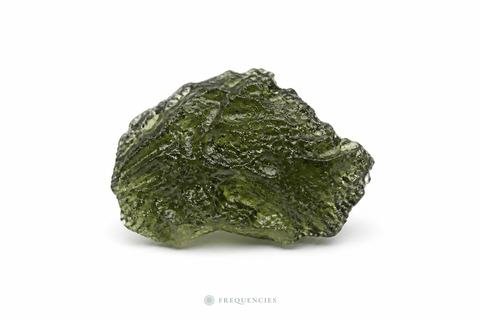
    No. Only glass that formed in the Nördlingen Ries meteorite impact in Germany roughly 15 million years ago is called moldavite, whereas Libyan Desert Glass is African impact glass and is usually paler, yellowish green. The name "African moldavite" is misleading.

    How old is Libyan Desert Glass?

    Roughly 28.5 to 29 million years. That is almost twice as old as moldavite, which formed roughly 15 million years ago, and since then the pieces of glass have lain in the dune corridor of the Great Sand Sea.

    Where is Libyan Desert Glass found?

    In Egypt's Western Desert, in the dune corridor of the Great Sand Sea near the Libyan border, where pieces of glass are scattered over an area of several thousand square kilometres. Although Libya is in the name, the main deposit lies on the Egyptian side.

    How can real Libyan Desert Glass be recognised?

    Real glass is pale yellow or greenish, and in it gas bubbles, dark streaks and tiny white spherical inclusions of cristobalite are often visible. There is no recognised synthetic analogue on the market, but industrial glass may be of a similar colour, so a gemmological laboratory can determine it reliably.

    What does Libyan Desert Glass have to do with Tutankhamun?

    At the centre of Tutankhamun's pectoral is a yellow-green scarab that was long thought to be chalcedony. In 1996 the Italian mineralogist Vincenzo de Michele noticed that it was carved from Libyan Desert Glass. He published his analysis in 1998.

    What does Libyan Desert Glass symbolise?

    In crystal traditions it symbolises willpower, self-confidence and a link with cosmic origins, and it is associated with Sun symbolism. Traditionally it corresponds to the Sacral, Solar Plexus and Third Eye Chakras, the Fire element and the signs of Leo and Libra.

    Sources. Mineralogical data: GIA Gem Encyclopedia, Mindat, Encyclopaedia Britannica (frequencies.lv crystal database v2), en.wikipedia.org, gemdat.org, hal-ensta-paris.archives-ouvertes.fr, theconversation.com, theconversation.com, archaeology.org, temehu.com, skyjems.ca, crystals.com, frequencies.lv, frequencies.lv.
    Further information: gia.edu, en.wikipedia.org, news.bbc.co.uk, skyjems.ca.
    Shopping Basket
    Scroll to Top