Staurolite
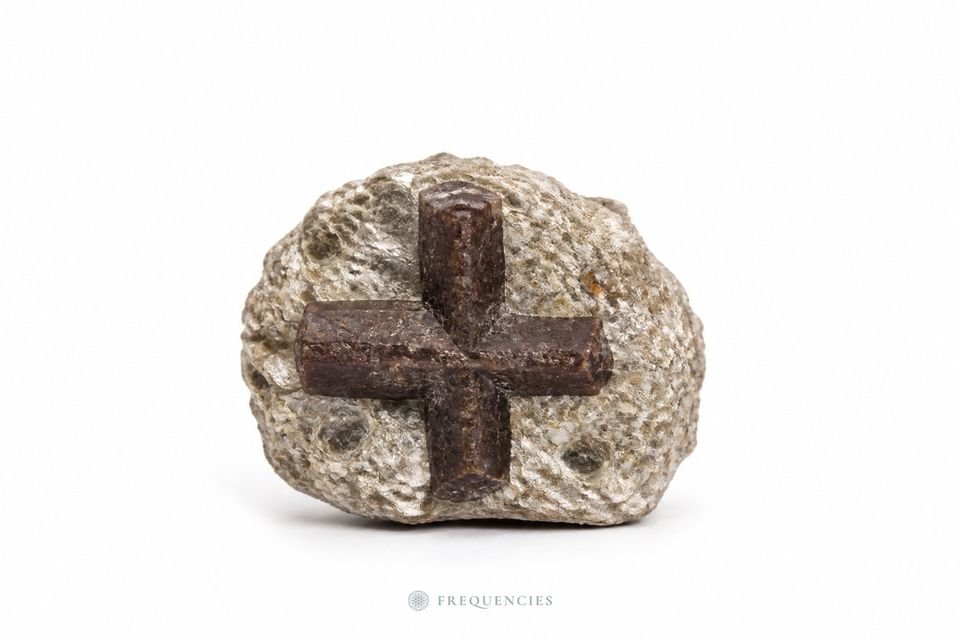
A brown mineral with a natural cross shape, traditionally carried as a lucky charm.
Staurolite is a brown silicate mineral with a hardness of 7 to 7.5 on the Mohs scale, which forms in metamorphic rocks under high pressure and temperature. Its crystals often grow together as cross-shaped twins, and the name comes from the Greek word for cross. The main deposit is in the USA. In folk beliefs, it is traditionally carried as a good luck charm.
Exhibit label
Mohs hardness scale
A hard stone: it scratches glass and is durable in everyday wear. Even so, protect it from knocks.
Care
Water
A brief rinse in lukewarm water, then wipe dry.
Sun
May be kept in a bright place.
Storage
Avoid strong knocks, harsh cleaning agents and prolonged soaking if the crystal sits in a schist matrix.
Note. Staurolite itself is hard and durable, but the crystals are often embedded in soft schist, which can crumble; clean such specimens gently with a soft brush.
In the crystal community, the following are used for cleansing: a brief rinse under running water, sound vibrations, moonlight, the presence of selenite.
Traditional meaning
This is crystal tradition and symbolism, not a scientific or medical claim. The chakras, signs and elements match our product pages.
Chakras
Staurolite is traditionally associated with the root chakra, which in crystal traditions symbolises groundedness, a sense of security and a connection with the earth.
Zodiac signs
In crystal traditions staurolite is attributed to Pisces, a sign associated with sensitivity and a belief in the miraculous; the stone itself is known as the fairy cross.
Element
The earth element traditionally symbolises stability and endurance, which the earthy brown tones and cross shape of staurolite reflect.
The traditional meaning of crystals has not been medically proven and does not replace the advice of a professional.
Interesting facts
- The name comes from the Greek word stauros, meaning cross, because staurolite crystals often grow together in the shape of a cross.
- Cruciform twin crystals form at two angles: more often at about 60 degrees (the oblique cross) and more rarely at 90 degrees (the right-angled cross).
- In the US state of Virginia there is Fairy Stone State Park, named after these natural little crosses and the legend associated with them.
How to use it
- Carry it in a pocket or on a cord as a traditional lucky charm
- Place it near the entrance of the home as a symbol of groundedness
- Choose it as an unusual gift for nature and mineral enthusiasts
- Use it in meditation together with earth-toned stones
Pairs well with
 Black Tourmaline
 Smoky Quartz
 Hematite
 Clear Quartz
Frequently asked questions
What is staurolite?
Staurolite is a brown silicate mineral that forms in metamorphic rocks, such as crystalline schists, under conditions of high pressure and temperature. Its hardness is 7 to 7.5 on the Mohs scale, and the crystals are usually dark reddish-brown to blackish-brown.
Why is staurolite cross-shaped?
That is how it grows in nature. Staurolite crystals often grow together in pairs as twins, more often at about 60 degrees (the oblique cross) and more rarely at 90 degrees (the right-angled cross). The name comes from the Greek word stauros, meaning cross.
How can you recognise a genuine staurolite cross?
By its hardness. Genuine staurolite is not scratched by a steel needle, whereas fakes carved from soft talc or soapstone scratch easily. Crosses that are too smooth and uniform are also suspicious, because natural crystals are sometimes ground and darkened with oil or wax.
Why is staurolite called the fairy cross?
Because of a legend. In Virginia, USA, it is told that the staurolite crosses are the petrified tears of fairies, and the state even has a Fairy Stone State Park, named after these crosses.
What does staurolite symbolise?
Staurolite symbolises groundedness, and in folk beliefs the little cross is carried as a lucky charm. In the crystal community it is associated with the root chakra, the earth element and the sign of Pisces.
Where is staurolite found?
Staurolite is not a rare mineral. The best-known localities for the crosses are in the USA: in Georgia, where staurolite has been the official state mineral since 1976, as well as in Virginia and Minnesota. In Europe the crosses are known from Brittany in France, and well-formed staurolite crystals are also found in Switzerland and Austria.
May staurolite be put in water?
Yes. Staurolite itself is hard and water does it no harm, but do not soak crystals in a soft schist matrix for long, because the rock can crumble. Clean them gently with a soft brush.
Read more
Staurolite: Properties, Meaning, and How to Use It in Daily Life