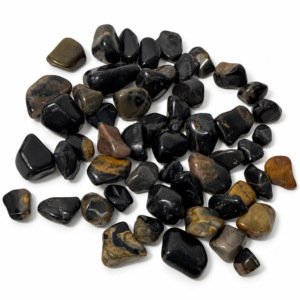
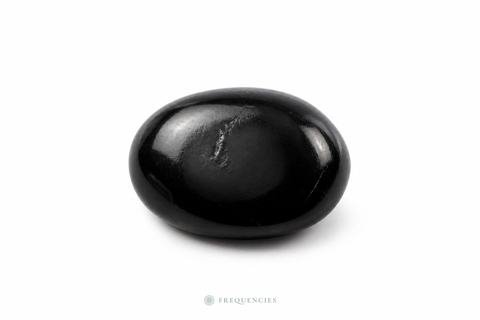
Onyx
Chalcedony variety

Onyx

Onyx is a stone traditionally associated with strength, endurance and steadfastness.

Hardness 6.5-7 May be rinsed in water Sunlight is not harmful Earth
In brief

Onyx is a variety of chalcedony, a microcrystalline quartz, in black, white or brown, often with layered bands. It has a hardness of 6.5 to 7 on the Mohs scale and is found in Brazil, India, Mexico and Pakistan. In the Victorian era, black onyx was one of the main materials for mourning jewellery. In the crystal community, onyx is regarded as a symbol of strength, endurance and resilience.

Onyx in our shop

Exhibit label

Name
Onyx
Type
Mineral
Mineral group
Chalcedony / quartz group
Hardness
6.5-7 on the Mohs scale
Colour
Black, white, brown or layered bands
Main locality
India
Localities
Brazil, India, Mexico, Pakistan
Planet
Saturn (tradition)
Black onyx on the market is almost always dyed chalcedony; this is an ancient and lasting treatment. Banded calcite ("onyx marble"), which is not quartz, is also sold under the name "onyx".

Mohs hardness scale

6.5-7out of 10

Moderately hard: durable in everyday wear, but it can be scratched by harder stones. Store it separately.

Care

Water

May be rinsed in water

A brief rinse in lukewarm water, then wipe dry.

Sun

Sunlight is not harmful

May be kept in a bright place.

Storage

Durable in everyday wear

Avoid: prolonged heat, harsh cleaning agents, strong knocks.

Note. If the stone is porous, coloured or has a softer surface, dry cleansing is the safer choice.

In the crystal community, the following are used for cleansing: a brief rinse under running water, the presence of selenite, sound vibrations, moonlight.

From geology to your shelf

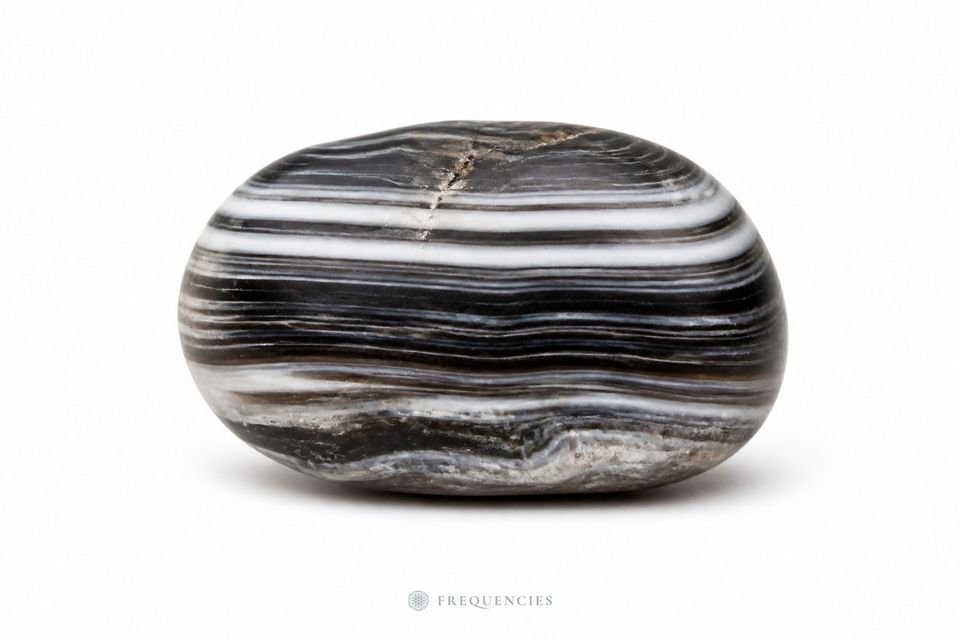
  • How it forms. Onyx is a variety of chalcedony, that is, microcrystalline quartz. It forms when thin layers of chalcedony are gradually deposited in rock cavities from groundwater containing silica; in onyx these layers are parallel, rather than wavy or concentric as in many agates.
  • Where the colour comes from. The bands are produced by impurities that changed along with the composition of the groundwater while each layer was forming. Classic onyx is black and white, while in sardonyx reddish-brown bands alternate with white or black ones.
  • History. The name comes from the ancient Greek word onyx, meaning fingernail. In ancient Rome two-layered onyx was used for cameos, such as the Gemma Augustea (around AD 9 to 12), and Pliny the Elder was already describing methods of artificially colouring onyx in the 1st century.
  • How to recognise a genuine stone.
    • Most of the uniformly black onyx on the market is artificially dyed, whereas banded black and white onyx is usually natural.
    • "Mexican onyx" or "onyx marble" is the name given to banded calcite or aragonite, which is much softer than chalcedony onyx.
    • "Green onyx" is usually chalcedony dyed green.
  • Treatment and imitations. The black colour is obtained by soaking or boiling chalcedony in a sugar solution and then treating it with acid, which carbonises the sugar absorbed into the surface layer of the stone; nowadays other dyes are also used.
  • How to choose. For black onyx, look for an even, deep black colour; for banded onyx, look for clear, parallel and contrasting bands. An honest description states that the uniform black colour has usually been obtained by dyeing.
  • Why black onyx is usually dyed

    GIA writes that what many people call black onyx is actually produced by dyeing chalcedony black, because black chalcedony is rare in nature. The colour is obtained through treatment, but the stone itself is natural chalcedony.

    • Why chalcedony takes up colour. Chalcedony consists of microscopically small quartz crystallites, and it is porous. GIA explains that when a stone is dyed, the colourant is introduced into its pores or fissures, and notes that chalcedony and quartz have been dyed since ancient times.
    • Bands beneath the black. In 1996 the GIA journal Gems & Gemology described a black onyx cabochon in which, in strong light, the bands could be seen only at the very thinnest edge. Before treatment the stone may have been a banded agate, or its layers may have absorbed the dye differently.
    • An ancient and widespread practice. Britannica writes that most of the agate on the market is artificially dyed, so that dull grey stones become suitable for jewellery and decoration. The agate-processing industry was established several centuries ago in Idar-Oberstein in Germany, where agate was plentiful, but after 1900 most of the agate was supplied by Brazil and Uruguay. The black onyx in our shop also comes from Brazil.
    • Where it is used. The same Gems & Gemology article notes that treated black chalcedony, black jade (nephrite or jadeite) and hematite have traditionally been the most sought-after black opaque stones. They are used as side stones, and also in mosaics and men's jewellery, and black onyx is also readily used to make artistic carvings.
    • Honest description. GIA stresses that if the treatment is not disclosed, the buyer may think the stone is of higher quality and value in nature than it really is. The US Federal Trade Commission has issued guidelines that require treatments to be disclosed, and trade organisations such as the World Jewellery Confederation CIBJO set similar rules for their members. As early as 1996 Gems & Gemology wrote that other materials are also sold under the name "black onyx", which is why dealers send samples to a laboratory to make sure the item is named correctly. A qualified gemmologist can in most cases identify a dyed stone (GIA).
    • Care. GIA advises protecting dyed stones from acetone and alcohol, because they can dissolve the dyes. Therefore remove onyx jewellery before using products that contain acetone or alcohol.

    Traditional meaning

    This is crystal tradition and symbolism, not a scientific or medical claim. The chakras, signs and elements match our product pages.

    Chakras

    Root ChakraSolar Plexus Chakra

    Onyx is traditionally associated with the root chakra and steadfastness.

    Zodiac signs

    ♌︎Leo♑︎Capricorn

    In traditional crystal astrology, onyx is often associated with people who value steadfastness and inner balance.

    Element

    Earth

    The Earth element is traditionally said to give this stone steadfastness and a balanced character.

  • Main symbolism: strength and endurance
  • Traditionally associated with strength, endurance and more conscious inner work
  • Traditionally associated with steadfastness and inner peace
  • In the crystal community, onyx is traditionally associated with the root and solar plexus chakras, the element of earth and the signs of Leo and Capricorn. It is often placed on a desk or by the entrance as a symbol of composure and steadfastness, and many people choose black onyx jewellery as a classic, elegant gift.
  • The traditional meaning of crystals has not been medically proven and does not replace the advice of a professional.

    Stories and legends

    The word onyx comes from a Greek word meaning fingernail.

    The name comes from the Greek word onyx, meaning fingernail or claw, because the layered, semi-translucent appearance of the stone resembles the structure of a fingernail. In antiquity almost any colour of chalcedony was called onyx, but the Romans later narrowed the name to black and dark brown shades.

    Legend has it that onyx came from the fingernails of the goddess Venus.

    A legend told in the jewellers' tradition says that Cupid trimmed the nails of the sleeping Venus, and the Fates turned the clippings into stone so that no part of the goddess would be lost. The sources that retell this story do not cite an ancient written origin, so it is regarded as a later, popular legend.

    The straight, parallel layers of onyx made it a favourite cameo stone as early as the ancient world.

    Onyx is layered chalcedony, and its almost parallel colour layers allow the craftsman to carve a light relief on a dark background. Such cameos and intaglios were already being cut in ancient Greece and Rome, and the collection of the Smithsonian National Museum of Natural History also holds an onyx cameo.

    In the Victorian era, black onyx became one of the main materials for mourning jewellery.

    During the reign of Queen Victoria, strict mourning traditions created a great demand for black jewellery. The Victoria and Albert Museum in London notes that black-dyed onyx, like jet, bog oak and black enamel, was suitable for mourning jewellery, and in March 1861, after her mother's death, the queen ordered several such pieces.
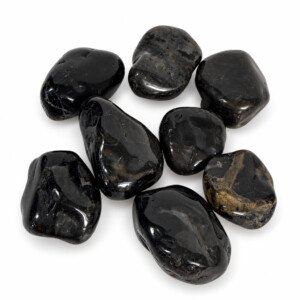
    Interesting facts

    • Onyx is a variety of chalcedony (microcrystalline quartz) with straight, parallel bands, usually black and white.
    • Most of the black onyx on the market is dyed chalcedony.
    • Banded calcite, or onyx marble, which is much softer and is not quartz, is also sold on the market under the name "onyx".

    Onyx marble in interiors and manufactured goods

    Onyx marble, or Mexican onyx, is banded calcite or aragonite, and it is called onyx only because of the similar bands. Mindat calls the use of the word "onyx" for this stone incorrect and confusing and recommends discouraging it.

    • How it forms. Britannica writes that onyx marble forms in caves, fissures and around spring outlets, where calcite or aragonite is deposited from cold water in concentric layers. Mindat describes it as banded calcite of karst (stalagmitic) origin, found all over the world.
    • Neither marble nor onyx. Britannica notes that in the strict sense it is neither marble nor onyx, because true onyx is banded chalcedony. In antiquity it was onyx marble that was called alabaster, whereas today alabaster is the name given to gypsum, the same mineral that selenite is made of. Mindat also lists other names for this stone: Algerian onyx, Oriental alabaster and banded travertine.
    • Where it is mined and used. Onyx marble is usually brown or yellow because it contains iron oxides. Britannica gives as well-known examples the large deposits in Mexico (Tecali) and the Algerian onyx marble, which was used in the buildings of Carthage and Rome and was rediscovered in 1849. Today it is mainly used in interior finishing and decorative objects, and Mindat writes that most of the "onyx" carvings now available, such as bookends and chess sets, are made from this carbonate stone.
    • How to tell it apart and care for it. Onyx marble is considerably softer than chalcedony onyx and withstands acids much less well (Mindat). That is why chalcedony onyx scratches glass whereas onyx marble does not, and surfaces and vessels made of onyx marble should be protected from vinegar, lemon juice and other acidic liquids. The black onyx sold in our shop is chalcedony onyx, with a hardness of 6.5 to 7.

    How to use it

    • Wear it every day as a piece of jewellery traditionally associated with strength and endurance
    • Keep it close during meditation or quiet moments
    • Place it in your work or relaxation area
    • Choose it as a gift with symbolic meaning

    Varieties

    Onyx occurs in various colours and forms. Each variety has its own page.

    Pairs well with

    Frequently asked questions

    What does onyx symbolise?

    In the crystal community, onyx is regarded as a symbol of strength, endurance and steadfastness. It is associated with the root and solar plexus chakras, with the zodiac signs Leo and Capricorn, and with the element of earth. In the Victorian era black onyx was one of the main materials for mourning jewellery.

    Is black onyx natural or dyed?

    Most of the black onyx on the market is treated greyish chalcedony: it is soaked in a sugar solution and then heated in sulphuric acid, and carbon is left in the pores of the stone. This treatment is ancient and lasting, but the black colour penetrates only a few millimetres deep.

    How can you tell onyx from agate?

    Both are varieties of layered chalcedony with the same composition. The difference is in the bands: in agate they are usually curved or concentric, whereas in onyx they are straight and almost parallel, which is why cameos were already being cut from onyx in antiquity.

    What is Mexican onyx, or onyx marble?

    It is not true onyx, but layered calcite or aragonite. Its hardness is only around 3 on the Mohs scale, and it has pronounced cleavage, so it is much softer and more brittle than chalcedony onyx and fizzes in acids.

    Can onyx be washed in water?

    Yes, a brief rinse is safe. The International Gem Society recommends cleaning onyx with a soft brush, mild detergent and warm water, and not using ultrasonic or other mechanical cleaning devices.

    Does onyx fade in the sun?

    Natural chalcedony is stable in sunlight, and so is the black colour obtained by sugar and acid treatment: it is formed by carbon in the pores of the stone. Onyx dyed with other colourants, for example green, can however fade in prolonged strong sunlight, so keep such jewellery in the shade. It is safer to store all onyx jewellery apart from harder stones so that it does not get scratched.

    Is onyx suitable for an everyday ring?

    Yes. Onyx is chalcedony with a hardness of 6.5 to 7 on the Mohs scale, and it has no cleavage, so it is well suited to everyday jewellery. The dyed surface layer can nevertheless wear away if the stone is polished or scratched too hard.

    Read more

    Onyx: Properties, Meaning, and How to Use It in Daily Life

    Sources. Mineralogical data: GIA Gem Encyclopedia, Mindat, Encyclopaedia Britannica (frequencies.lv crystal database v2).
    Further information: minerals.net, minerals.net, en.wikipedia.org, geology.com, 4cs.gia.edu, gia.edu, gia.edu, britannica.com, britannica.com, britannica.com, mindat.org, mindat.org.
    Shopping Basket
    Scroll to Top