Lemurian Quartz
Quartz variety

Lemurian Quartz

Lemurian quartz is a natural quartz crystal with characteristic striations; it is traditionally associated with intuition and inner wisdom.

Hardness 7 May be rinsed in water Sunlight is not harmful Air
In brief

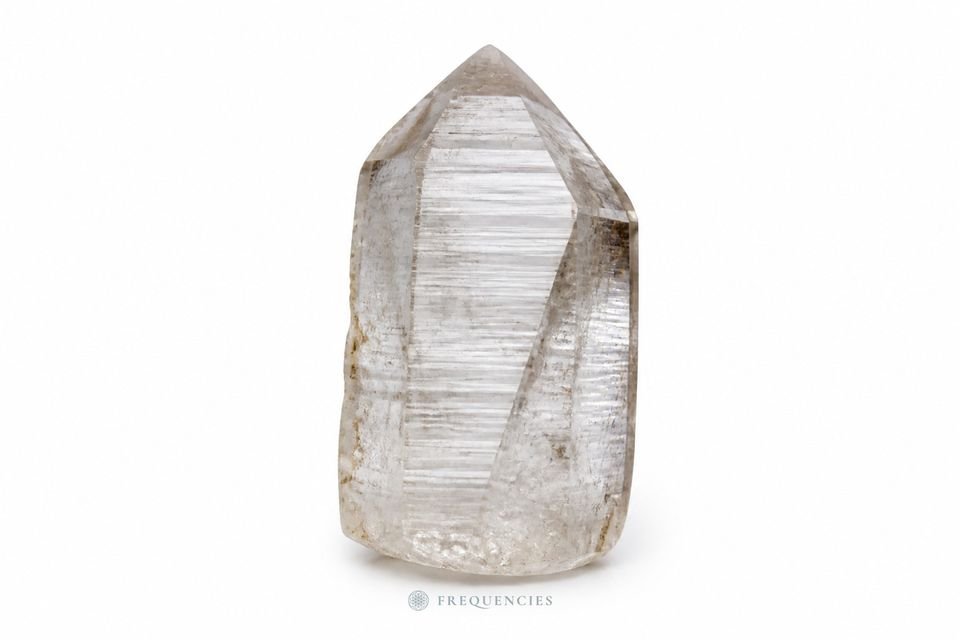
Lemurian Quartz is mineralogically ordinary quartz (SiO2) with a hardness of 7 on the Mohs scale, but in the trade the name is given to crystals with horizontal striations on the faces. The striations are growth features of the crystal, and the name is linked to the legend of Lemuria. In the crystal community, it is traditionally associated with intuition and inner wisdom.

Lemurian Quartz in our shop

Exhibit label

Name
Lemurian Quartz
Type
Mineral
Mineral group
Quartz group (SiO2); a trade name for natural quartz crystals with horizontal striations
Hardness
7 on the Mohs scale
Colour
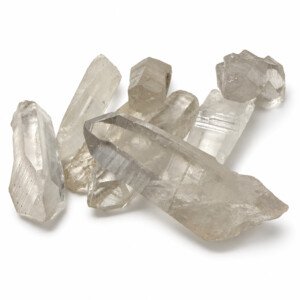
Transparent to milky clear, sometimes with a slight pink, yellowish or smoky tint; fine horizontal striations on the faces
Main locality
Brazil
Localities
Brazil, Colombia
Planet
Mercury (tradition)

Mohs hardness scale

7out of 10

A hard stone: it scratches glass and is durable in everyday wear. Even so, protect it from knocks.

Care

Water

May be rinsed in water

A brief rinse in lukewarm water, then wipe dry.

Sun

Sunlight is not harmful

May be kept in a bright place.

Storage

Durable in everyday wear

Avoid: strong knocks to the point and edges, sharp temperature changes, harsh and abrasive cleaning agents.

Note. The fine striations are a natural growth feature, so do not rub the surface with abrasive products. Clean with a damp cloth and avoid prolonged soaking in water.

In the crystal community, the following are used for cleansing: a brief rinse under running water, the presence of selenite, sound vibrations, moonlight.

From geology to your shelf

  • How it forms. Lemurian quartz is ordinary clear quartz (silicon dioxide) with pronounced horizontal grooves on the prism faces; it is a trade name, not a separate mineral variety. The original crystals are hydrothermal quartz points that were found in the late 1990s as single crystals in loose sandy soil in the Serra do Cabral area of Minas Gerais, Brazil, and similar material is also mined at Peñas Blancas in Colombia.
  • Where the colour comes from. The grooves, or barcode, are growth features: while the crystal was growing, the temperature, pressure or silicon dioxide concentration changed, and growth alternated with pauses or partial etching. The grooved faces are often matt, while the adjacent faces are glassy and shiny. A tangerine tone is given by a coating of iron oxide.
  • History. The name refers to the legendary Lemuria; this hypothetical sunken continent was proposed in 1864 by the zoologist Philip Sclater, and the theory of plate tectonics refuted it. The story of the crystals was popularised in the 1990s by esoteric authors in the USA, and Brazilian dealers began to use the name in the late 1990s.
  • How to recognise a genuine stone.
    • Genuine grooves can be felt with a finger; they are not merely visible.
    • On natural points the surface is often slightly matt rather than mirror-polished.
    • Horizontal grooves are characteristic of many quartz crystals all over the world, so they alone do not prove the origin of Lemurian quartz.
  • Treatment and imitations. A tangerine tint is usually a natural coating of iron oxide. The name "Lemurian quartz" is nowadays also applied to grooved quartz points from other mines that do not match the original locality or form.
  • How to choose. Well-formed, transparent points with clear, tangible grooves and a natural, unpolished tip are valued more highly. From a mineralogical point of view it is ordinary quartz with a hardness of 7, so the value is determined by form, transparency and how pronounced the grooves are.
  • Traditional meaning

    This is crystal tradition and symbolism, not a scientific or medical claim. The chakras, signs and elements match our product pages.

    Chakras

    Third Eye ChakraCrown Chakra

    In crystal traditions, Lemurian quartz is associated with the Third Eye and Crown Chakras. It is regarded as a symbol of intuition, inner wisdom and spiritual growth.

    Zodiac signs

    ♒︎Aquarius

    In crystal traditions, Lemurian quartz is often associated with Aquarius, whose symbolism includes visions of the future, ideas and a wish to look more broadly.

    Element

    Air

    The Air element traditionally symbolises clarity of thought, inspiration and communication. In Lemurian quartz this is reflected in the clarity and lightness of the crystal.

  • Main symbolism: intuition and inner wisdom
  • In the crystal community, it is regarded as a symbol of meditation and spiritual growth, linked with the legend of Lemuria
  • Traditionally associated with calm concentration and self-trust
  • In the crystal community, Lemurian quartz is traditionally used in meditation, held in the hands while the grooves are watched or lightly stroked with a finger. Many people place it in a meditation space or at the centre of a crystal grid and regard it as a special collection stone.
  • The traditional meaning of crystals has not been medically proven and does not replace the advice of a professional.

    Stories and legends

    Lemuria was originally a scientific hypothesis of the 19th century.

    In 1864 the zoologist Philip Sclater proposed that a sunken continent had once lain between Madagascar and India, because fossils of animals related to lemurs had been found in both places. He named it Lemuria after the lemurs. Later the theories of continental drift and plate tectonics explained these similarities, and science abandoned the idea of Lemuria.

    A legend of the crystal community tells of the Lemurian "knowledge crystals".

    In the crystal community it is told that the Lemurians, foreseeing the destruction of their civilisation, "seeded" their knowledge in crystals so that it would be preserved for later generations. The legend says that this knowledge is stored in the grooves on the faces of the crystal. This is a modern legend, not a historical fact.

    Interesting facts

    • The name arose among crystal dealers in the late 1990s, when single elongated quartz crystals, not attached to a matrix, were found in sand in the Serra do Cabral mountain area of Minas Gerais, Brazil.
    • The characteristic horizontal striations on the faces are growth features that are also found in quartz from other deposits, so the name alone does not confirm the origin of the crystal.
    • Lemuria is a hypothetical continent proposed in 1864 by the zoologist Philip Sclater to explain finds of lemur fossils in Madagascar and India; after the discovery of plate tectonics, science rejected this hypothesis.

    How to use it

    • Place it in a meditation space with the point upwards
    • Set aside a calm moment and feel the striations on the faces with your fingertips
    • Use it as the central stone in a crystal grid
    • Choose it as a collection specimen with a natural, unpolished form

    Pairs well with

    Frequently asked questions

    What is Lemurian quartz?

    Mineralogically, Lemurian quartz is ordinary quartz (SiO2), most often a transparent or slightly matt crystal with horizontal grooves on its faces. The name is a crystal-community and trade designation linked with the legend of Lemuria, not a separate mineral species.

    How can Lemurian quartz be recognised?

    The main feature is horizontal grooves that cross the faces like the steps of a staircase and can be felt with a finger. On natural points the surface is often slightly matt. However, many quartz crystals have such grooves, so the origin cannot be determined from them alone.

    Why does Lemurian quartz have grooves?

    The grooves are growth features. While the crystal was growing, the temperature, pressure or silicon dioxide concentration changed, and growth alternated with pauses or partial etching, so stepped striations were left on the faces.

    Did Lemuria really exist?

    No. Lemuria was proposed in 1864 as a hypothetical sunken continent by the zoologist Philip Sclater, and the theory of plate tectonics refuted the idea. In esoteric circles Lemuria has survived as a legend.

    Where is Lemurian quartz mined?

    The original crystals were found in the late 1990s in the Serra do Cabral area of Minas Gerais, Brazil, where they lay as single crystals in loose sandy soil. Similar material is also mined in Colombia, and nowadays the name is also used for grooved points from other mines.

    May Lemurian quartz be put in water?

    Yes, a brief rinse is fine, as with other quartz. Do not soak it for long or rub it with abrasive products, because the fine grooves are a natural growth feature; it is enough to clean it with a damp cloth and dry it.

    May Lemurian quartz be kept in the sun?

    Yes, clear quartz does not usually change colour in the sun. If the crystal has a pink or smoky tint, it is safer to avoid prolonged direct sunlight, because coloured varieties of quartz can fade.

    What does Lemurian quartz symbolise?

    In the crystal community, Lemurian quartz is regarded as a symbol of intuition, inner wisdom and meditation, and many people lightly stroke its grooves with a finger during meditation. Traditionally it corresponds to the Third Eye and Crown Chakras, the Air element and the sign of Aquarius.

    Sources. Mineralogical data: GIA Gem Encyclopedia, Mindat, Encyclopaedia Britannica (frequencies.lv crystal database v2), crystals.com, crystals.com, skyjems.ca, en.wikipedia.org, bigthink.com, frequencies.lv.
    Further information: skyjems.ca, crystals.com, minerals.net, en.wikipedia.org.
    Shopping Basket
    Scroll to Top