Introduction
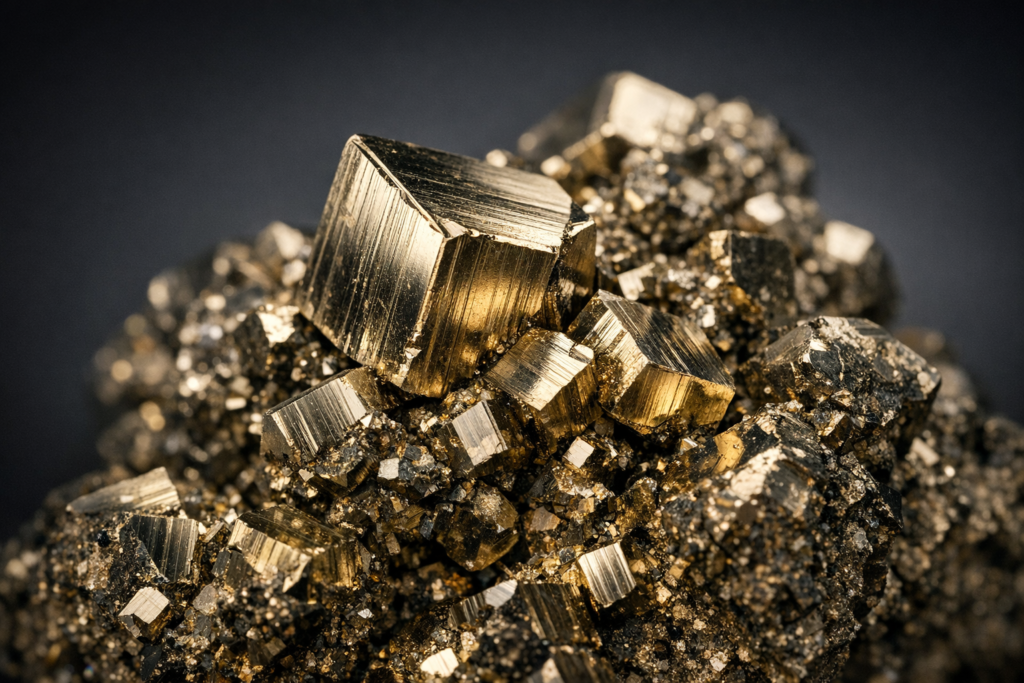
Pyrite is one of the most visually recognizable minerals in the world. Its metallic luster and golden shimmering surface have attracted collectors, mineral enthusiasts, and those interested in the symbolic and traditional uses of crystals for centuries. It is often referred to as “fool’s gold” because from a distance, pyrite can resemble gold, but mineralogically, it is a completely different mineral with its own unique composition and structure.
In crystal practices, pyrite is traditionally associated with protection, self-confidence, determination, and the symbolism of material prosperity. It is a stone that many choose for work environments, focusing intentions, or as a visually powerful reminder of discipline and inner stability.
Origin and Mineral Structure
Pyrite is an iron sulfide with the chemical formula FeS2. It forms under various geological conditions and is found in hydrothermal veins, sedimentary rocks, igneous rocks, and metamorphic processes. Pyrite is a widely distributed mineral, with significant deposits known in Spain, Peru, Italy, Mexico, the USA, and other parts of the world.
One of the most characteristic aspects of pyrite is its crystalline form. It is often found in cubic crystals, as well as in pyritohedral aggregates, granular masses, or radial formations. The mineral is characterized by its metallic luster, brass-yellow tone, and relatively high hardness compared to many other metallic-looking minerals.
From a mineralogical perspective, pyrite is interesting not only aesthetically but also historically. Throughout different eras, it has been used for fire-starting, in adornments, and as a collector’s item. Its geometrically precise crystals make pyrite particularly favored in mineral collections.
Traditional Energetic Associations
In crystal traditions, pyrite is often considered a stone of protection and willpower. It is traditionally associated with the ability to help maintain focus on goals, preserve inner strength, and reinforce confidence in one’s decisions. In many cases, pyrite is chosen during times when a person wishes to introduce more structure, discipline, or practical clarity into their daily life.
Its strong, metallic appearance is symbolically linked to boundaries, resilience, and energetic protection. In crystal practices, pyrite is often placed in spaces where concentration, productivity, or conscious progress towards a result is needed. It is also traditionally associated with themes of abundance and material stability, especially in the context of business, work, and financial intentions.
It is important to emphasize that these associations are based on traditions, symbolism, and personal experience, not medically proven effects.
Applications
Pyrite is a versatile mineral used both decoratively and symbolically. In interiors, it serves as an expressive accent, especially in workrooms, offices, and places where a purposeful, structured atmosphere is desired. Its geometric nature and metallic sheen fit well in both classical and modern environments.
In crystal practices, pyrite is often used in meditations, intention setting, or as a focus stone in daily work. Some people keep it on their desk, next to a planner, or in a place associated with financial management and professional goals. Pyrite is also popular as a gift for people starting a new project, business idea, or career phase.
Since pyrite contains iron and sulfur, it is not suitable for prolonged contact with water. Therefore, it is usually chosen as a dry, stable decorative or contemplative crystal, rather than a stone for regular rinsing or wet care.
Chakra Associations
Traditionally, pyrite is most often associated with the solar plexus chakra. This chakra is symbolically linked to willpower, self-confidence, personal power, and the ability to act. Therefore, in crystal practices, pyrite is often chosen when there is a need to strengthen inner focus, discipline, and determination.
Zodiac Associations
Pyrite is traditionally associated with several zodiac signs, especially Leo and Aries. In Leo’s energy, it harmoniously resonates with self-expression, courage, and inner brilliance. For Aries, pyrite often seems suitable due to its dynamic, action-oriented nature.
Of course, the choice of crystals is not strictly limited by astrology. Many people choose pyrite intuitively, based on its visual impact, symbolic meaning, or a specific intention they wish to work with.
How People Use This Crystal
In everyday life, people use pyrite in various ways. One of the most common is placing it on a desk or in an office space, where it serves as a visual symbol of focus and purposefulness. Some include it in their morning routine, formulating daily priorities or intentions. Others choose pyrite for meditations, especially when they wish to strengthen inner discipline or a more conscious attitude towards their resources and energy.
Pyrite is also used in crystal sets together with clear quartz, citrine, smoky quartz, or black tourmaline. Such combinations are traditionally chosen to combine clarity, grounding, protective symbolism, and purposeful energy. Pyrite is also favored among collectors, as its natural crystals are often geometrically impressive and decorative.
In jewelry, pyrite looks elegant and expressive, but it is recommended to use it carefully, as the material can be sensitive to moisture, chemicals, and scratches depending on the type of treatment.
Summary
Pyrite is a visually powerful and mineralogically interesting crystal that combines decorative appeal with rich symbolic meaning. Traditionally, it is associated with protection, self-confidence, focus, discipline, and themes of abundance. It is suitable for collections, interiors, and conscious daily practices where structure, purposefulness, and stability are important.
When choosing pyrite, people often appreciate not only its aesthetics but also the symbolic strength it brings to a space or personal ritual. It is a crystal that, with its appearance and character, reminds of a firm foundation, conscious direction, and respect for one’s goals.