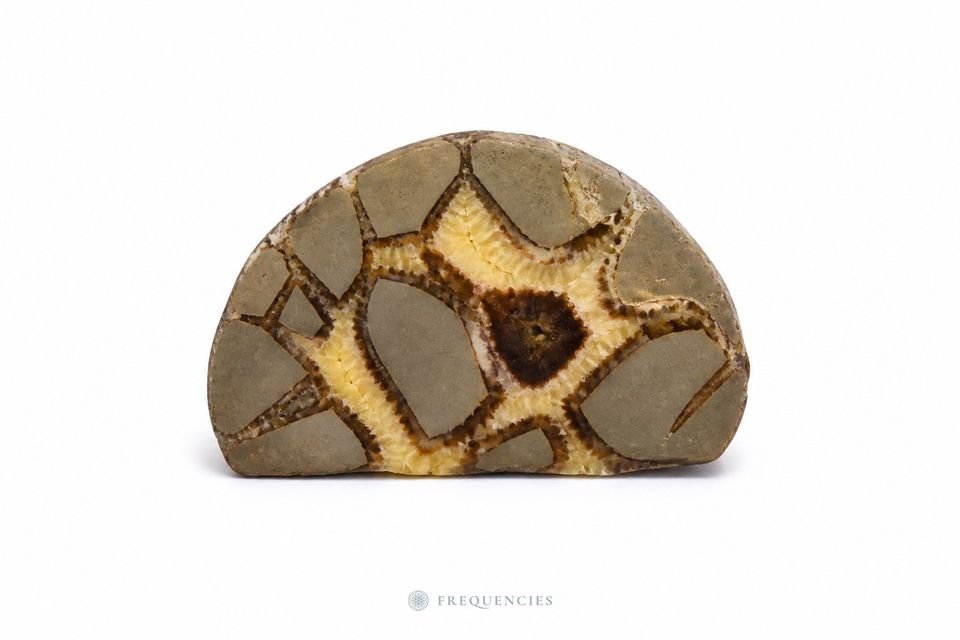
Septarian
A concretion with yellow calcite veins, traditionally associated with grounding and patience.
Septarian is a concretion, not a single mineral: a rounded formation of clay and carbonates whose internal cracks are filled with calcite, more rarely aragonite, siderite or barite. Its hardness is about 3 to 4 on the Mohs scale. In polished stone the yellow veins resemble reptile skin, which is why it is also called dragon stone. In the crystal community, it is traditionally associated with grounding and patience.
Exhibit label
Mohs hardness scale
A soft stone: it can be scratched by glass and steel. Store it separately and clean it with a soft cloth.
Care
Water
Water can damage the surface or colour. Clean with a dry, soft cloth.
Sun
Calcite veins and the clay matrix should not be heated, so it is safer not to keep septarian for long in direct sunlight or near heat sources
Storage
Avoid: prolonged soaking in water, vinegar and other acids, strong knocks.
Note. Calcite reacts with acids, so clean only with a dry or slightly damp soft cloth and dry it immediately.
In the crystal community, the following are used for cleansing: sage or palo santo smoke, the presence of selenite, sound vibrations, moonlight.
Traditional meaning
This is crystal tradition and symbolism, not a scientific or medical claim. The chakras, signs and elements match our product pages.
Chakras
Septarian is traditionally associated with the root, sacral and solar plexus chakras, which symbolise grounding, creativity and personal power.
Zodiac signs
In crystal astrology septarian is often recommended to Taurus as a symbol of patience and lasting strength.
Element
The earth element traditionally symbolises patience, endurance and a stable foundation.
The traditional meaning of crystals has not been medically proven and does not replace the advice of a professional.
Interesting facts
- The name comes from the Latin "septum", meaning "partition", because the cracks divide the stone into polygonal blocks.
- The cracks formed when the interior of the concretion shrank or dehydrated inside an outer shell that had already hardened; the exact mechanism is still being studied.
- The polished pattern resembles reptile skin, which is why septarian is also called "dragon stone" in the trade; some specimens have preserved fossils, such as ammonites.
How to use it
- Place it on a shelf or desk as an object of natural art
- Use it as a symbol of grounding in meditation
- Choose a polished half or a sphere as a decorative accent
- Give it to someone interested in geology or natural history
Pairs well with
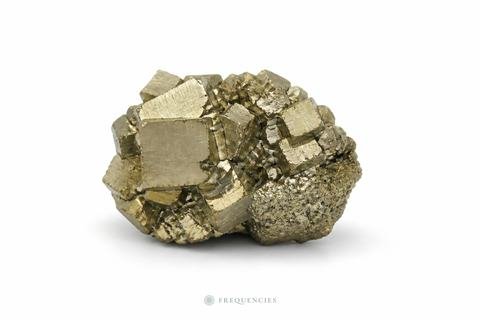 Pyrite
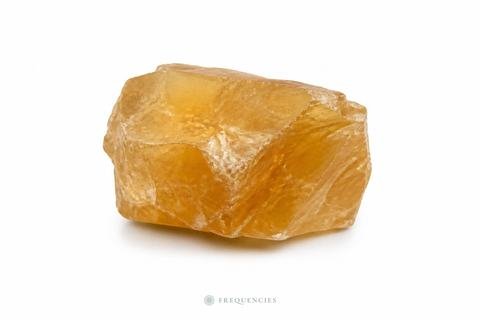 Honey Calcite
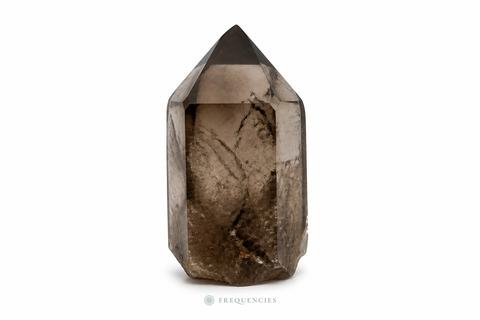 Smoky Quartz
 Clear Quartz
Frequently asked questions
What is septarian?
Septarian is a concretion, not a single mineral: a rounded clay and carbonate formation whose internal cracks have been filled by calcite, more rarely aragonite, siderite or barite. The name comes from the Latin word septum (partition), because the veins divide the stone into polygonal blocks.
How do septarian nodules form?
In ancient marine sediments over millions of years. First a hard clay concretion formed, then its interior shrank or dehydrated and cracked, and later calcite crystallised out of groundwater in the cracks. Septarian nodules from the US state of Utah formed in the Late Cretaceous. Geologists are still studying the exact mechanism of the cracking.
Why is septarian called dragon stone?
Because of its pattern. In polished septarian, yellow calcite veins divide the grey matrix into blocks that resemble reptile skin, which is why it is also called dragon stone in the trade. Some specimens have even preserved fossils, such as ammonites.
What does septarian symbolise?
Septarian symbolises grounding and patient strength, as well as Earth's history and time. In the crystal community it is associated with the root, sacral and solar plexus chakras, the earth element and the sign of Taurus.
Where is septarian found?
In many places around the world, so it is not especially rare. Decorative specimens most often come from Madagascar and the US state of Utah, but septarian is also found, for example, on the south coast of England and in New Zealand, where the famous Moeraki Boulders are also septarian concretions.
May septarian be put in water?
No, it should not be soaked. The calcite veins and the clay matrix are sensitive, so clean septarian with a dry or slightly damp soft cloth and dry it immediately. Do not use vinegar or other acids, because they dissolve calcite.
How hard is septarian?
About 3 to 4 on the Mohs scale. The hardness of the calcite veins is about 3, so they can be scratched with a steel knife, whereas the hardness of the matrix depends on its composition. Store septarian apart from harder stones.
Read more
Septarian: Properties, Meaning, and How to Use It in Daily Life