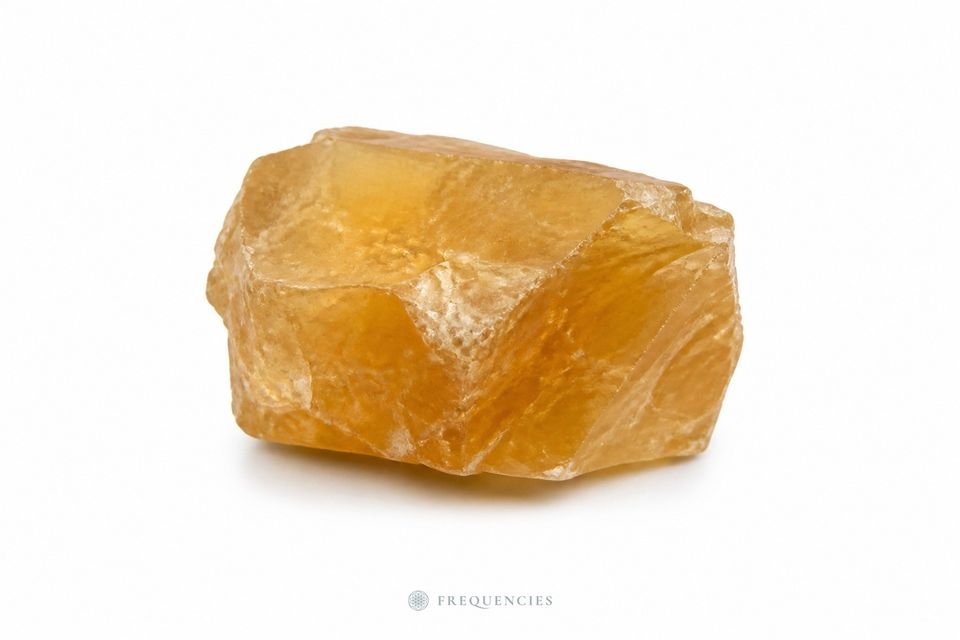
Honey Calcite
Honey-yellow calcite, traditionally associated with warm motivation and self-confidence.
Honey Calcite is the honey-yellow variety of calcite (CaCO3), also called amber calcite. It is transparent to translucent, in a golden-brown shade, with a hardness of 3 on the Mohs scale, and cleavage planes are often visible in it. The main deposit is in Mexico. In the crystal community, it is traditionally associated with warm motivation and self-confidence.
Honey Calcite in our shop

Exhibit label
Mohs hardness scale
A soft stone: it can be scratched by glass and steel. Store it separately and clean it with a soft cloth.
Care
Water
Water can damage the surface or colour. Clean with a dry, soft cloth.
Sun
A soft carbonate; it is safer to protect it from prolonged direct sunlight and sources of heat
Storage
Avoid: soaking in water, vinegar and other acids, ultrasonic and steam cleaning, strong knocks.
Note. Because of the cleavage planes, corners can break off on impact; store it separately and clean it with a dry, soft cloth.
In the crystal community, the following are used for cleansing: sage or palo santo smoke, the presence of selenite, sound vibrations, moonlight.
Traditional meaning
This is crystal tradition and symbolism, not a scientific or medical claim. The chakras, signs and elements match our product pages.
Chakras
Honey calcite is traditionally associated with the Solar Plexus and Sacral Chakras, which symbolise self-confidence, motivation and creativity.
Zodiac signs
In crystal astrology, honey calcite is often offered to Cancer as a symbol of warmth and calm determination.
Element
The Water and Fire elements traditionally symbolise flow and warm, purposeful energy.
The traditional meaning of crystals has not been medically proven and does not replace the advice of a professional.
Interesting facts
- Calcite has perfect cleavage in three directions, so it breaks into oblique, rhombohedral pieces.
- Transparent calcite has strong double refraction: objects look doubled when viewed through it; it was first described in 1669 by Rasmus Bartholin.
- Calcite is the reference mineral for the value 3 on the Mohs hardness scale.
How to use it
- Place it on a desk as a warm accent in honey tones
- Hold it up to the light and watch the amber glow
- Use it in a morning intention practice
- Include it in a composition of warm tones together with citrine or carnelian
Pairs well with
 Citrine
 Carnelian
 Tiger’s Eye
 Selenite
Frequently asked questions
What is honey calcite?
Honey calcite is the honey-yellow colour variety of calcite (CaCO3), also called amber calcite. It is transparent to translucent, with a golden-brown or amber tone, and cleavage planes are often visible in it. It is mined mainly in Mexico.
Are honey calcite and orange calcite the same thing?
The mineral is the same: both are calcite, and only the shade of colour differs. Honey calcite is yellowish brown or amber, whereas orange calcite is a warm orange. The properties and care are the same for both.
What does honey calcite symbolise?
In the crystal community, honey calcite is associated with warm motivation, self-confidence and the symbolism of inner light. Traditionally it corresponds to the Sacral and Solar Plexus Chakras, the Water and Fire elements, and the sign of Cancer.
May honey calcite be put in water?
Better not. Honey calcite is a soft carbonate that is damaged by acids, including vinegar, and prolonged soaking is not recommended. Wipe off dust with a dry, soft cloth and do not use ultrasonic or steam cleaning.
May honey calcite be kept in the sun?
Better not for long periods. Honey calcite is a soft carbonate, so it is safer to protect it from prolonged direct sunlight and sources of heat, because at high temperatures calcite can crack.
Why does honey calcite split into oblique pieces?
Calcite has perfect cleavage in three directions, so it breaks into oblique, rhombohedral pieces. Its hardness is only 3 on the Mohs scale, and corners can break off on impact, so store the stone separately from harder crystals.
How does honey calcite differ from citrine?
Honey calcite is much softer: its hardness is 3, whereas citrine, being quartz, is 7. Calcite cleaves along smooth, oblique planes, and objects look doubled through transparent calcite, which cannot be seen in citrine.