Ammonite
Fossil

Ammonite

An ancient marine cephalopod fossil whose spiral is traditionally associated with growth and change.

Hardness about 3-4 for calcite and aragonite specimens, about 6-6.5 for pyritised ones Protect from water Protect from direct sunlight Earth
In brief

Ammonite is the fossil of an extinct marine cephalopod, not a mineral. These molluscs lived mainly in the Jurassic and Cretaceous periods and died out about 66 million years ago. The shell has usually been replaced by calcite, aragonite or pyrite. In crystal traditions, its spiral is seen as a symbol of the life cycle, growth and change.

Exhibit label

Name
Ammonite
Type
Fossil
Mineral group
Fossil (shell of an extinct marine cephalopod); the shell has usually been replaced by calcite, aragonite or pyrite
Hardness
About 3-4 for calcite and aragonite specimens, about 6-6.5 for pyritised ones, on the Mohs scale
Colour
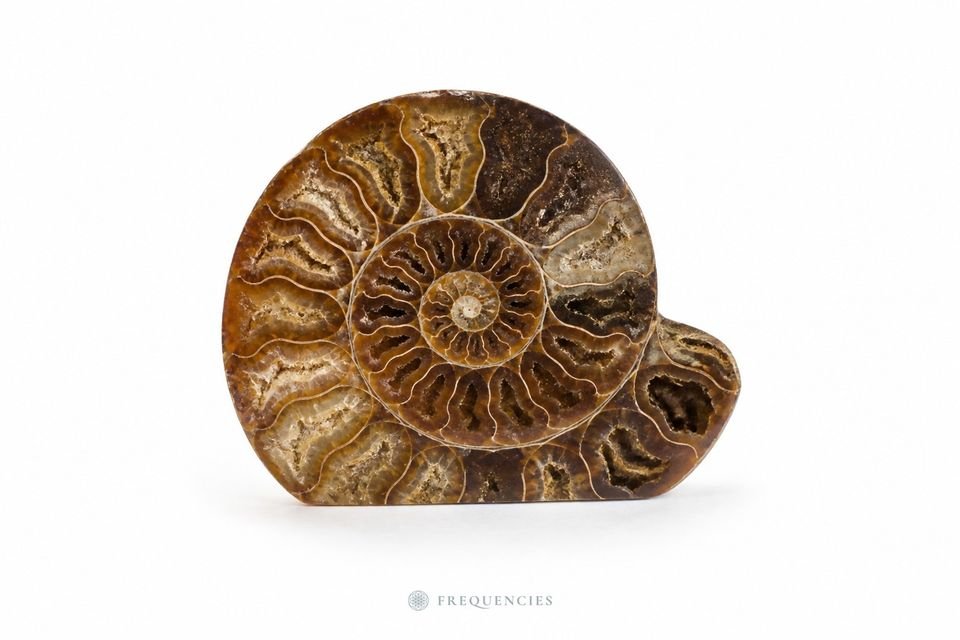
Brown, grey, cream, black or golden metallic (pyritised specimens); polished specimens show the spiral and the pattern of suture lines between the chambers, sometimes with a pearly iridescence
Main locality
Madagascar
Localities
Madagascar, Morocco, Great Britain
Planet
Saturn (tradition)
On the market ammonites are usually polished and often coated with lacquer or resin. Moroccan material in particular includes glued specimens, specimens with added filler or ground down, and, less often, carved fakes; casts of cut Madagascan halves are not widely documented, but these too may be ground down or coated. If a specimen seems unusually flawless, it is advisable to look at the back and the cut surface.

Mohs hardness scale

About 3-4 for calcite and aragonite specimens, about 6-6.5 for pyritised onesout of 10

A soft stone: it can be scratched by glass and steel. Store it separately and clean it with a soft cloth.

Care

Water

Protect from water

Water can damage the surface or colour. Clean with a dry, soft cloth.

Sun

Protect from direct sunlight

Polished specimens often have a lacquer or resin coating, which prolonged sunlight and heat can damage

Storage

Soft, easily scratched

Avoid soaking in water, acids, vinegar and salt, high humidity (especially for pyritised specimens) and strong knocks.

Note. Wipe off dust with a dry, soft cloth. Calcite and aragonite shells react with acids, while pyritised ammonites can start to oxidise and crumble in damp conditions, so store them in a dry place.

In the crystal community, the following are used for cleansing: placing it next to selenite, sound vibrations, moonlight, sage or palo santo smoke.

From geology to your shelf

  • How it forms. Ammonites were marine cephalopods with a spiral shell divided into chambers; they lived mainly in the Jurassic and Cretaceous periods and became extinct about 66 million years ago, along with the dinosaurs. Fossils formed when sunken shells were covered by sediments that later turned into rock; Canadian ammolite is preserved in the 70 to 75 million year old Bearpaw Formation in Alberta.
  • Where the colour comes from. The middle layer of the shell was nacre made of tiny aragonite crystals; where it has survived, the thin aragonite layer produces an iridescent play of colour known as ammolite, and the most common shades are red and green. In a cut ammonite the chambers and the suture lines can be seen.
  • History. The name comes from the Egyptian god Amun, whom the Greeks depicted with curled ram's horns. Ammonites were once regarded as petrified snakes, and dealers used to carve snake heads on them. In the mid 19th century Quenstedt and Oppel began to use them to date rock layers.
  • How to recognise a genuine stone.
    • A genuine ammonite shows suture lines, which mark where the partitions joined the wall of the shell.
    • Ammolite jewellery is often a triplet: from the side a transparent quartz or spinel top layer and a dark backing can be seen.
    • An ammonite with a carved snake head has been altered by people; Victorian dealers transformed fossils in this way to sell them at a higher price.
  • Treatment and imitations. Ammolite is usually made up as doublets or triplets with a quartz or spinel top layer, and many stones are impregnated with epoxy resin to make them more durable.
  • How to choose. For a fossil, look for an intact shell and clearly visible suture lines. For ammolite, look for bright, multicoloured iridescence visible from different angles and a pattern without cracks or breaks.
  • Traditional meaning

    This is crystal tradition and symbolism, not a scientific or medical claim. The chakras, signs and elements match our product pages.

    Chakras

    Root ChakraSolar Plexus ChakraThird Eye Chakra

    Ammonite is traditionally associated with the root, solar plexus and third eye chakras, which in crystal traditions symbolise a connection with the history of the Earth, personal power and insight.

    Zodiac signs

    ♒︎Aquarius

    In crystal traditions, ammonite is most often attributed to Aquarius, a sign associated with vision of the future and change.

    Element

    Earth

    The Earth element traditionally symbolises patience, time and permanence, reflected in a fossil millions of years old.

  • Main symbolism: change, growth and time
  • In crystal traditions the spiral symbolises life cycles, growth and continuous development
  • Traditionally associated with patience and the ability to accept change
  • In the crystal community, the spiral of the ammonite traditionally symbolises change, growth and the cycles of life. Many people place it somewhere visible at home or in a meditation corner, and the two halves of a cut ammonite are often given to couples or friends as a symbol of togetherness.
  • The traditional meaning of crystals has not been medically proven and does not replace the advice of a professional.

    Stories and legends

    The ammonite is named after the horned god Amun.

    The ancient Greeks associated spiral fossils with the horned god Jupiter Ammon, because they resemble a curled horn. The fossils were called "Cornu Ammonis", that is, the horns of Ammon, and the word ammonite comes from this name.

    Legend has it that Saint Hilda turned the snakes of Whitby to stone.

    In England ammonites were called "snakestones", because they resemble coiled snakes turned to stone. Legend has it that Saint Hilda, the 7th century abbess, turned the snakes of Whitby to stone and threw them off the cliffs before founding her monastery. Victorian dealers even carved snake heads on fossils to sell them at a higher price. Three ammonites with snake heads appear in the coat of arms of Whitby, and the common Whitby species Hildoceras bifrons is named after Saint Hilda.

    In Hinduism, shaligrams containing ammonites are a symbol of the god Vishnu.

    Black limestone concretions containing ammonites are called shaligrams, and their radial grooves resemble the disc, or chakra, held in the hand of the god Vishnu, a symbol of absolute perfection. They are kept in temples and homes and used at weddings, funerals and housewarming ceremonies, and Sanskrit texts have mentioned them for more than 2,200 years. Genuine shaligrams are found only in the Gandaki River valley in Nepal and in northern India.

    The shell of the largest known ammonite species exceeded one and a half metres.

    The largest known ammonite species is Parapuzosia seppenradensis from the Late Cretaceous. The largest specimen found is 1.8 metres in diameter, and that is incomplete; when whole it may have been 2.5 to 3.5 metres across.
    Interesting facts

    • Ammonites were marine cephalopods with a spiral shell; ammonoid fossils are found from the Devonian period to the end of the Cretaceous, when they became extinct about 66 million years ago, around the same time as the dinosaurs.
    • The name comes from the ancient Greek term Horns of Ammon (cornu Ammonis), because the spiral shell resembles the ram's horns of the god Ammon.
    • In England ammonites were called snakestones: legend has it that Saint Hilda, abbess of Whitby, turned snakes to stone, and local dealers even carved snake heads on fossils.

    How to use it

    • Place it on a shelf or a desk as a witness to ancient natural history
    • Use it in meditation, observing the spiral pattern as a symbol of growth
    • Choose it as a gift for lovers of natural history and fossils
    • Place a pair of halves of a cut ammonite as an interior accent

    Pairs well with

    Frequently asked questions

    What is an ammonite?

    An ammonite is the fossil of an extinct marine cephalopod. These molluscs with a spiral shell divided into chambers resembled the nautilus in appearance, but their closer relatives were squid and octopuses.

    How old are ammonites?

    Ammonites lived mainly in the Jurassic and Cretaceous periods and became extinct about 66 million years ago, when the dinosaurs also died out. So the fossil is at least 66 million years old, and geologists use ammonites to determine the age of rocks.

    What is an ammonite fossil made of?

    Usually calcite, aragonite or pyrite, which has replaced the original shell over time. Where the nacre layer of tiny aragonite crystals has survived, it produces an iridescent play of colour known as ammolite.

    How can you recognise a genuine ammonite?

    A genuine ammonite shows suture lines, which mark where the partitions joined the wall of the shell. Moroccan material in particular may include glued, with added filler or carved specimens, so look at the back and the cut surface.

    Can an ammonite be put in water?

    No, it should not be soaked. Pyritised ammonites can start to oxidise and crumble in damp conditions, while calcite and aragonite shells are damaged by acids, vinegar and salt. Wipe off dust with a dry, soft cloth and store the fossil in a dry place.

    Can an ammonite be kept in the sun?

    Better not for long periods. Polished ammonites often have a lacquer or resin coating, which prolonged sunlight and heat can damage, so keep them away from a sunny windowsill and sources of heat.

    What does an ammonite symbolise?

    In the crystal community, the spiral of the ammonite symbolises change, growth and the cycles of life. It is associated with the root, solar plexus and third eye chakras, the Earth element and the sign of Aquarius, and the two halves of a cut ammonite are often given to couples as a symbol of togetherness.

    What determines the value of an ammonite?

    Its state of preservation and appearance. For a fossil, an intact shell and clearly visible suture lines are valued, and for ammolite a bright, multicoloured play of colour from different angles and a pattern without cracks.

    Read more

    Ammonite: Properties, Meaning, and How to Use It in Daily Life

    Sources. Mineralogical data: GIA Gem Encyclopedia, Mindat, Encyclopaedia Britannica (frequencies.lv crystal database v2), nhm.ac.uk, nhm.ac.uk, bgs.ac.uk, britannica.com, sothebys.com, healingcrystals.com, crystalgemstones.net, frequencies.lv.
    Further information: bgs.ac.uk, geology.com, en.wikipedia.org.
    Shopping Basket
    Scroll to Top