Opal
Amorphous hydrated silica

Opal

Opal is a stone traditionally associated with creativity, emotional depth and inspiration.

Hardness 5 to 6.5 Protect from water Protect from direct sunlight Water
In brief

Opal is amorphous, hydrated silica containing up to 20% water, which is why geologists call it a mineraloid. In precious opal, tiny, orderly silica spheres split light into spectral colours, creating a play of colour. It has a hardness of 5 to 6.5 on the Mohs scale. Opal is the birthstone for October, and in the crystal community it is traditionally associated with creativity and inspiration.

Opal in our shop

Exhibit label

Name
Opal
Type
Mineraloid
Mineral group
Amorphous hydrated silica
Hardness
5 to 6.5 on the Mohs scale
Colour
White, fiery orange or with a multicoloured play of light
Main locality
Australia
Localities
Australia, Ethiopia, Mexico, Brazil
Planet
Venus (tradition)
Opals are sometimes glued together (doublets and triplets with a glass, chalcedony or plastic base) and treated (oil, wax, plastic, sugar or smoke treatment).

Mohs hardness scale

5 to 6.5out of 10

Moderately hard but brittle: it can chip on impact, and harder stones can scratch it. Wear it gently and store it separately.

Care

Water

Protect from water

Do not soak in water. Clean with lukewarm soapy water and a soft cloth, then dry.

Sun

Protect from direct sunlight

Prolonged direct sunlight can affect the colour, surface or structure

Storage

Protect from knocks

Avoid: prolonged direct sunlight, harsh cleaning agents, strong knocks.

Note. Opal contains water: heat, very dry air and bright direct light can produce a network of tiny cracks. Clean only with lukewarm soapy water and a soft cloth, without ultrasonic or steam cleaners; do not soak glued opals (doublets, triplets).

In the crystal community, the following are used for cleansing: sage or palo santo smoke, the presence of selenite, sound vibrations, moonlight.

From geology to your shelf

  • How it forms. Opal is amorphous, hydrated silica that can contain up to 20% water. It forms when rainwater seeps deep into the ground and carries dissolved silica; in dry periods the water evaporates, and the silica is deposited in fissures and between layers of sedimentary rock, for example in the desert regions of Australia.
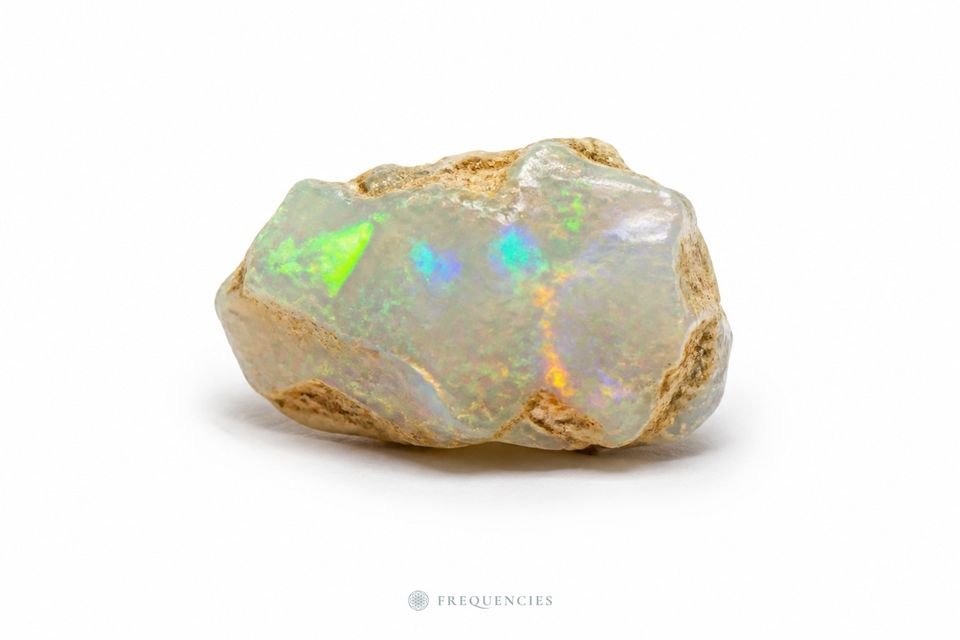
  • Where the colour comes from. The play of colour is produced by the diffraction of light in tiny silica spheres arranged in a lattice: spheres of around 0.1 micron give violet, and spheres of around 0.2 micron give red. The body colour of the opal is determined by minute impurities in the mass of spheres.
  • History. The Romans called opal opalus and regarded it as one of the most precious stones, and Pliny the Elder described it in the 1st century. The belief that opal brings bad luck arose only in the 19th century from Walter Scott's novel Anne of Geierstein. Australia became the main source of opal in the 1890s.
  • How to recognise a genuine stone.
    • The patches of colour in natural opal change as the stone is turned or the angle of the light changes.
    • In doublets and triplets, a glue line can be seen from the side between the thin layer of opal and the base or the transparent cap.
    • "Opalite" and similar trade names usually denote an imitation made of glass or plastic.
    • Synthetic opal, which has been produced since the 1970s, is usually identified by a gemmologist with a loupe or microscope, and in complicated cases in a laboratory.
  • Treatment and imitations. Some opals are impregnated with waxes or synthetic oils to improve lustre and stability. Thin layers of opal are glued into doublets and triplets with a base of obsidian, dyed chalcedony, glass or plastic.
  • How to choose. Look at the brightness of the play of colour, the variety of colours and the pattern; red is traditionally the most highly valued, whereas areas without play of colour lower the value. Avoid a fine network of cracks, which can be caused by loss of moisture in heat, dryness or direct sunlight.
  • Traditional meaning

    This is crystal tradition and symbolism, not a scientific or medical claim. The chakras, signs and elements match our product pages.

    Chakras

    Heart ChakraThird Eye ChakraCrown Chakra

    Opal is traditionally associated with the heart, third eye and crown chakras, and with inspiration.

    Zodiac signs

    ♋︎Cancer♎︎Libra♏︎Scorpio

    In traditional crystal astrology, opal is often associated with people who value inspiration and inner balance.

    Element

    Water

    The Water element is traditionally said to give this stone inspiration and a balanced character.

  • Main symbolism: creativity and emotional depth
  • Traditionally associated with creativity, emotional depth and more conscious inner work
  • Traditionally associated with inspiration and inner peace
  • Opal is the October birthstone, so in the crystal community many people choose it as a gift for those born in October, and it is traditionally associated with hope and inspiration. In crystal traditions opal corresponds to the heart and crown chakras, the element of water and the signs of Cancer, Libra and Scorpio. Many people place it in a meditation space where its play of colour can be watched in soft light, not direct sunlight.
  • The traditional meaning of crystals has not been medically proven and does not replace the advice of a professional.

    Stories and legends

    To the Romans, the word opal meant "gemstone".

    The Romans called this stone opalus, which meant "gemstone". Linguists link the word to the Greek opallios and possibly to the Sanskrit word upala, "stone, gemstone". In English the word opal entered the language at the end of the 16th century by way of French.

    Pliny the Elder described opal as a combination of the colours of all the gemstones.

    In AD 75 Pliny wrote that the play of colour in some opals resembles the deepest and richest colours of painters. He noted that opal shows the red of ruby, the green of emerald, the yellow of topaz, the blue of sapphire and the violet of amethyst. For most of history opal was therefore regarded as the luckiest and most magical gemstone.

    The "unlucky" reputation of opal comes from a 19th-century novel, not from ancient tradition.

    The belief that opal brings bad luck to those not born in October comes from Sir Walter Scott's 19th-century novel "Anne of Geierstein". GIA stresses that ancient traditions know of no such belief. In Europe opal was long regarded as a symbol of hope, purity and truth.

    In Australia opal is called the "fire of the desert", and it has been the national gemstone since 1993.

    Opal was officially proclaimed Australia's national gemstone on 23 July 1993. Aboriginal Australians call it the "fire of the desert", and Dreamtime stories tell that the colours of opal arose when a rainbow touched the earth. Black opal comes mainly from Lightning Ridge, and white opal from Coober Pedy and Andamooka.
    Interesting facts

    • Opal is not a crystalline mineral in the classical sense, but amorphous hydrated silica.
    • Some opals are characterised by a play of colour, produced by the diffraction of light in the microstructure of silica spheres.
    • Ethiopian opals are often more porous and more sensitive to abrupt changes in the environment than some other opals.

    How to use it

    • Wear it gently as a piece of jewellery traditionally associated with creativity and inspiration
    • Keep it close during meditation or quiet moments
    • Place it in your work or relaxation area
    • Choose it as a gift with symbolic meaning

    Varieties

    Opal occurs in various colours and forms. Each variety has its own page.

    Pairs well with

    Frequently asked questions

    What is opal?

    Opal is amorphous, hydrated silica with up to 20% water, which is why geologists call it a mineraloid rather than a mineral. In precious opal, tiny silica spheres arranged in a lattice split light into spectral colours, and this play of colour changes as the stone is turned. Common opal has no play of colour.

    What does opal symbolise?

    In the crystal community, opal is regarded as a symbol of creativity, emotional depth and inspiration. It is associated with the heart, third eye and crown chakras, with Cancer, Libra and Scorpio, and with the element of water. Opal is also the October birthstone.

    Does opal bring bad luck?

    No, it is a relatively recent myth that spread after Walter Scott's 19th-century novel "Anne of Geierstein". For most of history opal was regarded as a lucky gemstone, and the Romans valued it as one of the most precious stones.

    How can you recognise a genuine opal?

    The patches of colour in natural opal change as the stone is turned or the angle of the light changes. In doublets and triplets, a glue line can be seen from the side between the thin layer of opal and the base. Opalite is usually glass or plastic. Synthetic opal has been produced since the 1970s, and a gemmologist can identify it.

    What determines the price of opal?

    Mainly the play of colour: the brighter and more varied it is, the more valuable the stone, and red is traditionally the most highly valued. Areas without play of colour and a fine network of cracks lower the value. Black opals from Lightning Ridge in Australia are also highly valued.

    Can opal be put in water?

    Soaking opal is not recommended, and there is no need to store it in water. If a piece of jewellery needs cleaning, GIA regards warm soapy water and a soft cloth as safe. Do not soak glued doublets and triplets, because water can get between the layers. Porous Ethiopian opals absorb water.

    Can opal be kept in the sun?

    It is better not to keep it in direct sunlight for long periods. GIA notes that opal is generally stable, but heat from strong light and very dry air can cause a network of tiny cracks. Protect opal from sudden temperature changes too.

    Is opal suitable for an everyday ring?

    With caution. The hardness of opal on the Mohs scale is 5 to 6.5, and GIA rates its resistance to knocks as very poor to fair. An opal ring should therefore be worn gently and protected from knocks, whereas a pendant or earrings are a safer choice.

    Read more

    Opal: Properties, Meaning, and How to Use It in Daily Life

    Sources. Mineralogical data: GIA Gem Encyclopedia, Mindat, Encyclopaedia Britannica (frequencies.lv crystal database v2).
    Further information: gia.edu, gia.edu, gia.edu, gia.edu.
    Shopping Basket
    Scroll to Top