The name celestite means "heavenly".
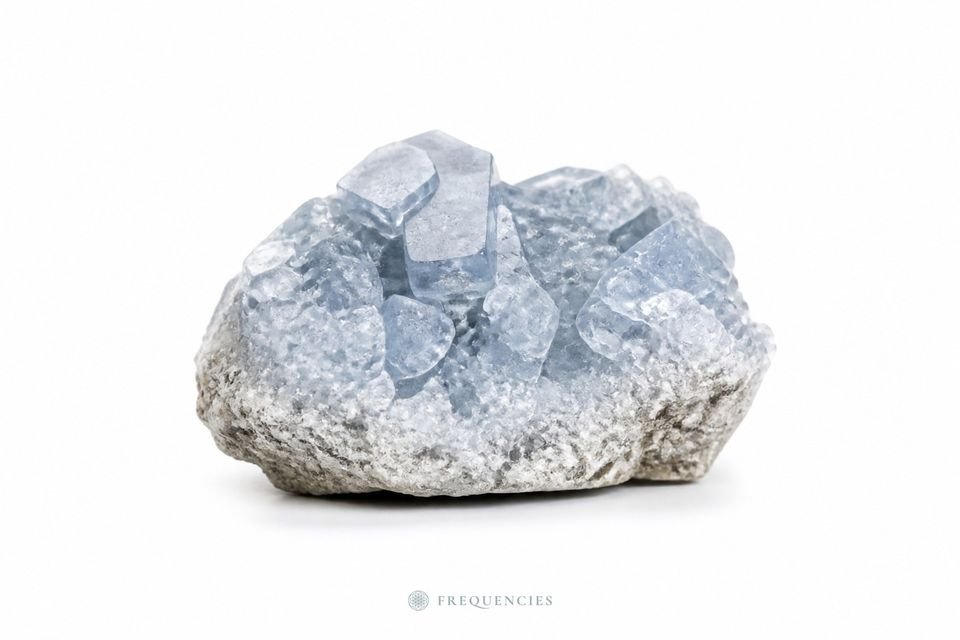
The mineral's name comes from the Latin word "caelestis", meaning heavenly, because its crystals are often a soft sky blue. Pure celestite, however, is colourless, and the blue, white, orange and other shades are produced by impurities.
Beneath a winery in Ohio there is a cave lined with celestite crystals.
The Crystal Cave at Put-in-Bay on South Bass Island in Lake Erie was discovered in 1897 by workers digging a well for the Heinemann Winery. The walls of the cave are lined with celestite crystals, many 20 to 46 centimetres long, and the winery calls the cave the world's largest geode. Some of the crystals were once removed and sold for making fireworks, which made the cave larger.
The blue celestite geodes known all over the world come from Madagascar.
Large blue celestite crystals and geodes are mined around Sakoany near Mahajanga in north-western Madagascar. They are popular both among collectors and as decorative stones in interiors.
Celestite is the main ore of strontium.
Celestite, or strontium sulphate, is the most common strontium mineral and the main source from which strontium is obtained. It usually forms when strontium-bearing groundwater deposits crystals in cracks and cavities in carbonate rocks, including caves, and in Sicily its crystals grow together with yellow sulphur.
 Clear Quartz
 Selenite
 Rose Quartz
 Black Tourmaline