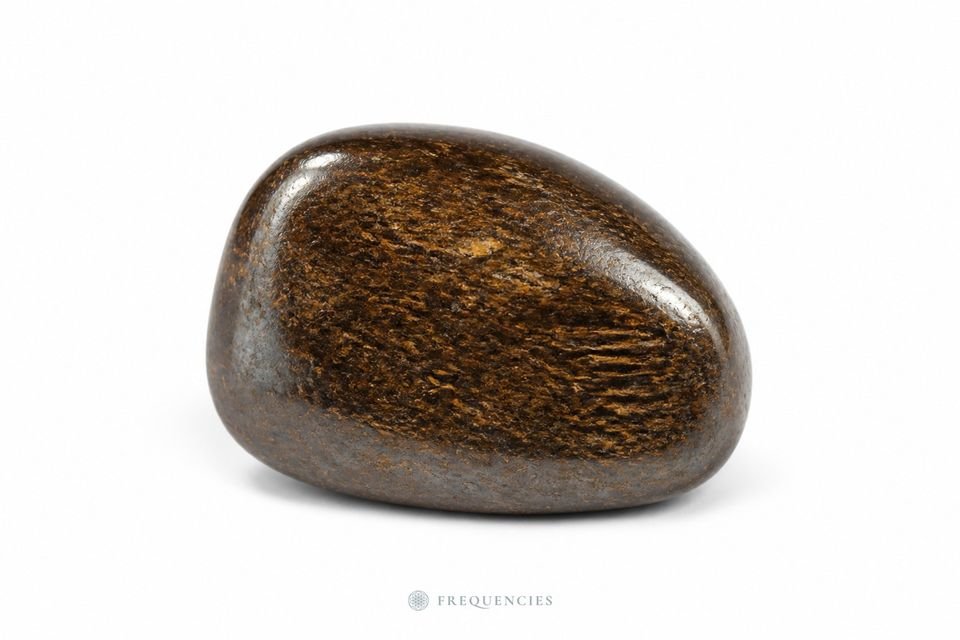
Bronzite
Bronzite is a stone traditionally associated with grounding, self-confidence and stability.
Bronzite is an iron-bearing variety of enstatite from the pyroxene group, with the formula (Mg,Fe)SiO3 and a hardness of 5.5 to 6 on the Mohs scale. Its bronze-brown colour with a golden sheen is produced by hematite and goethite impurities. It is found in Brazil, India, Austria and the USA. In the crystal community, bronzite is traditionally associated with grounding and self-confidence.
Bronzite in our shop

Exhibit label
Mohs hardness scale
Moderately hard: durable in everyday wear, but it can be scratched by harder stones. Store it separately.
Care
Water
A brief rinse in lukewarm water, then wipe dry.
Sun
May be kept in a bright place.
Storage
Avoid: prolonged heat, harsh cleaning agents, strong knocks.
Note. If the stone is porous, dyed or has a softer surface, dry cleansing is the safer choice.
In the crystal community, the following are used for cleansing: a brief rinse under running water, the presence of selenite, sound vibrations, moonlight.
Traditional meaning
This is crystal tradition and symbolism, not a scientific or medical claim. The chakras, signs and elements match our product pages.
Chakras
Bronzite is traditionally associated with the energy of the root and sacral chakras and with stability.
Zodiac signs
In traditional crystal astrology, bronzite is often associated with people who value stability and inner balance.
Element
The Earth element is traditionally said to give this stone stability and a balanced character.
The traditional meaning of crystals has not been medically proven and does not replace the advice of a professional.
Interesting facts
- Bronzite is an iron-bearing variety of enstatite from the pyroxene group; it takes its name from its bronze-like lustre.
- The bronze-like sheen is linked to impurities of hematite and goethite or fibrous inclusions.
- Polished bronzite sometimes shows a star or cat's-eye effect; a classic bronzite locality is the Kraubath chromium mine in Styria, Austria.
How to use it
- Wear it every day as a piece of jewellery traditionally associated with grounding and self-confidence
Pairs well with
 Clear Quartz
 Selenite
 Rose Quartz
 Black Tourmaline
Frequently asked questions
What is bronzite?
Bronzite is an iron-bearing variety of enstatite from the pyroxene group with the formula (Mg,Fe)SiO3. It takes its name from its bronze-like lustre, but it is a natural mineral, not a metal.
What does bronzite symbolise?
In the crystal community, bronzite is associated with grounding and self-confidence. It is linked to the root and sacral chakras, the Earth element and the sign of Leo.
Why does bronzite shimmer?
The bronze-like sheen is produced by impurities of hematite and goethite, which reflect light in the polished stone. The sheen changes as the stone is turned, and polished bronzite sometimes even shows a star or cat's-eye effect.
Can bronzite be put in water?
Yes, a brief rinse under running water or a wash in warm soapy water is fine; dry the stone afterwards. Avoid harsh cleaning agents and prolonged heat.
Can bronzite be kept in the sun?
Yes, a short time in the sun does not usually harm bronzite. Prolonged heating is not recommended, however, so do not leave it near a heat source or on a windowsill that has become hot in summer.
How hard is bronzite?
Bronzite has a hardness of 5.5 to 6 on the Mohs scale, so it is softer than quartz. Protect bracelets and jewellery from strong knocks and store them separately from harder stones.
Where is bronzite mined?
Bronzite is mined in several countries, including Brazil, India and the USA. A classic locality is the Kraubath chromium mine in Styria, Austria.