Celestite
Celestite / celestine

Celestite

Celestite is a stone traditionally associated with calm, subtle intuition and lightness.

Hardness 3-3.5 Protect from water Protect from direct sunlight Air
In brief

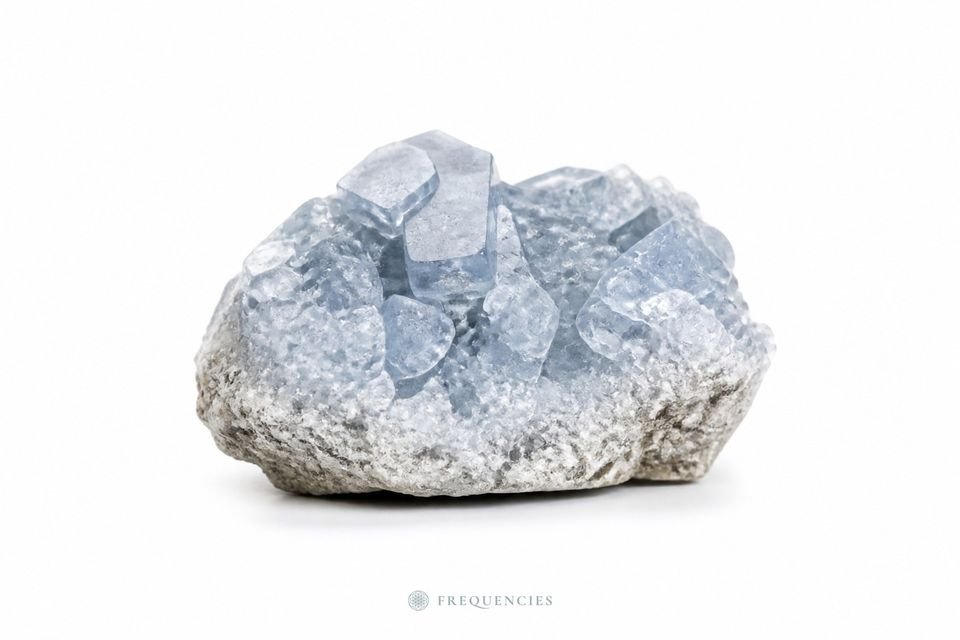
Celestite is a strontium sulphate mineral (SrSO4) and the main ore of strontium, with a hardness of 3 to 3.5 on the Mohs scale. The name comes from the Latin word caelestis, heavenly, because the crystals are often a soft sky blue, although pure celestite is colourless. In the crystal community, it is traditionally associated with the sky, peace and silence.

Exhibit label

Name
Celestite
Type
Mineral
Mineral group
Celestite / celestine (SrSO4), sulphate group
Hardness
3-3.5 on the Mohs scale
Colour
Pale sky blue to colourless
Main locality
Madagascar
Localities
Madagascar, Mexico, Poland, Great Britain
Planet
Moon (tradition)

Mohs hardness scale

3-3.5out of 10

A soft stone: it can be scratched by glass and steel. Store it separately and clean it with a soft cloth.

Care

Water

Protect from water

Water can damage the surface or colour. Clean with a dry, soft cloth.

Sun

Protect from direct sunlight

Prolonged direct sunlight can affect the colour, surface or structure

Storage

Soft, easily scratched

Avoid: prolonged direct sunlight, harsh cleaning agents, strong knocks.

Note. Celestite is very brittle, so protect it from damp, knocks and bright sun.

In the crystal community, the following are used for cleansing: sage or palo santo smoke, the presence of selenite, sound vibrations, moonlight.

From geology to your shelf

  • How it forms. Celestite is strontium sulphate, found mainly in sedimentary rocks such as limestone, often together with gypsum, anhydrite and halite. Celestite geodes form when strontium-bearing solutions dissolve nodules of gypsum or anhydrite and celestite crystals are immediately deposited in the void; large blue geodes come from Madagascar.
  • Where the colour comes from. Pure celestite is colourless, but impurities produce different colours, especially the soft sky blue. The blue colour can fade from heat or light.
  • History. The name comes from the Latin caelestis, heavenly, and refers to the soft blue colour. The Guinness World Records recognises the celestite Crystal Cave on South Bass Island in Lake Erie (USA) as the world's largest geode, about 10.7 m wide at its widest point.
  • How to recognise a genuine stone.
    • Celestite is soft (3 to 3.5) with perfect cleavage, so the tips of the crystals chip easily.
    • It is noticeably heavier than gypsum or calcite of a similar size, and calcite, unlike celestite, fizzes in acid.
    • The crystals are typically flat or prismatic and orthorhombic, often found in geodes.
  • Treatment and imitations. Celestite is usually sold in its natural state; gemmological sources mention that faded blue colour can be restored by irradiation.
  • How to choose. Look for a saturated sky blue colour and transparent, undamaged crystals. Because the blue colour can fade, it is better to keep a specimen away from direct sun and heat.
  • Traditional meaning

    This is crystal tradition and symbolism, not a scientific or medical claim. The chakras, signs and elements match our product pages.

    Chakras

    Throat ChakraThird Eye ChakraCrown Chakra

    Celestite is traditionally associated with the energy of the throat and crown chakras and with lightness.

    Zodiac signs

    ♊︎Gemini

    In traditional crystal astrology, celestite is often associated with people who value lightness and inner balance.

    Element

    Air

    The Air element is traditionally said to give this stone lightness and a balanced character.

  • Main symbolism: calm and subtle intuition
  • Traditionally associated with calm, subtle intuition and more conscious inner work
  • Traditionally associated with lightness and inner peace
  • In the crystal community, many people traditionally associate celestite with the heavens, calm and quiet, which its name also reflects. It is also linked to the throat, third eye and crown chakras, the Air element and the sign of Gemini. Celestite druses and geodes are often placed in a meditation corner, a reading spot or on a bookshelf, where they are safe from sun and knocks, and they are a popular housewarming gift.
  • The traditional meaning of crystals has not been medically proven and does not replace the advice of a professional.

    Stories and legends

    The name celestite means "heavenly".

    The mineral's name comes from the Latin word "caelestis", meaning heavenly, because its crystals are often a soft sky blue. Pure celestite, however, is colourless, and the blue, white, orange and other shades are produced by impurities.

    Beneath a winery in Ohio there is a cave lined with celestite crystals.

    The Crystal Cave at Put-in-Bay on South Bass Island in Lake Erie was discovered in 1897 by workers digging a well for the Heinemann Winery. The walls of the cave are lined with celestite crystals, many 20 to 46 centimetres long, and the winery calls the cave the world's largest geode. Some of the crystals were once removed and sold for making fireworks, which made the cave larger.

    The blue celestite geodes known all over the world come from Madagascar.

    Large blue celestite crystals and geodes are mined around Sakoany near Mahajanga in north-western Madagascar. They are popular both among collectors and as decorative stones in interiors.

    Celestite is the main ore of strontium.

    Celestite, or strontium sulphate, is the most common strontium mineral and the main source from which strontium is obtained. It usually forms when strontium-bearing groundwater deposits crystals in cracks and cavities in carbonate rocks, including caves, and in Sicily its crystals grow together with yellow sulphur.

    Interesting facts

    • Celestite is a strontium sulphate mineral that often forms pale blue druses.
    • The name is linked to the sky blue tone typical of some specimens.
    • Madagascan celestite druses are especially popular in interiors and collections.

    How to use it

    • Place it at home or wear it gently as a symbol of calm and subtle intuition

    Pairs well with

    Frequently asked questions

    What is celestite?

    Celestite is a strontium sulphate mineral (SrSO4) and the main ore of strontium. The name comes from the Latin caelestis, heavenly, because the crystals are often a soft sky blue, although pure celestite is colourless.

    Are celestine and celestite the same thing?

    Yes. It is one and the same mineral, strontium sulphate. Celestine is the mineral's official name, while celestite is a widely used alternative name.

    What does celestite symbolise?

    In the crystal community, celestite is associated with the heavens, calm and quiet, which its name also reflects. It is linked to the throat, third eye and crown chakras, the Air element and the sign of Gemini.

    How can you recognise genuine celestite?

    By its softness and weight. Celestite is soft (3 to 3.5 on the Mohs scale) with perfect cleavage, so the tips of the crystals chip easily. It is noticeably heavier than gypsum or calcite of a similar size, and calcite, unlike celestite, fizzes in acid.

    Can celestite be put in water?

    Better not. Celestite is soft, brittle and has perfect cleavage, so clean it dry, gently wiping off dust with a soft brush, and protect it from knocks.

    Does celestite fade in the sun?

    Yes. The blue colour of celestite can fade from heat and sometimes also from light, so keep druses and geodes away from direct sunlight.

    Where is celestite found?

    Large blue celestite geodes come from Madagascar, from the Sakoany area near Mahajanga. The Guinness World Records recognises the Crystal Cave on South Bass Island in Lake Erie, USA, as the world's largest geode: its walls are lined with celestite crystals, and at its widest point the cave is about 10.7 m wide.

    Read more

    Celestite: Properties, Meaning, and How to Use It in Daily Life

    Sources. Mineralogical data: GIA Gem Encyclopedia, Mindat, Encyclopaedia Britannica (frequencies.lv crystal database v2).
    Further information: minerals.net, en.wikipedia.org, gemsociety.org.
    Shopping Basket
    Scroll to Top


