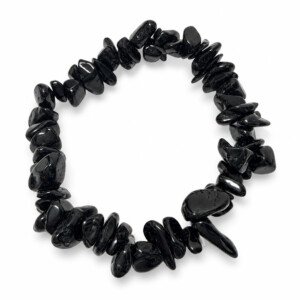
Tourmaline
Tourmaline group

Tourmaline

A multicoloured gemstone of the boron silicate group, traditionally associated with balance, strength of heart and flow.

Hardness 7-7.5 May be rinsed in water Sunlight is not harmful Earth
In brief

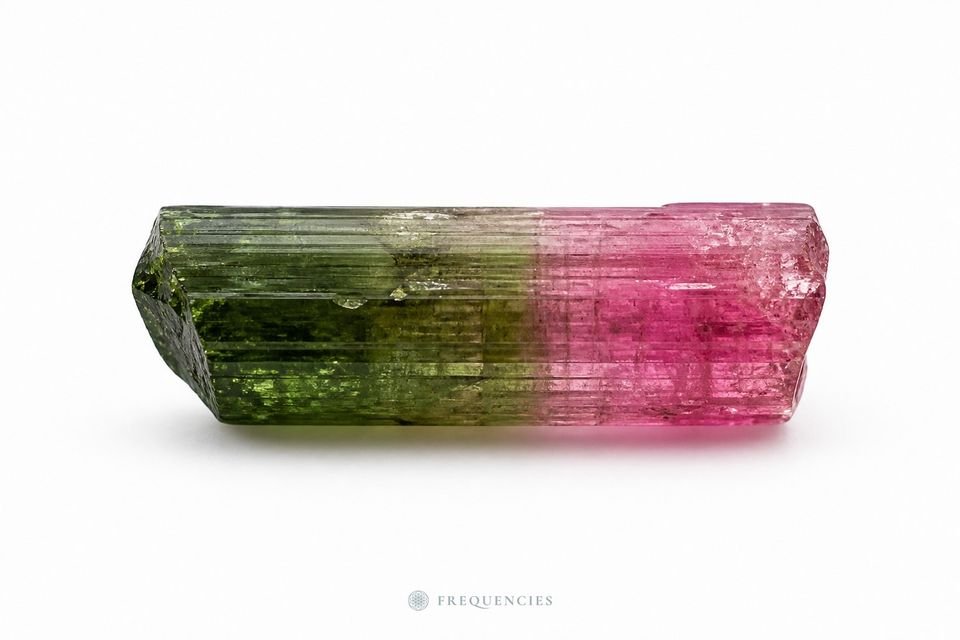
Tourmaline is a gemstone of the boron silicate group with a hardness of 7 to 7.5 on the Mohs scale, whose colour depends on composition: iron gives green shades, manganese pink and red. In watermelon tourmaline the centre of the crystal is pink and the outer edge green. It is the birthstone for October, and in the crystal community it is traditionally associated with balance and the strength of the heart.

Tourmaline in our shop

Exhibit label

Name
Tourmaline
Type
Mineral
Mineral group
Tourmaline group
Hardness
7-7.5 on the Mohs scale
Colour
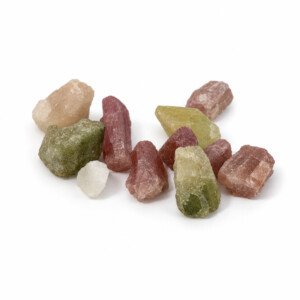
Green, pink to red (rubellite) or in watermelon colour combinations
Main locality
Brazil
Localities
Brazil, Afghanistan, Mozambique, Madagascar
Planet
Venus (tradition)
Some tourmalines are heated or irradiated; colour produced by irradiation can fade in heat or bright light.

Mohs hardness scale

7-7.5out of 10

A hard stone: it scratches glass and is durable in everyday wear. Even so, protect it from knocks.

Care

Water

May be rinsed in water

A brief rinse in lukewarm water, then wipe dry.

Sun

Sunlight is not harmful

May be kept in a bright place.

Storage

Durable in everyday wear

Avoid: prolonged heat, harsh cleaning agents, strong knocks.

Note. Tourmaline crystals are brittle and often cracked, so protect them from strong knocks.

In the crystal community, the following are used for cleansing: a brief rinse under running water, the presence of selenite, sound vibrations, moonlight.

From geology to your shelf

  • How it forms. Tourmalines are a group of related boron silicate minerals. Most gem tourmalines are elbaites, which form in granite pegmatites and hydrothermal cavities, where hot solutions bring the necessary elements and crystals can grow as much as a metre long; dravite and uvite form in metamorphosed limestone, or marble, whereas black schorl is common in many rocks.
  • Where the colour comes from. The green and blue colours are produced by iron and possibly titanium, the pink and red by manganese, the neon tones of Paraíba tourmaline by copper, and the colour of chrome tourmaline mainly by vanadium. If the impurities change during growth, zoned crystals form, for example watermelon tourmaline with a pink core and a green rim.
  • History. The name comes from the Sinhalese toramalli, mixed stones; in 16th-century Brazil a Spanish conquistador mistook green tourmaline for emerald, and it was recognised as a separate mineral only in the 19th century. The Chinese Empress Dowager Cixi particularly favoured California pink tourmaline.
  • How to recognise a genuine stone.
    • The crystals are prismatic with lengthwise striations and a rounded triangular cross-section.
    • Strong pleochroism: looking along the length of the crystal, the colour is often much darker.
    • When heated or squeezed, tourmaline acquires an electric charge (pyroelectricity and piezoelectricity).
  • Treatment and imitations. The colour of some tourmalines is changed by heating, and some pink and yellow tones can be the result of natural or laboratory irradiation. Dark dravite is sometimes heated to make it lighter.
  • How to choose. For green tourmalines, expect high purity and transparency, whereas for pink and red ones small inclusions are acceptable if the colour is strong. Stones that are too dark, which look almost black from some directions, are less valuable.
  • Traditional meaning

    This is crystal tradition and symbolism, not a scientific or medical claim. The chakras, signs and elements match our product pages.

    Chakras

    Root ChakraHeart Chakra

    Tourmaline is traditionally associated with the heart and root chakras, and it symbolises flow.

    Zodiac signs

    ♎︎Libra♏︎Scorpio♑︎Capricorn

    In traditional crystal astrology tourmaline is associated with Libra, Scorpio and Capricorn, as well as with people who value flow and inner balance.

    Element

    Earth

    The earth element in crystal traditions symbolises a balanced character, and tourmaline is also associated with flow.

  • Main symbolism: balance and strength of heart
  • In crystal traditions it symbolises balance, strength of heart and conscious work on oneself
  • Traditionally associated with flow and inner calm
  • In the crystal community many people traditionally choose tourmaline by colour: pink symbolises love, green is associated with courage and black with grounding; as a whole it is associated with the root and heart chakras, the earth element and the signs of Libra, Scorpio and Capricorn. Tourmaline crystals are often placed by the front door or at the workplace, and tourmaline is given to those born in October as their birthstone or on an 8th wedding anniversary.
  • The traditional meaning of crystals has not been medically proven and does not replace the advice of a professional.

    Stories and legends

    The name tourmaline comes from the Sinhalese language of Sri Lanka.

    The name comes from a Sinhalese word that is translated as "mixed gemstones" or "stone with mixed colours", because a single crystal often contains several colours. Dutch traders applied the word to coloured, water-rounded pebbles from the gem gravels of Ceylon.

    For centuries tourmaline was confused with emerald, ruby and sapphire.

    The first known green tourmaline crystal was found by Francisco Spinoza’s expedition in Brazil in 1554 and was called the "Brazilian emerald". Right up to the 19th century, when mineralogy recognised tourmaline as a separate mineral, it was called by the names of other gemstones depending on its colour.

    The Chinese Empress Dowager Cixi was passionate about pink and red tourmaline.

    From 1902 to 1910 mines in San Diego County, California, shipped 120 tonnes of red tourmaline, or rubellite, to China, from which craftsmen carved snuff bottles and jewellery. When the Chinese imperial government collapsed in 1912, the US tourmaline trade collapsed too.

    Paraíba tourmaline has been one of the most coveted gemstones since the late 1980s.

    Unusually bright blue to green tourmalines have been mined in Brazil’s Paraíba region since the late 1980s. Their colour is produced by copper, and these stones have become so famous that they are called by the name of the locality.
    Interesting facts

    • When heated or squeezed, tourmaline becomes electrically charged (the pyroelectric and piezoelectric effect).
    • Tourmaline has one of the widest colour ranges among gemstones, and a single crystal can be several colours, for example watermelon tourmaline.
    • The first known green tourmaline crystal was once regarded as a "Brazilian emerald".
    • Tourmaline is the birthstone of October.

    How to use it

    • Wear it in jewellery as a symbol of balance and flow
    • Keep it close during meditation or quiet moments
    • Place it in your work or relaxation area
    • Choose it as a gift with symbolic meaning

    Varieties

    Tourmaline occurs in various colours and forms. Each variety has its own page.

    Pairs well with

    Frequently asked questions

    What does tourmaline symbolise?

    Tourmaline symbolises balance, strength of heart and flow, and it is the birthstone of October. In the crystal community it is associated with the root and heart chakras, the earth element and the signs of Libra, Scorpio and Capricorn, and its meaning is often chosen by colour too.

    Why is tourmaline so multicoloured?

    Because of its composition. Tourmaline can contain sodium, lithium, iron, manganese, chromium, vanadium and copper: iron gives green and blue tones, manganese pink and red, and copper the bright blue colour of Paraíba tourmaline.

    What is watermelon tourmaline?

    It is an elbaite tourmaline whose crystal is pink or red in the middle and green at the rim. Such a crystal forms when the impurities change during growth, and the crystals are usually cut crosswise into slices so that the watermelon pattern is visible.

    How can you recognise genuine tourmaline?

    By its crystal form and colour change. Tourmaline crystals are prismatic with lengthwise striations and a rounded triangular cross-section, and, looking along the length of the crystal, the colour is often much darker. A cut stone can be determined reliably in a gemmological laboratory.

    Why does tourmaline attract dust?

    Because it is pyroelectric and piezoelectric. When the temperature or pressure changes, an electric charge arises in the crystal, and dust particles cling to its ends; this property is used in high-pressure measuring instruments.

    How durable is tourmaline?

    Durable enough for everyday jewellery: its hardness is 7 to 7.5 on the Mohs scale. The crystals are, however, brittle and often cracked, so protect tourmaline from strong knocks.

    May tourmaline be put in water?

    Yes. Tourmaline is best cleaned with warm soapy water and a soft brush, but do not use ultrasonic and steam cleaners, because tourmalines often have cracks.

    Does tourmaline fade in the sun?

    Usually not. The colour of natural tourmaline is stable in light, but in irradiated stones it can fade in bright light or heat. Protect tourmaline from great heat and rapid temperature changes too.

    Tourmaline in our shop: more

    Read more

    Tourmaline: Properties, Meaning, and How to Use It in Daily Life

    Sources. Mineralogical data: GIA Gem Encyclopedia, Mindat, Encyclopaedia Britannica (frequencies.lv crystal database v2).
    Further information: gia.edu, gia.edu, gia.edu, gia.edu.
    Shopping Basket
    Scroll to Top