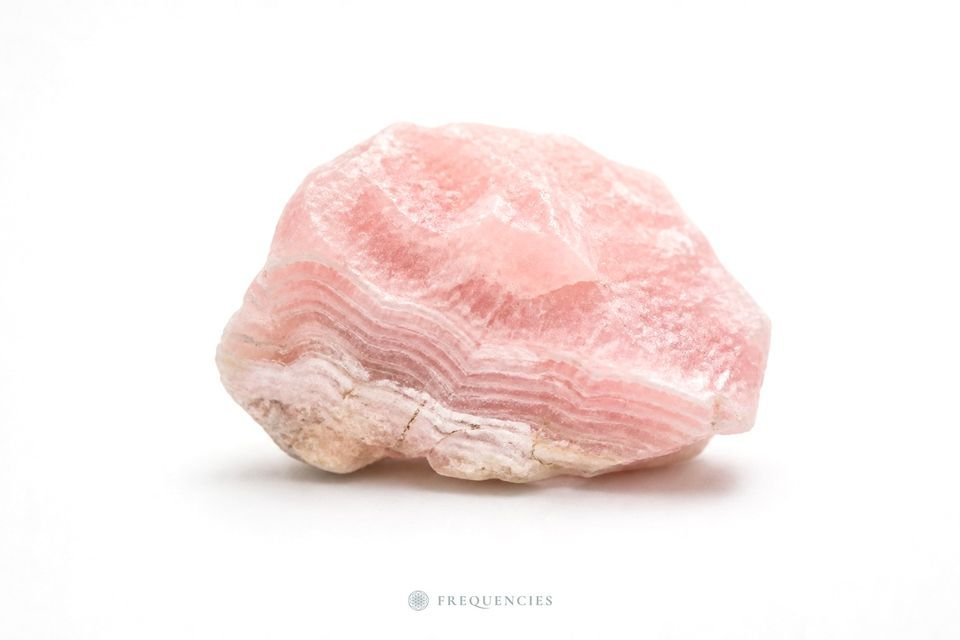
Mangano Calcite
Soft pink calcite, traditionally associated with gentleness and compassion.
Mangano Calcite is calcite with an admixture of manganese, which gives it a soft pink to peach-pink shade, often with white bands. Its hardness is 3 on the Mohs scale, and the more manganese, the redder the shade. Under ultraviolet light, many specimens glow orange-red or pink. In the crystal community, it is traditionally associated with gentleness and compassion.
Mangano Calcite in our shop
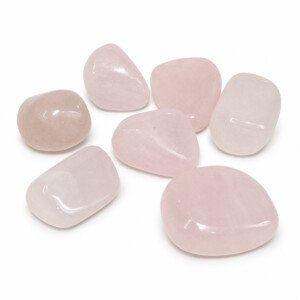
Exhibit label
Mohs hardness scale
A soft stone: it can be scratched by glass and steel. Store it separately and clean it with a soft cloth.
Care
Water
Water can damage the surface or colour. Clean with a dry, soft cloth.
Sun
A soft carbonate; it is safer to protect it from prolonged direct sunlight and sources of heat
Storage
Avoid: soaking in water, vinegar and other acids, ultrasonic and steam cleaning, contact with harder stones.
Note. Calcite reacts with acids and is easily scratched (Mohs hardness 3); clean it with a dry, soft cloth.
In the crystal community, the following are used for cleansing: sage or palo santo smoke, the presence of selenite, sound vibrations, moonlight.
Traditional meaning
This is crystal tradition and symbolism, not a scientific or medical claim. The chakras, signs and elements match our product pages.
Chakras
Mangano calcite is traditionally associated with the Heart Chakra, which symbolises gentleness, compassion and acceptance.
Zodiac signs
In crystal astrology, mangano calcite is often offered to Cancer as a symbol of care, gentleness and the warmth of home.
Element
The Water element traditionally symbolises gentleness, sensitivity and emotional flow.
The traditional meaning of crystals has not been medically proven and does not replace the advice of a professional.
Interesting facts
- The pink colour is given by manganese; calcite with manganese forms a transitional series to rhodochrosite, and the more manganese, the redder the tone.
- It was first described in the Banská Štiavnica mining district in Slovakia.
- Under ultraviolet light many specimens glow orange-red or pink, and this fluorescence is linked with manganese.
How to use it
- Place it in a bedroom as a gentle, pink accent
- Keep it close during quiet evening moments
- Use it in a meditation on self-love or gratitude
- Give it to someone close as a gentle sign of attention
Pairs well with
 Rose Quartz
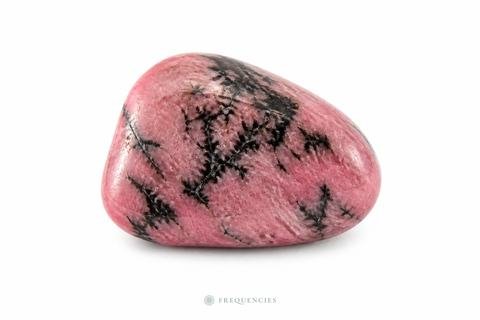 Rhodonite
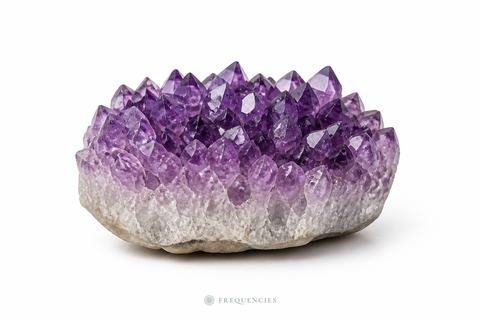 Amethyst
 Selenite
Frequently asked questions
What is mangano calcite?
Mangano calcite is calcite with an admixture of manganese, which gives it a soft pink to peach-pink tone, often with white bands. The more manganese, the redder the tone, and the composition gradually passes into rhodochrosite.
Why does mangano calcite glow under UV light?
This glow, or fluorescence, is linked with the admixture of manganese in the calcite: under ultraviolet light many specimens of mangano calcite glow bright orange-red or pink.
What does mangano calcite symbolise?
In the crystal community, mangano calcite is associated with gentleness, compassion and the symbolism of unconditional love. Traditionally it corresponds to the Heart Chakra, the Water element and the sign of Cancer.
May mangano calcite be put in water?
No, it should not be soaked. Calcite is soft and reacts with acids, so it is not cleaned with vinegar and not left in water for long. Clean it with a dry, soft cloth, without ultrasonic or steam.
May mangano calcite be kept in the sun?
Better not for long periods. Mangano calcite is a soft carbonate, so it is safer to protect it from prolonged direct sunlight and sources of heat, such as a sunny windowsill or a radiator.
How does mangano calcite differ from rose quartz?
Mangano calcite is much softer: its hardness is 3 on the Mohs scale, whereas rose quartz is 7, so calcite can be scratched with a steel needle. Calcite also has pronounced cleavage, and in dilute hydrochloric acid it fizzes, whereas quartz does not.
Where is mangano calcite mined?
Mangano calcite is mined in Peru, Bulgaria, China, Mexico and Slovakia. It was first described in Slovakia, in the Banská Štiavnica mining district, where ore was mined as early as the Middle Ages.